


Microsoft Pushes AI Vision with New, Expensive Surface Laptop

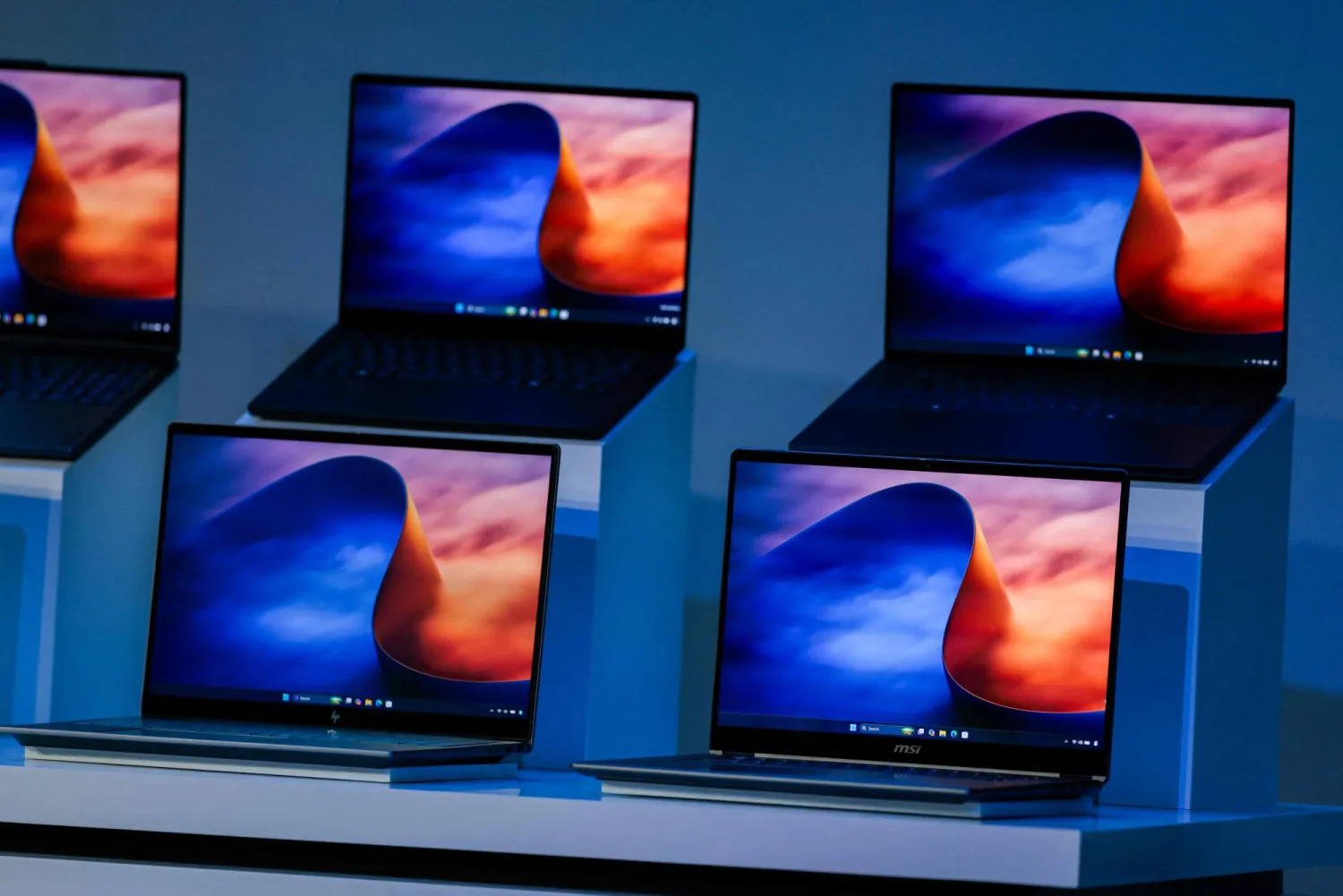
Windows laptops powered by Nvidia's RTX Spark chips are displayed at a Windows event on October 07, 2026 at Dogpatch studios in San Francisco, California. (Getty Images/AFP)
TT

Microsoft Pushes AI Vision with New, Expensive Surface Laptop

Windows laptops powered by Nvidia's RTX Spark chips are displayed at a Windows event on October 07, 2026 at Dogpatch studios in San Francisco, California. (Getty Images/AFP)

Microsoft is pushing a "hybrid intelligence" future with a new Surface Ultra laptop that runs on Nvidia artificial intelligence (AI) chips and will cost more than $2,500, the company announced Wednesday.

The launch is part of a broader push by tech companies to release hardware that can handle more AI computing on-device and offline, so users don't have to rely solely on remote cloud data centers, where running AI is slower and more expensive.

It also sees Nvidia, whose data center processors power the AI revolution, make a move into personal computing, a sector dominated for decades by chips from Intel and Qualcomm.

"The trajectory for me is so clear. There will never be a moment where we will go and look and say: 'Oh, this runs locally, this runs in the cloud.' You will expect this hybrid intelligence to be everywhere and pervasive," CEO Satya Nadella said during an event in San Francisco.

He was joined onstage by Nvidia CEO Jensen Huang, who echoed the idea that AI will be integrated into all computing going forward and on all devices.

Agentic AI, in particular, will be central to software development, Huang said, referring to systems programmed to be autonomous and perform tasks without supervision.

With all the changes from AI, "the computer has to be revolutionized," Huang said.

The partnership between the two US-based tech titans helps them compete with Apple, Intel and AMD in the personal computing market.

Apple unveiled two desktop computers in September, the Mac mini and Mac Studio, which it touted as powerful new options capable of processing AI software locally.

Microsoft has been working on building "AI PCs" since at least 2024, when its laptops were powered by Qualcomm chips.

The new Surface Ultra will use Nvidia's state-of-the-art AI chip, RTX Spark, which the semiconductor giant announced earlier this year.

It will cost $2,599 and begins shipping on October 16.

Some AI computing power and data will be processed locally, or on the device, while other applications are still handled remotely via Microsoft's cloud computing services.

"We built it for developers and creators pushing the limits of performance," Microsoft Executive Vice President of Windows and Device Pavan Davuluri said on Wednesday.

The news comes just a couple of weeks after Microsoft announced it would integrate Word, Excel and Powerpoint into its AI-powered assistant Copilot, in an effort to make AI the entry point for its famous suite of productivity software.

OpenAI, the company behind ChatGPT, and Claude-maker Anthropic each launched their own document creation tools in recent months.

The two San Francisco-based AI labs are also key suppliers for Microsoft, since Copilot runs primarily on their models.

Microsoft's in-house models currently only power a few products, such as GitHub's Copilot coding tool.

In June, Microsoft also unveiled its own cutting-edge artificial intelligence models -- a crucial step toward reducing its dependence on OpenAI, the creator of ChatGPT.




Popular Websites Subverted in Bid to Steal Crypto, Target iPhone Users

Apple's new iPhone 11 phones are displayed at the Apple Store in IFC, Central district, Hong Kong, China October 10, 2019. (Reuters)
TT

Popular Websites Subverted in Bid to Steal Crypto, Target iPhone Users

Apple's new iPhone 11 phones are displayed at the Apple Store in IFC, Central district, Hong Kong, China October 10, 2019. (Reuters)

Some of the world's most visited websites, including those belonging to Zoom, HSBC, Equifax, CNN, Salesforce and IKEA, were subverted in an effort to steal cryptocurrency and infect iPhones, a security researcher said on Monday.

Malicious JavaScript was aimed at visitors to the ‌websites of 178 ‌organizations across various sectors ‌through ⁠Optimizely, a website optimization ⁠platform, according to researcher Scott Helme.

The scripts attempted to replace cryptocurrency payment addresses with the attacker's wallet, skim card numbers as users entered credit card details, steal cookies and ⁠screenshots, and plant exploit code on ‌iOS devices.

Cybersecurity ‌firm HudsonRock also said it had found evidence ‌that the sites had served ‌malicious code to their visitors.

Reuters could not immediately ascertain whether the code was successfully used in each case, or the ‌extent of any resulting hacks.

Salesforce said it was investigating unauthorized Optimizely script ⁠changes, ⁠and had disabled them as a precaution.

Equifax also investigated the issue and ceased using Optimizely. The company said it did not find evidence of any compromise to its systems.

Optimizely, Apple, Zoom, HSBC, CNN and IKEA did not immediately respond to Reuters' requests for comment.


US Closes Loophole on China’s Access to AI Chips After Nvidia Scandal

Semiconductor chips are seen on a printed circuit board in this illustration picture taken February 17, 2023. (Reuters)
TT

US Closes Loophole on China’s Access to AI Chips After Nvidia Scandal

Semiconductor chips are seen on a printed circuit board in this illustration picture taken February 17, 2023. (Reuters)

The US Commerce Department on Monday issued a rule aimed at stopping Chinese companies from using advanced American AI chips housed in data centers in other countries.

The move comes days after a spy scandal forced Jensen Huang to step down as head of Nvidia, amid widening suspicions that he may have helped Chinese companies gain access to his company's most powerful AI chips in violation of US rules.

The Commerce Department, led by Howard Lutnick, has been accused by other voices inside the Trump White House of failing to properly enforce export controls that bar sales of Nvidia's most powerful AI chips to China.

One loophole allowed Chinese firms to rent AI computing power from data centers in Southeast Asia and elsewhere that run on US hardware not available for export to China.

Scrutiny of that loophole grew after Huang resigned last week over his relationship with Alice Huang, a former executive at Singapore-based Megaspeed.

US investigators suspect the Nvidia customer of illegally channeling the company's technology to China.

She is also suspected by some in US government to be an asset for Chinese secret services, according to The New York Times.

Megaspeed is under US investigation for possible export control violations and has denied wrongdoing. Alice Huang, who is not related to Jensen Huang, has not been charged, and Beijing has rejected the espionage allegations.

Treasury Secretary Scott Bessent on Friday blamed the Commerce Department for failing to blacklist Megaspeed over the alleged violations.

Under the new rule, data centers anywhere in the world will need a US license to provide large volumes of computing power from advanced chips to companies headquartered in China, Macau or other countries under US arms embargoes.

The rule also requires licenses to ship advanced chips to Singapore, Malaysia, Thailand, Indonesia and Brazil, which it says present a "higher-than-normal risk of diversion."

The rule "is designed to ensure that existing restrictions on access to sensitive American technology cannot be circumvented through remote computing arrangements involving data centers in third countries," the department's Bureau of Industry and Security (BIS) said in a statement.

BIS said the rule was "written by and at the direction of" the Treasury Department and the National Security Council.

The rule also formally rescinds the AI Diffusion Rule issued under former president Joe Biden. That rule set up a global licensing system for AI chips, and the Trump administration said in May 2025 that it would scrap it.


Tesla Invites Select Customers to Buy Cybercab for Personal Use

A passenger waves from a Tesla Cybercab driverless taxi as it travels through downtown Austin, Texas, US, October 27, 2026. (Reuters)
TT

Tesla Invites Select Customers to Buy Cybercab for Personal Use

A passenger waves from a Tesla Cybercab driverless taxi as it travels through downtown Austin, Texas, US, October 27, 2026. (Reuters)

Tesla said on Friday it was inviting select customers to buy the Cybercab for personal use, marking a push towards delivering fully designed autonomous vehicles to customers.

Tesla posted the announcement on X ‌with an ‌image of the golden butterfly door ‌two-seater, ⁠priced at $29,990 with ⁠an “Autonomy Subscription” of $299 a month.

Chief Executive Elon Musk said in a post on X that the offering would be available nationwide as Tesla receives regulatory approval.

"The monthly fee is too ⁠high," Musk said, adding that ‌it should match the ‌cost of Tesla Full Self Driving and connectivity ‌for other models, which is about $115 ‌per month.

The EV maker aims to start selling its Cybercab robotaxis to the public by the end of this year, ‌Lars Moravy, Tesla's vice president of vehicle engineering, said last month.

The ⁠Cybercab will work unsupervised in all the same geo locations as the robotaxi, Tesla’s head of artificial intelligence, Ashok Elluswamy, said in a separate X post.

Tesla launched its unsupervised robotaxi service in Austin, Texas, in June 2025, expanded the offering to Dallas and Houston in April 2026 and rolled it out in Miami in July 2026.