


Iraq’s Ruling Coalition Discusses Arrests of Armed Faction Members

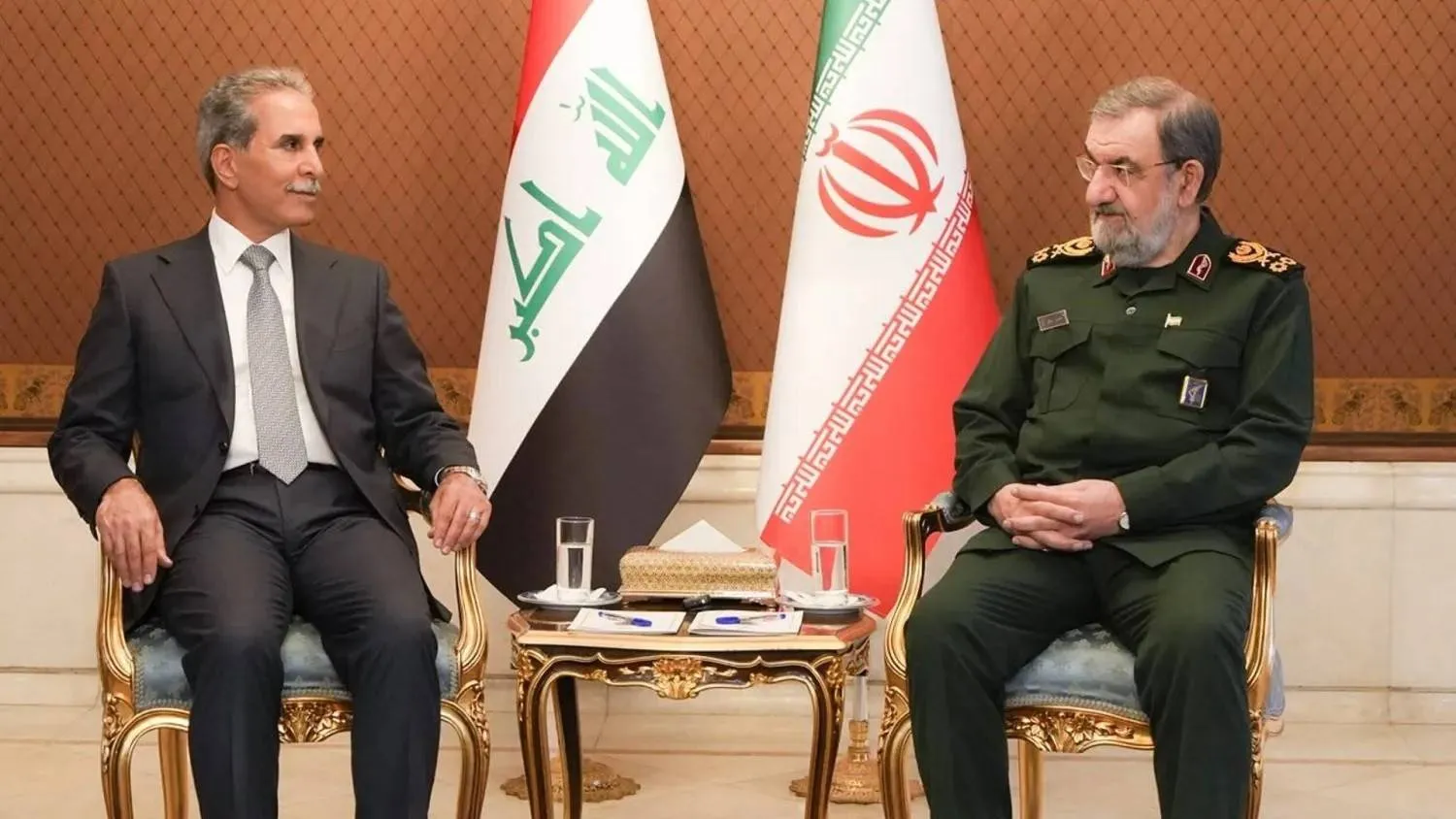
Iran’s Supreme National Security Council Secretary Mohsen Rezaei receives Iraq’s top judge Faiq Zidan in Tehran on Tuesday (Mehr)
TT

Iraq’s Ruling Coalition Discusses Arrests of Armed Faction Members

Iran’s Supreme National Security Council Secretary Mohsen Rezaei receives Iraq’s top judge Faiq Zidan in Tehran on Tuesday (Mehr)

Mohsen Rezaei, secretary of Iran’s Supreme National Security Council, said on Tuesday that regional countries would shape their own future and that the United States would have no place in the region.

Rezaei made the remarks in Tehran during talks with Faiq Zidan, head of Iraq’s Supreme Judicial Council.

He said Iran wanted a strong and independent Iraq and called for a resolution to the status of Iranian opposition groups based along the two countries’ border, an apparent reference to Iranian Kurdish parties in Iraq’s Kurdistan region.

His comments came days after Iranian parliament Speaker Mohammad Baqer Ghalibaf visited Baghdad, as Iraqi Prime Minister Ali Faleh al-Zaidi’s government faces growing pressure to press ahead with its plan to bring all weapons under state control.

During Ghalibaf’s visit, Iraqi National Security Adviser Qasim al-Aboudi said the government was moving forward with the plan.

He said the constitution did not allow armed groups to threaten the security of other countries and reaffirmed Baghdad’s commitment to its security agreement with Tehran.

The circumstances surrounding the visit suggested that armed factions were a central focus of the talks, even if the issue did not formally appear on every publicly announced agenda.

Iraqi reports said Ghalibaf conveyed Tehran’s position on government measures targeting the factions’ weapons as Baghdad’s deadline for completing the process approached.

Separately, leaders of the Coordination Framework discussed the arrests of Popular Mobilization Forces (PMF) members and commanders at a meeting in Baghdad attended by Mohsen Qomi, a representative of Iran’s supreme leader.

Local media said the leaders objected to how the arrests were carried out. They argued that those wanted by the authorities could have been summoned through formal judicial procedures instead of military force.

Underscoring the sensitivity of the issue, PMF later said what it called a “misunderstanding” over the arrests of several members had been resolved. It said they had been handed over to PMF security services to pursue their cases in court.

The developments come as al-Zaidi’s government seeks to enforce a state monopoly on weapons, bringing it into direct confrontation with armed factions that wield extensive political and security influence.

The weapons issue poses a sensitive test for al-Zaidi, who is also under US pressure to dismantle armed groups operating outside state control.

Baghdad ‘appreciates Tehran’s support’

In Tehran, Rezaei and Zidan focused their talks on security and judicial ties.

Zidan said Iraq appreciated Iran’s support and stressed the need for regional cooperation and security along the shared border.

He arrived in Tehran on Tuesday at the head of a senior judicial delegation following an official invitation. The delegation included the heads of the Judicial Supervision Commission and the Public Prosecution Service, as well as the director-general of the Judicial Protection Department.

Zidan was received by the Iranian judiciary’s deputy chief for international affairs and Nasser Seraj, secretary of the judiciary’s Human Rights Council.

During the visit, Zidan also met Iranian judiciary chief Gholam-Hossein Mohseni-Ejei to discuss closer judicial and legal cooperation.

Ejei said more than 131 Iranian convicts had been transferred from Iraqi prisons over the past year. He called for better prisoner-transfer and exchange mechanisms and measures to ease the difficulties facing their families.

He also said Iranian and Iraqi security were interconnected and urged closer coordination against activities threatening their shared border.

Zidan praised relations between the two countries and said the Iraqi government and people stood with Iran against what he described as “US and Israeli aggression.” He also recalled Iran’s support for Iraq during its war against ISIS.

Zidan also discussed several issues of common interest with Ghalibaf, according to Iraq’s state news agency.



Sudan Gold Mine Collapse Kills 10, Injures 21

Workers break rocks at a gold mine near Abu Delelq in Gadarif State, Sudan. (Reuters)
TT

Sudan Gold Mine Collapse Kills 10, Injures 21

Workers break rocks at a gold mine near Abu Delelq in Gadarif State, Sudan. (Reuters)

A gold mine collapsed in northern Sudan killing at least 10 people and injuring 21 others, two survivors told AFP on Sunday after overnight rescue efforts.

Shafts of the Awny mining area near Sudan's border with Egypt collapsed on Saturday.

By Sunday morning "10 bodies had been recovered and 21 injured miners pulled out", said one of the survivors who was working at the mine when it collapsed, requesting anonymity for security reasons.

Another survivor, also requesting anonymity, told AFP the rescue operation was "being carried out by the miners themselves" with little equipment available.

More miners were feared dead under the rubble and survivors said the search for the missing was ongoing.

Many young Sudanese have joined a dangerous gold rush, working in unregulated mines with their hands and rudimentary tools for meagre daily wages.

They face chemical poisoning and regular mine collapses.

Last week at least 82 people were killed and dozens injured in a collapse in the southern Kordofan region.

Artisanal and small-scale mining, which takes place in unofficial zones or decommissioned mines, accounts for the majority of gold extracted in Sudan.

Even before the war pushed nearly 20 million Sudanese into severe hunger, artisanal mining employed more than two million people, according to industry figures.


CIA Chief Meets Egypt's Sisi in Cairo

FILED - 18 October 2023, Egypt, Cairo: President of Egypt Abdel Fattah El-Sisi is pictured in Cairo. Photo: Michael Kappeler/dpa Pool/dpa
TT

CIA Chief Meets Egypt's Sisi in Cairo

FILED - 18 October 2023, Egypt, Cairo: President of Egypt Abdel Fattah El-Sisi is pictured in Cairo. Photo: Michael Kappeler/dpa Pool/dpa

US Central Intelligence Agency Director John Ratcliffe met Egyptian President Abdel Fattah al-Sisi Sunday in a rare visit to Cairo, as the United States warned of rapid escalation in the Middle East war.

Sisi's office said the meeting, attended by Egypt's spy chief Hassan Rashad, discussed the wars in Iran, the Gaza Strip and Sudan, as well as attacks on Gulf countries and threats to maritime security.

Sisi stressed "the paramount importance of settling regional crises through political and diplomatic tracks," according to a presidency statement.

"This military conflict has the potential to escalate rapidly," it warned.

Sisi's office said Ratcliffe on Sunday "lauded Egypt's pivotal role in supporting efforts aimed at reaching peaceful, comprehensive settlements to regional crises".


Arab Parliament Condemns Houthi Militia Attack Targeting Riyadh

Arab Parliament Condemns Houthi Militia Attack Targeting Riyadh
TT

Arab Parliament Condemns Houthi Militia Attack Targeting Riyadh

Arab Parliament Condemns Houthi Militia Attack Targeting Riyadh

The Arab Parliament has strongly denounced the terrorist Houthi militia's continued attacks, including the attack targeting Riyadh, stressing that it constitutes a flagrant violation of international law and a threat to Arab national security and regional stability.

In a statement on Sunday, Arab Parliament Speaker Mohammed Al-Yamahi expressed the parliament's full solidarity with the Kingdom of Saudi Arabia and its support for the measures it takes to defend itself against any attacks targeting its security and territorial integrity, SPA reported.

Al-Yamahi called on the international community, particularly the UN Security Council, to assume its legal and political responsibilities to stop these blatant attacks, ensure that they are not repeated, and hold those responsible accountable.