Families Evacuated as Algeria Wildfires Threaten Residential Areas

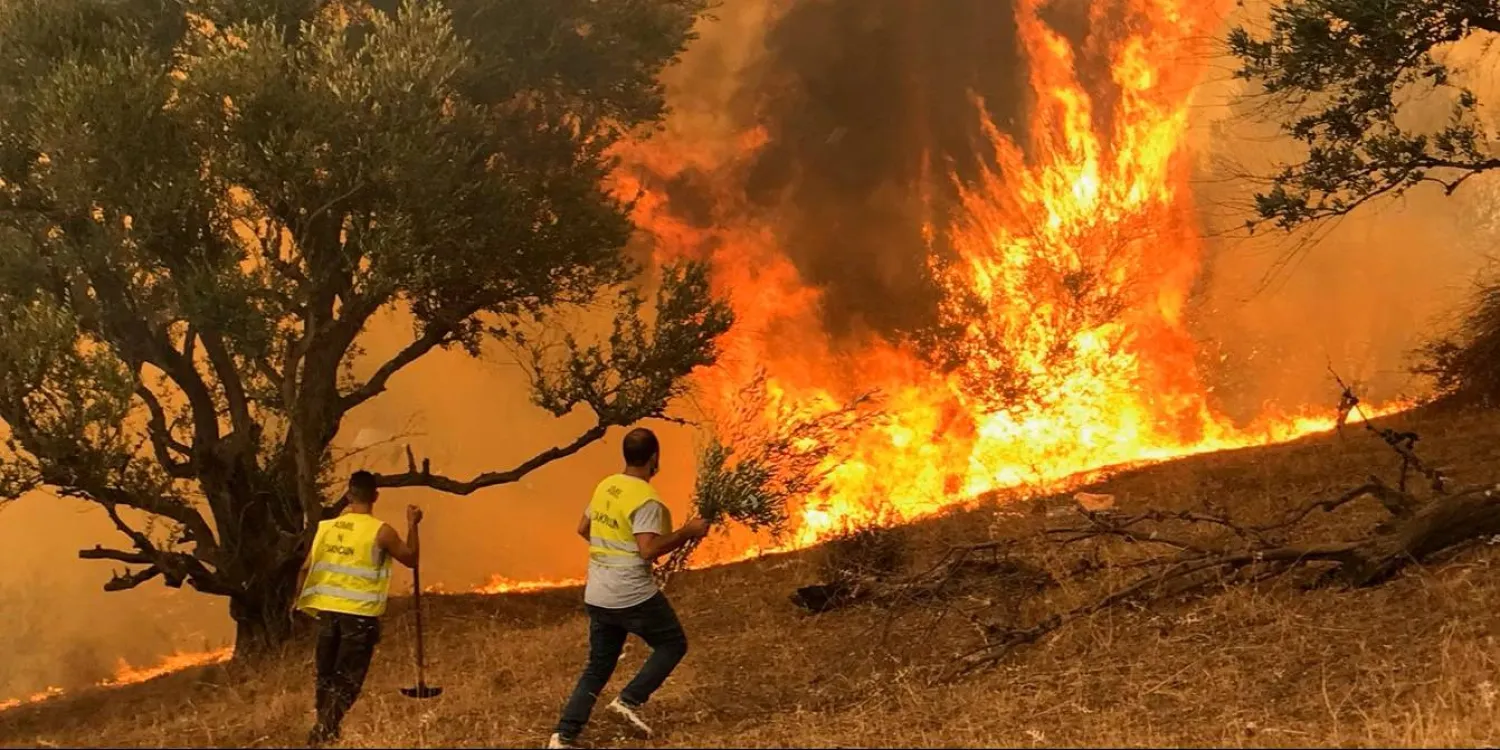
Every summer, northern Algeria is hit by forest fires, a phenomenon exacerbated by drought and climate change. (Reuters file)
TT

Families Evacuated as Algeria Wildfires Threaten Residential Areas

Every summer, northern Algeria is hit by forest fires, a phenomenon exacerbated by drought and climate change. (Reuters file)

Algerian civil protection authorities said Wednesday that they had evacuated several families in the country's northeastern province of Jijel as wildfires there threatened residential areas.

Videos circulating on social media showed panicked residents sheltering inside a building as thick smoke filled the air.

The civil protection said there were 37 active blazes nationwide, five of which were in Jijel.

The rescue body did not say how many people had been evacuated or displaced because of the fires.

Algeria has grappled with wildfires over the summer, with at least six people killed in several provinces last month, according to the authorities.

Every summer, northern Algeria is hit by forest fires, a phenomenon exacerbated by drought and climate change.

Dozens of people have been killed in recent years, and thousands of hectares of forest and farmland destroyed, along with numerous homes.


What Outcomes Will Hezbollah MP’s Visit to Tehran Have on Lebanon?

Lebanese lawmaker Hassan Fadlallah, a member of Hezbollah’s parliamentary bloc. (AFP)
TT

What Outcomes Will Hezbollah MP’s Visit to Tehran Have on Lebanon?

Lebanese lawmaker Hassan Fadlallah, a member of Hezbollah’s parliamentary bloc. (AFP)

The importance of Lebanese lawmaker Hassan Fadlallah’s latest visit to Tehran lies not in the trip itself. Hezbollah’s alliance with Iran is public and well established. What stands out is its timing and the way it was announced.

Iran’s Foreign Ministry disclosed the visit as the Lebanese state seeks to chart a political course free from regional rivalries and assert that decisions concerning Lebanon must run through state institutions.

Iran’s Foreign Ministry said two days ago that Foreign Minister Abbas Araghchi received Fadlallah, a member of Hezbollah’s parliamentary bloc, in Tehran. Hezbollah’s representative in Iran, Abdallah Safieddine, attended the meeting.

The ministry said the talks covered the latest developments in Lebanon and Israeli attacks. Araghchi reaffirmed Iran’s support for Lebanon and its “defense of its territorial integrity, dignity and national sovereignty.”

Fadlallah praised Iran’s position and what he called its strong diplomacy, urging a unified Islamic stand against Israel.

Outcomes of the visit

Ministerial sources said Hezbollah’s relationship with Iran “requires no interpretation. It is an alliance both sides openly take pride in.”

“At a time when Lebanese officials are working to separate the two tracks, this visit again raises questions about whether the party respects the role of the state and the positions of its officials,” they said.

The sources told Asharq Al-Awsat: “This is certainly not the first time a Hezbollah official has visited Tehran, nor will it be the last. But it may be the first time such a visit has been announced in this way — through an official statement from the Iranian Foreign Ministry.”

“That gives the meeting an official character that goes beyond receiving a Lebanese lawmaker. It appears almost as a meeting between officials of two states.”

Still, the sources said the key question was what the visit would produce: whether it would ease the process now underway or make it even more difficult, particularly because Fadlallah is responsible for negotiations with the Lebanese presidency.

“Will Hezbollah cooperate with the state in the process it is managing, particularly over negotiations with Israel? Or will it continue rejecting decisions made by state institutions and escalate further?” they asked.

The question is even more pressing as Iranian-American negotiations falter and threaten repercussions in Lebanon, they warned.

Communications cut

The sources said communications between President Joseph Aoun and Hezbollah had been cut, with no recent contact. The only remaining channel is with Parliament Speaker Nabih Berri, Hezbollah’s key ally.

The visit came days after the United States imposed new sanctions on Hezbollah, targeting 10 individuals and a network Washington accused of moving funds between Iran’s Revolutionary Guards’ Quds Force and the Lebanese group.

Hezbollah responded by declaring its pride in its relationship with Iran and reaffirming its commitment to the “path of resistance.”

El Hage: They challenge the state every day

Lebanese Forces parliamentary bloc member Razi El Hage said there was “nothing unusual” about Fadlallah’s visit to Tehran.

Hezbollah has never let a day pass without treating Iran as the foundation of the equation. The group opposed the state and sought to place Lebanon within the framework of Iranian-American negotiations, he told Asharq Al-Awsat.

“This is not a new challenge to the state. They challenge it every day through their positions and their insistence on keeping Lebanese decision-making tied to foreign powers,” El Hage said.

“They must understand that the clock will not be turned back. The state has embarked on a course from which there can be no retreat.”

“They are making the decision to slaughter Lebanon,” El Hage added.

“Our position will remain firm. We will not retreat from our demand that the state alone hold decision-making authority and continue along the path it has begun.”

El Hage also called on the government to enforce its decisions more firmly, saying the state must prove it can assert its authority and protect Lebanon from attempts to keep it an arena for other countries’ conflicts.

Lebanese decisions first

Fadlallah’s visit came as President Joseph Aoun and Prime Minister Nawaf Salam have taken clear positions on keeping Lebanon out of other countries’ conflicts.

Aoun previously said Iran was “using Lebanon as a bargaining chip” in its negotiations with the United States.

He said he was working to implement a policy of distancing Lebanon from regional conflicts and insisted that decisions affecting the country’s sovereignty and security must rest exclusively with the Lebanese state.

Salam previously said: “Once again, the South and its people are paying the price for a decision they did not take. If I may address Iran directly: have mercy on our south and stop treating it as a bargaining chip in your negotiations.”

“Lebanon is not a mailbox for others’ messages, nor a battlefield for their wars,” he stated.


Yemen’s PLC Urges Deterrent Measures against the Houthis

PLC Chairman Dr. Rashad al-Alimi chairs the council meeting attended by all its members and Prime Minister Shaya Zindani. (Saba)
TT

Yemen’s PLC Urges Deterrent Measures against the Houthis

PLC Chairman Dr. Rashad al-Alimi chairs the council meeting attended by all its members and Prime Minister Shaya Zindani. (Saba)

Yemen’s Presidential Leadership Council has raised the level of military, security, and intelligence readiness to confront the Houthi escalation, stressing that government forces are now prepared to take the initiative.

It warned that any new escalation by the Iranian-backed group will carry a direct cost for its leadership, capabilities, and funding sources.

PLC Chairman Dr. Rashad al-Alimi chaired a council meeting attended by all its members and Prime Minister Shaya Zindani.

The meeting was dedicated to discussing military, security, and economic developments, alongside the state's strategic options to counter the Houthi escalation, at a time when several fronts are witnessing increased military movements and attacks targeting civilian areas and vital installations.

The council stressed that the state is proceeding with its efforts to restore its institutions, impose its authority over the entire Yemeni territory, and end the Houthi coup.

The armed forces have become more prepared to fulfill their constitutional duties, deter Houthi attacks, and prevent the group from achieving any field or morale gains, it added.

The council was briefed on the latest developments on the ground. It also discussed a number of urgent economic and security measures aimed at improving living conditions and combating terrorism, smuggling, and organized crime.

The PLC said it was taking "legitimate and necessary" measures to protect citizens, sovereign installations, and national interests, including preemptive actions against threats, command and control centers, and military capabilities that are being used or prepared to target government forces, civilians, and vital facilities.

It praised the performance of the armed and security forces over the past weeks, highlighting their capability in foiling Houthi attacks, inflicting losses, and achieving military targets.

The council stated that recent government operations sent a message that targeting cities, civilians, and national installations "without cost" is no longer possible, warning that any new escalation will have direct consequences.


Türkiye Says Dissolution of Kurdish-Led SDF Crucial for Syrian Stability

Kurdish fighters from the Qamishli Brigade, part of the Syrian Democratic Forces (SDF) participate in a military parade in Qamishli on August 21, 2026, during the funeral ceremony for three Kurdish fighters killed in previous battles in Aleppo's Sheikh Maqsoud neighborhood in the north of Syria. (AFP)
TT

Türkiye Says Dissolution of Kurdish-Led SDF Crucial for Syrian Stability

Kurdish fighters from the Qamishli Brigade, part of the Syrian Democratic Forces (SDF) participate in a military parade in Qamishli on August 21, 2026, during the funeral ceremony for three Kurdish fighters killed in previous battles in Aleppo's Sheikh Maqsoud neighborhood in the north of Syria. (AFP)

Türkiye on Wednesday said the dissolution of the Kurdish-led Syrian Democratic Forces (SDF) marked a key step towards strengthening state authority and achieving lasting stability in Syria.

Türkiye has long regarded the SDF as an extension of the outlawed Kurdistan Workers' Party (PKK), which waged an insurgency against the Turkish state for decades.

"At this point, the dissolution of the SDF is an important development in terms of strengthening state authority across the country and bringing different segments of society together on a common political ground," Burhanettin Duran, the Turkish presidency's communications director, wrote on X.

"It is of great importance for the establishment of lasting stability that the Syrian administration continues to pursue an inclusive approach," he added.

The comments came a day after SDF leader Mazloum Abdi announced the group's dissolution in a televised address from the presidential palace in Damascus.

Ankara has often said it consistently backs Syria's territorial integrity and opposes any form of separatism in the country.

"It is crucial to establish a regional order... which is free from the tutelage of terrorist organizations, and where borders and sovereign rights are respected and protected," Duran said.

Türkiye has also launched a peace process with the PKK, which announced last year that it was disbanding following a call from its jailed leader Abdullah Ocalan.