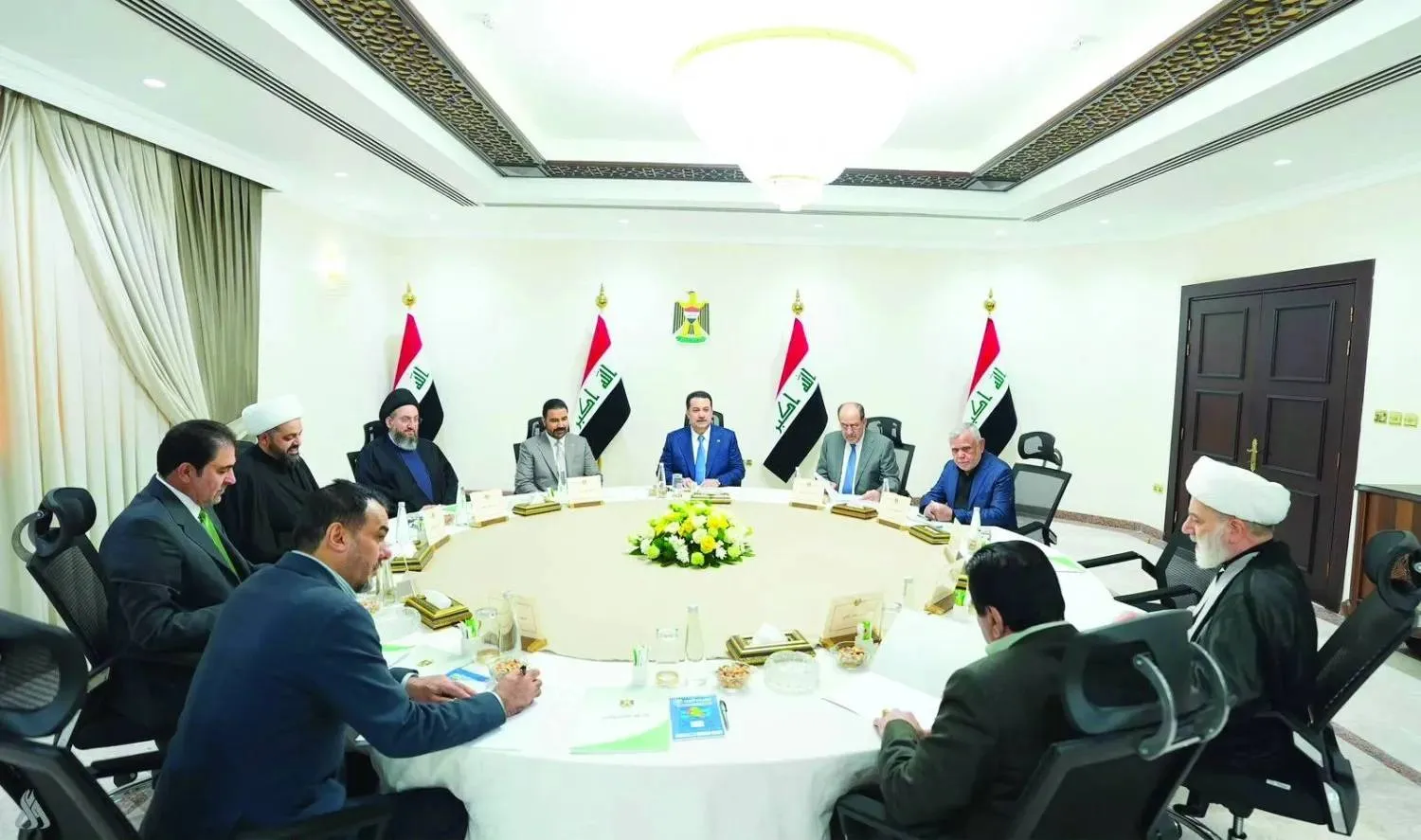
Iranian Messages Seek to Defuse Iraq Dispute Over Armed Factions

Iraqi Prime Minister Ali al-Zaidi attends a Coordination Framework meeting in Baghdad. (INA)
TT

Iranian Messages Seek to Defuse Iraq Dispute Over Armed Factions

Iraqi Prime Minister Ali al-Zaidi attends a Coordination Framework meeting in Baghdad. (INA)

Iran has urged leaders of Iraq’s Coordination Framework to contain a dispute over armed factions’ weapons and avoid a confrontation with groups that may refuse to disarm after a Sept. 30 deadline set by Baghdad.

Iraq’s judiciary, meanwhile, said it would take action against anyone carrying weapons after the deadline.

Local reports cited informed sources as saying Tehran had called for negotiations with the factions rather than confrontation. The proposed talks would cover which weapons could be surrendered, how they would be handed over, and what the factions might receive in return.

Committees could also be formed to manage the process and prevent a direct confrontation with the government or the United States.

The move comes as Prime Minister Ali al-Zaidi’s government pushes ahead with a plan to place all weapons under state control.

Baghdad has tied the end of September to the conclusion of the US-led international coalition’s military mission against ISIS and the start of a new phase in bilateral security relations.

National Security Adviser Qassem al-Araji said this week that the coalition’s mission would end on Sept. 30. Dialogue with the factions over restricting weapons could begin afterward, he said, in an apparent effort to ease tensions over the deadline.

An informed source said a senior Iranian official briefly attended a recent Coordination Framework meeting and delivered messages on how to handle the coming political and security developments.

The messages also addressed the communication channel between the Framework and Tehran.

The reports identified the official as Mohsen Qomi, a representative of Iran’s supreme leader. Qomi attended part of the meeting in Baghdad during a visit that the source said was also intended to formally introduce his role to the Iraqi government and political and religious leaders.

The source said Qomi left shortly afterward and did not take part in all the discussions.

Qomi also met Coordination Framework leaders in Baghdad, including Iraqi Islamic Supreme Council President Humam Hamoudi and al-Zaidi.

The meeting, held at Hamoudi’s office, covered issues of mutual interest, according to the Iraqi News Agency.

The reports said Qomi told Framework leaders that Hamoudi had been designated as a channel of communication between Iran and Iraq. The move would organize political contacts with Tehran as pressure mounts on Iran-aligned armed factions.

The reports attributed the delay in Qomi’s visit to security conditions in Iran. His arrival coincided with growing debate in Iraq over the future of armed groups after the coalition’s mission ends.

Ghalib al-Daami, a professor of media studies at Mustansiriyah University, said the Coordination Framework forces understood the risks of confronting the United States over the weapons issue.

But they also did not want disarmament to be carried out quickly or fully if that would strengthen the government and the prime minister, he said.

Daami said Shi’ite forces could seek a formula that partly meets US demands without handing the government a major political victory. In his view, those forces generally prefer to keep the prime minister’s success within limits they can control.

Washington says ending the coalition’s military mission does not mean abandoning its security relationship with Baghdad. Instead, the relationship will shift to a bilateral defense partnership.

The United States and Iraq agreed in 2024 on a timetable to end the coalition’s military mission in Iraq by September.

The deadline has brought growing pressure on Iran-backed armed groups to surrender their weapons or fully integrate into state institutions.

Iraqi officials say some factions are resisting the move, making the issue one of the most sensitive tests facing al-Zaidi’s government as the coalition mission draws to a close.

International coalition withdrawal

In the Kurdistan Region, German forces serving with the international coalition ended their military and advisory duties this week, another step in the coalition’s gradual withdrawal.

An official ceremony was held on Tuesday at Camp Stephan at Erbil International Airport.

Officials from the Kurdistan Regional Government and the Peshmerga Ministry attended, along with representatives of the German Defense Ministry.

The Peshmerga Ministry said the German advisers and trainers had completed their mission after years of working with Peshmerga forces in the fight against ISIS.

Kurdistan Region President Nechirvan Barzani told a member of the German parliament that the region valued Germany’s support during the war against terrorism.

He highlighted the assistance Germany provided while Peshmerga forces were fighting and the region was receiving large numbers of displaced people.

The German withdrawal comes as US troops and the remaining coalition forces finalize plans to leave Iraq.

The United States and Iraq agreed in 2024 to end the coalition’s military mission and move to a bilateral security partnership. Cooperation against ISIS will continue under the new arrangements.

Separately, Iraqi Supreme Judicial Council President Faeq Zidan met with Joshua Harris, chargé d’affaires at the US Embassy in Baghdad, on Wednesday.

They discussed judicial measures against individuals and groups carrying weapons in violation of the Constitution and the law.

The meeting signaled a growing focus on the judiciary’s role as the end of the coalition’s military mission approaches.

The Supreme Judicial Council said the talks covered measures the judiciary would take after the mission ends on Sept. 30. They also discussed how to enforce the rule of law equally.

The meeting followed Zidan’s visit to Iran, where he met several senior officials.

They included Judiciary Chief Gholam-Hossein Mohseni-Eje’i, President Masoud Pezeshkian, Parliament Speaker Mohammad Bagher Ghalibaf and Supreme National Security Council Secretary-General Mohsen Rezaei, according to statements from Iraq’s judiciary.

After meeting Zidan in Tehran, Rezaei said the countries of the region would determine their own future and that the US would have no place there.

He said Iran wanted “an independent and strong Iraq.”

Rezaei also called for resolving the status of groups opposed to Iran that are based along the two countries’ border, a reference to Iranian Kurdish parties in Iraq’s Kurdistan Region.


Iran Supreme Leader Warns of 'Geographically Unrestricted Response' to Any Attack

Iranians walk past billboards featuring Iran’s Supreme Leader Mojtaba Khamenei on a street in Tehran, Iran, 28 October 2026, amid the ongoing US-Iran conflict. (EPA)
TT

Iran Supreme Leader Warns of 'Geographically Unrestricted Response' to Any Attack

Iranians walk past billboards featuring Iran’s Supreme Leader Mojtaba Khamenei on a street in Tehran, Iran, 28 October 2026, amid the ongoing US-Iran conflict. (EPA)

Iran's supreme leader Mojtaba Khamenei on Saturday met with top military commanders and ordered them to meet any US or Israeli attack with a "geographically unrestricted response", according to a written statement.

"Any level or type of threat must be met with an immediate, impactful, and geographically unrestricted response," the leader said, according to the statement published on his website.


Iran's Army Warns Any New US Attack Would Spread War Wider

A woman walks through traffic while crossing Enghelab Square in Tehran on October 26, 2026.  (Photo by ATTA KENARE / AFP)
A woman walks through traffic while crossing Enghelab Square in Tehran on October 26, 2026. (Photo by ATTA KENARE / AFP)
TT

Iran's Army Warns Any New US Attack Would Spread War Wider

A woman walks through traffic while crossing Enghelab Square in Tehran on October 26, 2026.  (Photo by ATTA KENARE / AFP)
A woman walks through traffic while crossing Enghelab Square in Tehran on October 26, 2026. (Photo by ATTA KENARE / AFP)

Iran's army warned Saturday that any new US attack would only spread their war wider, following threats by America and Israel of further military action as they hold crucial elections.

The Iranian warning comes with fresh diplomatic efforts underway to avert a resumption of fighting, with Qatari mediators in Tehran and US Vice President JD Vance reportedly sending a letter to Iran's security chief Mohsen Rezaei, said AFP.

"If the US president once again embarks on more regional adventurism under pressure from, and in an attempt to appease, the Zionists, the flames of war will undoubtedly engulf a much wider geographical area," Iranian army spokesman Mohammad Akraminia said in a post on X, without elaborating.

Iranian Foreign Minister Abbas Araghchi also warned on Saturday that "Iran's Powerful Armed Forces will deal against those who dare harm our people".

On Friday, a Qatari delegation arrived in the Iranian capital for talks with senior Iranian officials.

Qatar and Pakistan have been mediating between the warring parties, but the talks have yet to produce a lasting agreement.

The Wall Street Journal reported on Wednesday that Vance had sent his letter to Iran's security chief at the direction of President Donald Trump in a bid to revive negotiations and avert further US strikes.

Iran has confirmed receiving the letter but has not announced any response.

The US holds midterm elections on Tuesday that could determine the direction of the war, which has proven unpopular with American voters following a spike in energy prices due to the conflict.

Last Tuesday, Israel also held legislative elections, with voters given a chance to offer a verdict on right-wing Prime Minister Benjamin Netanyahu.

Under Netanyahu, who has vowed to topple Iran's government, Israel and Iran have engaged in direct military confrontations after decades of shadow war.

The Middle East war began in late February with US-Israeli strikes on Iran that killed the country's supreme leader Ali Khamenei as well as senior military commanders.

Iran in response targeted US assets across the Middle East as well as Israel.

Most recently hostilities have focused on the Strait of Hormuz, a crucial Gulf shipping route for energy exports that Iran has blockaded since the start of the war.

The US has in retaliation been blockading Iranian ports in an attempt to squeeze the nation's economy.


Flavio Bolsonaro Says He Left Brazil Because He Is the Victim of ‘Persecution’

Flavio Bolsonaro steps off a plane after arriving at Opa Locka Executive Airport in Miami, Florida on October 28, 2026. (AFP)
TT

Flavio Bolsonaro Says He Left Brazil Because He Is the Victim of ‘Persecution’

Flavio Bolsonaro steps off a plane after arriving at Opa Locka Executive Airport in Miami, Florida on October 28, 2026. (AFP)

Former conservative presidential candidate Flavio Bolsonaro said Friday that he fled Brazil to the United States because he was a victim of "persecution" in his country.

Bolsonaro, who lost Sunday's election runoff to President Luiz Inacio Lula da Silva, secretly left Brazil on Tuesday and arrived in Florida aboard a private jet on Wednesday after traveling through Argentina and Ecuador.

"The persecution began even sooner than I imagined," the senator said during an Instagram livestream in which he discussed his decision to flee after his Brazilian passports were canceled as part of a money laundering investigation.

In the video, he recounted how police informed him Monday that his passports were being revoked as he left a visit to his father, former president Jair Bolsonaro, who is under house arrest.

"With tears in his eyes, he told me: 'You know where they're going with this, don't you?'" he said of his father.

"I told him: 'Dad, I know... Now I know what I have to do,'" he recounted.

Although he gave no details of how he left the country, he said he and his wife made the decision "without anyone knowing" and urged people not to "point the finger at anyone."

US President Donald Trump and Argentine President Javier Milei are under pressure to explain the involvement of the United States and Argentina in the senator's escape.

"I didn't leave Brazil, I left for Brazil," Flavio Bolsonaro said, alleging that Supreme Court Justice Alexandre de Moraes had made false accusations against him.

He also suggested there had been irregularities in the runoff, comparing them to "handball goals" that were not disallowed by VAR, without detailing what those irregularities might have been.

He also predicted that the economy would "go bust" under Lula and said he was willing to run for president again: "I'm not talking about 2030, I'm talking about before then."