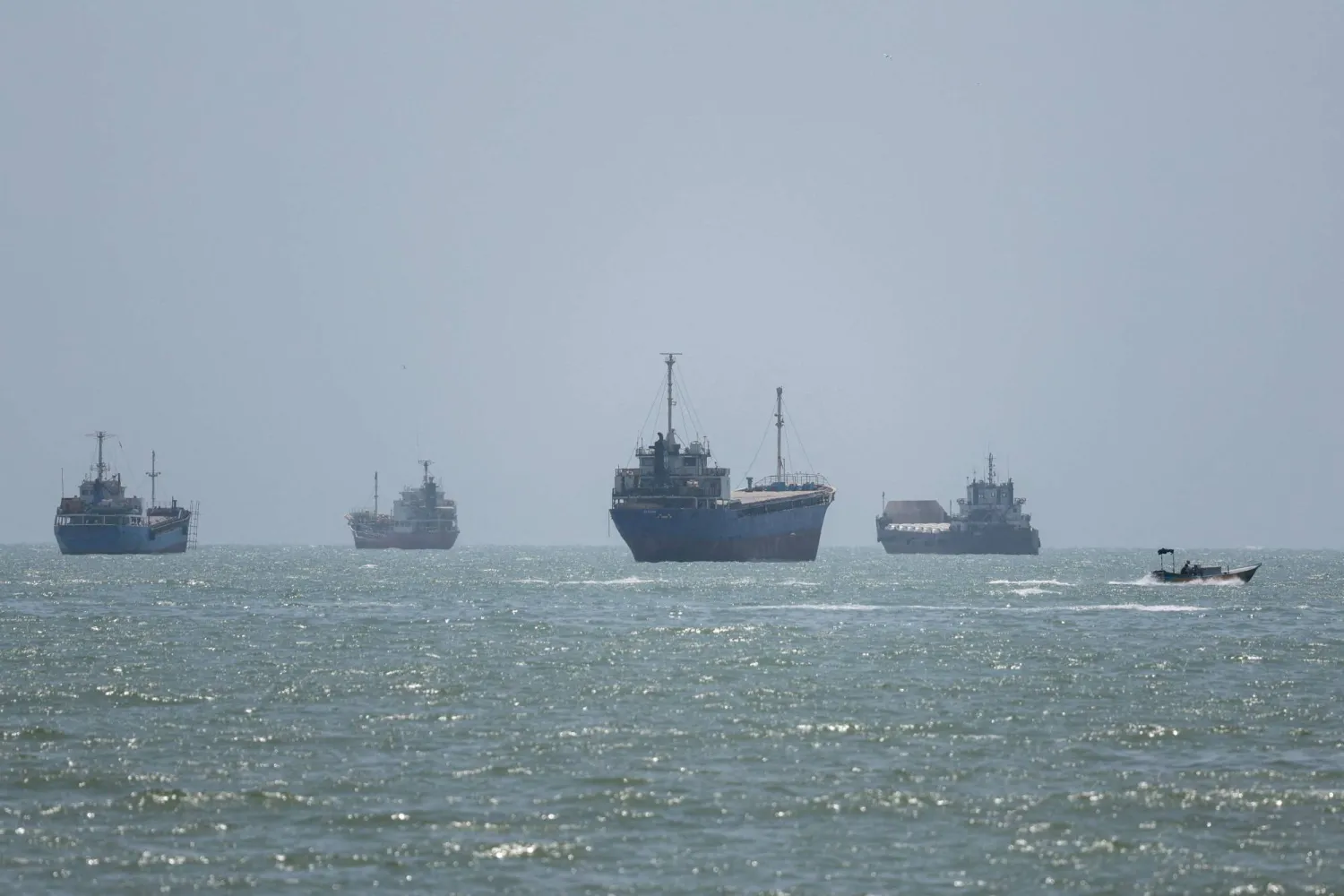
Tanker Hit by 'Unknown Projectile' in Strait of Hormuz, Says UKMTO

Vessels in the Strait of Hormuz are visible near the beach of Bandar Abbas, Iran, August 26, 2026. Majid Asgaripour/WANA (West Asia News Agency) via REUTERS
TT

Tanker Hit by 'Unknown Projectile' in Strait of Hormuz, Says UKMTO

Vessels in the Strait of Hormuz are visible near the beach of Bandar Abbas, Iran, August 26, 2026. Majid Asgaripour/WANA (West Asia News Agency) via REUTERS

An "unknown projectile" struck a tanker in the Strait of Hormuz this week, causing a fire that has since been put out, a British maritime agency said early on Thursday.

Iran has effectively blockaded the Strait of Hormuz since the United States and Israel attacked the republic in late February.

Tehran wants to charge tolls for passage, and has attacked ships it accuses of trying to skirt its preferred route.

"Local authorities have reported a tanker has been hit by an unknown projectile causing fire to the vessel which has since been extinguished," the United Kingdom Maritime Trade Operations (UKMTO) said.

The incident occurred near the Omani coastal city of Khasab and was reported to the UKMTO on Tuesday, the agency said.

There were no casualties among the crew and no adverse environmental impact, it said.

Authorities are investigating the cause, it added.

The online notice did not specify the vessel's nationality or direction of travel.

US Treasury Secretary Scott Bessent laid out plans on Monday for the "economic asphyxiation" of Iran.

Iranian President Masoud Pezeshkian said on Wednesday that the new sanctions "will not achieve anything".


Japan to Survey Animal Cafes over Hygiene, Welfare Concerns

A Japanese customer at a 'cat cafe' in Tokyo. TORU YAMANAKA / AFP/File
TT

Japan to Survey Animal Cafes over Hygiene, Welfare Concerns

A Japanese customer at a 'cat cafe' in Tokyo. TORU YAMANAKA / AFP/File

Japan plans to probe popular animal cafes, where visitors can interact with anything from cats to capybaras, following concerns about hygiene and the creatures' welfare, authorities said Thursday.

Japan has hundreds of the cafes where campaigners say animals are sometimes kept in cramped spaces, and that their popularity encourages the capture and illegal trade of rare wildlife.

A fact-finding survey will begin as early as next month, starting with obtaining basic facts such as the number of establishments and what animals they keep, an environment ministry official told AFP.

The ministry will examine whether they comply with relevant laws, including whether animals have enough space and how often cleaning takes place, said the official, without wishing to be named.

"We may then do on-site inspections if we find facilities that appear to be breaching rules" stipulated by the animal welfare law, he said.

The decision to launch the survey followed recommendations by members of an expert panel about animal welfare.

Animal welfare groups have long been alarmed by the cafes, where visitors can pet and play with a dizzying array of animals including micro-pigs, hedgehogs, owls and snakes.

A 2025 survey by World Wide Fund for Nature Japan said that some kept endangered species listed on the Red List of the International Union for Conservation.

They also included species covered by the Convention on International Trade in Endangered Species, which regulates international trade in wildlife.

Some shops had inadequate hygiene management without nudging users to handwash after contact with animals, and its "microbiological testing detected pathogenic bacteria in multiple facilities", the report said.

"Whether the animals are otters, capybaras, raccoons, owls, reptiles, or other wild species, these businesses are built around close encounters that prioritize customer entertainment over the animals' needs," said Laila Imai, campaign coordinator in Asia of animal welfare group PETA.

"Many are subjected to constant handling, noise, flashing cameras, and interactions with strangers throughout the day," Imai said.

"What may appear charming to visitors can be stressful and unnatural for the animals forced to live that way."

Some animal cafes act as adoption centers, helping to find new homes for rescued cats and dogs.


Iran Unable to Import Petrol amid US Blockade

Drivers queue at a petrol station to refuel in Tehran, on August 25, 2026. (AFP)
TT

Iran Unable to Import Petrol amid US Blockade

Drivers queue at a petrol station to refuel in Tehran, on August 25, 2026. (AFP)

Iran has been unable to import enough petrol to make up for insufficient domestic production because of a US naval blockade, a senior Iranian official said.

"Petrol production is insufficient, and because of the US naval blockade, we cannot import it," the official IRNA news agency quoted Vice President Mohammad Jafar Ghaempanah as saying on Wednesday.

The remarks came as Iranians have in recent days queued outside petrol stations, with the war with the United States increasingly shifting towards economic pressure on Tehran, said AFP.

On Monday, the Iranian president's chief of staff Mohsen Haji-Mirzaei said petrol quotas would be reviewed, without elaborating.

War broke out between Iran and the United States on February 28. Tehran has since seized control of the strategic Strait of Hormuz, with Washington imposing a naval counter-blockade on Iranian ports.

Ghaempanah criticized the distribution of highly subsidized fuel in Iran, saying the current system disproportionately benefits people who own multiple vehicles.

"The distribution of petrol in the country is inequitable. Owners of several vehicles benefit from subsidies, unlike those who do not own one," he said.

Iran, a major oil producer with some of the world's cheapest fuel, has for years heavily subsidized petrol, making any changes to pricing politically sensitive.


Death Journey from Kordofan Ends in Hunger in Omdurman

A displaced woman from Dalanj braids her grandmother's hair at a displacement registration center in El Obeid, North Kordofan State, Sudan, January 15, 2026. REUTERS/El Tayeb Siddig
TT

Death Journey from Kordofan Ends in Hunger in Omdurman

A displaced woman from Dalanj braids her grandmother's hair at a displacement registration center in El Obeid, North Kordofan State, Sudan, January 15, 2026. REUTERS/El Tayeb Siddig

A long journey marked by fear, hunger and thirst has been undertaken by large numbers of Sudanese families fleeing cities and towns in North Kordofan state, where fighting has flared again, for Omdurman, the second-largest city in the capital Khartoum.

Families that have lost children, relatives, and perhaps all their possessions have been forced to leave their homes and take difficult routes through mountains and valleys. Some have travelled on foot, while others have relied on animal-drawn carts or trucks. Others have become stranded before reaching safety.

Reports by local and international aid organizations said hundreds of families — with some estimates putting the number at more than 3,000 — have been displaced in recent weeks following a resurgence of military operations in parts of North Kordofan, amid what the reports described as “dire humanitarian conditions”.

After weeks of hardship, the families reached the far western outskirts of Omdurman “hungry and exhausted,” carrying what remained of their belongings and memories of the homes they had left behind.

Others had lost family members along the arduous journey. But reaching Omdurman did not end their ordeal. Displaced families face shortages of food and drinking water and a lack of humanitarian assistance, while cases of diarrhea, fever and infections are spreading among children, turning their escape from the war into an open-ended ordeal with no clear end in sight.

The Arduous Journey

The Sudanese Armed Forces and allied forces are seeking to expand their control in North Kordofan and secure the area around the state capital, El Obeid, while large numbers of the Rapid Support Forces are positioned west and south of the city.

Halima Dhow al-Bait said she fled with her family of nine from the Al-Jamama area of Sodari locality in North Kordofan after they were forced to leave their home at gunpoint.

Her journey took several days aboard cargo trucks and was arduous and exhausting, while some residents and neighbors became stranded in the mountains and among the trees.

“We arrived in Omdurman in a state of extreme exhaustion,” the Sudanese woman told Asharq Al-Awsat. “During the first few days, we received some food supplies, including oil, sugar and flour, but those supplies later stopped.”

Another displaced woman said: “During the journey, three of my children fell ill because of hunger, thirst and the hardships of the road.”

“We left our homes, our property and everything we owned. We left with nothing but the clothes we were wearing,” she said. “Our situation is now extremely difficult, and we are receiving no humanitarian assistance.”

“We saw death with our own eyes”

Sudan’s humanitarian crisis has deepened as a result of the war between the Sudanese army and the Rapid Support Forces, which has continued since April 2023, killing hundreds of thousands of people and displacing about 13 million others as refugees and internally displaced people, according to UN estimates.

Sayedah Khamis, a displaced woman from the town of Al-Jamama, recounted the details of her arduous journey.

“Our journey took about 13 days. At times we travelled on foot, and at others in donkey-drawn carts,” she said.

“We left because of the deteriorating security situation, violations and the looting of civilians’ property,” she added.

The displaced woman described the hardship of the journey and the harsh conditions her family endured throughout those days.

A New Reality

Renewed fighting in Sudan’s Kordofan region has displaced hundreds of families to El Obeid, Khartoum, Kosti and Omdurman. The crisis has also displaced about 200,000 people in North Darfur and a similar number in Blue Nile state.

Mohamed Ali, who was also displaced from Abu Hadid, said armed conflict forced his family to leave the area. They traveled for about two weeks through mountains and valleys, using different forms of transport and sometimes sleeping outdoors in harsh conditions amid insects and disease.

He said they lost several family members along the way and now urgently need food and clean drinking water, particularly as flies have contributed to illnesses among children.

Although the families’ displacement journey to Omdurman may have ended, their hardship continues. They have lost homes, property and relatives, and now face a daily struggle for food, water and healthcare. Their hope of returning home remains on hold until the violence ends, turning their escape from war into an ongoing fight for survival.