


Iran War Diplomacy Turns toward Reopening Strait of Hormuz

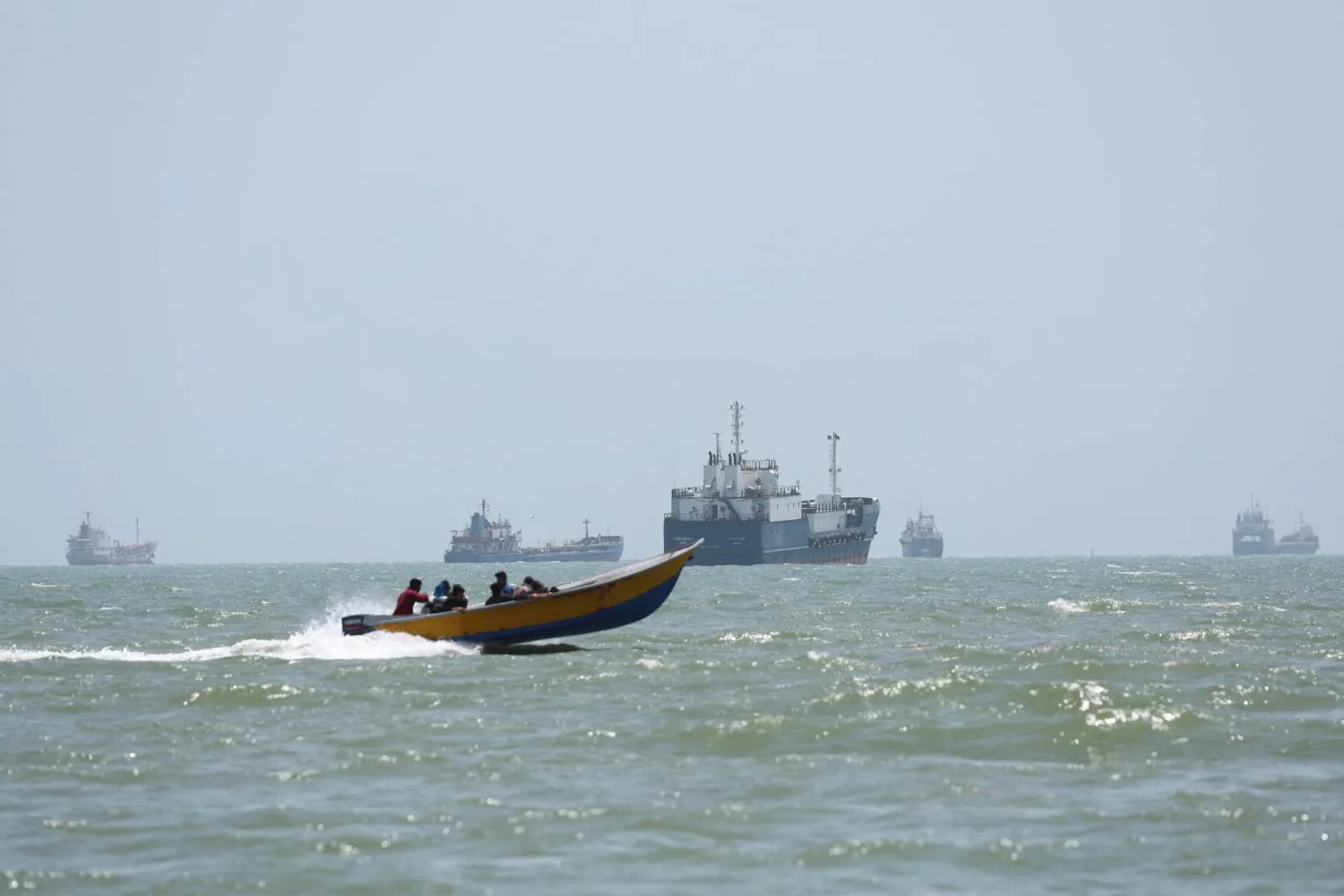
Vessels in the Strait of Hormuz are visible near the beach of Bandar Abbas, Iran, August 25, 2026. Majid Asgaripour/WANA (West Asia News Agency) via REUTERS
TT

Iran War Diplomacy Turns toward Reopening Strait of Hormuz

Vessels in the Strait of Hormuz are visible near the beach of Bandar Abbas, Iran, August 25, 2026. Majid Asgaripour/WANA (West Asia News Agency) via REUTERS

Iran war mediators have placed renewed emphasis on reopening the Strait of Hormuz, with Tehran agreeing to draw up a list of conditions to restore normal traffic after a Qatari emissary pressed the Iranians to respect freedom of navigation.

With the US having disengaged from talks in favor of an economic pressure campaign, the prime minister of Qatar met senior Iranian leaders in Tehran on Thursday, stressing the importance of returning to the pre-war status of open shipping through an international waterway, said Reuters.

Qatar and Pakistan helped broker a memorandum of understanding in June that led to a ceasefire and set terms for shipping in the Strait of ‌Hormuz, the narrow stretch ‌between Iran and Oman that before the war was the conduit for 20% of ‌the ⁠world's oil supply.

After ⁠the US and Israel launched the war six months ago, Iran threatened to strike any vessel transiting the strait without its authorization, driving down traffic and sending up the price of oil, providing Iran with leverage in the bargain.

In his mission to Tehran on Thursday, Qatari Prime Minister and Foreign Minister Sheikh Mohammed bin Abdulrahman Al Thani said on X that he underscored to senior Iranian officials "the importance of respecting freedom of navigation in the Strait of Hormuz in accordance with international law."

Mohsen Rezaei, secretary of Iran's Supreme National Security Council, later said Iran was preparing a list of ⁠conditions for reopening the strait after mediators asked Tehran to set them out.

Speaking through an ‌interpreter in an Al Manar TV interview, Rezaei said Iran had ‌agreed with Oman on a shipping corridor through the strait, with parts of the route in Omani waters and parts in ‌Iranian waters. Ships would use a designated central channel if the US met Iran's conditions, he said.

In the ‌past Iran's conditions have included an end to the US blockade on Iranian ports, compensation and removal of sanctions. It remained unclear whether Iran intended to amend those demands in a way that might be acceptable to the Americans.

Tehran and Washington have exchanged little more than bellicose statements in recent weeks, leaving the diplomacy to third parties.

So far Iran has insisted on returning to ‌the June memorandum of understanding that established a ceasefire within a 60-day window for negotiations. But that deal quickly fell apart over differing interpretations of Iran's authority over ⁠shipping arrangements, and Trump declared ⁠the MOU was "over" three weeks after it was signed.

Iran's Revolutionary Guards said on Wednesday that Iran and Oman had agreed in principle on administering traffic in the strait and sharing revenues, but a senior Iranian source later said the two countries were still working on the details of an agreement.

Meanwhile, US military commanders say American forces have cleared sea mines from the strait that had been laid months ago by Iran's Revolutionary Guard Corps.

"Bottom line: today, international shipping lanes are open and momentum is building," Admiral Brad Cooper, commander of the US military's Central Command, said in a video message posted on social media.

US forces have in recent months helped 1,500 commercial vessels carrying nearly 750 million barrels of crude oil to transit the strait, Cooper said.

Trump has repeatedly said the strait was open, but many vessels have opted against sailing through it because of Iranian threats, and ship tracking services have estimated activity at roughly 5% to 15% of normal volumes.

The UN's International Maritime Organization has reported 70 incidents in the Strait of Hormuz since the start of the war that have killed 19 seafarers.



French Police Detain Pupil Suspected in School Shooting in France in Which Two Were Wounded

Policemen stand in front of Joseph-Lakanal high school after a headmaster was injured by a hunting rifle shot and a teenager was arrested in Aubagne, southern France, on October 12, 2026. (Photo by Miguel MEDINA / AFP)
TT

French Police Detain Pupil Suspected in School Shooting in France in Which Two Were Wounded

Policemen stand in front of Joseph-Lakanal high school after a headmaster was injured by a hunting rifle shot and a teenager was arrested in Aubagne, southern France, on October 12, 2026. (Photo by Miguel MEDINA / AFP)

Police have detained a 14-year-old pupil suspected in a rare school shooting in France that wounded the principal and another staff member, according to The Associated Press on Monday.

The Bouches-du-Rhône police department, in southern France, said the suspect’s motive was unknown. The 14-year-old boy taken into custody Monday was carrying a gun, police said. The staff members were hit with ammunition used in 12-gauge shotguns, police said.

It’s not clear whether the shooting was in any way connected to the protest movement by high school pupils that has been shaking France for several weeks. The shooting occurred outside a middle school that wasn’t impacted by the protests on Monday, police said.


US Republicans, Democrats Want Trump to Reverse Course on Russia Diesel

US President Donald Trump and his Russian counterpart Vladimir Putin (AFP) 
TT

US Republicans, Democrats Want Trump to Reverse Course on Russia Diesel

US President Donald Trump and his Russian counterpart Vladimir Putin (AFP) 

Republican and Democratic US senators called on President Donald Trump on Sunday to “reverse course” on his diesel supply deal with Russia, saying it runs counter to US law barring imports of energy until Russia ends its aggression against Ukraine.

“Congress explicitly banned Russian energy imports in 2022 to prevent American dollars from financing (Russian President Vladimir) Putin’s brutal war against Ukraine,” the seven senators – four of Trump’s fellow Republicans and three Democrats – said in a statement, according to Reuters.

They also said that the administration failed to consult with Congress or submit any explanation of its decision, something also required by law.

“The United States should not provide Putin with a financial lifeline while Russia continues to kill Ukrainian civilians. The Administration must immediately reverse course,” the statement said.

It was only the latest bipartisan criticism of Trump's deal, a shift from his party's near-unanimous support for Trump's foreign policy decision weeks before November 3 midterm elections that will determine whether his Republicans will retain their control of Congress.

It was issued by Republican Senators Susan Collins of ⁠Maine, Lisa Murkowski of Alaska, Thom Tillis of North Carolina and John Curtis of Utah and Democrats Jeanne Shaheen of New Hampshire, Richard Blumenthal of Connecticut and Ron Wyden of Oregon.

Tillis had said earlier on Sunday that the diesel deal may be illegal and would put American lives at risk.

Trump said on Friday that Russia had agreed to supply diesel to global markets, and his administration temporarily lifted US sanctions on Russian fuel designed to deprive Moscow of revenue for its war on Ukraine.

“I do believe there’s a legitimate case for saying the president’s not following the law,” Tillis, who is retiring from the Senate in January, told NBC's “Meet the Press.”

Prices for diesel — used for agriculture, heating homes and trucking — are near record highs and could hurt Republicans in next month's congressional elections.

Analysts have said that Trump's agreement with Moscow was unlikely to lead to sustained lower fuel prices.

US Treasury Secretary Scott Bessent told Fox News on Sunday that the Trump administration will follow through with the deal using existing legal authority, and the agreement was good for the American people and would bring prices down.

“We're going to do it with all the legal authorities ‌we have. ⁠So, you know, anyone in Congress who says whether it's an old bill or the current Lindsey Graham bill (that) prohibits us from doing it is wrong,” Bessent told “Fox & Friends.”

Trump last month signed a sweeping Russia sanctions bill into law, called the “Lindsey O Graham Sanctioning Russia and Iran Act of 2026,” to honor the South Carolina Republican and longtime Russia hawk who died in July.

Some other Republicans had also criticized the diesel plan. Retiring Representative Don Bacon of Nebraska said on X on Friday that “propping up Putin's war economy is morally wrong as he uses that money to bomb cities.”

Mike Pence, Trump's former vice president, called his decision to lift ⁠sanctions on Russian oil a “betrayal" of Graham’s legacy and urged the president to “rescind” it.


Top NATO Commander Set to Issue Warning to Russia over Any Attack

The move from the top military commander comes as NATO seeks to send a message to Moscow to halt what Western officials say is a 'hybrid' campaign of sabotage and interference against Ukraine's backers. NICOLAS MAETERLINCK / Belga/AFP
TT

Top NATO Commander Set to Issue Warning to Russia over Any Attack

The move from the top military commander comes as NATO seeks to send a message to Moscow to halt what Western officials say is a 'hybrid' campaign of sabotage and interference against Ukraine's backers. NICOLAS MAETERLINCK / Belga/AFP

NATO's top military commander is expected to deliver a warning to Russia on Monday over the alliance's ability to counter any attack, as worries grow over the threat from Moscow.

NATO officials have said US General Alexus Grynkewich -- the alliance's Supreme Allied Commander Europe -- will elaborate his "theory of victory" over any potential attack at a security conference in Warsaw, reported AFP.

The move from the top military commander comes as NATO seeks to send a message to Moscow to halt what Western officials say is a "hybrid" campaign of sabotage and interference against Ukraine's backers in the war against Russia.

Fears have grown in recent months that the Kremlin is stepping up its actions after high-profile incidents including the discovery of an explosive-laden drone at a German airport.

"The Supreme Allied Commander Europe's theory of victory is simple: maintain NATO's advantage, which is consistent with and grounded upon the alliance's deterrence and defense plans," Colonel Martin O'Donnell, a spokesman for the US general, said last week.

"But given the unsettled and complex global security environment, we need to set conditions now to deter aggression and, if necessary, win if attacked," O'Donnell said, noting the theory sets out a framework to do just that.

NATO -- which was founded in the wake of World War II to counter the Soviet Union -- traditionally closely guards its defense plans to counter any attack by Russia.

Grynkewich's intervention looks unlikely to divulge many new details on NATO's strategy and is intended to both send a signal to Moscow and reassure members on the alliance's eastern flank.

NATO insists it remains a defensive alliance and has no intention of attacking Russia.

Western officials say that Moscow's "hybrid attacks" have become more reckless as the Kremlin's forces are stalled in Ukraine, and that they risk causing significant loss of life.

The alliance -- whose primary purpose is deterring an armed Russian invasion -- has struggled to work out how to cope with incidents in the grey zone beneath open conflict.

NATO civilian head Mark Rutte has urged countries to keep "calm, carry on and support Ukraine".

"We should not be naive... about Russia, but they know we are stronger," Rutte said last month.

But the uptick in Russian activity comes at a time of potential vulnerability for Europe. Allies are currently bracing for possible cuts to US forces in Europe as the Pentagon conducts a review of its deployments on the continent.

The results of the process are expected to be announced towards the end of the year.

European countries are already rushing to bolster their militaries as doubts have soared over the reliability of the United States under President Donald Trump.