


Chinese Factory Slump Eases, but Weak Services Signal Uneven Recovery

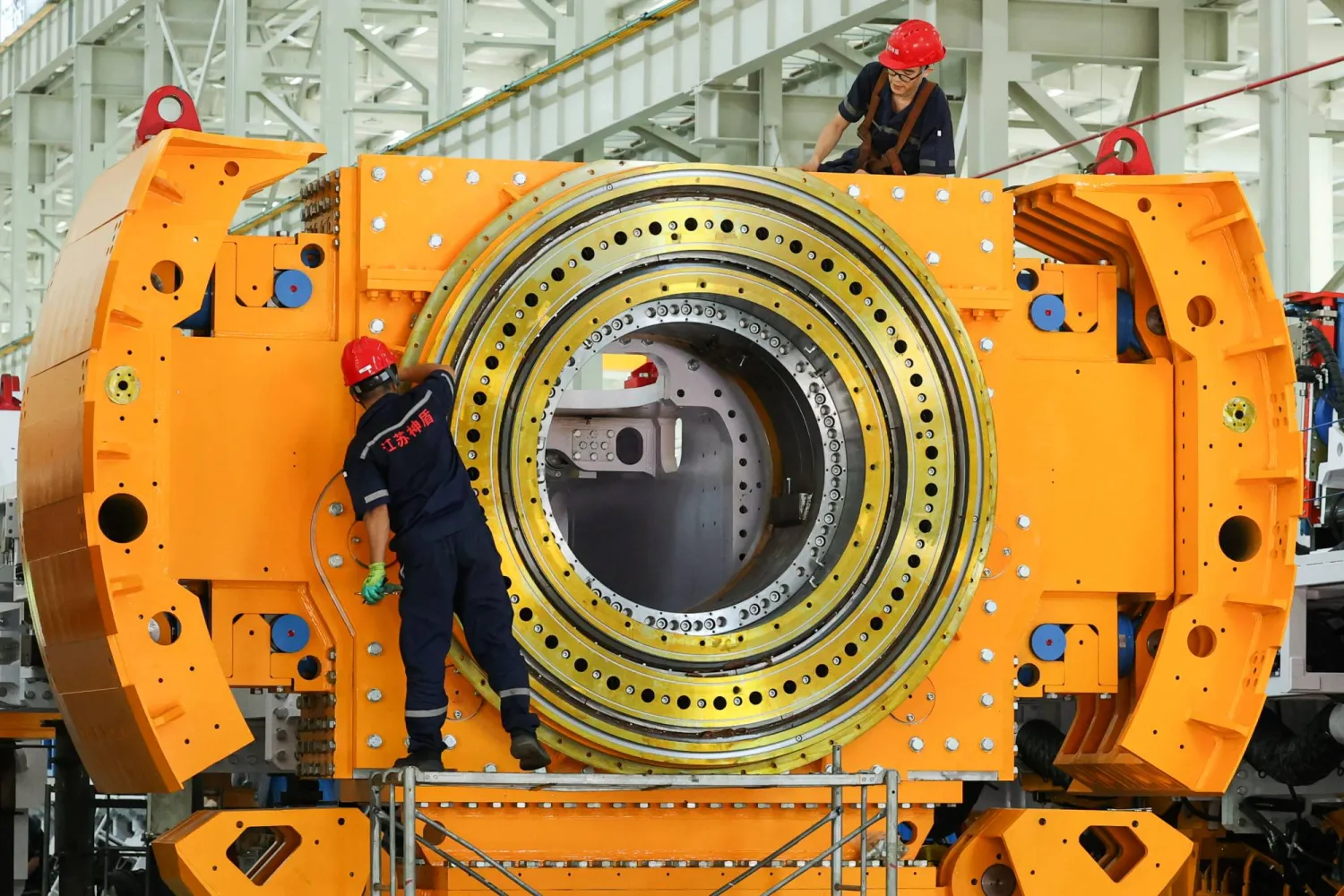
Workers install a tunnel‑boring machine at a factory in Jinhu county in eastern China's Jiangsu province on Aug. 25, 2026. (Chinatopix via AP)
TT

Chinese Factory Slump Eases, but Weak Services Signal Uneven Recovery

Workers install a tunnel‑boring machine at a factory in Jinhu county in eastern China's Jiangsu province on Aug. 25, 2026. (Chinatopix via AP)

China's factory activity improved in August on stronger demand but remained in contraction, while services activity stayed weak, underscoring deepening imbalances in the economy and fueling calls for policy measures to boost the economy.

The divergence between manufacturing and service sectors suggests that China will continue to rely on manufacturing and exports to drive growth as momentum remains under pressure from lackluster domestic consumption and investment.

The official manufacturing purchasing managers' index (PMI) picked up to 49.8 from 49.2 in July, remaining below the 50-mark separating growth from contraction, a survey by the National Bureau of Statistics showed on Monday. It beat the median forecast of 49.6 in a Reuters poll.

NBS data showed both demand and output improved in August, with sub-indexes ‌for new orders ‌and production returning to expansion territory above 50.

TOO EARLY TO PREDICT ECONOMIC ‌RECOVERY

"Domestic ⁠demand seems to ⁠be coming back, although it's more likely to have been driven by AI and exports than by policy expansion," said Xu Tianchen, senior economist at the Economist Intelligence Unit.

Zhiwei Zhang, president and chief economist at Pinpoint Asset Management, said it was too early to conclude the economy had rebounded.

The non-manufacturing purchasing managers' index (PMI), which covers services and construction, remained unchanged at 49.0, matching July's reading, the weakest since December 2022.

"Because China's services sector is primarily domestically focused, this suggests domestic demand remained relatively sluggish in August," Lynn Song, ING's Greater China chief economist, said in a note. "For ⁠now, the PMI data suggests that we are due for another month of ‌relatively sluggish domestic activity data in August, with any potential rebound ‌likely to be limited."

The August PMIs for equipment manufacturing and high-tech manufacturing both came in above 51, while consumer goods ‌and high-energy-consuming industries stayed in contraction, according to data released by the NBS.

Zhang Liqun, an analyst with the ‌China Federation of Logistics & Purchasing, said that with the manufacturing PMI reading still in contraction, business confidence remained unstable.

"Continued government investment in public goods should be strengthened to effectively drive increased orders for businesses, continuously consolidate and enhance business confidence, and further strengthen factors contributing to economic stabilization and recovery."

SIGNS OF PREVAILING WEAKNESS

Economic data released earlier this month showed that growth remained under ‌pressure at the start of the second half, with goods consumption and industrial output both slowing.

Fixed-asset investment extended declines and the property market is still ⁠struggling to find a ⁠bottom more than five years into a slump.

Exports remained a growth driver, helped by robust demand for AI-related shipments that lifted prices for Chinese-made high-tech goods, but the profit squeeze felt by manufacturers relying on domestic demand weighed on overall industrial profits.

China's top leaders pledged in late July to introduce additional policies to support the economy as growth slowed to a more-than-three-year low of 4.3% in the second quarter, and vowed to accelerate fiscal spending on already-budgeted infrastructure projects for the remainder of the year.

The finance ministry recently expanded loan interest subsidies for small private firms and consumers to spur demand, while the central bank said this month it would roll out measures without signaling explicit cuts to policy rates or banks' reserve-requirement ratio.

ING's Song said the positive impact from interest subsidies "may be relatively marginal," and expects more measures in the weeks ahead.

In a sign the government will not unveil large-scale stimulus, an article published this month in the People's Daily, the Communist Party's official newspaper, said China is not excessively reliant on strong policy stimulus and that it is capable of achieving its annual economic growth target.



Digital Spending Is Reshaping Saudi Consumer Habits

A woman shops at a retail and grocery center in Saudi Arabia (SPA)
TT

Digital Spending Is Reshaping Saudi Consumer Habits

A woman shops at a retail and grocery center in Saudi Arabia (SPA)

Saudi consumers are rapidly reducing their reliance on cash as digital payments expand across everyday sectors, from grocery shopping to entertainment and electronic gaming. The shift is being driven by a young population, widespread smartphone adoption, and increasingly advanced payments infrastructure.

Grocery shopping is emerging as one of the sectors benefiting most from this transformation. Digital spending in the sector grew by 18 percent over the past year, while spending on electronic gaming has surpassed global averages, pointing to the expanding reach of the digital economy and changing consumption patterns in the Kingdom.

The total value of digital transactions across the Gulf countries is expected to grow at an annual rate of 8.7 percent between 2024 and 2028, reaching $178 billion, according to Oxford Business Group (OBG). This growth comes amid wider adoption of digital wallets, money-transfer applications, and cashless payment methods.

Against this backdrop, Mohamed Nana, Mastercard's Senior Vice President for Digital Partnerships in Eastern Europe, the Middle East and Africa, told Asharq Al-Awsat that this growth is being driven by the digital transformation visions adopted by countries across the region.

He also pointed to the launch of Buna, the Arab regional payments system, which is fully owned by the Arab Monetary Fund and supported by Arab central banks. The system aims to reshape cross-border payments and strengthen economic integration both regionally and globally.

Nana said Mastercard has made its Mastercard Move money-transfer solutions available through Buna, in what he described as the first collaboration of its kind between the public and private sectors. In Saudi Arabia, he said, the company is focused on supporting the growth of the digital economy through technology, secure payments infrastructure, and local partnerships.

Saudi Consumers Expand Their Digital Payment Use

Nana said the adoption of a broader range of digital payment methods is accelerating in Saudi Arabia. In addition to becoming familiar with solutions such as digital wallets, money-transfer applications, biometric identification, and installment-payment services, consumers are becoming increasingly comfortable using them in their everyday lives.

They are also turning to more diverse ways of shopping, including through voice assistants and social media platforms.

He said the continuing shift away from cash is being driven by a young, tech-savvy population and widespread smartphone penetration. Speed, security, convenience, and a seamless payment experience are among the main factors encouraging consumers to adopt digital payments.

Maintaining this momentum, he added, requires giving consumers confidence in new payment methods through secure technologies and an interconnected digital payments ecosystem.

Grocery shopping stands out among the Saudi sectors that have experienced notable growth in digital payment use. The sector recorded annual growth of 18 percent over the past year, driven by the expansion of digital platforms, promotional pricing, delivery services, and integration with mobile devices.

Nana said the fashion and electronics sectors have also recorded strong performance, while digital spending on electronic gaming exceeds global averages. This reflects the strength of Saudi Arabia's esports economy, which is valued at $1 billion and is being developed under the National Gaming and Esports Strategy.

Local Infrastructure for Electronic Payment Processing

Alongside growing demand for digital payments, Mastercard is developing local infrastructure for processing electronic transactions in Saudi Arabia. Nana said the company, under the auspices of the Saudi Central Bank, SAMA, has launched technology infrastructure inside the Kingdom, powered by Mastercard Gateway, allowing e-commerce transactions to be processed locally.

He added that Mastercard Gateway has become part of Mastercard Merchant Solutions, a payments platform that brings together the company's services to help businesses manage their commerce operations. He noted that Mastercard received certification last December allowing it to process electronic transactions through SAMA's new e-commerce payment interface.

Artificial Intelligence

Nana said artificial intelligence has been a core part of Mastercard's ecosystem for nearly two decades. It helps make every digital experience more secure, intelligent, and personalized for consumers and businesses, while improving efficiency for customers and partners.

In Saudi Arabia, AI is a key component of the company's strategic collaboration with Riyadh Air, which aims to redefine the travel experience across multiple customer touchpoints. It is also central to the work of Mastercard's Cyber Resilience Center in Riyadh, strengthening its ability to detect and respond to sophisticated cyber threats and fraud attempts.

Data to Help Attract Visitors

Last August, the Saudi Tourism Authority and Mastercard signed a memorandum of understanding to cooperate in supporting the growth of the Kingdom's tourism sector and strengthening Saudi Arabia's position as a global tourism destination. The partnership involves campaigns and initiatives aimed at attracting international visitors from target markets, supporting the Kingdom's goal of receiving 150 million visitors by 2030.

Nana said the partnership with the Saudi Tourism Authority uses Mastercard data and insights to segment visitor groups, analyze spending, monitor travel trends, measure the impact of events, and conduct predictive analytics. These capabilities help inform marketing strategies and policy development.

He added that the company's goal is to design global campaigns and initiatives to attract international travelers from target markets, in conjunction with the Priceless platform, which promotes unique cultural experiences across the Kingdom.


UK Economic Growth Revised Up to 0.5 Percent in Q2

The British capital, London (Reuters)
TT

UK Economic Growth Revised Up to 0.5 Percent in Q2

The British capital, London (Reuters)

Britain's economy grew more than initially estimated in the second quarter, revised data showed Wednesday, offering a boost to Prime Minister Andy Burnham ahead of next month's annual budget update, AFP said.

Gross domestic product increased 0.5 percent in the April-June period, up from a first estimate of 0.4 percent, the Office for National Statistics said.

The figure still marked a slowdown from the 0.6 percent expansion recorded in the first quarter.

"Stronger services growth in the latest quarter means the economy is now slightly larger than previously estimated," ONS director of economic statistics Liz McKeown said in a statement.

Burnham, who has made easing the cost of living a key focus for his Labor government, has set the stage for difficult decisions to be made in the October 28 budget presentation.

With inflation rising and government bond yields reaching multi-decade highs this month, Finance Minister John Healey, who will unveil the budget, has pledged to maintain strict fiscal discipline.

"Growth has come in marginally better than initially expected, but it remains difficult to come by as households and businesses contend with high borrowing costs, inflationary pressures and a cooling labor market," said Richard Carter, head of fixed interest research at Quilter Cheviot.

He noted that since the second quarter, "the outlook has become more uncertain" following a recent surge in energy prices and borrowing costs.


Russia Extends Diesel Export Ban until End of October

FILE -Diesel prices are displayed at a gas station Thursday, Sept. 10, 2026, in Carlsbad, Calif. (AP Photo/Gregory Bull, File)
TT

Russia Extends Diesel Export Ban until End of October

FILE -Diesel prices are displayed at a gas station Thursday, Sept. 10, 2026, in Carlsbad, Calif. (AP Photo/Gregory Bull, File)

Russia has extended its ban on diesel exports for fuel producers until the end of October, the government said on Wednesday, adding further strain to a global energy market already rattled by ongoing conflicts and supply shortages.

Global fuel shortages and sharp price increases have been in focus, especially in ‌the United ‌States, where diesel prices ‌have shot ⁠to records over $6.50 ⁠a gallon as the wars in Iran and Ukraine constrain deliveries of fuel, a political risk for US President Donald Trump ahead of the midterm elections, Reuters reported.

The price of ⁠diesel at the pump in ‌the United ‌Kingdom has hit record highs due to the ‌US-Israeli war on Iran, motoring body ‌RAC said on Monday.

Russia has repeatedly imposed curbs on gasoline and diesel exports to rein in rising fuel prices and ‌tackle shortages triggered by Ukrainian drone attacks on oil refineries.

In ⁠late ⁠August, Moscow extended a ban on diesel exports until the end of September while allowing supplies to countries such as former Soviet republics and Mongolia under intergovernmental agreements.

Usually the world's second-largest exporter of diesel after the United States, Russia had already reduced its exports in summer before imposing the overseas supply.