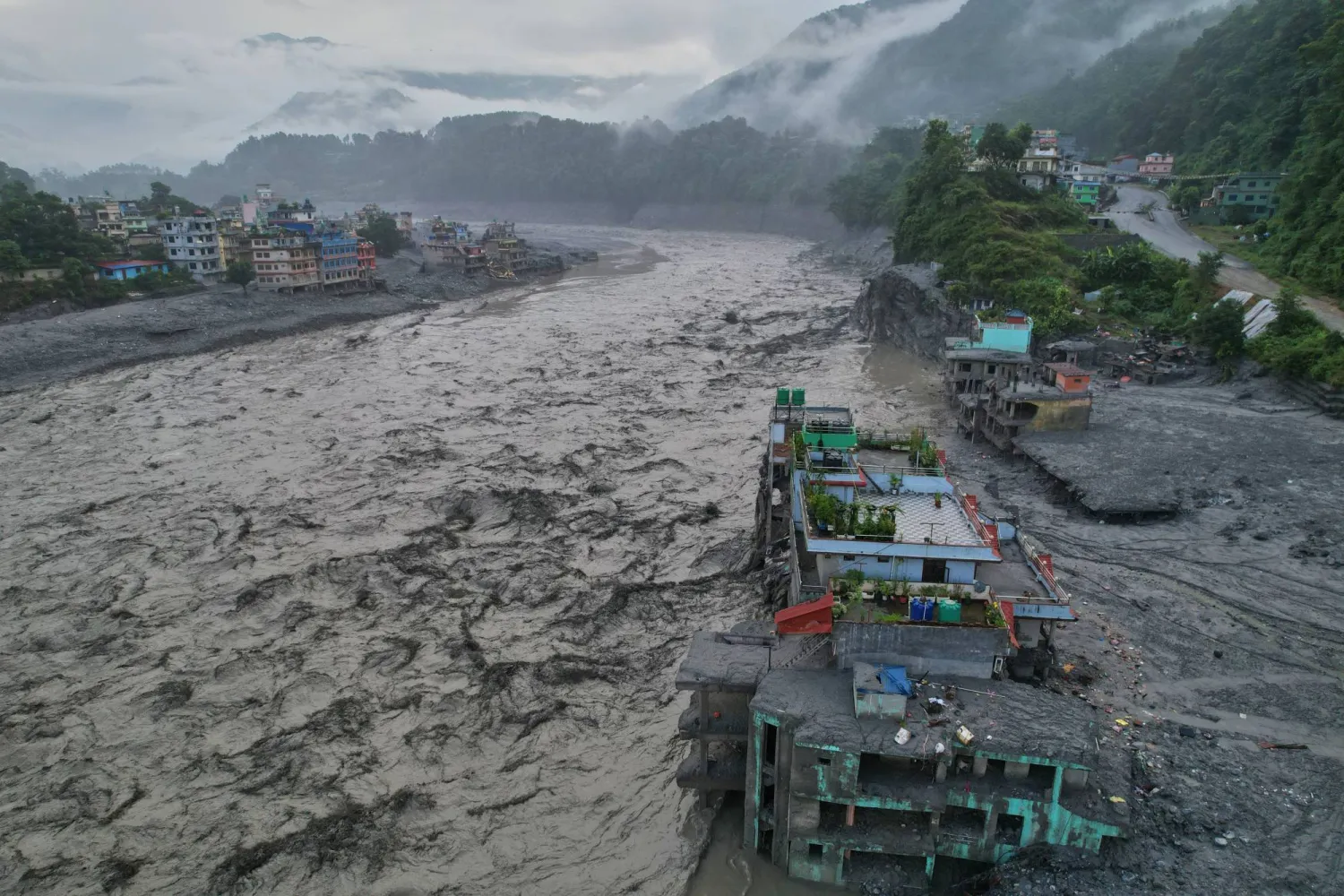
Nepal PM Says Nation Facing ‘Unimaginable’ Disaster

A drone view of the aftermath of flash flooding along the Trishuli river amidst fresh water surge warning in the Trishuli Bazaar area of Nuwakot district, Nepal, Sunday, Aug. 30, 2026. (AP)
TT

Nepal PM Says Nation Facing ‘Unimaginable’ Disaster

A drone view of the aftermath of flash flooding along the Trishuli river amidst fresh water surge warning in the Trishuli Bazaar area of Nuwakot district, Nepal, Sunday, Aug. 30, 2026. (AP)

Nepal is facing an "unimaginable and heartbreaking" disaster with authorities struggling to assess the full scale of devastating floods that have killed hundreds, Prime Minister Balendra Shah has said.

The huge wave of ice, rocks and debris that smashed into villages and towns on Wednesday has claimed at least 797 lives in both Nepal and Tibet, across the border in China.

"Our country has been facing an unimaginable and heartbreaking natural disaster," Shah said in a social media post late Sunday.

"The devastating floods in the Bhote Koshi River in Rasuwa have made it extremely difficult to collect a complete account of the loss of life, property, and infrastructure," he added.

"Although this task remains challenging due to adverse weather, difficult terrain, and ongoing risks, we are moving forward with determination to protect the lives of the citizens."

At least 3,048 people remain missing, including many tourists and pilgrims to Tibet's Mount Kailash.

Shah, a 36-year-old rapper-turned-politician widely known as "Balen", faces the enormous task of rebuilding communities and critical infrastructure.

Nepal's economy is already under pressure, with limited resources to respond to a disaster of this scale.

The disaster came ahead of the anniversary of last year's September 8-9 mass anti-corruption protests that toppled the previous government.

Shah's party swept elections in March on a wave of euphoria calling for change.

"We will succeed in overcoming this crisis through our unity and collective efforts," he said of the floods.


US Military Leaders Warn Against Prolonging Iran Operations

US Defense Secretary Pete Hegseth speaks during a ceremony to honor Marines who served at Abbey Gate at Hamid Karzai International Airport in Kabul during the August 26, 2021, suicide bombing that killed 13 US service members and roughly 170 Afghan civilians during the US military evacuation from Afghanistan, at the Pentagon in Washington, DC, US, August 26, 2026. (Reuters)
TT

US Military Leaders Warn Against Prolonging Iran Operations

US Defense Secretary Pete Hegseth speaks during a ceremony to honor Marines who served at Abbey Gate at Hamid Karzai International Airport in Kabul during the August 26, 2021, suicide bombing that killed 13 US service members and roughly 170 Afghan civilians during the US military evacuation from Afghanistan, at the Pentagon in Washington, DC, US, August 26, 2026. (Reuters)

Several US military leaders have advised Defense Secretary Pete Hegseth that prolonging large-scale operations against Iran is unsustainable and risks weakening their ability to confront threats elsewhere, including the US homeland, The Washington Post reported on Sunday citing people familiar with a recent assessment prepared for the Pentagon chief.

The warnings appeared in the August 14 edition of the Secretary of Defense Orders Book (SDOB), which is typically produced twice monthly to outline the worldwide availability of American warships, aircraft, personnel and weapons systems.

The warnings were detailed for Hegseth by the heads of the Army, Navy and Air Force and the four-state commanders overseeing US operations throughout Europe, Asia and Latin America, the people familiar with the assessment said.

One official familiar with the assessment described the overall message from the military leadership, which comes about six months of fighting with Iran, as “too much, for too long.”

US Central Command, the headquarters responsible for prosecuting the Iran war, has kept a force of more than 50,000 troops on alert for months in case US President Donald Trump orders additional attacks, according to the newspaper.

The orders book reportedly stated some US troops deployed in the Middle East to remain there through September, while others would remain in the region until 2027, sources familiar with the matter said.

The prospect of extending those forces further compelled military leaders to voice their concern, the sources noted.

Objections

The Post reported that the navy’s top admiral, along with the leaders from America’s European Command, Pacific Command, and the Southern Command, responded with “non-concur,” which means that they do not agree with Hegseth’s order, but will execute it regardless.

It was noted that the geographic combatant commands overseeing American operations in Europe, Asia and Latin America have had their ships, aircraft and other equipment pulled away to support the Iran conflict.

This has limited their ability to conduct missions and ensure proper training, those familiar with the assessment said.

When the Army and Air Force leadership concurred with Hegseth’s desire to extend their deployed forces, each emphasized that doing so would come with significant risk, these people said.

Admiral Samuel Paparo, the chief of Pacific Command, objected to continually supplying an aircraft carrier strike group and destroyers to the fight against Iran.

He disagreed with the level of support he was ordered to continually provide, including an aircraft carrier strike group and naval destroyers.

Ammunition shortages

Meanwhile, Admiral Daryl Caudle, the chief of Naval Operations, provided Hegseth with the dimmest picture, saying in the SDOB that the Navy cannot sustain its current pace without a defined end date and that only about one-quarter of the destroyer fleet is ready to deploy, a sharp drop from prewar levels, those familiar with the assessment said.

According to the assessment, if demands on the Navy remain at the same level, the impact on ship maintenance could jeopardize fleet availability in the event another conflict breaks out elsewhere in the world.

The Navy has been required to provide dozens of vessels for the campaign: initially for US strikes and defense against Iranian counterattacks, and later to enforce Trump’s blockade of Iranian ports as part of efforts to force Tehran to reopen the Strait of Hormuz. As a result, the deployments of several ships and their crews have been extended by months.

The aircraft carrier USS George Washington, permanently based in Japan and a central element in deterring China, was moved to the Middle East to replace the USS Abraham Lincoln, which has been on an extended deployment since November and is expected to complete more than 300 days at sea before returning to base.

The heads of the Army and Air Force did not oppose the deployment extensions requested by Hegseth, but they too warned of the risks involved.

About 2,000 soldiers from the 82nd Airborne Division, rushed to the region in March following the outbreak of the war, are expected to remain in the Middle East at least through September, and the Army assesses that their mission could be extended even further.

The division is considered a key force in the event of a US ground operation in Iran.

On the other hands, deployments for Army Patriot air-defense crews, whose interceptors have been depleted by the Iran war and previous transfers to Ukraine, are also slated to be extended.

Units operating Patriot air defense systems also are expected to remain in the region beyond the original plan. Interceptor stockpiles for the systems were depleted during the war, after interceptors had already been transferred to Ukraine, and the shortage is limiting the Trump administration’s ability to escalate the fighting again because Iran still retains the capability to strike US bases across the Middle East.

The war has also depleted stocks of THAAD interceptors and long-range Tomahawk cruise missiles.

According to The Washington Post, about 25% of the Pentagon’s Reaper drone fleet was lost during the fighting, while US bases in the region sustained billions of dollars in damage.

The Trump administration, for its part, says reports of ammunition shortages are inaccurate.

Tensions inside the Pentagon over the continuation of the campaign are not new. Even before the fighting began, Joint Chiefs of Staff Chairman General Dan Caine warned the White House that the United States did not have enough munitions — or enough support from its allies — to wage a large-scale, prolonged campaign.

This month it was also reported that European Command chief General Alexus Grynkewich warned the Pentagon that he did not have enough naval forces to defend Israel and the United States simultaneously against missile attacks.


Trump Says Iran's Kharg is Being 'Blown to Smithereens', But Gives No Details

FILE PHOTO: A satellite image shows an oil terminal at Kharg Island, Iran, February 25, 2026. 2026 Planet Labs PBC/Handout via REUTERS
TT

Trump Says Iran's Kharg is Being 'Blown to Smithereens', But Gives No Details

FILE PHOTO: A satellite image shows an oil terminal at Kharg Island, Iran, February 25, 2026. 2026 Planet Labs PBC/Handout via REUTERS

Iran's energy hub of Kharg Island is being blown to smithereens, US President Donald Trump said on Sunday in a one-line social media post accompanied by an AI-generated video clip.

There was no other evidence that the Iranian energy hub was under attack. The White House and the US Defense Department did not immediately respond to Reuters requests for comment outside regular business hours.

There was no immediate response to Trump's post on Iranian media.

"Kharg Island being blown to smithereens!!! President DJT," Trump said on social media, but gave no further details.

Reuters confirmed that an accompanying video clip showing dramatic explosions was most likely synthetically-generated, using software that detects AI-manipulated imagery.

Attacking Kharg, which handled 90% of Iran's oil exports before the war launched by US and Israeli attacks on February 28, would severely disrupt its energy trade and put huge pressure on its economy.

Iran responded to an earlier US ‌attack on rocket launchers on ‌its island of Larak, about 660 km (410 miles) east of Kharg, with an assault ‌on two ⁠US bases in ⁠Jordan, Iranian media said.

The return to hostilities followed weeks in which the Trump administration has stepped up efforts to punish Tehran and its business partners with costly economic sanctions, shifting away from military options.

US Treasury Secretary Scott Bessent told Reuters on Sunday new secondary sanctions were likely to be unveiled weekly in the effort to pressure Iran, with an initial focus on banks.

"We're starting with the banks, and we're telling the banks it's not okay to have Iranian money and to aid the regime," Bessent said in an interview.

After imposing penalties on the United Arab Emirates branches of Egypt's Banque Misr on Friday over alleged financial links to Iran, Bessent said the next step ⁠may be cutting off an institution entirely from the dollar-based financial system.

"You're going to see a ‌lot more of these every week," Bessent told Reuters, ahead of a meeting ‌of Group of 20 finance leaders.


Bessent Expects New US Secondary Sanctions Weekly, Aiming to Increase Pressure on Iran

 US Treasury Secretary Scott Bessent speaks during an interview with The Associated Press in Asheville, NC, Sunday, Aug. 30, 2026. (AP)
US Treasury Secretary Scott Bessent speaks during an interview with The Associated Press in Asheville, NC, Sunday, Aug. 30, 2026. (AP)
TT

Bessent Expects New US Secondary Sanctions Weekly, Aiming to Increase Pressure on Iran

 US Treasury Secretary Scott Bessent speaks during an interview with The Associated Press in Asheville, NC, Sunday, Aug. 30, 2026. (AP)
US Treasury Secretary Scott Bessent speaks during an interview with The Associated Press in Asheville, NC, Sunday, Aug. 30, 2026. (AP)

The US Treasury Department is likely to unveil weekly new secondary sanctions aimed at increasing economic pressure on Iran, with an initial focus on banks, US Treasury Secretary Scott Bessent told Reuters on Sunday.

After imposing penalties on the United Arab Emirates branches of Egypt's Banque Misr on Friday over ‌alleged financial links ‌to Iran, Bessent said ‌in ⁠an interview that the ⁠next step may be cutting off an institution entirely from the dollar-based financial system.

"You're going to see a lot more of these every week," Bessent said ahead of a Group of 20 finance leaders meeting. "We're ⁠starting with the banks, and ‌we're telling the ‌banks it's not okay to have Iranian money and ‌to aid the regime."

Bessent said he ‌intends to drive the message home to G20 finance ministers and central bank governors to cut economic ties to Iran, or face secondary sanctions. ‌The Treasury launched the effort, dubbed Operation Economic Outcast, last week.

"There can ⁠be ⁠no leakage," Bessent said. "You're either with us or you're with the Iranians."

However, he said that he disagreed with some critics who have said that Iran sanctions will not be successful without targeting Chinese companies for secondary sanctions.

Most of China's Iran oil purchases have been curbed by the US blockade of Iranian ports, and the amount of Iranian oil stored in tankers is dwindling, he said, adding: "Problem solved."