



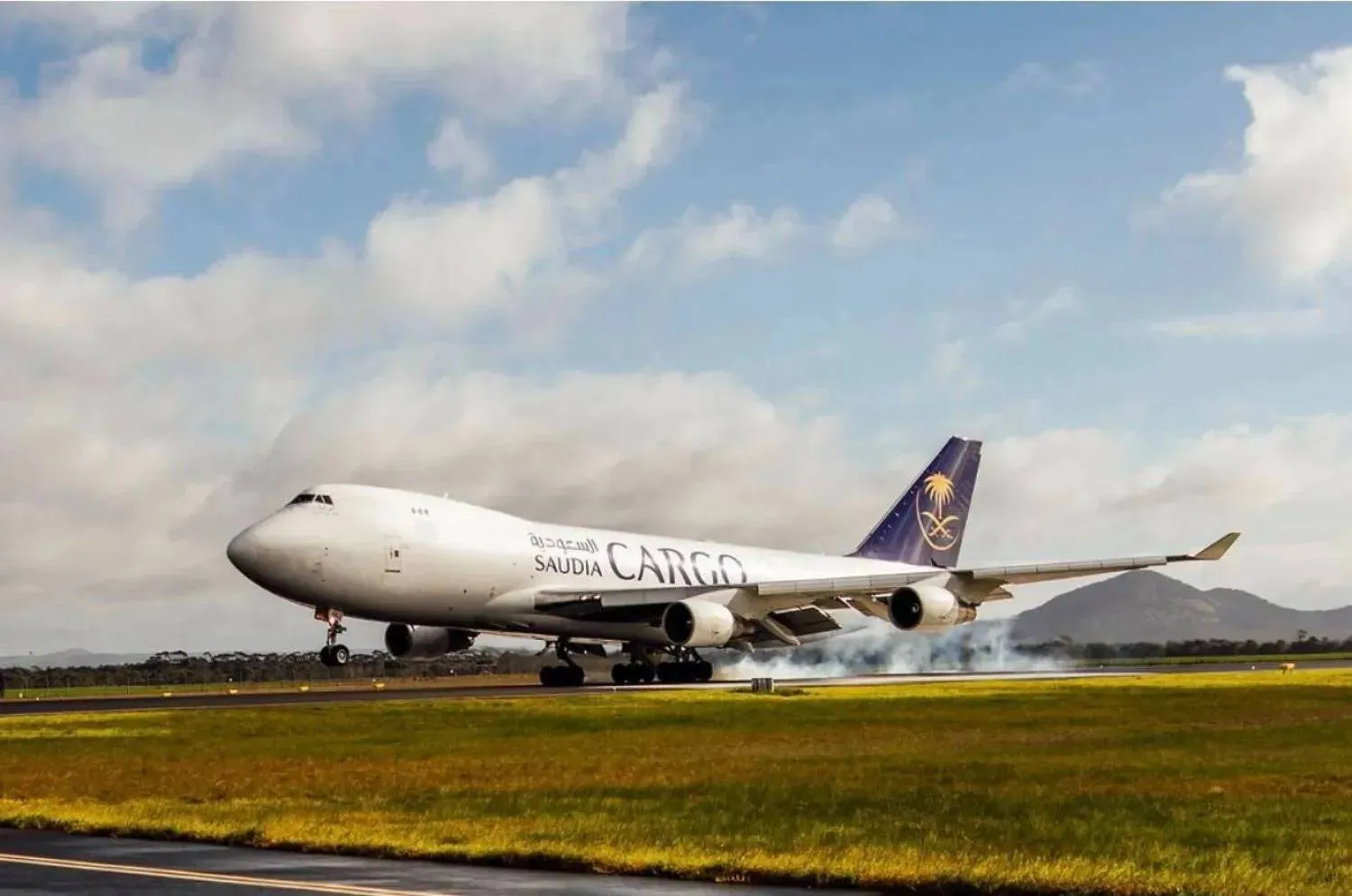

Saudi Arabia’s air cargo industry is undergoing a technology-led structural shift to make global supply chains more efficient.
At the center of that shift, Saudia Cargo is entering a new phase of operational and technological expansion built on artificial intelligence and a doubling of its fleet, supporting the kingdom’s ambition to become a global logistics hub linking three continents by 2030.
Artificial intelligence and digital technologies are now embedded in the company’s operations, rather than used merely as supporting tools, Saudia Cargo Vice President of Shared Services Hisham Mallakah told Asharq Al-Awsat in an exclusive interview on the sidelines of the LEAP 2026 technology conference.
The company uses algorithms to forecast demand, manage capacity and optimize cargo weight and load distribution, Mallakah said. It also deploys sensors to monitor the temperature of sensitive shipments and tools to automate operations.
Saudia Cargo’s drive to automate operations and forecast demand mirrors the global air freight industry’s shift toward smart logistics.
According to reports by the International Air Transport Association (IATA), using artificial intelligence and algorithms to manage cargo loads and cold chains cuts operating costs by more than 15% and improves delivery-time accuracy amid volatility in global e-commerce markets.
Saudia Cargo is Saudi Arabia’s national carrier for air freight, cargo transportation and logistics solutions. It is part of the Saudia Group.
Technology partnerships
Mallakah said Saudia Cargo was participating in LEAP to keep pace with technological advances and explore opportunities for cooperation, particularly in artificial intelligence and cloud computing.
The conference allows the company to examine new technologies, exchange expertise with industry leaders and explore future partnerships to develop solutions that are more flexible and responsive to market shifts.
Doubling the cargo fleet
Saudia Cargo is preparing to add four Boeing 777-200F aircraft to its fleet, doubling its size over more than two years.
The Boeing 777-200F is a preferred choice among global air cargo operators for long-haul flights, with a range of about 9,200 kilometers at full payload.
The fleet expansion comes as global demand for transporting high-value and temperature-sensitive goods, such as semiconductors and pharmaceuticals, is growing by more than 7% annually.
Mallakah said the new aircraft would strengthen the company’s ability to transport heavy and temperature-sensitive cargo nonstop over long distances. Their fuel efficiency would also improve performance while reducing costs and emissions.
The aircraft would support expansion into high-yield markets and help the company capitalize on rising demand for express freight and e-commerce, particularly between China, the rest of Asia, Europe and North America, as well as in the pharmaceutical and perishable-goods sectors.
The Riyadh-Melbourne route links continents
Saudia Cargo has also launched a new route between Riyadh and Melbourne, tapping Australia’s importance as a source of fresh produce, meat, dairy products and pharmaceuticals.
The direct service will expedite the transport of those goods to markets in the Middle East and Europe while supporting Saudi exports to Oceania.
The Riyadh-Melbourne route carries particular strategic importance. Australia is one of the largest exporters of meat and fresh food products to Oceania and the Middle East, while the pharmaceutical industry depends on fast and reliable supply chains.
The direct connection will shorten transit times and reduce losses involving perishable cargo compared with indirect routes.
Mallakah identified further growth opportunities in East and Southeast Asia, particularly China, Vietnam and Indonesia, driven by e-commerce.
The company is also targeting the African market to strengthen Saudi Arabia’s role as a logistics corridor between Asia and Africa. Its expansion plans extend to Central and Eastern Europe.
Supporting Saudi Arabia’s logistics transformation
The company’s expansion aligns with the National Transport and Logistics Strategy, which aims to raise Saudi Arabia’s annual air cargo capacity to 4.5 million tonnes by 2030.
The kingdom is seeking to cement its position as a global logistics hub connecting continents, capitalizing on its geographic location and its expanding role in trade and supply chains.
It is also working to strengthen technology, aviation and logistics as pillars of economic diversification and sustainable growth.


