


Hamas Shocked by Al-Arabeed’s Abduction as Israel Eyes ‘Intelligence Trove’

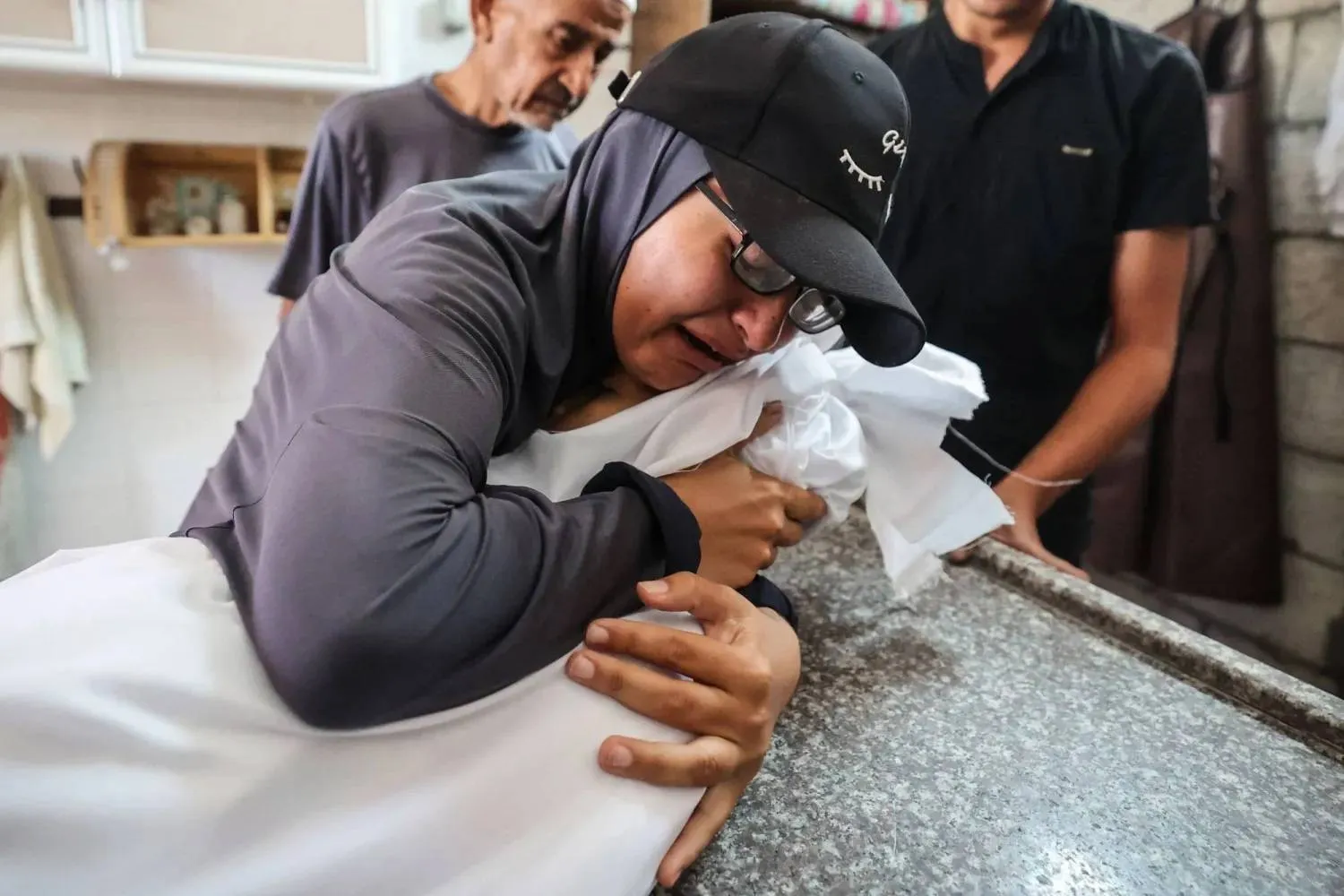
A Palestinian bids farewell to her sister, Israa al-Hassi, 7, after she was killed by Israeli military fire in central Gaza on Tuesday (AFP)
TT

Hamas Shocked by Al-Arabeed’s Abduction as Israel Eyes ‘Intelligence Trove’

A Palestinian bids farewell to her sister, Israa al-Hassi, 7, after she was killed by Israeli military fire in central Gaza on Tuesday (AFP)

Hamas security bodies were reeling after a swift Israeli operation shortly before noon on Tuesday seized Moin Al-Arabeed, a senior security official in the movement and its government, and took him into Israel.

Israeli reports said interrogating Al-Arabeed could yield an “intelligence trove.”

A day after the raid, Israeli Prime Minister Benjamin Netanyahu visited Israeli troops in Gaza and said Israel would not withdraw from the Palestinian enclave.

“We control the area. We will not retreat. We will remain on this line,” Netanyahu said from the “Yellow Line,” which separates areas held by Israeli forces from those administered by Hamas.

The raid, carried out by a Shin Bet force, nearly unraveled when Al-Arabeed, members of his family — including his wife and daughter — and his bodyguards exchanged fire with the Israelis in an attempt to thwart it.

The operation took place in a residential block known as the Villas in Gaza City’s Al-Katiba district, an area considered safe. Sources told Asharq Al-Awsat that the headquarters of Gaza’s Internal Security Service, which Al-Arabeed headed, was no more than 250 meters from the scene.

The neighborhood also houses many displaced people and armed Palestinian families. Some of those weapons were used days earlier in a major dispute in which gunfire continued for hours and at least one person was killed.

Hamas sources in Gaza told Asharq Al-Awsat that a broad committee had been formed to investigate the raid and determine how the Israeli force entered the area.

Investigators collected videos recorded by residents and displaced people nearby, as well as security-camera footage from homes and apartment buildings, to reconstruct each stage of the operation, the sources said.

What happened during the raid?

Two security sources told Asharq Al-Awsat that Al-Arabeed was leaving his home with a bodyguard when the Israeli special force opened fire on them. His wife then spotted the raiders.

“His wife, who was killed in the attack, opened fire at the Israeli force,” one source said. “Two of her sons then joined the exchange of fire and tried to give their father a chance to withdraw despite his leg injury. Both were seriously wounded.”

A second security source said surveillance footage and witness accounts showed the force pursuing and wounding Al-Arabeed before seizing him and taking him out of Gaza City toward Israeli-controlled territory.

Warplanes and drones flew intensively overhead to cover the force’s withdrawal, the source said.

A source from a Palestinian faction said one of Al-Arabeed’s sons, who married four months ago, had an eye removed after being struck directly in it. His other son, who had been due to sign his marriage contract on Tuesday, was seriously wounded.

Their sister suffered moderate injuries, while their mother was shot directly in the head during the exchange of fire, the source said.

At least two bodyguards who were in the house’s rear courtyard also were wounded after engaging the Israeli force.

Drones fired more than five missiles, while small quadcopters dropped more than 14 bombs in and around the area to create a diversion and protect the force, the source said.

A video recorded by residents showed a wounded Al-Arabeed crawling and apparently trying to escape. The vehicle carrying the special force reached him, and he opened fire toward it. The Israelis returned fire and threw a bomb toward him before seizing him.

Israel hails an ‘intelligence trove’

Israeli officials celebrated the raid, with Netanyahu praising it on Tuesday evening and alleging that Al-Arabeed was behind the holding of Israeli hostages and efforts to rebuild Hamas’s capabilities in Gaza.

A senior Hamas source denied to Asharq Al-Awsat that Al-Arabeed had played any role in matters involving the Israelis held by the movement during the war.

Nitzan Shapira, military correspondent for Israel’s Channel 12, said information Al-Arabeed might disclose during questioning could be an “intelligence trove” for Israel.

Channel 12 said Al-Arabeed was in good condition after receiving treatment at an Israeli hospital and had begun undergoing questioning. Israeli security officials believe his senior Hamas role could make him a valuable source of information, it said.

The channel said the Shin Bet carried out the operation alone and that none of the armed gangs in Gaza took part.

The Shin Bet had tracked Al-Arabeed for a long time before obtaining what the channel called “golden intelligence” and finding the right opportunity to arrest him.

The operation was conducted under intense secrecy, and officials planned to conceal its details. But reports from Palestinian sources about the nature of the attack forced the security agencies to disclose them, Channel 12 said.

Field sources told Asharq Al-Awsat on Tuesday that the Israeli force may have been in the area for at least two days before the raid.

Israel’s Kan public broadcaster said the Shin Bet had located Al-Arabeed several weeks earlier. Israel considered killing him in an airstrike but concluded that a special operation could bring him to Israel for questioning.

The raid was planned over several months and directed from the Shin Bet’s special operations room, Kan said.

Citing sources, the broadcaster said Israel decided to take Al-Arabeed alive because of his role in rebuilding Hamas and because he was among those obstructing efforts to dismantle and disarm the movement.

The operation was coordinated with the Americans and approved by Netanyahu and Israeli Defense Minister Israel Katz, according to the report.

Intelligence was not the only objective

Israeli sources told Channel 12 that the raid was intended not only to gather intelligence but also to make senior Hamas leaders feel hunted, even during a period of relative calm in Gaza.

Israel’s Maariv newspaper said the operation had made Hamas realize that its leaders were exposed to Israeli intelligence and that Israel could reach every home and tunnel.

An Israeli security official told the newspaper that Al-Arabeed’s position was comparable to that of brothers Mohammed and Yahya Sinwar, who controlled Hamas’s military wing.

An informed Hamas source rejected that account but told Asharq Al-Awsat that Al-Arabeed was not merely an ordinary officer or security official.

Maariv cited sources describing the raid as strategic. Israel could have killed Al-Arabeed from the air, as it had done with others, but chose to seize him for the information he could provide.

The operation was likely to produce results depending on that information, the newspaper said.

Haaretz said Al-Arabeed’s capture was highly valuable from Israel’s perspective. His interrogation could reveal, for example, what Hamas knows about the network of agents Israel currently operates in Gaza.

The newspaper linked the issue to lessons from the Oct. 7, 2023, attacks, saying investigations found that agents had conducted very little operational activity before the war.

Haaretz said Hamas was likely to take steps to limit the intelligence damage caused by Al-Arabeed’s capture.

Hamas sources told Asharq Al-Awsat on Tuesday that Al-Arabeed was responsible for files involving suspected collaborators with Israel.

He also handled several sensitive security matters, including the arrest of ISIS loyalists and others, and oversaw investigations into armed gangs.



Sudanese Army Continues Military Buildup in Blue Nile

Sudanese Army Commander-in-Chief Abdel Fattah al-Burhan attends an event in Khartoum on Aug. 15 marking the anniversary of the army’s founding (AFP)
TT

Sudanese Army Continues Military Buildup in Blue Nile

Sudanese Army Commander-in-Chief Abdel Fattah al-Burhan attends an event in Khartoum on Aug. 15 marking the anniversary of the army’s founding (AFP)

Sudanese Army Chief of Staff Gen. Yasser al-Atta said the armed forces plan in the coming phase is to deploy troops continuously to the battlefronts, signaling an intensification of military operations in Darfur, Kordofan and Blue Nile.

During an inspection of special forces at a frontline position in Khartoum on Tuesday, al-Atta strongly criticized the Rapid Support Forces (RSF), accusing them of systematically committing killings, ethnic cleansing and genocide on ethnic and tribal grounds, according to an army statement.

The chief of staff ordered the continuous deployment of all troop contingents to reinforce forces already positioned in operational areas toward Darfur in western Sudan.

“They killed and exterminated our brothers in El Geneina, North Darfur and villages in Al Jazira in central Sudan, and they continue to this day to kill civilians in West Kordofan,” he stated.

Al-Atta also accused the RSF of exploiting traditional administration leaders, including tribal chiefs and mayors, to recruit children and send them into battle under the pretext of protecting women from killing and rape. He stressed that the Sudanese Army is “a national and professional force that does not fight civilians.”

“We reassure our people in Darfur that we are coming to protect them from the violations of the rebel and lawless RSF, so that they can enjoy security and stability like the states that have been cleared of the rebellion,” he said.

Al-Atta had earlier vowed to eliminate the RSF before the end of this year.

Blue Nile

Last month, the Sudanese Army recaptured several strategic areas in North Kordofan, including the towns of Bara, Jabra al-Sheikh, Umm Sayala and Umm Qirfa, while the RSF retreated to positions it continued to control in West Kordofan state.

The army chief’s remarks came as the RSF continued to strengthen its control over strategic positions in the Blue Nile region of southeastern Sudan after seizing the areas of Bakori and Sarkam in recent days.

At the same time, the Sudanese Army has continued to amass additional troops and military equipment to halt the RSF advance in Blue Nile.

The 4th Infantry Division, headquartered in Damazin, the regional capital, on Tuesday received the first contingent of the Joint Force comprising armed movements that support the army. The troops are to join elite forces deployed in recent days to frontlines around Bakori and Sarkam.

The division’s commander, Maj. Gen. Ismail al-Tayeb, said the forces were fully prepared to continue their operations in the region, adding that “the rebellion is suffering successive and painful blows on various battlefronts.”

Humanitarian Situation

Separately, the UN Office for the Coordination of Humanitarian Affairs (OCHA) said humanitarian organizations continue to provide lifesaving assistance in Sudan despite the ongoing conflicts and funding shortages.

The International Organization for Migration, for its part, revealed that 730 people fled several villages in South Kordofan on Sunday.

According to the World Health Organization, more than 2,600 cholera cases had been reported across several states through early August, with Kordofan at the center of the latest outbreak.

UN spokesman Stephane Dujarric said Tuesday that the United Nations and its partners were stepping up efforts to combat cholera, as health workers continued to provide treatment, conduct vaccination campaigns and distribute essential medical supplies.

He added that humanitarian organizations were expanding efforts to provide clean water in Kordofan, where a water network rehabilitated with UNICEF support in Abu Jubeiha provides safe water to about 25,000 people a day, including 5,000 displaced people.


Public Anger, Lawsuits Mount Against Badr Chief Hadi al-Amiri in Iraq

A protest in Iraq in October 2019 (File photo)
TT

Public Anger, Lawsuits Mount Against Badr Chief Hadi al-Amiri in Iraq

A protest in Iraq in October 2019 (File photo)

Public anger and criticism are mounting against Badr Organization chief Hadi al-Amiri after he acknowledged the involvement of what he called the “resistance” in events surrounding Iraq’s October 2019 protest movement.

The movement lasted nearly two years, leaving more than 600 demonstrators dead and over 20,000 wounded.

Many families of the victims said they planned to sue al-Amiri over his latest “admissions.”

“The resistance courageously stood against the Tishreen sedition and preserved the state and the political system,” al-Amiri said last Monday.

Most activists and observers saw the remarks as “an explicit admission that armed factions describing themselves as the ‘resistance’ were implicated in the bloodshed of demonstrators and protesters.”

Iraqi authorities formed numerous committees over the past several years to investigate the protests and the events surrounding them. But they announced no significant findings despite the high death and injury toll.

That reinforced a widespread belief that “armed factions feared by the authorities were involved in massacres of protesters.”

In September 2020, the office of Iraq’s top Shi’ite cleric, Ali al-Sistani, called on the authorities to “work with utmost seriousness to uncover everyone who committed criminal acts — including killing, wounding or otherwise — against demonstrators, security forces or innocent citizens.”

The authorities did not respond. Instead, they suggested a “third party” was behind the killings and other violence that accompanied the protest movement.

Hussein al-Gharabi, head of the National Home Party, which emerged from the Tishreen movement, said in a Facebook post: “Al-Amiri is publicly admitting that the third party in Tishreen was the resistance.”

He called al-Amiri’s statement “extremely dangerous” and said it contradicted the position of the religious authority, which called the Tishreen youth “the beloved” and described the blood of those killed as pure.

“Yet he comes forward and admits that the force that suppressed the ‘Tishreen sedition’ — as he unjustly and maliciously calls it — was the resistance’s weapons,” al-Gharabi said.

“Who gives him this advice and these hurtful words that divide the people?” he asked.

“How has he turned the resistance, which many Iraqis view through a patriotic lens, into a force that restrains the people’s aspirations and suppresses their legitimate demands — even burdening it with responsibility for the blood spilled during Tishreen?”

Sheikh Aws al-Khafaji, a former commander of the Abu al-Fadl al-Abbas faction, also lashed out at al-Amiri.

“God reveals the truth, even after a time,” al-Khafaji said in a television interview. “The blood shed in Tishreen carries a reckoning — the consequence of injustice. That reckoning has emerged in several stages and at many levels, including this moment when the leader of an Iraqi faction admits that he and his faction took part in killing hundreds of Iraqi youths.”

“I hope this declaration is used to submit a statement and a complaint to Iraq’s public prosecutor over his responsibility for this bloodshed,” he added, referring to al-Amiri.

Rights groups and political figures issued a stream of statements over the next two days rejecting al-Amiri’s remarks.

Al-Amiri and his organization are close allies of Iran and fought alongside it in its 1980-1988 war against Iraq.

The Nazil Akhudh Haqqi Democratic Movement, which emerged from the Tishreen movement, said: “At a time when state institutions are working to entrench the rule of law, combat corruption and address challenges, some political parties are issuing irresponsible statements describing Tishreen as a ‘sedition.’”

“Tishreen was and remains an honest expression of Iraqis’ concerns and their aspirations for reform and change,” it added. “Its young people shed their pure blood in defense of their freedom, while questions remain over the parties that targeted them.”

Ali al-Abadi, head of the Iraq Center for Human Rights, called on the Supreme Judicial Council and other relevant authorities to “address the Tishreen events and open a serious and transparent investigation that identifies those responsible for the violations in accordance with the law.”

“Al-Amiri’s statements require serious judicial scrutiny, away from political calculations,” he said.

Al-Abadi also urged international organizations, the United Nations and the International Criminal Court to follow the case “to ensure that those involved in violations do not escape accountability and justice.”

What ‘resistance’?

Writer and analyst Falah al-Mashaal said in a post on X that “the revolutionaries of the Tishreen uprising represent the conscious and courageous vanguard expressing the broad, national popular rejection of the quota-based system and the departure from the constitution, rights and justice.”

“Are these people to be killed in the name of the ‘resistance’ to preserve a system of thieves ... who violated the country, plundered its wealth and impoverished its people?” he asked.

“What kind of ‘resistance’ defends the most corrupt political system in history? Is it conceivable that revolutionaries should be killed for seeking to reclaim their country from the gangs of political parties and corrupt officials?”

Analyst and writer Yahya al-Kubaisi said on X that al-Amiri’s comments about those who killed Tishreen protesters were “not a slip of the tongue or a belated admission.”

Rather, he said, they were “a veiled threat that the militias will confront any future protest with the same machinery of death and will escape punishment, as usual.”

Former lawmaker Sajjad Salim said in a similar post: “Hadi al-Amiri has confirmed what everyone knows and what the resistance denies — and what led to us being inundated with lawsuits that pursue me today wherever there is a court in Iraq.”

“Al-Amiri confessed as though delivering the confession of a victor,” he added. “He confessed as thousands of young people from southern Iraq left the country after the resistance turned it into hell for them and their families.”

Complaint filed with the public prosecutor

Lawyer Hazem Mazen al-Badri filed a formal complaint with the public prosecutor in Wasit province on Wednesday, seeking legal proceedings and al-Amiri’s summons over his remarks about the “Tishreen sedition.”

According to the complaint, al-Badri cited a widely circulated video in which al-Amiri is heard saying: “The resistance courageously stood against the Tishreen sedition and preserved the state and the political system.”

Al-Badri said the remarks “raise serious questions requiring a judicial investigation to determine the nature of the tasks and actions carried out by the groups known as the ‘resistance.’”

The investigation should determine whether those actions were linked to attacks on protesters, their suppression, or the deaths and injuries recorded during the demonstrations, he said.

Al-Badri urged the judiciary to open a formal investigation, secure the original video recording and summon al-Amiri for questioning. He also called for al-Amiri’s testimony to be compared with previous investigations and the files of those killed and wounded.


Lebanon Dismantles Security Network Linked to Hezbollah, Assad Remnants

Syrian army patrols the Lebanese border near Qusayr and searches tunnels used by Hezbollah in April 2026 (AFP)
TT

Lebanon Dismantles Security Network Linked to Hezbollah, Assad Remnants

Syrian army patrols the Lebanese border near Qusayr and searches tunnels used by Hezbollah in April 2026 (AFP)

Lebanese authorities have foiled a plot threatening security in Lebanon and Syria, dismantling a dangerous cross-border network linked to Hezbollah and remnants of the former Syrian regime.

Judicial and security sources told Asharq Al-Awsat that five network members, three Syrians and two Lebanese, had been arrested.

The group brought fighters from Syria into Lebanon across the northern border, moved them to Beirut’s southern suburbs and then sent them to a training camp in the Baalbek-Hermel region.

The detainees held both Lebanese and Syrian citizenships, the sources said. The most prominent was Syrian Colonel Manaf Ali Safi, who had been in charge of a security branch under the former Syrian regime.

Authorities seized weapons and ammunition from the network, including hand grenades, machine guns, and sniper rifles. The arsenal raised fears about what the group was preparing to do, particularly as investigators examine whether its objectives went beyond military training.

Possible attack on the Bekaa

Preliminary investigations showed that the detainees admitted receiving training from Hezbollah fighters and operatives led by a man known as “Hajj Alaa,” according to the sources.

The network was run by Major General Mohammed Jaber, the former commander of the Desert Brigade in the Syrian army, the sources revealed.

Jaber is now in Moscow and is known to have been close to ousted Syrian President Bashar al-Assad.

The case poses a major security challenge for Lebanon, given the network’s ability to move across the Lebanese-Syrian border at a highly sensitive time in relations between Beirut and Damascus.

The detainees claimed the stated purpose of the training was to prepare for a possible attack by Syria’s current forces on Lebanon’s Bekaa region, the judicial and security sources said.

Initial findings also pointed to a broader network inside Syria involving more than 50 remnants of the former regime. They arranged the transfer of fighters from Syria into Lebanon and monitored Syrian forces’ movements inside Syria.

Sowing unrest and security chaos

Initial information also implicated three Hezbollah-linked individuals in bringing in and training the fighters. Several other names remain under scrutiny as investigators seek to establish their roles.

The sources said the network’s mission likely went beyond preparing to repel a possible Syrian incursion. They said it may have sought to sow unrest and security chaos in Lebanon, carry out assassinations and, most importantly, conduct operations in Syria’s coastal region.

That assessment was based on the weapons seized, including explosives, military-grade machine guns, sniper rifles and hand grenades.

Bodyguard to Christian bloc leader arrested

In a significant development, the sources said a member of Lebanon’s State Security agency who was part of the group had been arrested at dawn on Wednesday after more than a week in hiding. The man worked as a bodyguard for the head of a Christian parliamentary bloc.

He is the brother of one of the detainees and helped another person move and conceal a cache of weapons hidden in Talbira, an Akkar town near the Syrian border, the sources said.

The town served as an assembly point for fighters arriving from Syria before they were moved to Beirut’s southern suburbs. That adds a more sensitive dimension to the case, pointing to organized routes for moving people and weapons across the border.

Lebanese security agencies are working to uncover the network’s full structure and identify everyone involved, particularly those suspected of handling financing, recruitment, transportation and training.

Investigators are also seeking to determine what operations the group was preparing and whether it has other cells in Lebanon or Syria.