

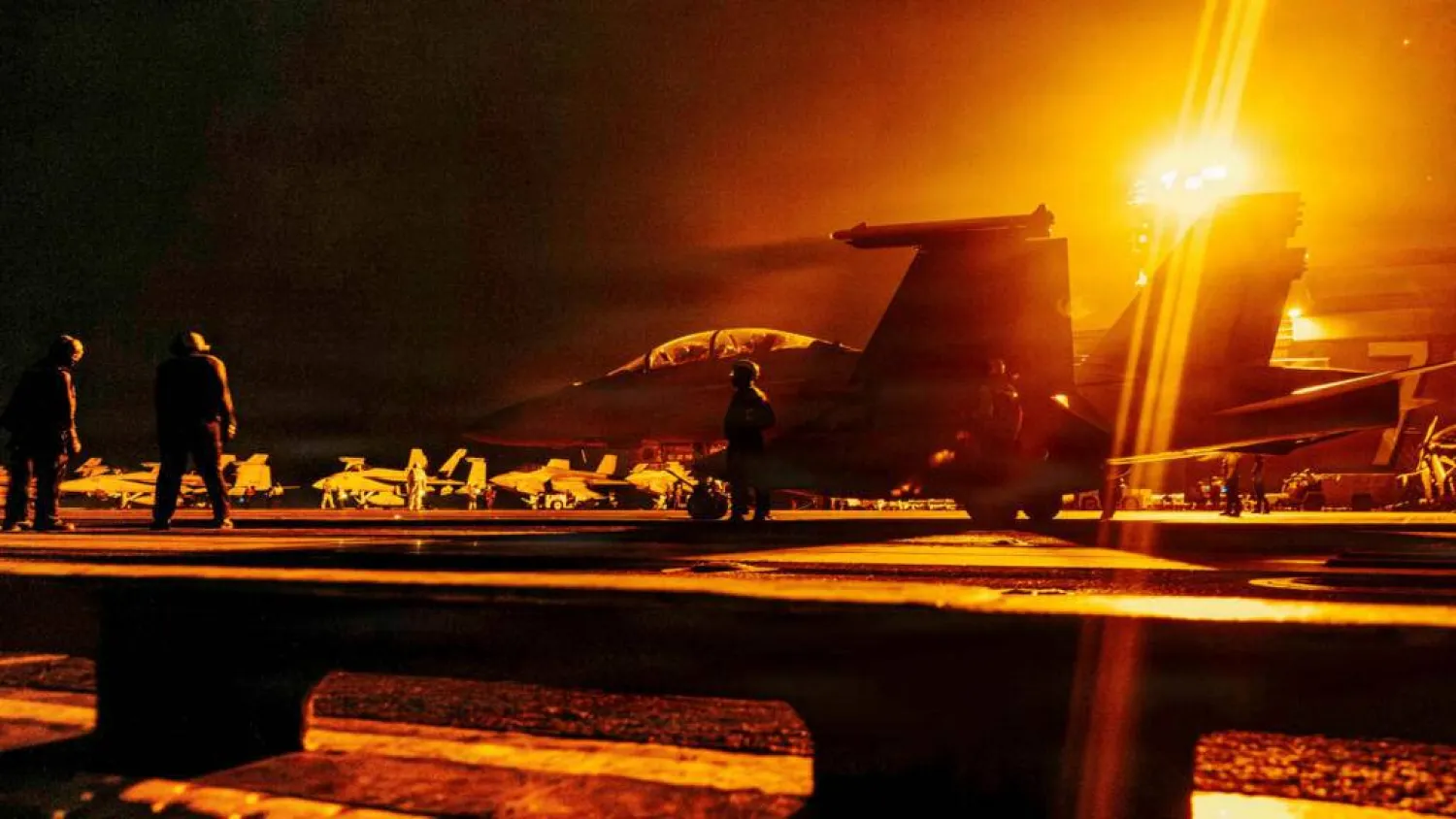

Iran Attacks US Targets Despite Trump Threats

Trump said the US military was prepared to attack Iran 'any time we want'. US NAVY/AFP
TT

Iran Attacks US Targets Despite Trump Threats

Trump said the US military was prepared to attack Iran 'any time we want'. US NAVY/AFP

Iran attacked US military bases in Kuwait on Thursday, despite President Donald Trump threatening further strikes in a fresh flare-up six months into the war.

The new clashes, which began with US raids on Sunday, deepen the ongoing impasse in the war, as Iran maintains a stranglehold on the strategic Strait of Hormuz and the US presses its counter-blockade of Iranian ports.

Trump said his military was prepared to attack Iran "any time we want" after extensive US bombardment of sites across the country left at least 19 Iranians dead between Tuesday and Wednesday.

Tehran has once again retaliated with strikes across the Middle East this week, saying it targeted US bases and forces in the United Arab Emirates, Kuwait, Bahrain, Jordan and Iraq's Kurdistan region.

Iran's security chief Mohsen Rezaei warned the United States on Wednesday that Iran had adopted a "new strategy" in the war that "will shatter your foundations".

Iran's pummeling of US military targets across the region came after a US attack that hit a wedding in the country's south, prompting fury from Tehran.

The Iranian Red Crescent said shrapnel from the missile attack in the coastal town of Kuhestak killed four people, including a child, and wounded more than 50.

The US military did not address the attack directly.

US Central Command (CENTCOM) spokesman Tim Hawkins said "the US military never targets civilians, unlike the IRGC", referring to Iran's Revolutionary Guards.

Kuwait's army on Thursday said it was intercepting a missile and drone attack from Iran, with the Iranian army saying it hit "the Ahmad al-Jaber Air Base in Kuwait with missiles and drones".

- 'Maximum pressure' -

Kuwait called the attacks "a direct threat to its security and stability, and the safety of its citizens and residents on its territory, and a grave breach of the rules of international law".

Aside from military action, Washington has vowed to choke Iran's economy, threatening to slap sanctions on its trade partners.

Energy Secretary Chris Wright pledged on Wednesday that a US plan for expanded sanctions targeting the Iranian republic's economic partners would deliver "absolutely maximum pressure".

Trump also suggested on Wednesday renaming the Strait of Hormuz, a major shipping lane that Tehran has effectively shut for six months, as "Trump Strait" -- although he implied later that he wasn't serious.

"Now that we have it under U.S.A. control, should we change the name Hormuz Strait to TRUMP STRAIT???" the US president wrote on Truth Social.

- 'Acts like Satan' -

Iran's top negotiator Mohammad Bagher Ghalibaf lashed out at Washington over the wedding attack, calling the United States "Satan".

"If a power acts like Satan, picks targets like Satan, and kills like Satan, it's Satan," he posted on X.

Iranians meanwhile expressed dismay over the return to hostilities.

Hossein Moazami, 50, who is self-employed, called the attacks "truly distressing".

"I hope they all return to the negotiating table because the only people suffering from this are the Iranian people," he said. "The Americans are on the other side of the world and nothing happens to them."

A video shared by an Iranian government account showed debris and damage at what it said was the wedding site in Kuhestak following the US strike, with people heard screaming in the background.

"It is a very saddening incident," Ali Mallahi, father of the bride and owner of the building that was hit, said in a video carried by state TV.

"Thank God the casualties were not higher."

The war erupted on February 28 with US-Israeli attacks on Iran that killed its supreme leader Ali Khamenei.

A fragile ceasefire collapsed in July after attacks on commercial ships in the Strait of Hormuz, through which one-fifth of world oil supplies previously flowed.

Israel's defense minister meanwhile said his country was prepared to respond "with great force" if attacked by Iran over the Jewish high holiday season, which begins in mid-September.

"For now, they are striking throughout the region except us," Israel Katz said.


2 Ships Ablaze in Romanian Black Sea Waters, 7 Sailors Missing

A screengrab from an aerial footage shows San Marino-flagged tanker ship that caught fire in Romanian territorial waters, released October 15, 2026. Romanian Interior Ministry/Handout via REUTERS
TT

2 Ships Ablaze in Romanian Black Sea Waters, 7 Sailors Missing

A screengrab from an aerial footage shows San Marino-flagged tanker ship that caught fire in Romanian territorial waters, released October 15, 2026. Romanian Interior Ministry/Handout via REUTERS

Rescuers were searching for seven missing crew on Thursday from one of two chemical tankers that caught fire overnight inside Romanian territorial waters in the Black Sea, after Russian drones strayed into Romanian airspace, Romanian officials said.

Romanian officials stopped short of explicitly linking the fires onboard the ships to the Russian drones. But the incidents follow drone strikes on at least five other cargo ships near the coasts of Romania and neighboring fellow NATO member Bulgaria over the past 10 days.

At least 23 sailors were lost from those strikes, which unlike the latest incidents took place ⁠just outside NATO's territorial ⁠waters.

The two ships hit overnight were both anchored in the Black Sea near the mouth of the canal leading into the Danube River, a major shipping route used by Ukraine as Russia has attacked Ukraine's own Black Sea ports.

Romania's naval authority said it received an emergency alert from the San Marino-flagged tanker. Seven of its 12 crew were missing and 5 were rescued, Reuters reported.

The interior ministry said it had sent two Black Hawk helicopters to the ⁠search and rescue mission, as well as two ships with medical staff on board.

"At the moment, the rescue cannot be done safely because of very big waves," it said in a statement.

Late on Wednesday, a Comoros-flagged chemical and oil tanker also caught fire. Romanian authorities initially said it was not clear whether it had been attacked. All its crew were safe.

Romania shares a 614-km (381-mile) border with Ukraine, much of it along the Danube. It has reported repeated breaches of its airspace by Russian drones over the past four years.

Both vessels caught fire near the mouth of the Danube River's Sulina Canal leading to the Black Sea, where ships often anchor waiting to pass because of ⁠delays from weather and ⁠congestion.

Increasing attacks on Black Sea shipping connected with the Russia-Ukraine war in recent months have threatened to cause a global food crisis, as both countries are major exporters of grain, as is Romania.

"We're looking at the Black Sea as a global food artery," Romanian Foreign Minister Oana Toiu told a security conference in Warsaw earlier this week.

"It is currently, unfortunately, the deadliest sea when it comes to the number of casualties of sailors in the last months. That means we need to increase our investments in deterrence, defense."

Bulgarian Prime Minister Rumen Radev said EU leaders would discuss on Thursday a proposed moratorium on attacks on civilian ships in the Black Sea.

Russia has been bombing Ukraine's Black Sea ports, forcing Kyiv to rely increasingly on Danube River ports and shipping routes close to the coasts of Bulgaria and Romania. For its part, Ukraine has targeted Russian ships near the mouth of the Don River in the Azov Sea.


Moscow Arrests Swede for 'Illegally' Crossing into Russia and Planning Attacks

People walk near the Kremlin, in Moscow, Russia, 25 September 2026. EPA/MAXIM SHIPENKOV
TT

Moscow Arrests Swede for 'Illegally' Crossing into Russia and Planning Attacks

People walk near the Kremlin, in Moscow, Russia, 25 September 2026. EPA/MAXIM SHIPENKOV

Russia's security services arrested a Swedish man they said fought for Ukraine for "illegally" crossing into Russia and allegedly planning attacks on military infrastructure, Russian media reported Thursday.
Russia's FSB security service, quoted by state news agencies, said an unnamed Swede was arrested in the northwestern Pskov region near the Lithuanian border, adding that "under the pretext of joining the Russian armed forces, he travelled to Russia to carry out acts of sabotage and terrorism on military facilities".


Washington Divided Over Renewed Strikes on Iran

US Secretary of War and CENTCOM commanders favor resuming the war against Iran, according to Axios. (CENTCOM)
TT

Washington Divided Over Renewed Strikes on Iran

US Secretary of War and CENTCOM commanders favor resuming the war against Iran, according to Axios. (CENTCOM)

Divisions have emerged within the Trump administration over whether to resume major military operations against Iran, with Defense Secretary Pete Hegseth and US Central Command (CENTCOM) leadership favoring fresh strikes while most presidential advisers advocate continued economic pressure, Axios reported.

The disagreement comes after President Donald Trump and Israeli Prime Minister Benjamin Netanyahu discussed a possible joint operation against Iranian military and nuclear facilities last week, according to US and Israeli officials and another informed source.

On Wednesday, Netanyahu warned that Iran’s proxies were seeking to launch missiles and carry out attacks.

Speaking to Israeli Army Radio, he said he opposed a preemptive strike on Tehran ahead of the elections, arguing that the timing was inappropriate. He nevertheless vowed to eliminate Hamas and Hezbollah and bring down Iran within two years.

Military Option Remains Open

The discussions suggest military escalation remains possible despite Trump’s insistence that he will not attack Iran before the US midterm elections, scheduled a week after Israel’s October 27 vote.

A US official said Netanyahu appeared eager to resume hostilities, but Trump had offered no firm commitment.

“Go ahead and prepare,” Trump reportedly told Netanyahu, a remark the official said could signal imminent action, a later operation or no attack at all.

A White House official denied that the leaders had discussed resuming the war, reiterating Trump’s position on the midterms.

Netanyahu’s office confirmed regular contacts with Washington but declined to discuss their substance.

According to the sources, Trump initially appeared inclined toward renewed strikes before becoming more hesitant.

Hegseth and CENTCOM leaders remain the strongest advocates of military action, while most advisers argue that sanctions and other economic measures are increasingly effective.

The debate pits military action aimed at disrupting Iran’s capabilities against sustained pressure intended to extract concessions without another round of fighting.

US and Israeli forces remain on alert, although preparations do not indicate that a final decision has been made.

Nuclear Concerns

Israel says intelligence indicates Iran is rebuilding parts of its nuclear program, concerns Netanyahu raised with Trump.

Israeli officials are particularly worried that Tehran could use the Pickaxe Mountain facility for uranium enrichment.

Senior Trump administration officials met for hours at Camp David on October 2 to discuss possible renewed strikes, including operations against Iranian military installations.

Whether the intelligence concerns will prompt military action or strengthen Washington’s negotiating position remains unclear.

The electoral calendar further complicates the calculations. A renewed offensive could provoke hundreds of Iranian ballistic missile launches toward Israel, potentially widening the conflict and disrupting its elections.

Diplomacy Continues

Meanwhile, Qatari mediators are awaiting Tehran’s response to Washington’s latest counterproposal to end the war, which demands nuclear concessions.

A US official said negotiations had not collapsed but were making little progress.

The official said Tehran had expected Trump to retreat under wartime pressure and with the midterms approaching, but the president had demonstrated that those calculations were mistaken.

On Tuesday, Trump again called Iran a “failed state” and said Washington would make a decision concerning Tehran “very soon.”
