


‘Race Against Time’: Hamas Moves to Protect Networks Linked to Al-Arabeed

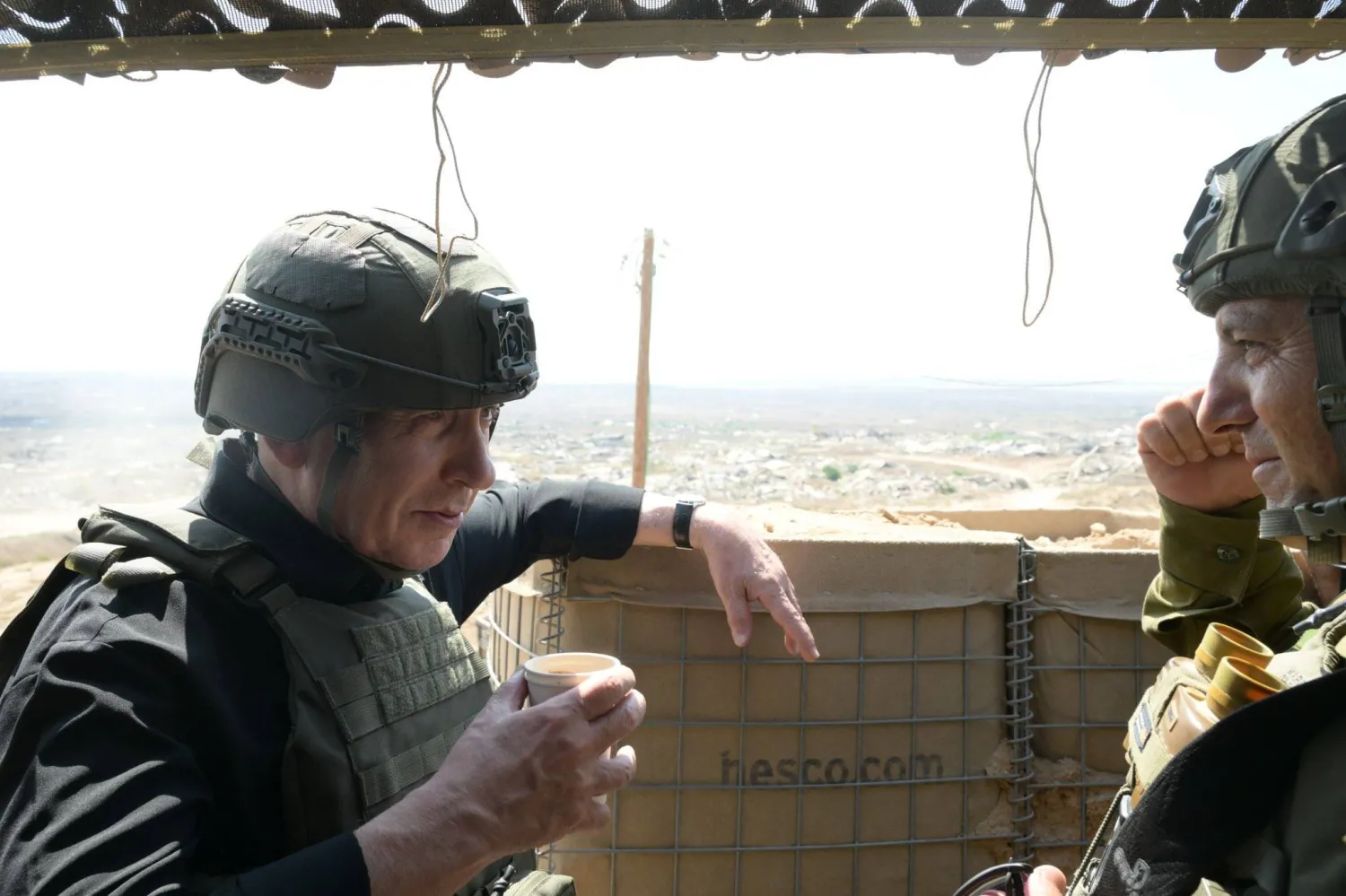
Israeli Prime Minister Benjamin Netanyahu in an area occupied by Israeli forces in Gaza on Wednesday (Netanyahu’s X account) 
TT

‘Race Against Time’: Hamas Moves to Protect Networks Linked to Al-Arabeed

Israeli Prime Minister Benjamin Netanyahu in an area occupied by Israeli forces in Gaza on Wednesday (Netanyahu’s X account) 

Hamas has entered a “race against time” to protect networks linked to senior security officer Moin Al-Arabeed after an Israeli force captured him Tuesday in a rare operation deep inside Hamas-controlled Gaza City.

Three Hamas sources told Asharq Al-Awsat that the group imposed emergency security measures following al-Arabeed's capture, moving quickly to prevent Israel from obtaining information that “could be extremely important,” according to one source.

Speaking separately, the sources said the measures were intended to head off potential surprise Israeli attacks, including assassinations of leaders, security officials and other figures who had been in direct contact with al-Arabeed.

“Hamas is in a race against time,” one source said. “Some officials who had been in contact with al-Arabeed were moved to safe locations, while documents were removed from places he frequented and from other locations he knew about.”

Two sources said Hamas security services had also scrapped some procedures used to relay messages through intermediaries and replaced the people involved. The sources agreed that Hamas was moving swiftly to “reduce the risk” after confirming that al-Arabeed had been captured alive.

A New Target Bank

One source assessed that a key Israeli objective was to “gather new security intelligence about Hamas’ structure in Gaza, after the previously known security picture changed as a result of intensive assassinations, determine who is now running the organization, and compile a new target bank.”

According to the sources, information gathered by Hamas security services over the past two days indicated that the Israeli force received “partial and limited” assistance from Israeli-backed armed Palestinian groups that had been operating in the area for some time, including through surveillance, movement around the site of the operation and monitoring nearby locations.

Some Israeli media cited Palestinian sources as confirming the armed groups’ involvement. However, military correspondents for Israeli television channels quickly relayed denials from Shin Bet security sources, saying the agency had “fully supervised the operation and carried it out highly professionally,” according to Channel 12.

Israeli Forces on Alert

Israeli forces, meanwhile, raised their alert level along the Gaza border over what Israel claimed was the possibility of Hamas attacks in retaliation for al-Arabeed’s capture.

Israel’s Channel 14 reported a “maximum security alert” after what it described as precise intelligence indicating Hamas intended to attack forces deployed in the area.

The Israeli military prepared its troops to thwart any such attack, but none occurred over the following two days. The channel said the intelligence nevertheless indicated Hamas’ growing motivation to target forces deployed near the so-called Yellow Line separating Israeli-held areas from those controlled by Palestinian factions.

Israel Hayom, however, reported that the heightened alert coincided with and followed Prime Minister Benjamin Netanyahu’s visit to the Yellow Line opposite Jabalia in northern Gaza, a day after al-Arabeed’s capture.

During the visit, Netanyahu hailed the operation to seize the Hamas internal security official and said Israeli forces would continue their missions and would not withdraw from Gaza until Hamas and the territory were fully disarmed.

Israeli military operations in Gaza intensified Thursday. Two people, including a child, were killed by Israeli fire near the Yellow Line in Beit Lahia in northern Gaza. Israeli forces also carried out a limited ground incursion near Kamal Adwan Hospital, temporarily forcing it to suspend operations after gunfire reached the facility.

Four Palestinians were wounded in similar shooting incidents near the Yellow Line in several areas of Khan Younis in southern Gaza and east of Deir al-Balah in central Gaza.

Israel Releases Five Civilian Lebanese Detainees

A photograph taken from the southern Lebanese area of Nabatieh shows smoke as it rises from the site of Israeli strikes that targeted the hilltops of the mountainous area of the strategic Ali al-Taher Ridge on August 14, 2026.  (Photo by AFP)
A photograph taken from the southern Lebanese area of Nabatieh shows smoke as it rises from the site of Israeli strikes that targeted the hilltops of the mountainous area of the strategic Ali al-Taher Ridge on August 14, 2026. (Photo by AFP)
TT

Israel Releases Five Civilian Lebanese Detainees

A photograph taken from the southern Lebanese area of Nabatieh shows smoke as it rises from the site of Israeli strikes that targeted the hilltops of the mountainous area of the strategic Ali al-Taher Ridge on August 14, 2026.  (Photo by AFP)
A photograph taken from the southern Lebanese area of Nabatieh shows smoke as it rises from the site of Israeli strikes that targeted the hilltops of the mountainous area of the strategic Ali al-Taher Ridge on August 14, 2026. (Photo by AFP)

Israel announced Thursday the release of five civilians captured in southern Lebanon, where it is at war with the pro-Iranian Hezbollah group, with one man already handed over to the Lebanese army.

Lebanon said its army had received a man returned by the International Committee of the Red Cross (ICRC), the first since Beirut called in August talks for the release of an initial group seized since the start of a 2024 Israel-Hezbollah war.

"It was decided to release five Lebanese civilians who were arrested in areas under (Israeli army) control in southern Lebanon," the office of Israeli Prime Minister Benjamin Netanyahu said in a statement.

"After their interrogation was completed, it became clear that they are civilians who are not members of any terrorist organization, have not engaged in terrorism, and there is no reason to continue holding them in Israel."

A Lebanese official told AFP on Thursday that the release of the four other civilians -- two Lebanese and two Syrians -- was postponed to Friday.

Their release is a prelude to the continuation of Lebanon-Israel talks in Rome, the official added, requesting anonymity.

Lebanese authorities have not officially announced the number of citizens Israel seized during that war and a subsequent 2026 conflict, but a list of more than 30 people has been compiled by their families and a committee working on their cases.

The list includes at least one Syrian national and several Hezbollah fighters.

Netanyahu's office said the decision followed "extensive efforts" by Israel and Lebanon to locate and return the bodies of leaders of Lebanon's Jewish community abducted and killed in the 1980s during the country's 15-year civil war.

After the latest round of Lebanon-Israel talks in Rome last month, a Lebanese official said Israel gave Beirut a list of individuals to demand the return of their remains.

The Israeli military said in August it recovered the remains of a soldier killed in eastern Lebanon in 1982.

- 'Humanitarian operation' -

The ICRC, which handles the transfer of released people between Israel and Lebanon, said a humanitarian operation was underway.

Lebanon's state-run National News Agency said that the Lebanese army received Malek Ghazi earlier on Thursday, adding that he was taken to an army intelligence headquarters in the southern city of Tyre.

Ghazi's family, from the southeastern town of Ain Ata, said in October last year that they had lost contact with him after he had gone out to exercise.

Lebanese Prime Minister Nawaf Salam hailed the release, thanking "the American administration... for the efforts exerted in this regard".

He pledged to work "until the release of all our prisoners" and "the disclosure of the fate of the missing", as well as an Israeli withdrawal from Lebanese territory.

The United States, which is sponsoring the Lebanon-Israel talks, commended through a State Department spokesperson both Israel and Lebanon "for demonstrating good faith through these initial steps" and added it hoped "this will serve as the basis for expanded discussions on other civilian issues".

Hezbollah attacked Israel in 2023 in support of Hamas after the outbreak of the Gaza war, leading to over a year of hostilities that escalated into a full-blown war in 2024.

The group drew Lebanon into the Middle East war two years later in support of its backer Iran after launching rockets at Israel.

Israel responded with airstrikes and a ground invasion that Lebanon says have killed more than 4,300 people.

The conflict has calmed since a US-Iran memorandum of understanding and a framework agreement between Israel and Lebanon agreed in June.

The Lebanon-Israel deal calls for the disarmament of Hezbollah, a gradual withdrawal of Israeli forces from south Lebanon and the deployment of the Lebanese army to the region, starting in "pilot zones".

A date has not yet been set for the next round of Lebanon-Israel talks, and Israel still carries out strikes on Lebanon while occupying parts of its territory.


UN's Sudan Probe Says Foreign Fighters Fueling Conflict

 Women walk through a war-torn neighborhood in Sudan's Omdurman on November 2, 2024. (AFP)
Women walk through a war-torn neighborhood in Sudan's Omdurman on November 2, 2024. (AFP)
TT

UN's Sudan Probe Says Foreign Fighters Fueling Conflict

 Women walk through a war-torn neighborhood in Sudan's Omdurman on November 2, 2024. (AFP)
Women walk through a war-torn neighborhood in Sudan's Omdurman on November 2, 2024. (AFP)

Foreign fighters and support networks are fueling the conflict in Sudan and worsening violence against civilians, a UN-backed investigation warned Thursday.

The United Nations' independent fact-finding mission on Sudan said foreign involvement was strengthening the military capabilities of the country's warring parties, enabling increasingly sophisticated military operations, with devastating consequences for ordinary people.

Since April 2023, the conflict between Sudan's army and the paramilitary Rapid Support Forces has killed tens of thousands and forced millions to flee their homes.

In a report, the probe documented the recruitment, training and deployment of foreign personnel to support the RSF, with transnational entities also facilitating the transfer of weapons, ammunition, military technology and logistical support.

It also said there were reasonable grounds to believe that the regular army used foreign-supplied drones in its operations that harmed civilians and civilian infrastructure.

"This external support has not brought greater protection for civilians," said the fact-finding mission's chairman Mohamad Chande Othman.

"Instead, civilians are paying the price through attacks on homes, hospitals, schools, markets and places of refuge."

The UN Human Rights Council established the probe in October 2023, to begin gathering evidence of violations in Sudan.

The independent investigative team does not speak on behalf of the United Nations.

- Colombian contingent -

The investigation documented the deployment of up to 2,000 ex-military Colombian contractors who directly operated combat drones, artillery and advanced weapons alongside RSF units.

Witnesses also reported fighters from South Sudan, Chad and Ethiopia, "including women, serving primarily in frontline, rather than technical roles", identified by language, accent "and, in some cases uniforms", the report said.

Private entities, intermediaries and recruiters operating from countries including Colombia used transit locations in Chad, Libya and Somalia to facilitate the delivery of personnel, training, weapons and logistics to the RSF in Sudan, the report said.

It found that foreign suppliers had boosted the RSF and the army's drone capabilities, allowing them to strike far beyond the front lines.

The mission found reasonable grounds to believe that the army and RSF attacks it documented may amount to war crimes.

The United States last month urged the UN Security Council to expand an arms embargo on the Darfur region to cover all of Sudan -- a call echoed by the fact-finding mission.

"Protecting Sudan's civilians requires action not only against those fighting the war, but also against the individuals, entities and networks that enable it to continue," said Chande Othman.


Israeli Military Says It Has Control of Lebanon’s Strategic Ali Al-Taher Area

A satellite image shows damage at the Ali al-Taher ridge near Nabatiah, Lebanon, March 8, 2026. 2026 (Planet Labs PBC/Handout via Reuters)
TT

Israeli Military Says It Has Control of Lebanon’s Strategic Ali Al-Taher Area

A satellite image shows damage at the Ali al-Taher ridge near Nabatiah, Lebanon, March 8, 2026. 2026 (Planet Labs PBC/Handout via Reuters)

Israel's military said on Thursday it had taken “operational control” of the strategic Ali al-Taher ridge area in southern Lebanon, the site of sporadic clashes between Israeli forces and Hezbollah in recent weeks. It is where Hezbollah is believed to have an extensive underground military facility.

The military said troops had cleared Hezbollah fighters from two underground routes, killing some while others fled. It said operations were ongoing.

Operations aimed at neutralizing underground infrastructure, after clearing them of Hezbollah operatives, are ongoing, with the military set to redeploy defensively following the completion of the activity, based on a situational assessment, it added.

The military accused the fighters inside the facilities of working to carry out plots against Israel and army forces. It noted that operations in the area in recent weeks have neutralized the capability to launch attacks against Israelis and army forces from it.

The Israeli army stated that inside the underground infrastructure, it discovered operations rooms, rooms designated for combat gear, and others for generators and accommodation, in addition to showering facilities and a kitchen, allowing Hezbollah fighters to manage combat and remain inside for extended periods.

It described these facilities as “strategic infrastructure” built over two decades, saying they were planned and funded by the Iranian regime.

There was no immediate comment from Hezbollah.

The Israeli army said its forces will continue to clear the occupied so-called “security zone” in southern Lebanon of Hezbollah, saying it will not allow the party to carry out plots against it,

Any attempt by Hezbollah to launch attacks against the army “will be met with force,” warned Israel, while saying it was committed to the ceasefire agreement in Lebanon.

The Ali al-Taher hill overlooks several villages as well as main roads leading to the city of Nabatieh. Losing control of it would disrupt Hezbollah’s presence and supply lines in the area.
