


Could Sudan’s Conflict Become a Regional War?

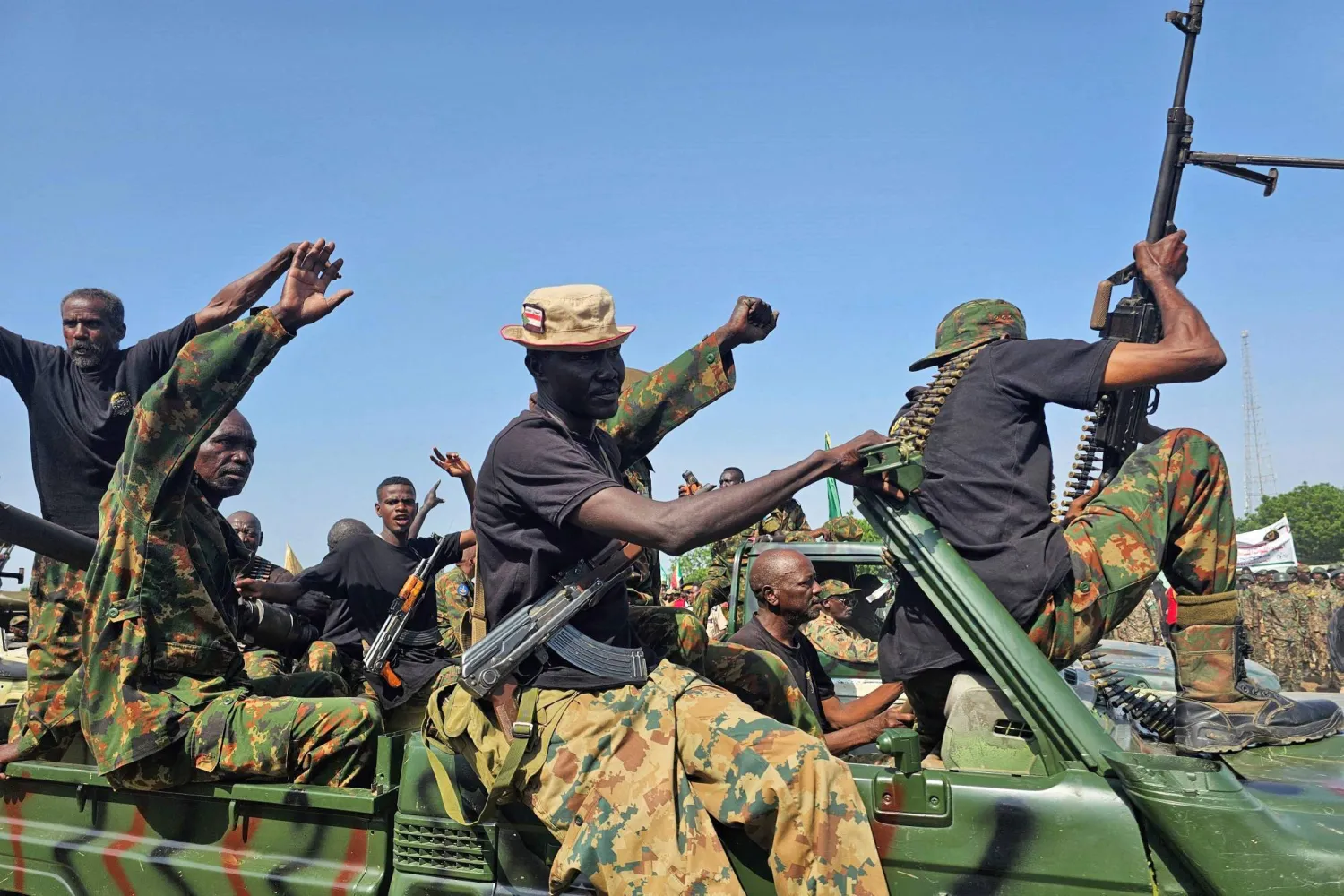
Members of the Sudanese army take part in a military parade in Gedaref in August. (AFP)
TT

Could Sudan’s Conflict Become a Regional War?

Members of the Sudanese army take part in a military parade in Gedaref in August. (AFP)

Fears that Sudan’s war could turn into a regional conflict are no longer merely assessments raised by observers following cross-border strikes and mutual accusations between Sudan and Chad, alongside troubling military movements near the border with Ethiopia.

Massad Boulos, senior adviser to the US president for Arab and African affairs, conveyed those concerns to the UN Security Council, warning that the repercussions could fuel the conflict and threaten to draw neighboring countries more deeply into the war.

The US warnings do not appear to have emerged in a vacuum. They are difficult to separate from Washington’s extensive intelligence capabilities, which allow it to monitor military movements, weapons and drone routes, and cross-border networks.

Raising the level of concern to the Security Council therefore reflects a US assessment that the risks are real and growing, even if the administration has not publicly disclosed all the information on which that assessment is based.

The warning was reinforced by a call Boulos held with Chadian President Mahamat Idriss Deby following reports of a military strike inside Chadian territory.

Boulos said the two expressed “deep concern about the war in Sudan spilling across its borders, fueling further escalation and threatening regional peace and stability,” while calling for an end to external support for the warring parties.

More than three years after the war began, it is no longer simply an internal confrontation between the Sudanese army and the paramilitary Rapid Support Forces. As fighting has moved into areas bordering Chad and Ethiopia and the use of sophisticated weapons has expanded, Sudan has become the center of a conflict in which the calculations of neighboring countries intersect with the interests of regional and international powers.

Growing internationalization

Evidence of the war’s internationalization can be seen in the UN Fact-Finding Mission’s finding that weapons, military technology, fighters and external supply networks are helping prolong the conflict and strengthen the capabilities of both sides.

The mission described a cross-border network linked to individuals, entities and countries that it said had provided the RSF with weapons, equipment, logistical support and foreign personnel. The countries concerned have denied the accusations, saying they remain neutral and support peace efforts.

The mission, meanwhile, said its investigations into sources of external support for the army were still at a preliminary stage.

Sudanese researcher Kholood Khair, director of Confluence Advisory, told the Financial Times in April that the war had “spread across the Red Sea, the Horn of Africa and the Sahel,” and that none of Sudan’s seven neighbors was entirely removed from its effects.

Alan Boswell, director of the Horn of Africa project at the International Crisis Group, has similarly argued that the war is dividing the region and increasing polarization among surrounding countries over the two sides.

He considers Chad and South Sudan the most exposed to its repercussions, while also pointing to the need to watch Ethiopia and tensions in Somalia.

A prolonged conflict, he has warned, could drag the region into a “spiral of violence.”

Amin Ismail Majzoub, an expert on crisis management and negotiation at the Center for Research and Strategic Studies, ruled out the conflict developing into a direct military confrontation between Sudan and neighboring countries.

He said the more likely scenario was an escalation of “proxy warfare,” through continued financial and military support and the use of mercenaries and armed groups, which would prolong the war.

Majzoub told Asharq Al-Awsat that Khartoum’s accusations against Chad and Ethiopia were, according to Sudanese authorities, based on evidence submitted to the African Union, IGAD and the Security Council, in addition to reports that bases and airports had been used in support of the RSF.

He added that if those parties moved from indirect support to declared military intervention, Sudan’s regional allies could step in to back it, at which point the conflict could expand to include the Horn of Africa and sub-Saharan Africa.

Majzoub nevertheless dismissed that scenario, saying: “This will not happen,” because a comprehensive regional war would not be welcomed by the countries of the region.

At the same time, he noted that the conflict’s repercussions were already becoming visible inside neighboring countries, citing increasingly vocal opposition groups in Chad that reject what they say is support being provided to Arab groups aligned with the RSF.

Retired Sudanese army Maj. Gen. Kamal Ismail, for his part, warned that the intersection of regional interests was gradually pushing the conflict beyond Sudan’s borders.

“We have repeatedly warned that the conflict could move from inside Sudan into the region, and the indicators point to that direction,” Ismail told Asharq Al-Awsat.

He added that the widening scope of the fighting could lead to a broader civil war and further complicate the situation.

Ismail said intensifying competition over regional interests could push some actors toward direct intervention under the pretext of protecting their interests, warning that “the longer the war continues, the more its parties lose the ability to control its course or stop it.”

He urged Sudanese to unite to halt the fighting and preserve what remains of the country.

Ethiopia and Chad

The movement of military operations into Blue Nile state near the Ethiopian border is among the most worrying developments.

Yale University’s Humanitarian Research Lab has published reports based on satellite imagery and open-source analysis pointing to the assembly of brigade-size military support inside an Ethiopian National Defense Force base in Asosa and linking it to RSF activity.

Asosa is significant because of its proximity to Blue Nile and the town of Kurmuk. Any military presence in the area connected to the war, if confirmed, could therefore lay the groundwork for a new border front.

To the west, Chad stands at the center of the storm because of its long border with Darfur and the tribal ties spanning both sides.

Tensions escalated after Sovereignty Council Chairman and army commander Gen. Abdel Fattah al-Burhan accused N’Djamena of facilitating support to the RSF, while Chad denies that its territory or airports are being used to transfer weapons.

Cameron Hudson, a former US official and Sudan expert, says the repercussions of strikes inside Chad are no longer confined to the battlefield but have developed into a diplomatic confrontation.

Countries affected by the war

South Sudan may be the country most exposed to the consequences of the war. Its economy depends on exporting oil through Sudanese facilities and ports, while it has received more than 1 million Sudanese and returning South Sudanese since the fighting began.

A halt in oil exports or the spread of fighting to the border could threaten Juba’s fragile stability.

Kenya, although it does not share a border with Sudan, is exposed to the spillover of political polarization, financing and fighter networks, as well as trade disruption and damage to the role of IGAD, of which Nairobi is a key pillar.

Uganda faces similar risks through South Sudan. Any renewed eruption of instability in Juba could trigger a new refugee influx into Uganda, which already hosts more than 1 million South Sudanese refugees. In this way, the effects of the war could spread from Sudan to South Sudan and then to Uganda and Kenya without regular armies ever crossing borders.

Egypt, for its part, faces repercussions related to refugees, security along its southern border, Nile waters and the balance with Ethiopia. Eritrea fears instability spreading into eastern Sudan and the Red Sea coast.

IGAD Executive Secretary Workneh Gebeyehu has said that peace and security challenges have become too interconnected for any single country or institution to confront alone, describing Sudan as one of the clearest examples of the convergence of military confrontation, humanitarian catastrophe, institutional fragmentation, regional spillover and geopolitical rivalry.

Sudan’s war has not yet become a full-fledged regional confrontation, but it long ago moved beyond the confines of an internal conflict. As the different strands become increasingly intertwined, the question in the future may no longer be: Will the war spread into the region? But rather has it already begun?



How Egypt Benefits From Expanding Nile Basin Power, Water Projects

Tanzania’s president and Egypt’s prime minister attend the inauguration of the Julius Nyerere Dam in Tanzania last month. (Egyptian Cabinet/Facebook)
TT

How Egypt Benefits From Expanding Nile Basin Power, Water Projects

Tanzania’s president and Egypt’s prime minister attend the inauguration of the Julius Nyerere Dam in Tanzania last month. (Egyptian Cabinet/Facebook)

Egypt is seeking funding for 36 projects in the southern Nile Basin, expanding its role in the region through hydropower, electricity and water schemes that experts say could benefit both Cairo and its neighbors.

The projects include power interconnections, transmission lines, water supplies and multipurpose schemes. Experts told Asharq Al-Awsat that Egypt’s growing involvement was guided by a principle of mutual benefit.

The southern Nile Basin countries are Burundi, Congo, Kenya, Rwanda, South Sudan, Tanzania and Uganda. They are among the Nile’s upstream countries and, together with the eastern Nile countries of Ethiopia, Sudan, Egypt and Eritrea, make up the Nile River Basin region.

Egyptian Minister of Water Resources and Irrigation Hani Sewilam said on Friday that Cairo had agreed to support efforts to mobilize funding for the 36 projects after studying them, exchanging information, assessing their impacts and reaching agreement through consultations.

Sewilam pointed to Tanzania’s Julius Nyerere Dam as a practical example of cooperation among Nile Basin countries. The Egyptian-Tanzanian partnership had brought gains to both sides, he said.

The dam provides electricity for Tanzania, Sewilam said, and its power could also support regional integration, cross-border connections and electricity trade with neighboring countries.

He also cited the Grand Fula Dam project in South Sudan, saying Egypt supported Juba’s development goals, including that project.

Tanzania inaugurated the Julius Nyerere hydropower dam and plant in late August. The Egyptian consortium of Arab Contractors and Elsewedy Electric built it over five years, with 1,700 Egyptian engineers and technicians among a workforce of about 12,000.

Hussein al-Buheiri, an African affairs expert at the National Center for Middle East Studies, said Egypt had the resources and capabilities to play a central role in developing Nile Basin and Horn of Africa countries, particularly through hydropower dams and irrigation and agricultural projects.

He said Egyptian companies’ work on the Julius Nyerere Dam and Egypt’s help in building power plants in countries such as Djibouti showed how the country could act as a strategic development partner.

African countries gained development, while Egypt gained investment and thousands of jobs, he said.

That approach also advanced Egyptian foreign policy and helped protect its Nile water security by drawing basin countries closer to Cairo and countering Ethiopian moves, al-Buheiri said.

Salah Halima, deputy chairman of the Egyptian Council for African Affairs and a former assistant foreign minister, said Egypt’s support for development projects reflected a broader commitment to shared interests and sustainable development across the basin.

Egypt had long supported water and electricity projects in Nile Basin countries, approving and helping carry out dozens of them, he said. That record showed Cairo’s support for those countries’ right to develop without harming others.

Halima described current water projects as an expression of partnership and mutual investment between Egypt and its African neighbors. Their expansion, he said, was part of longstanding collective action and close cooperation.

The message, he said, was clear: understanding and cooperation, rather than confrontation or dispute, should guide the management of international rivers.


Can Libyan Lawmakers Force a Change in Parliament’s Leadership?

A still from the Libyan House of Representatives’ latest session on Sept. 15 (video posted by the House on its Facebook page)
TT

Can Libyan Lawmakers Force a Change in Parliament’s Leadership?

A still from the Libyan House of Representatives’ latest session on Sept. 15 (video posted by the House on its Facebook page)

A push to change the rules of Libya’s parliament and rotate its leadership has put a question to the Benghazi-based chamber: Can lawmakers unseat Speaker Aguila Saleh after nearly 12 years at its helm?

The effort has also raised questions about why a bloc opposed to Saleh’s “unilateral decision-making” is acting now, whether its campaign is tied to the “4+4” agreement, and whether that deal can be carried out.

The agreement is seen as a possible route out of Libya’s political divide through a unified executive authority that would lead the country to elections within two years.

The lawmakers opposing Saleh say they will press on with efforts to “reform parliament and change its leadership.”

They say they were blocked from holding a session on the issue in the middle of last week when the chamber’s Benghazi headquarters was closed on its leadership’s orders.

Issam al-Jehani, a prominent member of the bloc, said its 86 lawmakers could meet in any Libyan city where they could carry out their duties.

Their aim was “neither a conspiracy nor an attempt to take Saleh’s seat,” he said, but reform in response to Saleh’s unilateral decisions and determination to stay in office.

Other political figures say the campaign could splinter and fade. Its momentum, they argue, depends on the balance of power in eastern Libya and on regional pressure.

Lawmaker Ali al-Takbali expects it to lose steam. He told Asharq Al-Awsat that a similar call in March for a session to change parliament’s rules came to nothing.

He also questioned whether Saleh’s opponents could keep enough lawmakers together to hold a session to remove him. They may unite over a grievance, al-Takbali said, but become harder to assemble once they return home, particularly if some reconsider their position because of personal interests or tribal ties.

Fellow lawmaker Montaser al-Hassi warned that some members’ actions could split parliament. Lawmakers have the right to amend its rules, he said, but must do so through legal channels.

Libya has long been divided between two governments: the interim Government of National Unity led by Abdulhamid al-Dbeibah in Tripoli, and Osama Hammad’s parliament-appointed government, which runs the east and some southern cities and is backed by Libyan National Army commander Field Marshal Khalifa Haftar.

Under the “4+4” agreement reached late last month by representatives of the Government of National Unity and the Libyan National Army under UN auspices, a new presidential council and unified government would prepare the country for general elections within two years.

Some observers and political figures say regional countries regard Saleh’s continued leadership as a safeguard against a split in the legislature, which they describe as the only institution to have remained intact through Libya’s institutional divisions.

Analyst Hossam Fnish linked the turmoil in parliament to the “4+4” deal. He said the reform bloc’s insistence on changing the rules before holding sessions would delay incorporating the agreement into Libya’s constitutional declaration, hindering a deal that could lead to elections and end the divide.

The UN mission, he said, prefers to incorporate the agreement through a constitutional amendment before seeking Security Council endorsement.

Fathi al-Shibli, head of the Voice of the People party, questioned the reform bloc’s motives. Complaints about Saleh making decisions alone and sessions going ahead without a quorum had circulated for years without drawing objections from lawmakers, he said.

That, in his view, lent weight to suspicions that the dispute was a struggle between blocs backed by powerful interests, rather than a drive for reform.

Al-Shibli expects Saleh to remain in office until the UN mission calls for a constituent council to replace parliament and the High Council of State to implement the “4+4” agreement. He said both bodies oppose a change to Libya’s political landscape.

Political analyst Mohammed Mahfouz likewise described the parliamentary dispute as a contest between powerful groups in eastern and western Libya, each seeking to show the international community that it can control the political scene.

Saleh’s hold on his position rests on two factors, Mahfouz told Asharq Al-Awsat: whether he and his allies can absorb the current anger, and whether regional and Western countries support him.

Saleh’s two deputies may help him contain the challenge, Mahfouz said, because they too could face replacement.


Iraq’s PM Tells UN The State Alone Will Decide War, Peace

Iraqi Prime Minister Ali al-Zaidi speaks during the 81st session of the United Nations General Assembly on Sept. 25, 2026. (AP)
TT

Iraq’s PM Tells UN The State Alone Will Decide War, Peace

Iraqi Prime Minister Ali al-Zaidi speaks during the 81st session of the United Nations General Assembly on Sept. 25, 2026. (AP)

Iraqi Prime Minister Ali al-Zaidi said on Friday that one of his government’s priorities was to ensure the state alone decides matters of war and peace, stressing that weapons must remain in the hands of constitutional institutions.

“The practical measures to bring weapons and decisions on war and peace under state control are moving in the right direction,” al-Zaidi told the UN General Assembly.

He called them essential to building state institutions, protecting sovereignty and securing stability.

He said the end of the international coalition’s mission in Iraq would mark a new phase in relations with strategic partners, shifting from military cooperation to economic and development cooperation. Iraq would continue to strengthen its security and military capabilities, he added.

Al-Zaidi called for tighter border controls, the closing of security gaps and continued vigilance against conditions that could fuel extremism.

He reiterated Iraq’s support for dialogue, diplomacy, respect for sovereignty, noninterference and good neighborly relations, and urged countries to resolve conflicts through negotiations and prevent renewed wars.

He urged the world to engage more closely with Iraq, saying the country could contribute to security and stability.

He also highlighted the Development Road project as a “strategic corridor for trade, investment and energy” linking Iraq’s Grand Faw Port to Türkiye and, from there, Europe.

“Iraq has never been on the margins. It is at the heart of history and the pulse of the present, and it deserves a partnership for the future,” he said.

US Secretary of State Marco Rubio had warned Baghdad that militias must be disarmed to avoid the “Balkanization of Iraq,” amid growing pressure on the Iraqi government to bring weapons under state control.

Rubio expressed US support for al-Zaidi’s efforts to strengthen state authority and called for armed factions to be dismantled. He warned that competing centers of power could fragment Iraq and weaken its institutions.

Al-Zaidi had proposed a plan beginning with a 90-day period during which armed factions would cease attacks, with the transfer of weapons to the state to be completed by June 30, 2027.