


Houthi Escalation Backfires in Taiz, on Yemen’s Western Coast

Yemeni government forces launch counteroffensive in Taiz, Hodeidah — military media
TT

Houthi Escalation Backfires in Taiz, on Yemen’s Western Coast

Yemeni government forces launch counteroffensive in Taiz, Hodeidah — military media

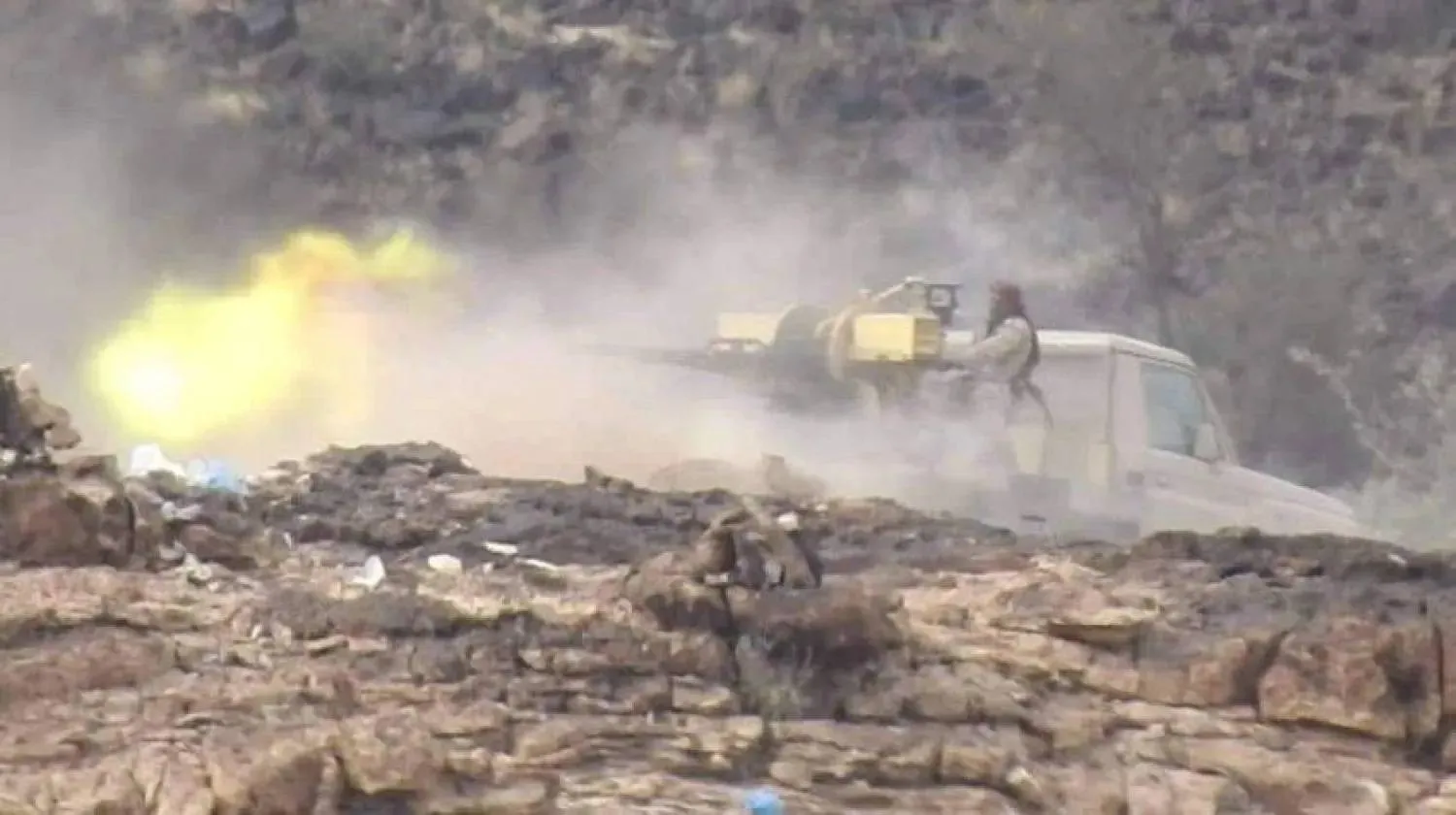
A large-scale Houthi ground offensive launched on Thursday across Yemen’s western coast, southern Hodeidah, and western Taiz was faltering on Saturday as government forces counterattacked on several fronts, backed by intensified air strikes and efforts to cut the group’s supply lines.

In the most significant battlefield development on Saturday morning, national resistance forces, backed by units from the Giants Brigades, launched a counterattack south of al-Jarrahi district in Hodeidah province.

National resistance drones simultaneously struck Houthi reinforcements in the area, according to its military media office.

The operation came as government forces advanced from Hays towards al-Jarrahi in southeastern Hodeidah, seeking to regain the initiative on one of the fronts where the Houthis had carried out major attacks in recent days.

Military sources said the group had suffered heavy losses in personnel and equipment during the fighting.

In southeastern Taiz, government forces made further gains on the Hayfan front and seized al-Wathra hill and Saeed Taha hill in the al-Mafalis area, as well as the Dheiban, al-Khudaira and al-Najdain hills, according to a military source.

The recaptured positions are militarily significant because they overlook al-Khazja market and Houthi supply routes towards fronts in northwestern Lahj and southern Taiz, the source said. The source added that the group had suffered losses in personnel and equipment and that some of its fighters had fled their positions.

Counteroffensive

In western Taiz, government forces recaptured al-Khazan hill in Jabal Habashi district on Friday after fierce clashes with the Houthis, as fighting intensified on the Maqbanah and al-Kadaha fronts and government reinforcements arrived.

The rapidly unfolding developments on these fronts indicate that the initiative is gradually shifting from the Houthis to government forces after three days of fighting in which the group sought to break through in southern Hodeidah and western Taiz, particularly in Jabal Habashi.

On the Saqam front, the national resistance’s military media office said on Saturday that Second Division forces were inflicting heavy losses on the Houthis in the al-Muharraq mountains.

The national resistance’s naval forces said they destroyed two Houthi explosive-laden boats that had attempted to target the al-Fajra area south of al-Khokha and the port of Mokha.

Military sources also said a Houthi infiltration attempt from the eastern entrance to Taiz city had been thwarted and several members of the group killed, while fighting continued in various sectors of the front.

At the same time, Houthi shelling struck the Hayjat al-Abd road linking Taiz and Aden, killing four civilians and wounding nine others, according to local and medical sources. The attack also caused property damage at the site.

The incidents reflect the widening scope of the Houthi escalation to include roads and civilian areas alongside the group’s ground operations on the front lines.

Air strikes enter the battle

For the first time, the Yemeni army said it had used combat aircraft to strike Houthi positions on the Taiz and Hodeidah fronts, marking a notable development in the course of the current fighting.

The armed forces’ media center said on Friday evening that combat aircraft had carried out more than 15 strikes on Houthi positions, gatherings and vehicles on the western coast fronts in Taiz and Hodeidah provinces, as artillery fire and ground clashes continued.

Military sources said Yemeni aircraft continued to strike Houthi positions in Taiz and Hodeidah, targeting supply lines and weapons depots. Houthi positions in the city of al-Hazm in al-Jawf province were also hit by air strikes, according to military sources.

Field sources said the Houthis had suffered heavy losses during three days of fighting, with hundreds of the group’s fighters killed or wounded. Hospitals under Houthi control in Hodeidah were facing mounting pressure as casualties arrived from the battlefronts, they said.

The group transferred another group of fighters killed or wounded in the clashes to hospitals in al-Jarrahi and Zabid, according to local media sources, indicating the scale of its losses during the offensive and subsequent efforts to repel the counterattacks.

The Houthis, meanwhile, continued to send reinforcements to the battle zones to hold positions they had initially advanced to and contain the government forces’ counteroffensive.

Protecting Bab al-Mandab

As the fighting widened, Rashad al-Alimi, chairman of Yemen’s Presidential Leadership Council, and other council members monitored developments in the military operations and contacted military and field commanders to review the course of the battles, readiness levels, and operational and logistical needs, according to a statement from the office of the supreme commander of the armed forces.

Al-Alimi warned on Friday evening of the consequences of the Houthi escalation, holding the group responsible for the resulting humanitarian impact, including the displacement of hundreds of families from areas affected by the fighting.

He said government forces would not allow what he described as Iran’s objective of controlling the Bab al-Mandab Strait to be achieved, adding that any advance towards those areas would severely drain the Houthis.

The Ministry of Planning and International Cooperation called on international organizations and donors to intervene urgently to help displaced and affected families in Taiz and Hodeidah.

It warned of growing needs for shelter, food, medicine, water and medical services, and called for field hospitals to be established to receive the wounded.

Mokha and its port were hit by a series of Houthi ballistic missile and drone attacks last August, in an escalation that struck civilian facilities and sites, disrupted port traffic, and put its facilities out of service.

Government forces responded with military operations and strikes targeting the group’s movements and offensive capabilities.



Attention Shifts to Lebanon’s Iqlim al-Tuffah amid Israeli Military Moves

Israeli heavy machinery bulldozes houses in al-Mansouri, as seen from Hinniyeh, southern Lebanon, September 19, 2026. (Reuters)
TT

Attention Shifts to Lebanon’s Iqlim al-Tuffah amid Israeli Military Moves

Israeli heavy machinery bulldozes houses in al-Mansouri, as seen from Hinniyeh, southern Lebanon, September 19, 2026. (Reuters)

Military operations have escalated over the past few hours amid Israeli discussions regarding a transition to a "new phase" of occupation in southern Lebanon. Attack helicopters and tanks have been redeployed alongside airstrikes, artillery fire, and heavy weaponry sweeps.

Amid ongoing airstrikes, demolition operations, and movements on the ground, a critical question is being raised in Lebanon: Is the Israeli escalation limited to intensifying military pressure, or is it paving the way for a shift in the nature of operations and occupation in the South?

While the new date for the Lebanese-Israeli negotiations has not yet been set, the head of the Lebanese negotiating delegation, Simon Karam, is expected to visit the Vatican, where he will meet with Secretary of State Cardinal Pietro Parolin and Foreign Minister Paul Richard Gallagher to discuss the negotiation file and the role the Vatican could play in supporting this path, informed sources told Asharq Al-Awsat.

Lebanese President Joseph Aoun was in Rome recently where he discussed the negotiations.

On the ground, Israeli attacks continued in the South on Sunday where an Apache helicopter struck a commercial center on the Shokin-Mayfadoun road in the Nabatieh region, while heavy machine-gun sweeps targeted the towns of Beit Yahoun, Serbine, and Wadi Zibqeen.

An ambulance crew survived an airstrike that targeted a building while personnel were in the area conducting a field inspection following a previous raid, resulting in damage to shops and residential apartments in the targeted building.

An Israeli Merkava tank also targeted the town of Hadatha with four shells, before Israeli forces advanced toward a center in the town and set fire to the location. The Israeli army also demolished a number of houses in the town of al-Mansouri on Sunday.

The Israeli army announced that it attacked Hezbollah targets in southern Lebanon, stating that the strikes came in response to the launch of an explosive-laden drone toward its forces during the past night.

Retired general and military expert Hassan Jouni said the recent Israeli operations could either be part of routine maneuvers or aimed at finalizing operations in the al-Mansouri area.

This comes as the Israeli army announced it is nearing the completion of its phase focused on destroying Hezbollah’s infrastructure in the region.

Consequently, the central question following the conclusion of this phase focuses on what Israel's next move will be, Jouni told Asharq Al-Awsat.

"According to Israeli sources and official positions, discussions are underway regarding a redeployment of the army into positions currently under preparation,” he added.

This would consolidate the Israeli military presence and its defensive positions in the buffer zone and along the borders of the Yellow Line, he said.

However, Israeli operations, particularly Saturday's targeting of the Jabal al-Rihan region and its surroundings, Jabal Safi, and Sejod, are troubling indicators regarding the potential launch of a military offensive in the Iqlim al-Tuffah region, which lies geographically north of Ali al-Taher, added Jouni.

He explained that "Iqlim al-Tuffah is historically considered one of the last areas in southern Lebanon to house Hezbollah logistics bases. This raises the question of whether Israel has decided to continue operations and expand into this area, and whether Saturday’s actions will pave the way for an escalation or if the army was consolidating its defensive positions.”


Halt of Iranian Flights Sparks Debate within Iraq’s Ruling Coalition

 Iraqi Prime Minister Ali al-Zaidi meets with US President Donald Trump in New York on September 23, 2026. (Iraqi government)
Iraqi Prime Minister Ali al-Zaidi meets with US President Donald Trump in New York on September 23, 2026. (Iraqi government)
TT

Halt of Iranian Flights Sparks Debate within Iraq’s Ruling Coalition

 Iraqi Prime Minister Ali al-Zaidi meets with US President Donald Trump in New York on September 23, 2026. (Iraqi government)
Iraqi Prime Minister Ali al-Zaidi meets with US President Donald Trump in New York on September 23, 2026. (Iraqi government)

The Iraqi government's decision to enforce the US Treasury Department's ban on Iranian aviation remains highly contentious, as factions within the ruling Coordination Framework refuse to comply despite Baghdad's officially declared commitment to the policy.

According to a government source, Baghdad has received a serious American warning against receiving any Iranian airline at Iraqi airports. The government of Prime Minister Ali al-Zaidi had, however, requested that Washington grant it an exemption from the flight ban for certain airports, including Najaf airport, for humanitarian reasons.

According to an informed political source, "Iraq is currently caught between the American hammer and the Iranian anvil."

The source told Asharq Al-Awsat that "the situation in reality appears extremely difficult, as complying with Tehran's desire to completely ignore the flight ban could result in sanctions that Iraq can no longer tolerate.”

“This is particularly critical given that a shipment of US dollars is scheduled to arrive in Baghdad soon, as part of successful talks held by al-Zaidi with the US administration, specifically President Donald Trump, during his participation in the United Nations General Assembly meetings,” it added.

According to the informed political source, "leaders of the Coordination Framework are attempting to strike a middle ground during their discussions with and in the presence of al-Zaidi, in terms of not going too far in defying the US decision, while simultaneously declaring their support for the PM’s efforts to secure a single exemption, even if only for Najaf airport."

A government source confirmed on Sunday that Baghdad "has received a serious and direct American warning that continuing to receive any Iranian airline at Iraqi airports exposes the airport, as well as the entities and companies providing services to these flights, to US sanctions."

"The Americans made it clear to the Iraqi government that the punitive measures will not be limited solely to the sanctioned Iranian airlines, but could also extend to any entity or airport providing services or facilitating the operation of those companies' flights, including landing, ground handling, refueling, and other services,” it said.

"This warning has left the government with a single option: to avoid exposing Iraqi airports, the aviation sector, and the operating entities to US sanctions,” it continued.

"The decision was not linked to an Iraqi political stance regarding air traffic with Iran, but rather came as a result of the legal and economic risks resulting from US sanctions,” it explained.


Syrian Security Forces Arrest Official Responsible for Torture of Child Hamza al-Khatib in Daraa

Hamza al-Khatib became a symbol of the Syrian revolution. (SANA)
TT

Syrian Security Forces Arrest Official Responsible for Torture of Child Hamza al-Khatib in Daraa

Hamza al-Khatib became a symbol of the Syrian revolution. (SANA)

Syrian Internal Security Forces arrested Brig. Gen. Jaber Mehrez Ibrahim, who served as commander of the 138th Air Defense Brigade in the town of Saida during the era of the deposed regime, following a precise surveillance and tracking operation, reported Syria’s state news agency SANA on Sunday.

Records and preliminary investigations showed that Ibrahim was involved in issuing orders to kill and arrest people and suppress protesters, as well as participating in military campaigns targeting villages and towns in eastern Daraa countryside, pursuing civilians and targeting their homes.

Investigations also indicate that he was directly responsible for the Saida Housing massacre, in which nearly 120 people were killed, and that his name was linked to systematic arrests and torture involving a large number of people from the province, including child martyr Hamza al-Khatib.

The ousted regime arrested al-Khatib, 13, in the early days of the Syrian uprising that erupted in the city of Daraa on March 18, 2011. He died under torture in detention.

On May 21, 2011, al-Khatib’s tortured and mutilated body was returned to his family, weeks after his arrest during an anti-government demonstration.

His death, alongside the torture of other children and teenagers arrested for writing anti-Assad graffiti, triggered widespread protests and a brutal crackdown by government forces.

Following the ouster of the regime in December 2024, the new authorities launched a crackdown against former officials and military personnel. Ibrahim’s arrest is part of these ongoing prosecutions over allegations of abuses committed during the former regime's years in power.