
China's Memories of Mao Fade to Nostalgia 50 Years after His Death

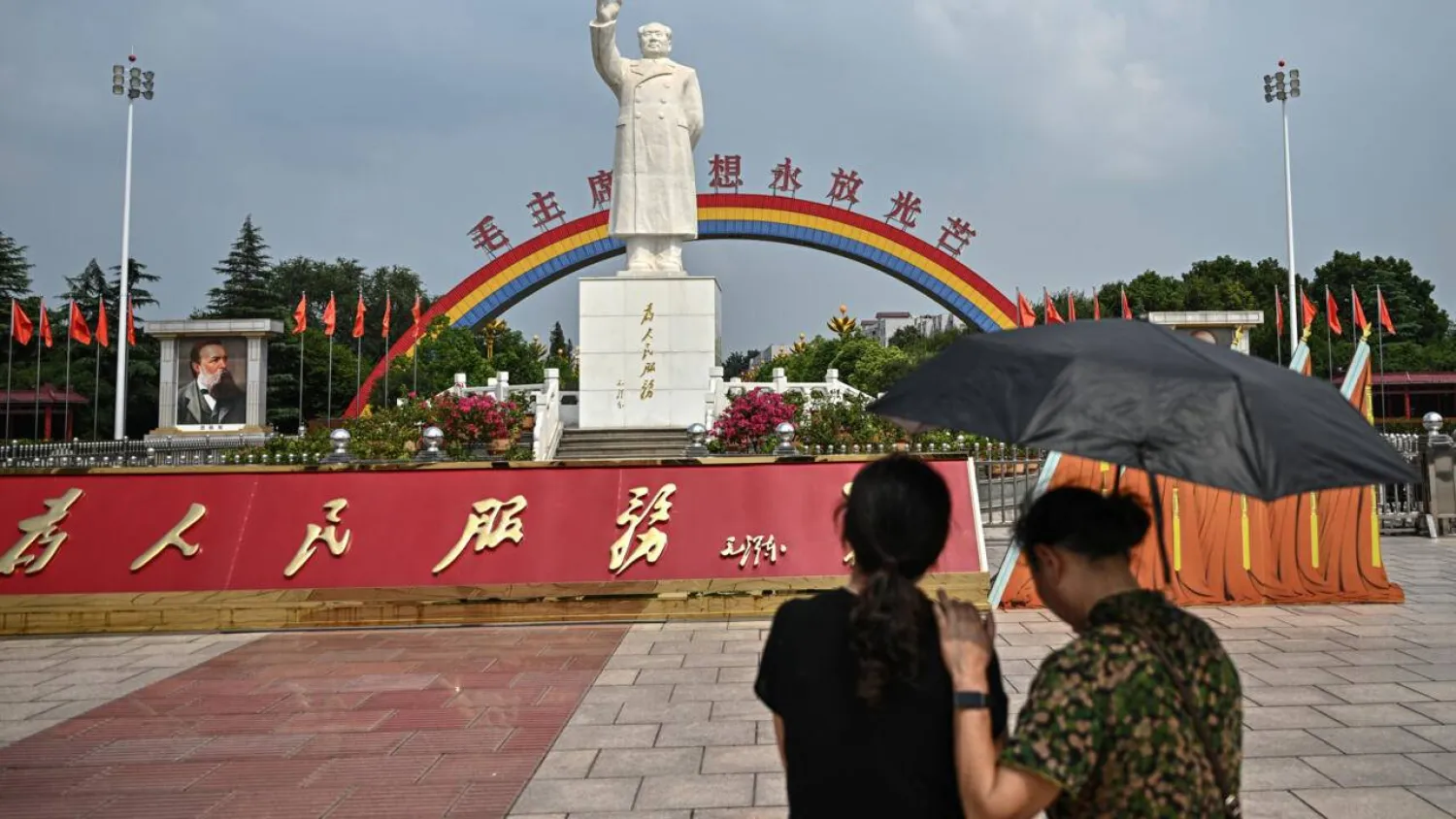
The Great Helmsman, who died September 9 1976, is still very much a fixture in central Henan province's Nanjie -- often dubbed "China's last Maoist village". Pedro PARDO / AFP
TT

China's Memories of Mao Fade to Nostalgia 50 Years after His Death

The Great Helmsman, who died September 9 1976, is still very much a fixture in central Henan province's Nanjie -- often dubbed "China's last Maoist village". Pedro PARDO / AFP

The crimson flags on Nanjie village's "East is Red" Square hang limp in the sweltering summer heat as a trickle of tourists take photos with a towering statue of Chairman Mao Zedong, still gleaming white almost 50 years after he died.

The Great Helmsman, who died September 9 1976, is still very much a fixture in central Henan province's Nanjie -- often dubbed "China's last Maoist village", said AFP.

Nostalgia for Mao's egalitarian ideals is growing in China as memories of his turbulent rule fade and the country grapples with a slowing economy and inequality.

Mao, who led the 1949 communist revolution against the ruling nationalists, ushered in an era of collectivized ownership he argued would drive industry and unite the country, but his drastic policies are also blamed by historians for mass starvation and millions of deaths.

While the ruling Chinese Communist Party maintains Mao was a revolutionary hero, it publicly acknowledged after his death that his devastating Cultural Revolution was a "grave mistake" -- a verdict upheld by subsequent leaders.

In Nanjie, countless murals of the former Chinese leader are plastered around the village.

Residents still live under Maoist principles of shared ownership, while the rest of the country moved on from that economic model.

"I still revere him very much," Xie Kaiyue, a 22-year-old local university student, said of Mao, who died almost three decades before she was born.

"I think young people in the village and, actually, myself, aren't as strong-spirited as in the past... People were purer," she said.

Nearby, electric carts whisked visitors past uniform apartment blocks plastered with socialist slogans as guides explained how cooperative ownership in local enterprises funds free housing for residents.

- Party line -

Around 500 kilometers (310 miles) north, in the mountain village of Dazhai in Shanxi province, once promoted by Mao as a national model after locals terraformed its arid hills into irrigated fields, tourists reminisce about an era when the Great Helmsman dominated political and social life.

"(People) didn't have enough to eat or to wear," Li, a 64-year-old tourist from Xi'an, said of his childhood.

"But... the whole country was full of vigor, and there was a spirit of struggling with heaven, earth, and people to change every aspect of China," the retiree said.

"Of course I miss it."

Now, Dazhai is overflowing with shops selling items that support Mao's personality cult -- posters, playing cards, and crockery emblazoned with his image, and the "Little Red Book" of his quotations.

Still, references to dark chapters of his decades in absolute power are tightly censored in public discourse.

The decade-long episode instigated by Mao in 1966 saw intellectuals brutally targeted as "class enemies" and schools shuttered, setting China back for years in education and development.

Private property and land were collectivized, while economic management pushed the country to the Great Famine, which the government says killed around 15 million people, while historians estimate around 20-43 million.

In one museum, text mentioning the Cultural Revolution had been crudely scraped off signage.

"Everything you see in the public domain... is the party line. No one is allowed to deviate from this," said scholar Xu Chenggang, who was targeted as a child in Beijing during the Cultural Revolution because his father was labelled a "rightist".

Mao's face is printed on banknotes, his portrait overlooks Tiananmen Square, and his body is preserved in a mausoleum.

Every year new movies and TV shows dramatizing Mao's life beam the message of his great deeds to public.

Public discussion has been squeezed further under current leader Xi Jinping, who warns against "historical nihilism", or narratives contradicting the party's own.

"The Communist Party told people there were mistakes, but what's the meaning of 'mistake'? No one knows," Xu said.

- 'Great figure' -

The sanitized history has left space for romanticized interpretations among youths frustrated by long working hours and intense competition in education and the job market.

In December, a viral video series on Bilibili -- a platform popular with those under 30 -- argued that the 2017 movie 'Youth', which follows young performers in a military dance troupe during the 1970s, was a subtle ode to the Cultural Revolution.

The videos, which praised Mao and blamed capitalist elites for crushing the movement, were removed after gaining over 35 million views in less than a week.

"Today, there is more of a sense that the Cultural Revolution was a period of idealism, where society was fired by ideals and not by the relentless pursuit of money and material goods," said to Kerry Brown, head of the Lau China Institute in London and author of a recent book on Mao.

"This is, of course, a total fabrication," he said.

Many also credit Mao with laying the foundation for China to become a modern, technologically advanced nation, said Mobo Gao, professor of Chinese studies at Adelaide University.

"They ask, where did (today's China) come from? It came from the establishment of the PRC," said Gao, who lived through the Mao era in rural Jiangxi province.

"Who was the one who really established the PRC? It must be Mao."

In Shijiazhuang, an industrial city of seven million northeast of Dazhai, 20-year-old Wang Zhihao and his classmates posed with a giant Mao statue opposite the municipal government.

"We admire and revere Chairman Mao very much. He is a great figure," Wang said, as the sound of elderly residents singing songs praising the Communist Party drifted over from the nearby square.

"He led the founding of New China."


US-led Troops Exit Iraq: What's Next for Pro-Iran Groups?

A giant Iraqi flag hangs off the reconstructed 12th century "Hadba" leaning minaret at the historic Great Mosque of al-Nuri in the old city of Mosul on September 29, 2026 as Iraq marks the withdrawal of the US-led anti-ISIS coalition forces from the country.  (Photo by Zaid AL-OBEIDI / AFP)
A giant Iraqi flag hangs off the reconstructed 12th century "Hadba" leaning minaret at the historic Great Mosque of al-Nuri in the old city of Mosul on September 29, 2026 as Iraq marks the withdrawal of the US-led anti-ISIS coalition forces from the country. (Photo by Zaid AL-OBEIDI / AFP)
TT

US-led Troops Exit Iraq: What's Next for Pro-Iran Groups?

A giant Iraqi flag hangs off the reconstructed 12th century "Hadba" leaning minaret at the historic Great Mosque of al-Nuri in the old city of Mosul on September 29, 2026 as Iraq marks the withdrawal of the US-led anti-ISIS coalition forces from the country.  (Photo by Zaid AL-OBEIDI / AFP)
A giant Iraqi flag hangs off the reconstructed 12th century "Hadba" leaning minaret at the historic Great Mosque of al-Nuri in the old city of Mosul on September 29, 2026 as Iraq marks the withdrawal of the US-led anti-ISIS coalition forces from the country. (Photo by Zaid AL-OBEIDI / AFP)

With the US-led anti-extremist coalition leaving Iraq, Baghdad faces mounting pressure to rein in Tehran-backed armed groups, a difficult task in a country long caught between its allies, the US and Iran.

Prime Minister Ali al-Zaidi, who assumed power earlier this year with the United States' blessing, has pledged that after the coalition exits on Wednesday, pro-Iran groups would hand over their weapons to the state.

But the issue has proven far more complicated than simple announcements, said AFP.

Iraq has long been a proxy battleground for the US and Iran, with each interfering in major political decisions and government formation.

The ongoing Middle East war, during which Iran-backed groups in Iraq targeted US facilities there and around the region hundreds of times, has deepened Iraq's entanglement.

- 'Tricky' -

Several senior Iraqi officials told AFP that Iran will not accept that the factions hand over their weapons, especially amid the regional war, and its officials have clearly relayed the message.

"If there's a deal between the US and Iran, I think that this whole issue becomes very easy to deal with," Iraqi political analyst Sajad Jiyad said.

But Jiyad said "Iran has been very clear that while there is a conflict going on, they cannot give up their strategic capabilities", including the Iraqi groups and "their ability to attack US interests in Iraq and the region".

It is, however, a "tricky situation", because Iran doesn't want an "unstable Iraq", he added.

"Iran's agenda is to reach a deal with the US, so that these groups will naturally reduce their visibility and activity," without giving up capabilities.

The factions also want assurances that the US won't target them before they consider surrendering their weapons.

But if no progress is forthcoming in terms of disarming these groups, then "the US is not going to make a longer-term commitment of not targeting them", he said.

It will continue on its usual paths: diplomatic and economic pressure through sanctions, and occasional strikes.

- 'Liability' -

The US-led coalition deployed to Iraq and Syria in 2014 to fight the ISIS group, which seized large swathes of both countries and committed atrocities.

Both the coalition and Tehran-backed groups fought ISIS, their common enemy.

After ISIS's defeat in Iraq in 2017, those groups demanded the withdrawal of US troops and began targeting them with drones and missiles, triggering US retaliatory strikes that killed several of their commanders over the years.

US pressure on successive Iraqi governments to disarm the factions mounted, especially after they intervened in support of Palestinians during the Gaza war in 2023, and later backed Tehran in the Middle East war.

Political analyst Jiyad said little should be expected after the coalition's pullout.

"We are not going to get disarmament... but there has to be some sort of progress and some plan," he said.

"What is probably going to happen is the process begins" towards a solution, but it will require time and "trust-building measures".

The Tehran-backed groups feel the government is unable to protect them from the US, and the government sees them as a "liability," he added.

- No plan -

While some groups said they would disarm, other powerful factions refuse to do so.

But the government "does not even have a plan" for how it is going to disarm them, a diplomatic source in Baghdad said.

Two senior politicians told AFP that Zaidi, a newcomer to politics, had repeatedly said he was ready to "confront" the groups if they don't disarm.

For weeks, tensions grew until an unannounced truce was reached, with the intervention of senior politicians who are now hoping to work out a deal.

An Iraqi official said that "the issue needs time to reassure the factions, and prevent any confrontation between Iraqi forces and the armed groups".

Kazem al-Fartoussi, spokesperson for the Kataeb Sayyid al-Shuhada armed group, said the factions don't want a confrontation with the state because "there will be no winners".

But "our weapons are precious, so we have said these weapons are in exchange for sovereignty," including the withdrawal of foreign troops and an end to American political and economic interference.

Fartoussi said the factions are in talks with the government about "regulating" their weapons, as well as their relationship with the state, but he doesn't trust the US.

For the Americans and Israelis, their objective is "nothing other than eliminating the factions, not the weapons," Fartoussi said.

If the issue is the factions' "existence", then "we reject any discussion".


Israel Obliterates South Lebanon's Architectural Heritage

The residence of Said Shahine, father of Ghaleb and Fahmi Shahine, which was completely destroyed in the city of Nabatieh (Kamel Jaber archive)
TT

Israel Obliterates South Lebanon's Architectural Heritage

The residence of Said Shahine, father of Ghaleb and Fahmi Shahine, which was completely destroyed in the city of Nabatieh (Kamel Jaber archive)

Daily attacks around the city of Nabatieh and the town of Kfar Rumman have not stopped the Zein family from launching work to restore “what can be restored” of the home of Youssef Bek Zein, which was damaged by intensive Israeli strikes several months ago.

Descendants of one of Nabatieh’s best-known political families see preserving their heritage as an act of defiance against Israel, which they say is erasing physical traces and memories from the land and seeking to eliminate historic homes with distinctive architecture, political family residences, and urban and historical landmarks of all kinds across South Lebanon.

During the two large-scale wars Israel waged on South Lebanon, airstrikes and demolitions wiped out dozens of heritage landmarks, including political family homes whose architecture and libraries documented periods of Jabal Amel’s political history over the past two centuries.

This photograph taken from the southern Lebanese village of Hanniyeh shows smoke rising from the site of a series of Israeli controlled explosions in the nearby village of al-Mansouri on September 28, 2026. (Photo by Kawnat HAJU / AFP)

In Nabatieh alone, Israeli bombardment razed 147 homes between 80 and 110 years old. Some had developed from houses originally built 200 years ago. They included heritage properties belonging to local political leaders, ministers and lawmakers who had played roles in Nabatieh and its surroundings over past decades.

The damage also extended to political family residences around Nabatieh, including the Asaad family home in Taybeh. Local activists say many old houses were razed along with it, including the home of Khalil Abdallah in Khiam, one of the region’s most prominent historical leaders, built in 1862.

Abdel Aziz Zein’s Home: A Cultural Role

The home of Youssef Bek Zein, heavily damaged by Israeli bombardment, is now among the last remaining heritage landmarks and architectural witnesses in the Nabatieh area following the loss of the Abdel Aziz Zein residence.

In recent years, that residence had become a cultural hub in the region. His son, Dr. Saad Zein, expanded it to host cultural and community activities.

“My family home, the Abdel Aziz Zein residence, was more than 80 years old,” Dr. Saad Zein told Asharq Al-Awsat. “An Israeli strike completely demolished the house and wiped out all its features — not only its architecture, but also its cultural role.”

The Abdel Aziz Zein residence (Saad Zein archive)

Zein said the house had served as a venue for cultural and social activities since at least 2000. He had established a small museum there documenting the history of Jabal Amel, and the house “became a cultural destination in the region.”

The residence was later expanded to include gardens and a diwaniya, a traditional reception space that is a central feature of southern Lebanese architecture. In recent years, it became known as the “Saad Zein House.”

The strike on the large residence also damaged the adjoining Zein family home. That residence had been a center of political and social leadership for more than a century. Built 150 years ago, it housed the Ottoman governor in the 19th century before ownership passed to the Zein family and Youssef Bek Zein took up residence there.

Even the Family Tombs Were Hit

Zein entered parliament after the proclamation of Greater Lebanon in 1924, and his family became one of Jabal Amel’s most prominent political families during the last century. Its parliamentary representation continued uninterrupted until 2018.

“The Youssef Bek Zein residence was severely damaged. The roof, courtyard and family tombs were hit, including Youssef Bek’s grave,” Dr. Saad Zein stated.

“We are now working intensively and quickly to restore the house so it can be usable again and remain a witness to a political era, given that the family is one of Jabal Amel’s founding families and has maintained a cultural, developmental and social presence — a role that continues with me and my uncle.”

Zein stressed that the targeting of political homes and urban and historical landmarks “aims to erase traces and memories from the land in order to sever the Lebanese people’s connection to their homes, land and heritage.”

Deliberate and Systematic Destruction

Cultural and social figures in Nabatieh broadly agree that what occurred during the wars of 2024 and 2026 amounted to the “systematic destruction of memory without any actual justification.”

They argue that the concentrated bombardment and leveling of longstanding family homes historically associated with political positions opposed to Hezbollah contradicts the Israeli military’s assertion that its strikes target only Hezbollah facilities and headquarters.

One particularly notable case was the leveling of the home of former lawmaker Habib Sadek, founder of the Cultural Council for South Lebanon, in Kfour, west of Nabatieh.

Sadek was among South Lebanon’s best-known political and cultural activists. He served in parliament in 1992 and was one of the most prominent chroniclers of Israeli violations in the south since the 1940s. He encouraged the publication of works sponsored by the Cultural Council and combined a political career with his work as a writer, poet and thinker.

Manuscripts Documenting Violations

Kamel Jaber, head of the Cultural Council’s Nabatieh branch, told Asharq Al-Awsat that after Sadek’s home in Khiam was demolished in 1977, the area remained under occupation until 2000 and the family was forced to live between Beirut and Nabatieh.

“The family was determined to build a house outside the city resembling the homes of southerners — meaning it would have a garden surrounded by pine trees, with roses blooming in it,” Jaber said.

“Sadek paid particular attention to a diwaniya on the lower floor of the house, where he kept many of the manuscripts he had presented through various radio programs, as well as writings from the 1960s and 1970s. He also created extensive libraries in the diwaniya containing books, manuscripts and the rest of his cultural legacy.”

Jaber said Sadek was “one of the most prominent cultural figures who wrote and published works and books about the south, documenting violations and various forms of Israeli occupation, whether related to ambitions over water, geography or other issues, and produced studies showing the harm inflicted on the south through occupation.”

From that perspective, Jaber said the targeting of the house “was a targeting of Habib Sadek, his role, legacy and career.” He ruled out any security-related reason for striking the house, which he said was “closed and checked daily by a caretaker.”

Erasing Architectural and Political Heritage

The devastation is viewed locally as part of an effort to eliminate Nabatieh’s urban, architectural and political heritage.

After the 2024 war, cultural figures in the city launched an initiative, involving civil society groups in cooperation with the municipality, to document heritage buildings lost to Israeli bombardment. The survey was updated just two weeks before this article was written.

It found that 147 homes had been completely razed, leaving only a very small number of such buildings standing.

During the 2026 war, what remained of the Fadl al-Fadl house in the Manshieh district was demolished. The house was built late in the last century and designed by an Egyptian architect. General Gouraud visited it in the 1920s during a trip to the south while serving as French high commissioner in Lebanon.

The home of former lawmaker Mohammed Bek al-Fadl, meanwhile, lost large sections after strikes hit its surroundings in 2024. The house is 102 years old. Jaber, who works to document local memory through a civil society organization in Nabatieh, said its new owner had decided to restore it.

The home of Mohammed Bek al-Fadl (Kamel Jaber archive)

Erasing Cultural Memory

Nabatieh residents see the campaign as targeting architecture that embodies the area’s cultural heritage and its social, political and urban memory.

In Nabatieh, Israeli strikes completely leveled the residence of the late minister and lawmaker Rafik Shahine, as well as the home of Said Shahine, father of lawmakers and ministers Ghaleb and Fahmi Shahine.

Other buildings lost in the strikes had been regarded as architectural masterpieces, including the palace of Dr. Bahjat al-Mirza, considered one of the city’s most beautiful homes because its facades featured carvings in stone. Mirza was among Nabatieh’s first physicians in the 20th century to open his home to provide medical care to residents.

Mahmoud Shahine’s house was also razed in 2026. The building had served as a school during the last century and was among the houses constructed on the remains of older homes built some 200 years ago.

On Sept. 6, 2026, an Israeli strike leveled the home of Dr. Adnan Sharif, a century-old architectural landmark.

The home of Dr. Adnan Sharif (Kamel Jaber archive)

The home of former lawmaker Anwar Sabbah, father of Sadek Sabbah, director of Sabbah Brothers television production company, was also demolished. Built on a hill in Nabatieh in the early 1990s, it was separate from the family residence in the city, which remained standing.

Strikes also razed Ghandour Hospital, one of the main hospitals that provided medical services to the Nabatieh area during the period of occupation beginning in the 1980s.

A War on History

Israeli strikes did not only target houses and mansions but also hit archaeological and heritage sites across the south.

A market dating to the Mamluk era in Nabatieh was heavily bombarded, leaving part of it in ruins. The capital of an ancient column was dislodged at a UNESCO-listed site in the southern coastal city of Tyre.

A religious site known as “Shamoun al-Safa,” visited by both Muslims and Christians in the southern town of Shamaa, was also razed, as was Shamaa’s Crusader castle.

There is also no information about the condition of “Ain al-Fawqa” in Taybeh after the area surrounding it in the town square was devastated. The water collection spring was built in a spiral form and contains architectural features resembling examples from the Roman and Byzantine periods. It was restored during the Ottoman era.

Culture Minister Ghassan Salame told Reuters last month that historic towns outside the designated area were pummeled with airstrikes, including Tyre and Nabatieh.

Heavy bombing hit the town of Tebnin, prompting fears that its Crusader fortress was also damaged, Salame said.

"Heritage is not only Roman and Phoenician antiquities,” he added. “Heritage is also historic buildings, archaeological sites, and buildings with a cultural function."

He expressed concern that the Israeli campaign could completely erase centuries of Lebanese history.

UNESCO, meanwhile, said in a statement that it was concerned about the situation in Tyre, a World Heritage site under the agency’s enhanced protection.

It added it was deeply concerned by reports of damage to Shamaa Castle in South Lebanon and fighting near Beaufort Castle, denouncing what it described as “unlawful attacks on cultural property.”


'Currently Impossible': North Korea Defections in Freefall

Visitors look towards North Korea, which has worked to seal off links to the outside world. Lillian SUWANRUMPHA / AFP
TT

'Currently Impossible': North Korea Defections in Freefall

Visitors look towards North Korea, which has worked to seal off links to the outside world. Lillian SUWANRUMPHA / AFP

A building-sized North Korean flag waves from a tower on the de facto border with South Korea, marking territory that experts say has become nearly impossible to escape.

The combined total of North Koreans to reach South Korea in the past six years is less than the number that typically defected each year for decades -- and appears to be declining further in 2026, said AFP.

The main cause is leader Kim Jong Un's aim to preserve his family dynasty by sealing the country off from the outside, keeping people in and information out, experts say.

"As I understand it, bringing family members directly from North Korea is currently impossible," 29-year-old Chae Yoon-seo, who fled in 2019, told AFP.

She swam across a river into China at night with a smuggler's help, and travelled through Laos, Vietnam and Thailand before finally flying to South Korea.

Defections to the South hit a peak of more than 2,900 in 2009 and stayed well above 1,000 per year for the next decade.

But there were just 63 in the first half of this year -- down by over a third from the same period in 2025, said Seoul's Unification Ministry.

- 'Soviet-style border' -

Arrivals have fluctuated over the decades, but plunged sharply during the Covid pandemic when many nations shut their borders.

A key change in North Korea, however, started years before.

After taking power in 2011, Kim began restricting the informal trade and migration links along the roughly 1,415-kilometer (880-mile) northern border with China.

In addition to being an economic lifeline, the Chinese border region has also been the first step in most defectors' escapes.

The long frontier was relatively porous, unlike the heavily mined, fenced and surveilled Demilitarized Zone (DMZ) that serves as the Koreas' de facto border.

Along the boundary with China, Kim's government has erected fences and installed cameras as well as strips of sand that preserve the footprints of anyone who crosses.

"North Koreans built a real Soviet-style border security system," said Andrei Lankov, an expert on the North at Kookmin University in Seoul.

Beijing has helped too, said Lankov, noting China's preference to keep the status quo of the Kim dynasty by opposing potential instability from defectors or their supporters.

As part of its efforts, China reportedly has put in place hundreds of facial recognition cameras, noted Rachel Minyoung Lee, senior fellow with the Stimson Center's 38 North.

She added that Beijing also added more patrol boats and new or planned deportation facilities along its northeastern border.

- Ousted, killed or exiled -

The roughly 34,500 defectors to reach the South since 1998 are a fraction of North Korea's 26.6 million people, UN figures show, but the plunging number of escapes has consequences.

"Defectors are the main source of information about the North," said Fyodor Tertitsky, lecturer at Seoul's Korea University, noting both South Korean intelligence and researchers interrogate them.

Though some people still do get out.

Defector Gyuri Kang's 2023 escape by boat with her mother and aunt -- across the maritime border with the South, an extremely rare feat -- was a "miracle", she told a UN hearing.

She is also a case in point for why North Korea has made great efforts to seal itself off.

Kang noted the influence of South Korean dramas smuggled in on USB drives, finding them "so refreshing and more credible than North Korea state propaganda".

"North Korean authorities are keenly aware of the impact of outside media," she said.

In 2020, North Korea made possessing foreign media a crime punishable by years-long forced labor terms -- and potential death sentences for large-scale distribution, according to Amnesty International.

Lankov, from Kookmin University, said external information is the greatest threat to the long-term survival of North Korea's leadership.

"If they let their people interact with the outside world, they are highly likely to be overthrown, and maybe killed or driven into exile," he added.

Chae, the defector, said her hope was that the North's isolated people are not one day simply forgotten by the outside world.

"These days, there are a lot of cynical reactions on helping other countries, so I am a bit worried that one day, interest in North Korean human rights might fade away as well," she added.