
Syria’s Al-Sharaa: Economic Transition Demands ‘Shock’ Decisions

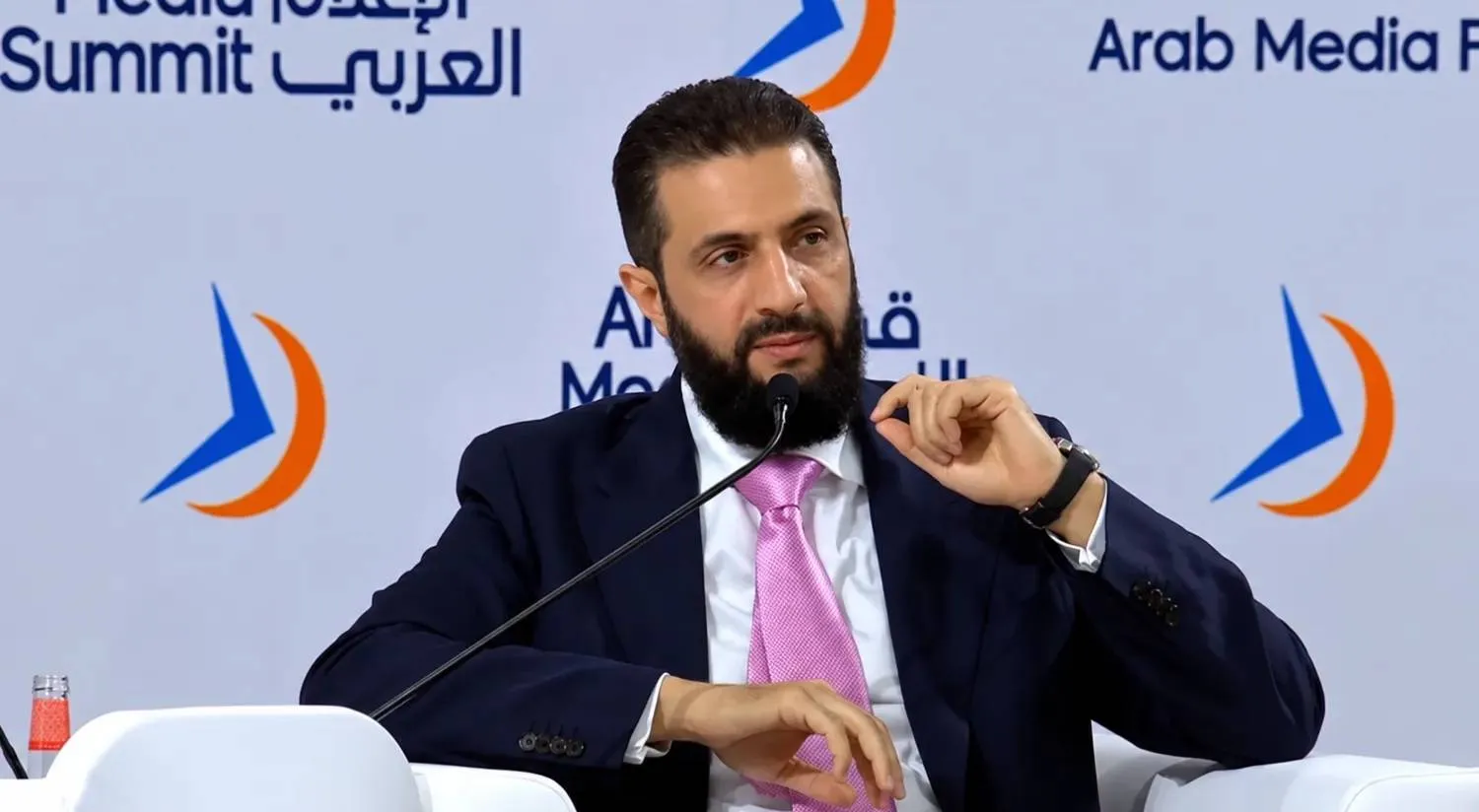
Syrian President Ahmad al-Sharaa speaks at the Arab Media Summit in Dubai on Tuesday. (Asharq Al-Awsat)
TT

Syria’s Al-Sharaa: Economic Transition Demands ‘Shock’ Decisions

Syrian President Ahmad al-Sharaa speaks at the Arab Media Summit in Dubai on Tuesday. (Asharq Al-Awsat)

Syrian President Ahmad al-Sharaa said his country has gone from being a security and political “problem” troubling the region to an economic and strategic opportunity that could contribute to the security of supply chains, energy and trade between East and West.

Speaking at the Arab Media Summit in Dubai on Tuesday, al-Sharaa projected Syria’s economy would reach about $50 billion this year, up from roughly $20 billion in 2024.

He acknowledged that the economic transition requires “shock” decisions, in what appeared to be an implicit reference to measures such as fuel price increases that have triggered protests in several Syrian regions in recent days.

He stressed that his government did not want to pursue a “policy of complaints or promises,” but instead focus on work, with success measured by results felt by Syrians.

Syria is moving away from an economic model marked by heavy bureaucracy, state dominance and corruption toward one giving greater scope to the private sector and investment, he explained.

A sudden transition, however, could cause “a kind of shock”, he added.

The government had studied the experiences of countries that underwent similar transformations and managing the transition required a degree of gradualism alongside decisions that could sometimes be “shocking”, he warned.

Syria’s economy stood at about $60 billion at its prewar peak in 2010 before falling to around $20 billion in 2024. It grew to roughly $32 billion in 2025 and is expected to reach about $50 billion in 2026, before recovering to around its 2010 level in 2027.

Al-Sharaa said ambitions extended beyond a return to prewar levels, with economic programs targeting the possibility of expanding the economy to about $200 billion over the following five to 10 years, provided stability prevailed and the region and world avoided major upheaval.

Regional risks

Regional risks remain among Syria’s biggest challenges, according to al-Sharaa.

The country faces a “heavy legacy resulting from 60 years of destruction and 14 years of continuous war,” he remarked, adding that ending Syria's conflict was not enough to ensure lasting stability without greater regional and strategic security.

“What frightens us most is that wars expand further and further,” he said.

Damascus is working with Arab countries to reduce the impact of wars and mitigate future risks, he added, stressing that Syria could play a pivotal role in strengthening regional stability.

He said the country was undergoing a broad transition involving the rebuilding of state institutions, economic transformation, attracting investment and rehabilitating infrastructure, alongside efforts to consolidate domestic stability and restore its place in its Arab and regional surroundings.

Al-Sharaa described Syria as having gone from “a source of Captagon and human trafficking, and a foothold for spreading conflicts and problems in the region” to a country seeking to become “an area of stability.”

He pointed to growing discussions of its potential role in regional trade, supply-chain and energy security, as well as its position on routes linking East and West.

‘Syria is not a follower’

Turning to foreign policy, al-Sharaa stressed that Damascus sought relations based on “credibility and trust” while preserving the independence of its decision-making.

“Syria does not need to be a follower of any party,” he declared, adding that the country had the civilization, expertise and human resources to make independent decisions while drawing strength from “its brothers and its surroundings.”

Moreover, he stressed that Syria cannot do without its Arab and Islamic surroundings, and relies heavily on Arab states for political support and to benefit from their expertise and development experience.

The country does not want “to start from the zero where these countries began, but from the 100 they have reached,” he revealed.

On international sanctions, he noted that Syria had been among the world’s most heavily sanctioned countries for decades, with the impact extending beyond state institutions to society and the economy.

Generations of Syrians had been unable to engage normally with financial transactions, bank guarantees and the global financial system because of the country’s prolonged isolation, he continued.

He further praised efforts by Prince Mohammed bin Salman, Saudi Crown Prince and Prime Minister, and Turkish President Recep Tayyip Erdogan with US President Donald Trump over sanctions, describing their lifting as a historic turning point for his country.

“I believe Syria was born again after the sanctions were lifted,” al-Sharaa said, adding that the main restrictions had been broken and responsibility now lay in adopting the right “policies, procedures and choices” to move the economy and the state forward.

Aoun: Lebanon Wants Israel Security Deal, Hezbollah Disarmament Without Confrontation

Lebanese President Joseph Aoun speaks during an interview with AFP at the Presidential Palace in Baabda on September 15, 2026. (Photo by JOSEPH EID / AFP)
TT

Aoun: Lebanon Wants Israel Security Deal, Hezbollah Disarmament Without Confrontation

Lebanese President Joseph Aoun speaks during an interview with AFP at the Presidential Palace in Baabda on September 15, 2026. (Photo by JOSEPH EID / AFP)

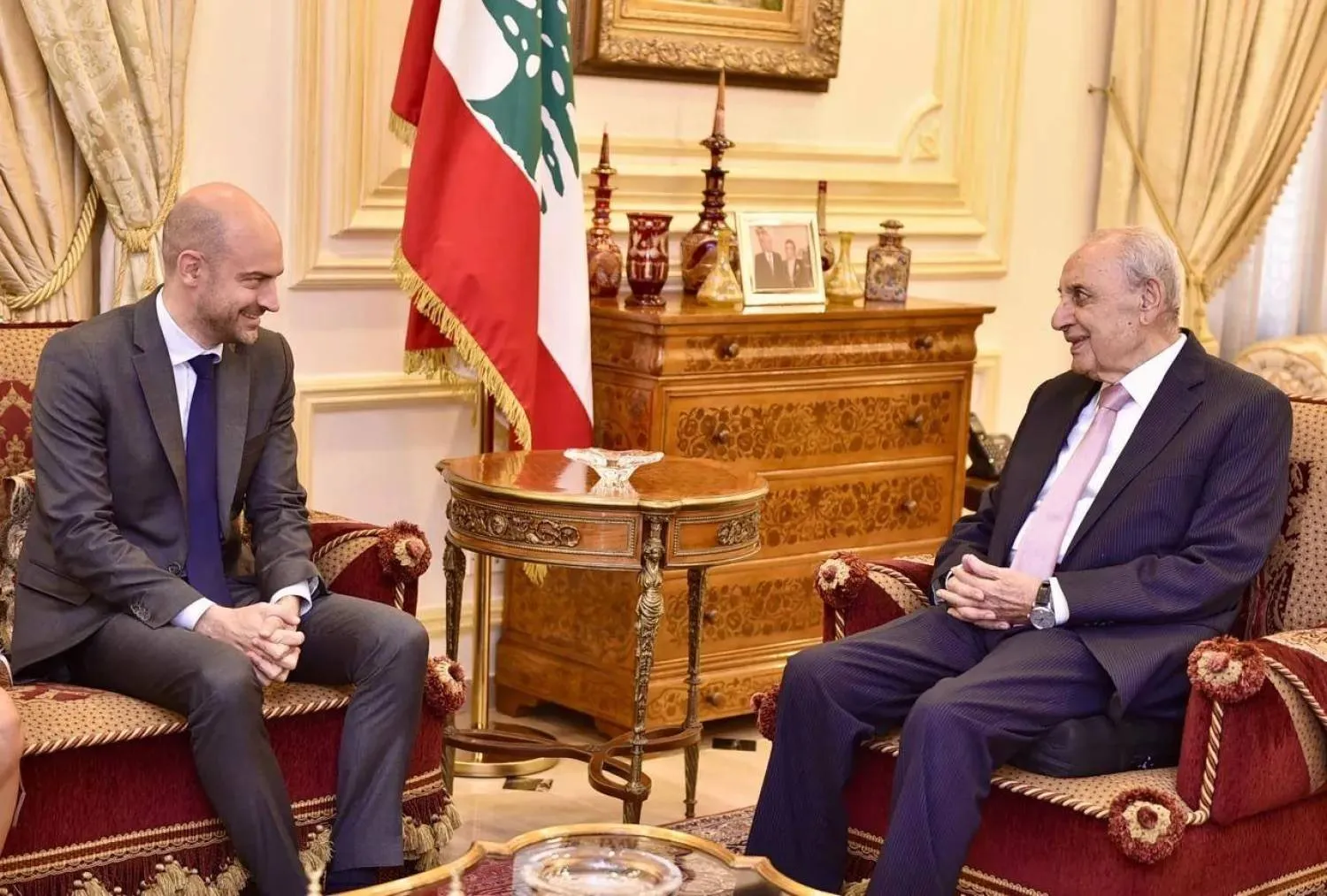
Lebanese President Joseph Aoun told AFP in an exclusive interview he wants to reach a security agreement with Israel once it withdraws from the south, and is determined to disarm Hezbollah without resorting to confrontation.

Speaking ahead of his departure to France on Wednesday, Aoun said Lebanon wanted a new force, European or otherwise, to prevent a security vacuum after UN peacekeepers leave south Lebanon when their mandate expires at the end of the year.

He called on the United States, European Union and Arab countries to support Lebanon's military as it deploys across the south.

In Paris, Aoun will attend a meeting hosted by President Emmanuel Macron and attended by King Abdullah II of Jordan to build international support for Lebanese troops as they deploy across the country.

"What matters is that there is no vacuum," Aoun told AFP on Tuesday. He added that any new force for Lebanon's south, part of which is occupied by Israel, would be "temporary until the (Lebanese) army can deploy."

"Whatever the nature of this force, that poses no problem for me: European, non-European, American, another United Nations force, Asian, or even a mix of European, Arab and Asian forces," Aoun said.

"The best and most optimal option remains extending UNIFIL's mandate," he added.

Under US pressure, the UN Security Council voted last year to end the force's mandate on December 31, 2026.

The mission, currently involving around 8,500 peacekeepers from nearly 50 countries, has been deployed in south Lebanon since 1978.

Aoun also said he wants a security agreement with Israel "primarily to end the state of hostility and the deployment of the army on the border. This could be a prelude to a later peace agreement, but we cannot jump directly to a peace agreement."

"We have no choice but negotiations, because the alternative is war, which would be very costly for us," Aoun added.

"Our Arab and European partners, as well as the United States and our friends, must share with us the responsibility of supporting the army and strengthening the Lebanese state," he said.

Aoun reiterated Lebanon was determined to disarm Hezbollah, saying the decision was "neither negotiable nor open to discussion."

However, he said, "the objective is not a confrontation... We are determined to resolve this issue peacefully.

"This is not about building a state at the cost of a bloody conflict... or a new civil war."

Aoun said he had told Iran that after Hezbollah's disarmament, relations "must be based on mutual respect and non-interference in the internal affairs of the Lebanese people.

"We have no problem with having a relationship with Iran, but we do have a problem with interference in our internal affairs."


Yemeni Government Forces Regroup to Shift the Momentum

Othman Mujalli, a member of Yemen’s Presidential Leadership Council, inspects forces in Hajjah. (government media)
TT

Yemeni Government Forces Regroup to Shift the Momentum

Othman Mujalli, a member of Yemen’s Presidential Leadership Council, inspects forces in Hajjah. (government media)

Yemen’s army and allied forces have raised their state of alert on the Taiz and Hajjah fronts as they move to reorganize their military positions to shift the momentum, while the Houthis increase pressure on Taiz after seizing the western coast as far as Bab al-Mandab.

In northwestern Hajjah province, Presidential Leadership Council member Othman Mujalli inspected Fifth Military Region forces and affiliated fronts, reviewing their readiness, training and morale.

Mujalli said the armed forces would continue confronting the Houthis and working to restore state institutions, stressing the need to maintain morale and prepare for the battle to liberate the country.

He also praised the Fifth Military Region’s ability to develop equipment for ammunition production and the maintenance of weapons and vehicles, as well as bolster its drone unit and advanced surveillance system.

The visit included naval forces, the coast guard and several islands off Midi district. Mujalli reviewed efforts to evacuate civilians and personnel from Zubair Island after they were stranded because of recent developments along the western coast. He also inspected naval readiness to secure the islands and territorial waters and strengthen the military and security presence along the coast.

The visit comes as government forces seek to hold their positions in the northwest while reassessing their military deployment following rapid developments on the western coast.

Pressure on Taiz

In southwestern Taiz, the Yemeni army announced Tuesday that it had struck a Houthi ballistic missile launch platform at Taiz airport, east of the city. The Taiz Military Axis said warplanes targeted the platform as military vigilance increases around the city amid growing pressure from the west.

The Yemeni Armed Forces had earlier announced strikes on Houthi equipment, personnel and positions seized by the group in Dhubab in Taiz province and Al-Khawkhah in Hodeidah province, according to military spokesman Col. Majid al-Nazili.

The strikes coincided with an inspection tour by Taiz Military Axis Chief of Staff Maj. Gen. Abdulaziz al-Majidi of several fronts surrounding the city.

In southern Taiz, Tur al-Bahah Axis commander and 4th Mountain Infantry Brigade commander Maj. Gen. Abu Bakr al-Gbouli inspected front lines stretching from Bani Omar to Jardad and the outskirts of Al-Wazi’iyah district.

Al-Gbouli said his forces were at a high level of combat readiness and capable of responding to developments on the ground, stressing vigilance, operational discipline and constant preparedness for Houthi movements.

Regrouping

The moves follow a major shift after the Houthis seized large parts of the western coast, including Mokha, Al-Khawkhah and Hays, before reaching Bab al-Mandab and several Red Sea islands. The developments have increased pressure on Taiz, which could become a target for Houthi attempts to expand their control and tighten their grip on the city and surrounding countryside.

Observers say government military activity in Taiz and Hajjah reflects an effort to contain the repercussions of losing the coast and prevent the Houthis from turning their recent gains into a permanent reality on the ground, while reorganizing forces and raising readiness in the most sensitive sectors.

Mujalli also urged tribes to protect their sons from Houthi recruitment and being drawn into fighting. He praised Saudi support for Yemeni forces and humanitarian and development projects and inspected efforts by the Masam mine-clearance project to remove mines planted by the Houthis in government-held areas.

The developments indicate that government forces are seeking to move beyond responding to the recent setback and build a more cohesive military posture, particularly in Taiz, where inland fronts intersect with the coast and Red Sea routes, making the province central to any attempt to shift the momentum.


Survivors: Sudan Gold Mine Collapse Kills at Least 60

A group of armed defectors from the Rapid Support Forces (RSF) arrive in a vehicle as they are believed to be surrendering to the Sudanese military, in the west of Omdurman on August 19, 2026. (Photo by Ebrahim Hamid / AFP)
TT

Survivors: Sudan Gold Mine Collapse Kills at Least 60

A group of armed defectors from the Rapid Support Forces (RSF) arrive in a vehicle as they are believed to be surrendering to the Sudanese military, in the west of Omdurman on August 19, 2026. (Photo by Ebrahim Hamid / AFP)

A gold mine collapsed in southern Sudan, killing at least 60 small-scale miners, two survivors told AFP on Wednesday, while many more are missing and feared dead under the rubble.

Shafts began collapsing in the Al-Zaraa mine near the town of El-Nahud in West Kordofan on Tuesday, and by the following morning 60 bodies had been retrieved.

"We don't know how many more are still inside," one of the survivors, Khair al-Sayyed Jabara, told AFP after an all-night rescue operation with fellow miners, using the same rudimentary tools they use to mine.

"Everyone's working very hard to retrieve the bodies or any survivors, but it's difficult. We need heavy machinery to clear the rock and soil."

Since war erupted in April 2023 between Sudan's army and the Rapid Support Forces, the war efforts of both sides have been largely funded by the gold industry, in addition to foreign backers.

The conflict has devastated Sudan's already fragile economy and left much of the country out of work, pushing many into a dangerous gold rush.

Artisanal and small-scale mining, which takes place in unofficial zones or decommissioned mines, accounts for the majority of gold extracted.

Al-Amin Suleiman, another miner who was working at the rim of Al-Zaraa on Tuesday, told AFP that "the shafts here are all close together, if one collapses, it brings down all the ones next to it".

"This is what happened here. So far, 60 bodies have been pulled out but there are people still trapped underground since yesterday. I don't think they are alive."

Sudan is suffering the world's largest hunger and displacement crises, with nearly 20 million people facing crisis levels of hunger.