

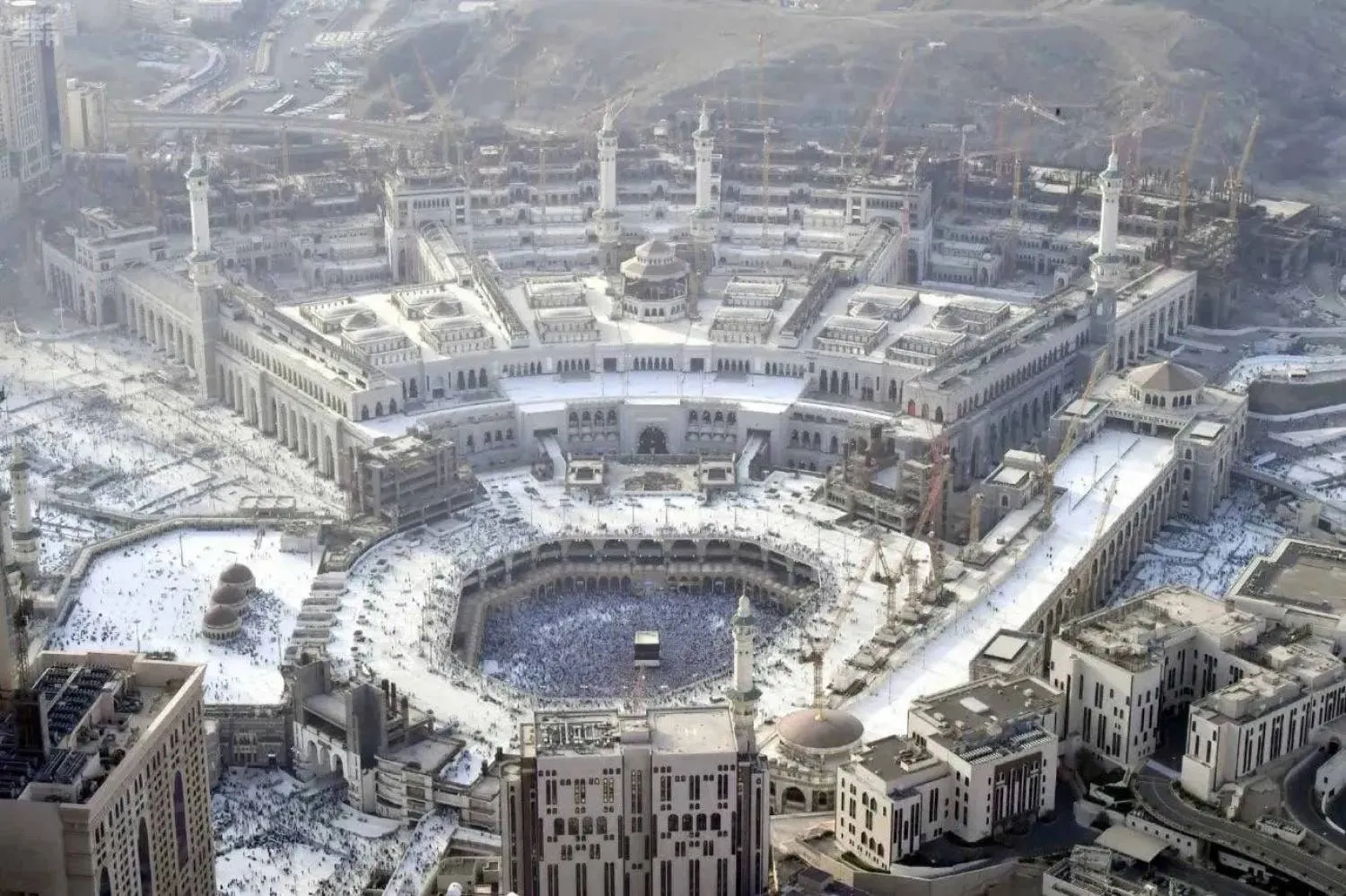

Houthis Continue Targeting Islamic Holy Sites, Arab Coalition Says Security of Two Holy Mosques Is a ‘Red Line’

Attacks by the Houthis have escalated systematically, targeting Islamic holy sites and civilian facilities in Saudi Arabia (SPA)
TT

Houthis Continue Targeting Islamic Holy Sites, Arab Coalition Says Security of Two Holy Mosques Is a ‘Red Line’

Attacks by the Houthis have escalated systematically, targeting Islamic holy sites and civilian facilities in Saudi Arabia (SPA)

A Houthi drone attack targeting Makkah on Tuesday was not the first of its kind, but followed an earlier ballistic missile attack in July 2017, according to Maj. Gen. Turki al-Malki, spokesperson for the Saudi-led Arab Coalition.

The Coalition said firmly that “the security of the Two Holy Mosques and the pilgrims is a red line, and the Joint Forces Command of the Arab Coalition will not hesitate to take the necessary deterrent measures against the terrorist Houthi militia and its hostile and terrorist conduct.”

By targeting Makkah with a drone, which the Royal Saudi Air Defense Forces intercepted and destroyed south of the city, the Houthis committed a new violation against Islamic holy sites and places of worship.

The incident followed an attack on a mosque in Al-Tuwal governorate in Jazan on Saturday, as well as an attack launched from Iraqi territory toward Madinah, revealing a pattern of conduct by the militias.

A Coalition statement said the incident “can only be described as a disgraceful act — an attempt to target the cradle of revelation, the land of the divine message and a destination cherished by millions of Muslims from around the world.”

It said the attack also sought to terrorize pilgrims visiting the Grand Mosque and harm citizens and residents.

“This hostile attempt will remain a black mark on the record of violations committed by the extremist terrorist Houthi militia, as it was a deliberate act intended to provoke the feelings of millions of Muslims,” the statement said.

The Saudi Foreign Ministry’s condemnation, along with broad expressions of solidarity from several Arab and Islamic countries and other states in the region and around the world, reflected the gravity of the Houthi action.

The countries also commended the Royal Saudi Air Defense Forces for intercepting the hostile drone before it entered the restricted airspace over the holy city of Makkah.

Violation of international law

Under the Rome Statute of the International Criminal Court, intentionally targeting mosques and other places of worship is prohibited as long as they are not military objectives. Such attacks constitute war crimes in both international and non-international armed conflicts.

Places of worship of cultural or spiritual importance also receive additional protection under Article 53 of Additional Protocol I to the Geneva Conventions and Article 16 of Additional Protocol II.

Rule 38 of customary international humanitarian law further requires special care to avoid damage to buildings dedicated to religious purposes.

Consequently, deliberate attacks on mosques and places of worship during armed conflict constitute violations of international humanitarian law and may amount to war crimes when the sites are not military objectives.

Targeting regional security

Khaled al-Habbas, a former assistant secretary-general for political affairs at the Arab League, told Asharq Al-Awsat that attacks on Saudi Arabia by Iran-aligned militias underscored the functional role those groups play as proxies directed by Iran’s Revolutionary Guards to destabilize security in the region.

He said Iran had sought to target the kingdom through its regional proxies because of Saudi Arabia’s standing and influence regionally and internationally, its spiritual and economic importance, and its role as the strategic depth of the Gulf states and the heart of the Arab and Islamic worlds.

In reality, he said, targeting Saudi Arabia amounted to targeting the security and stability of the entire region, as well as regional and international security.

Aggression against the Islamic world

Al-Habbas said the escalation came as Iran’s regional role was receding, including a decline in its ability to control the Strait of Hormuz.

He described the conduct of Iran’s proxies and their aggression against Saudi Arabia as evidence of a lack of ethical restraint, a failure to respect the principles of good-neighborly relations and a disregard for international law and the purposes and principles of the United Nations Charter.

Al-Habbas said attacks on holy sites constituted a grave violation of their sanctity and blatant aggression against all Islamic countries, requiring condemnation and firm action.

“Despite the kingdom’s consistent approach of seeking de-escalation and supporting a political settlement, it unquestionably has the right to defend its security and stability,” he said.

“Arab and Islamic countries must also stand against the arrogance and aggression of Iran and its proxies.”

Al-Habbas also called for a firm international stance against the militias’ aggression, saying regional security was inseparable from international security because of the region’s geostrategic and economic importance.

Political analyst Abdul Latif al-Mulhim described such attacks as a continuation of the Houthi militia’s systematic hostile approach and its attacks on residential areas and critical facilities, in flagrant defiance of international and humanitarian laws and conventions.

He said the attacks embodied the group’s extremist criminal conduct, its rejection of all peace efforts and the threat it posed to regional and international security and stability.

The international community must fulfill its responsibilities

Al-Habbas and al-Mulhim agreed that the timing of the attacks, coinciding with the militia’s control of the Bab al-Mandab Strait and its restrictions on maritime traffic, offered the world and the international community a clear picture of the conduct to be expected from the group if it continued its actions.

They said the situation also warned of an imminent threat to the region’s security and economic future if the international community delayed fulfilling its responsibility to combat the group’s criminal activities.



Arab League Secretary-General Condemns Attempted UAV Attack on Makkah

Arab League Secretary-General Condemns Attempted UAV Attack on Makkah
TT

Arab League Secretary-General Condemns Attempted UAV Attack on Makkah

Arab League Secretary-General Condemns Attempted UAV Attack on Makkah

Arab League Secretary-General Nabil Fahmy condemned the attempted UAV attack on Makkah, following the Kingdom's interception and destruction of the hostile aircraft south of the city before it could breach the holy site's restricted airspace.

Fahmy emphasized that compromising the sanctity of Islamic holy sites endangers the safety of citizens, residents, and pilgrims and constitutes a flagrant provocation to Muslims worldwide, SPA reported.

He said the attack reflects a continued and dangerous escalation by the Houthi militia targeting Saudi civilian infrastructure, exacerbating regional tensions and undermining stability.

He stressed the urgent need to halt this escalation, respect international law and the UN Charter, and adhere to UN Security Council Resolution 2216 (2015), which calls for an end to threats against neighboring states.

Fahmy affirmed that the Kingdom's security is an essential pillar of regional stability and reiterated the Arab League's complete solidarity with Saudi Arabia and full support for all measures taken to defend its territory, citizens, and holy sites. He also commended the vigilance and efficiency of the Royal Saudi Air Defense Forces in thwarting the attack.


Hajj and Umrah: Expanded Options for Umrah Performers, No New Requirements for Arrivals from 170 Countries

Engineer Abdulmohsen Al Salem, Saudi Ministry of Hajj and Umrah Undersecretary for Umrah and Visit Affairs (Photo: Ghazi Mahdi)
TT

Hajj and Umrah: Expanded Options for Umrah Performers, No New Requirements for Arrivals from 170 Countries

Engineer Abdulmohsen Al Salem, Saudi Ministry of Hajj and Umrah Undersecretary for Umrah and Visit Affairs (Photo: Ghazi Mahdi)

Abdulmohsen Al Salem, Undersecretary of the Ministry of Hajj and Umrah for Umrah and Visit Affairs, confirmed that there are no new requirements for Umrah, explaining that the ministry continues to work to facilitate procedures for Umrah performers.

In an interview with Asharq Al-Awsat, Al Salem stressed that the ministry is working to develop the Umrah journey and expand the options available to Umrah performers through initiatives including the multiple-entry Umrah visa, enabling bookings through approved online travel platforms, and enhancing the integration of digital services and artificial intelligence applications. He noted that this approach coincides with early preparations for peak periods and efforts to enhance the sector's readiness to accommodate expected growth.

Peak Periods

Regarding peak periods, Al Salem said they are affected by Umrah demand levels throughout the season. The ministry, in coordination with relevant authorities and service providers, works to prepare for these periods in advance and enhance readiness to accommodate the expected growth.

He added that each year, the ministry works to achieve gradual and sustainable growth in the number of Umrah performers, in line with the targets of Saudi Vision 2030, while simultaneously developing services, enhancing the sector's readiness, and improving the quality of the experience for the Guests of Allah.

New Initiatives

According to Al Salem, the ministry is working on a number of initiatives aimed at developing the Umrah experience and facilitating the Umrah journey. Among the most prominent is the multiple-entry Umrah visa initiative, which the ministry launched recently. He said the initiative represents a model for developing arrival procedures and gives Umrah performers greater flexibility in planning their journeys and performing Umrah.

The ministry is also working to expand direct access for individuals to Umrah services through approved global and local online travel platforms, enabling Umrah performers to plan their journeys, access services, and make bookings with greater ease and flexibility.

Al Salem said these initiatives form part of a broader approach to developing the Umrah journey model by expanding the options available to Umrah performers, facilitating access to services, and utilizing digital solutions throughout the different stages of the journey. This contributes to enhancing the quality of the experience and raising the level of competitiveness in the Umrah sector.

Artificial Intelligence

In the area of artificial intelligence, the Ministry of Hajj and Umrah continues to utilize modern and emerging technologies, particularly artificial intelligence, Al Salem confirmed. These technologies are being used to develop the services provided to the Guests of Allah and to move beyond digitizing procedures toward leveraging data and advanced analytics to improve the experience and support decision-making.

He said one of the most prominent current applications is the "Nusuk AI" service, the intelligent digital assistant within the Nusuk application. It provides the Guests of Allah with information and guidance and answers their inquiries through text and voice interaction.

Another service is the Digital Mutawwif, which assists Umrah performers and pilgrims in counting the circuits of Tawaf and Sa'i, directing them toward areas with lower crowd density, and guiding them with prescribed supplications and remembrances.

The Monitoring and Control Center is also one of the technological enablers on which the ministry relies to monitor the journeys of pilgrims and Umrah performers. It does so by integrating live data and converting it into indicators and dashboards that support rapid response, decision-making, and the improvement of service quality.

Digitalization and Requirements

The Undersecretary of the Ministry of Hajj and Umrah confirmed that there are no new requirements for Umrah, and that the ministry continues to work to facilitate procedures and develop services to make the Umrah journey easier and more flexible.

He added that the Umrah journey has now reached an advanced level of digital integration through a system of services that enables various procedures to be completed electronically. Among the most prominent are the Nusuk application and platform, which provide more than 150 digital services to more than 51 million users from more than 170 countries, in addition to providing direct access to Umrah services and package bookings through approved global and local online travel platforms.

The next phase will focus on strengthening this integration and developing a more interconnected and seamless digital experience, while leveraging data and modern technologies to provide more proactive and personalized services based on the needs of the Guests of Allah.

346 Companies Providing Services

There are currently 346 licensed Umrah companies authorized to provide Umrah services, according to Al Salem, who said this reflects the expansion of the service-provider base and the growing participation of the private sector in serving Umrah performers.

The ministry continuously works to develop policies and regulations, empower the private sector, and create a more attractive and competitive environment to enhance the experience of the Guests of Allah in the Umrah sector. This opens the way for new companies to enter the sector and for the development of diverse service models that meet the needs of Umrah performers and keep pace with the continued growth in their numbers.

Monitoring

Regarding the monitoring of companies' performance, Al Salem said there is an ongoing regulatory and field oversight system that conducts daily inspection tours across various Umrah service locations.

Since the beginning of the 1448 AH Umrah season, the number of these inspection tours has exceeded 32,000. They have covered accommodation facilities for Umrah performers, Umrah companies and service providers, as well as a number of service locations, to verify compliance with regulatory and operational requirements, identify observations, and address them.

Whenever any deficiency is identified, it is addressed immediately in accordance with the applicable regulatory procedures, which may include suspension, thereby safeguarding the rights of Umrah performers.

He added that the ministry's work is not limited to measuring satisfaction. Through field and digital measurement tools and data analysis, it monitors observations, seeks to understand the needs of the Guests of Allah, and identifies opportunities for improvement.

The ministry is also expanding its use of advanced and predictive analytics to support decision-making and anticipate challenges. This contributes to moving from addressing observations after they occur to identifying their indicators at an early stage and continuously improving services.

Reclassification

The quality of the Umrah performer's experience is a fundamental component in the classification of Umrah companies. According to Al Salem, the assessment of companies' performance is not limited to their compliance with regulatory and operational requirements. It also encompasses the quality of services provided and the actual experience of Umrah performers.

He noted that companies undergo periodic assessments based on a set of criteria related to service quality and compliance with regulations and requirements.

In June, the ministry suspended 21 Umrah companies following an assessment of their performance during the previous season. Of these, 15 companies were suspended due to low performance evaluation ratings, while six were suspended for violations of regulations and instructions.

He added that the ministry continuously works to develop its classification methodology and assessment criteria and to benefit from the results of measuring the experience of the Guests of Allah and service quality indicators. This is intended to strengthen competition among companies based on the quality of the experience and raise the level of services provided to Umrah performers.


Saudi Arabia Condemns Terrorist Houthi Militia's Hostile Drone Targeting Makkah

The Kingdom reiterated its legitimate right to take all necessary measures to defend the security of the Two Holy Mosques. (SPA)
TT

Saudi Arabia Condemns Terrorist Houthi Militia's Hostile Drone Targeting Makkah

The Kingdom reiterated its legitimate right to take all necessary measures to defend the security of the Two Holy Mosques. (SPA)

Saudi Arabia condemned on Wednesday the terrorist Houthi militia's launch of a hostile drone toward Makkah on Tuesday. 

A Foreign Ministry statement said the Kingdom slammed the “cowardly terrorist attack targeting the holy city,” saying it was the second time the Houthis attempted to attack Makkah. The first was on July 27, 2017. 

The attack is a “provocation to the sentiments of Muslims around the world,” it added.  

The Kingdom commended the vigilance of the Royal Saudi Air Defense Forces, which responded to this attack and successfully intercepted and destroyed the drone before it entered the restricted airspace of Makkah.  

The Kingdom renewed its call on the international community to condemn these grave attacks and to take a firm stance against the terrorist Houthi militia's attacks on the holy sites and civilian and economic facilities in the Kingdom, as well as the threats posed by the militia to freedom of maritime navigation, commercial shipping, and international trade.  

The Kingdom reiterated its legitimate right to take all necessary measures to defend the security of the Two Holy Mosques and the pilgrims and visitors they receive, as well as the Kingdom's entire territory, citizens, and residents.