


Gold Extends Gains to Scale One-week High as Crude Prices Ease

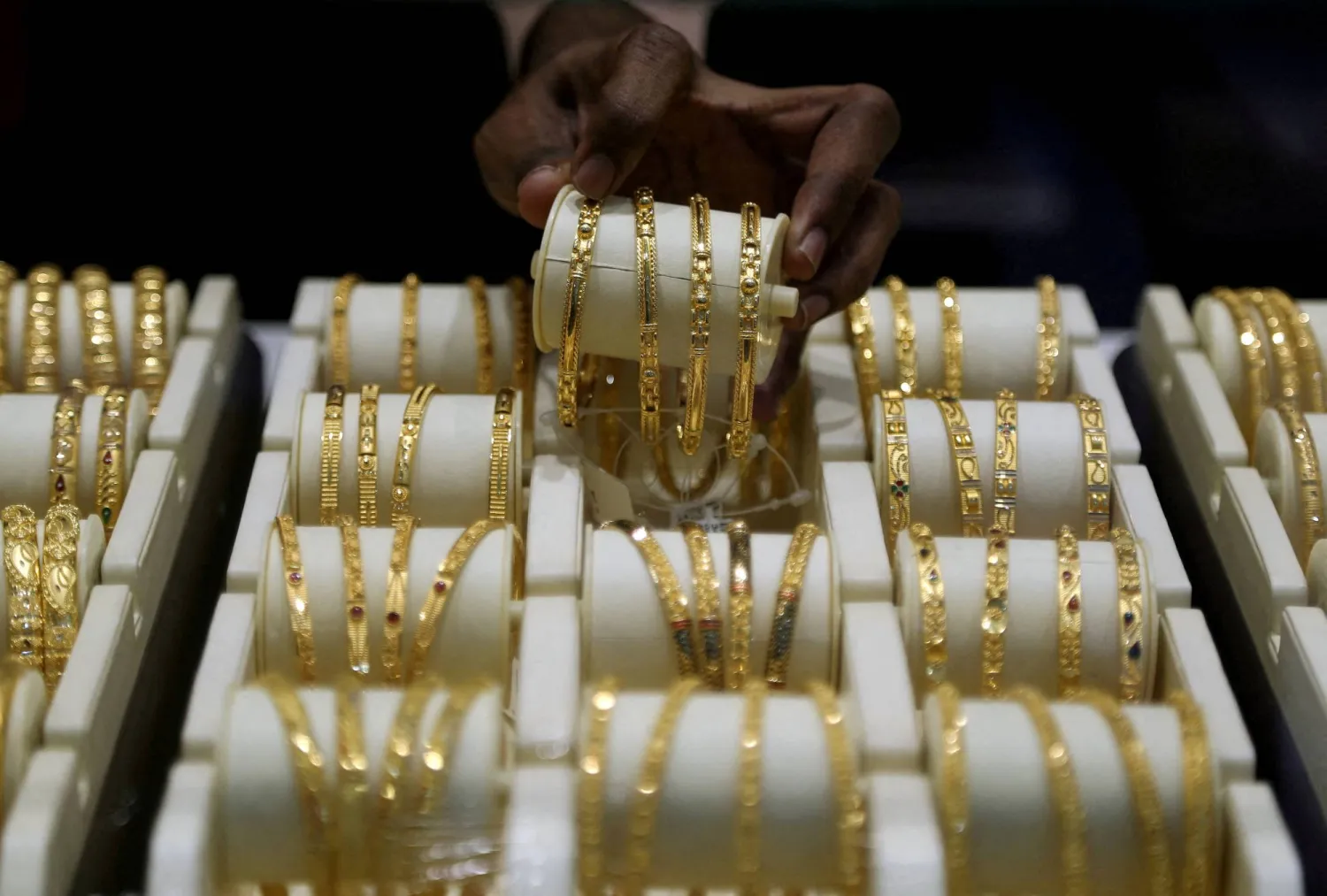
FILE PHOTO: A salesman arranges gold bangles inside a jewelry showroom on the occasion of Akshaya Tritiya, a major gold buying festival, in Mumbai, India, May 7, 2019. REUTERS/Francis Mascarenhas/File Photo/File Photo
TT

Gold Extends Gains to Scale One-week High as Crude Prices Ease

FILE PHOTO: A salesman arranges gold bangles inside a jewelry showroom on the occasion of Akshaya Tritiya, a major gold buying festival, in Mumbai, India, May 7, 2019. REUTERS/Francis Mascarenhas/File Photo/File Photo

Gold rose for a second straight session on Friday, hitting a one-week high, as oil prices fell, while investors kept a close watch on developments in the Middle East conflict.

Spot gold was up 1.1% at $4,387.69 per ounce by 0829 GMT, and was on track for a weekly gain ‌of 1%.

US ‌gold futures rose 0.6% to $4,428.

Oil prices fell ‌for ⁠a third straight ⁠session, as easing concerns over supply disruptions outweighed anxiety about a widening Middle East conflict.

"The precious metal appears to have taken the Fed's hawkish signals in stride, instead finding immediate relief from falling oil prices amid hopes that the Fed's hiking cycle will prove shallow," said Han Tan, chief market analyst ⁠at Bybit.

Although gold is traditionally viewed as ‌a hedge against inflation, higher rates ‌can curb its demand by increasing the appeal of yield-bearing assets.

The ‌US Federal Reserve raised interest rates on Wednesday and flagged ‌more hikes in the coming months.

Goldman Sachs said in a note that it expects "the impact of tighter monetary policy to be felt primarily through a slower near-term appreciation path rather than a lower ‌terminal gold price."

Meanwhile, the Bank of Japan raised interest rates to a 31-year high and signaled ⁠its readiness ⁠to keep pushing up borrowing costs, joining other major central banks in fighting persistent inflation pressures.

"Looking ahead, the state of the conflict in the Middle East will be a key factor influencing gold prices. If the conflict prolongs and oil prices remain high well into next year, that could prompt central banks to raise rates more than investors expect, which would put downward pressure on gold prices," said Hamad Hussain, a climate and commodities economist at Capital Economics.

Spot silver rose 2.7% to $66.98, platinum gained 2.6% to $1,814.95 and palladium added 3.1% at $1,330.95. All metals were headed for a weekly gain.



Riyadh to Add 94 New Trains to Boost Transport Capacity

A Riyadh Metro train travels through the Saudi capital. (SPA)
TT

Riyadh to Add 94 New Trains to Boost Transport Capacity

A Riyadh Metro train travels through the Saudi capital. (SPA)

The Royal Commission for Riyadh City has signed contracts to procure and manufacture 94 new trains for the capital’s metro network, increasing its fleet to 277 from 183, with deliveries scheduled to begin in batches in 2028.

The new trains are expected to boost the network’s overall passenger capacity by 57%, with increases varying by line: 142% on the red line, 116% on the yellow line, 57% on the blue line, 27% on the orange line and 16% on the purple line. Additional capacity will be allocated according to ridership and projected demand.

The expansion comes as the Riyadh Metro has recorded about 275 million passenger trips since December 2024. Average monthly ridership in 2026 has risen by around 25% compared with the same period in 2025.

The investment is intended to accommodate anticipated growth in travel demand as Riyadh expands and prepares to host major international events, including Expo 2030 and the 2034 FIFA World Cup.

Germany’s Siemens and France’s Alstom are carrying out the contracts, which are worth more than $5 billion in total and cover train manufacturing, systems and equipment, maintenance, training and other technical and operational services.

The trains will be delivered in stages as manufacturing is completed, then undergo testing and operational trials before gradually entering service.

The investment is part of broader efforts to develop Riyadh’s transport infrastructure, including public transit, roads and intersections, to meet the needs of the capital’s growing population and urban expansion.


Copper Steadies as Dollar Strength Counters Chile Supply Worries

Stacks of copper cathodes sit inside Glencore's Canadian Copper Refinery in Montreal, Quebec, Canada on October 3, 2026. (Photo by ANDREJ IVANOV / AFP)
TT

Copper Steadies as Dollar Strength Counters Chile Supply Worries

Stacks of copper cathodes sit inside Glencore's Canadian Copper Refinery in Montreal, Quebec, Canada on October 3, 2026. (Photo by ANDREJ IVANOV / AFP)

Copper prices ‌held nearly steady on Tuesday as a strong US dollar countered support from supply concerns in top producer Chile.

Benchmark three-month copper on the London Metal Exchange was little changed at $14,628.00 a metric ton by 0700 GMT, after hitting a two-week high in the previous session, said Reuters.

The most-traded copper contract on the Shanghai Futures Exchange edged 0.2% higher to 110,990 yuan a ton.

The dollar took ‌a breather ‌but hovered near an 18-month high, ‌underpinned ⁠by safe-haven demand ⁠amid escalating tensions in the Middle East. A stronger greenback makes dollar-denominated metals more expensive for holders of other currencies.

Supply concerns remained in focus after Chilean state miner Codelco partially suspended operations at its El Teniente mine following a landslide, ⁠while Antofagasta's Centinela copper mine and two ‌unions were set ‌to resume talks as a strike continued.

Copper inventories outside ‌the United States have declined in recent ‌months as shipments were diverted to the country ahead of potential tariffs on refined copper imports.

Analysts at BMI raised their average copper price forecast for 2026 ‌to $13,500 per ton from $12,700, citing tariff-related market distortions and persistent supply constraints.

"For the ⁠remainder ⁠of the year, prices are set to oscillate sharply in response to tariff-policy headlines, with the eventual US decision likely to dictate near-term price direction," BMI said.

Among LME metals, aluminium was down 0.4% at $3,039 after touching an eight-month low on Monday, zinc lost 0.7% to $3,729.50, lead rose 0.4% to $1,891, nickel gained 0.2% to $15,640 and tin eased 0.6% to $52,870.

Among SHFE metals, aluminium slipped 1.1%, zinc fell 1.7%, lead rose 1.3%, nickel dipped 0.1% and tin dropped 0.4%.


IMF Forecasts Saudi Economy to Grow 7.9% in 2027

General view of the Kingdom Tower in downtown Riyadh, Saudi Arabia, October 12, 2026. Picture taken with a mobile phone. REUTERS
TT

IMF Forecasts Saudi Economy to Grow 7.9% in 2027

General view of the Kingdom Tower in downtown Riyadh, Saudi Arabia, October 12, 2026. Picture taken with a mobile phone. REUTERS

The International Monetary Fund (IMF) expects the Saudi economy to record strong growth of 7.9 percent in 2027, reflecting a projected recovery in energy production and exports, as well as the gradual restoration of regional trade flows as war-related disruptions ease and the Strait of Hormuz reopens under the report’s baseline scenario.

The forecast highlights the Saudi economy’s ability to regain momentum after the pressures caused this year by disruptions to energy production and transportation. Saudi Arabia is expected to benefit from its diversified oil export routes and infrastructure, which allow part of its exports to be shipped via the Red Sea rather than through the Strait of Hormuz.

In its October World Economic Outlook, the IMF projected that Saudi Arabia’s economy would contract by 3.3 percent in 2026 before rebounding to 7.9 percent growth in 2027.

In its April forecasts, the Fund had expected growth of 3.1 percent in 2026 and 4.5 percent in 2027, reflecting a significant shift in projections due to developments in the conflict and assumptions regarding the resumption of economic activity.

Export Infrastructure Supports Economic Resilience

Saudi Arabia benefits from alternative oil-export outlets, most notably the East-West Pipeline, which transports crude oil from the Eastern Province to the Red Sea port of Yanbu with a capacity of approximately 7 million barrels per day.

The Kingdom aims to raise pipeline capacity to 10 million barrels per day, enhancing the flexibility of its export system in the face of maritime disruptions.

These alternatives strengthen Saudi Arabia’s ability to mitigate the impact of shipping interruptions on oil flows. Under the IMF’s forecasts, the gradual recovery of production and exports is expected to support economic activity next year.

Gulf Recovery Driven by Rebound in Energy Production

The strong growth forecast is not limited to Saudi Arabia. The IMF also expects several Gulf economies to recover sharply in 2027 as production, exports, and logistics services rebound.
Projected growth rates for 2027 are Qatar 18.8%, Kuwait 17.1%, Bahrain 13.9%, the United Arab Emirates 7.7% and Oman 2.2%.

These forecasts follow severe pressure during 2026, when the IMF expects Kuwait’s economy to contract by 16.7%, Qatar’s economy by 15.6%, Bahrain’s economy by 11.3% and the UAE economy to contract by 3.9%.

Meanwhile, Oman is expected to achieve growth of 4.1 percent in 2026.

The IMF’s baseline scenario assumes that the Strait of Hormuz will begin reopening in March 2027, with a broad return to pre-war conditions by October 2027. This would allow energy flows, shipping, insurance services, and payment systems to recover gradually.

The pace of this recovery remains dependent on the course of the conflict and the stability of maritime navigation. Nevertheless, Saudi Arabia’s diversified export routes provide an important buffer, enhancing the economy’s capacity to absorb shocks and restore growth as regional conditions improve.