Gaza ‘Armed Gangs’ Abduct Two Palestinians, Including Faction Operative

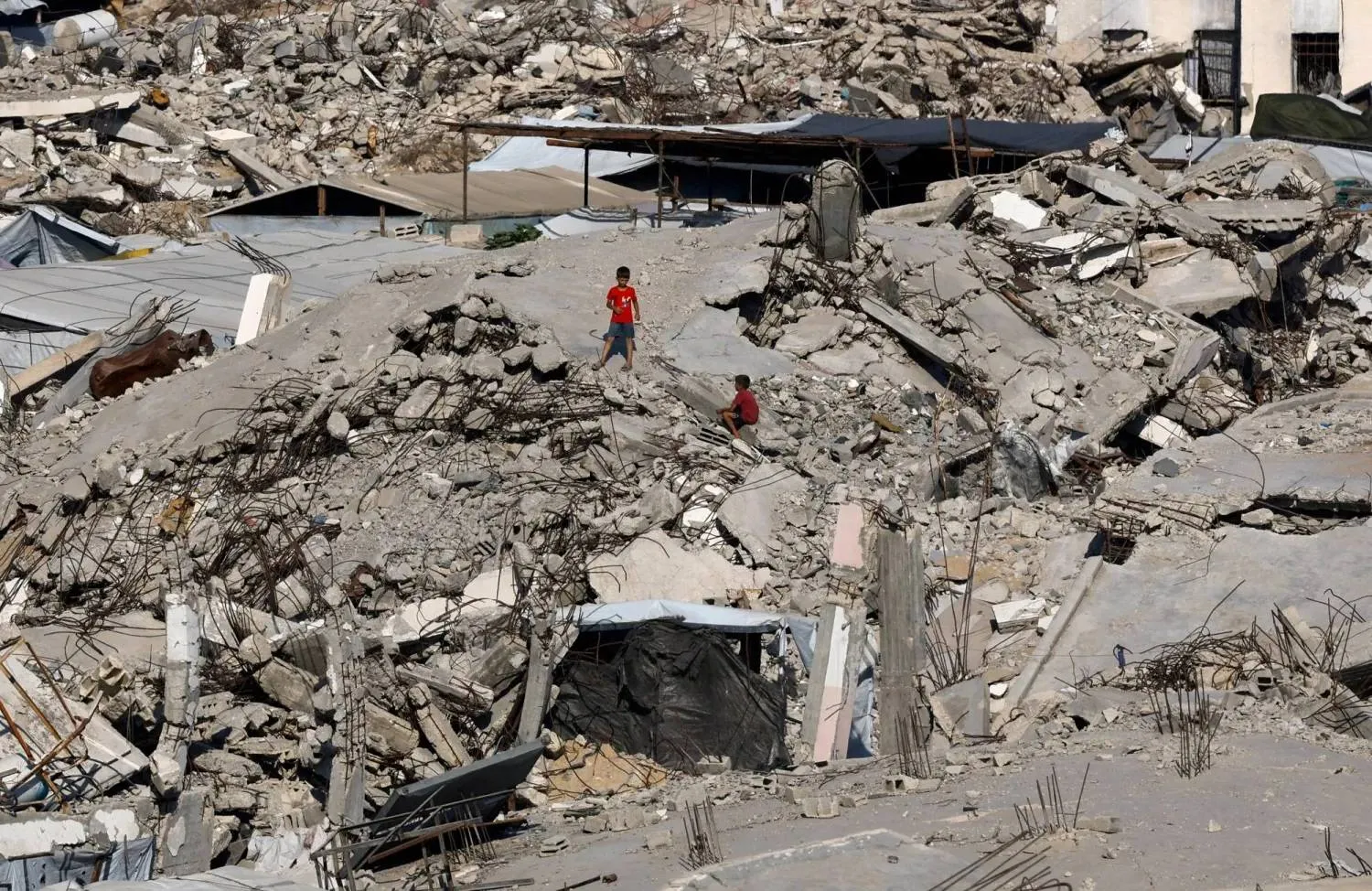
Young Palestinians amid the rubble of buildings destroyed during the war at Jabalia refugee camp in the northern Gaza Strip (File photo: Reuters)
TT

Gaza ‘Armed Gangs’ Abduct Two Palestinians, Including Faction Operative

Young Palestinians amid the rubble of buildings destroyed during the war at Jabalia refugee camp in the northern Gaza Strip (File photo: Reuters)

Armed gangs in the Gaza Strip, operating mainly in Israeli-controlled areas, abducted two Palestinians from their home at dawn on Thursday after a force infiltrated an area east of the Bureij refugee camp in central Gaza.

The abductees, cousins from the Issa family, prompted their relatives to appeal to the Red Cross to contact Israel and try to determine their fate. Armed gangs that abduct Palestinians in Gaza are known to hand them over to Israel, as has happened in several cases.

Some were later released after it was established that they had no links to any Palestinian faction.

Torture and abduction

Field sources told Asharq Al-Awsat that one of the abductees belonged to a prominent Palestinian faction and was seized from his home along with his cousin, more than 800 meters (875 yards) from the boundary of the “Yellow Line.”

Bloodstains were found at the site of their abduction, suggesting that the two men may have been wounded or subjected to interrogation and torture, the sources said. They added that the operation took place in an area considered relatively vulnerable to security breaches.

Some of the home’s contents were stolen, the sources said, adding that the operation was carried out under the cover of Israeli drones that fired in various directions across the area.

The sources said armed gangs have recently stepped up efforts to abduct members of Palestinian factions living about 1 km (0.6 mile) from the Yellow Line and hand them over to Israel.

They said the operations were managed entirely by Israeli intelligence officers overseeing the gangs’ areas of operation, primarily in an effort to create chaos and demonstrate the gangs’ ability to advance Israeli security objectives.

One source said Palestinian factions regularly issue warnings to their members about the gangs’ operations.

Other attempts

Another source told Asharq Al-Awsat that an attempt was made about a week ago to abduct a member of a different faction in the Nuseirat refugee camp in central Gaza.

The man escaped but sustained moderate injuries while fleeing from the vehicle in which he had been held, the source said.

On Sept. 4, the Al-Quds Brigades, the armed wing of Palestinian Islamic Jihad, said members of the armed gangs had attempted to abduct one of its fighters on Al-Jumayza Street in the town of Al-Qarara, northeast of Khan Younis.

The group said the gunmen had advanced into the area with support from Israeli drones before they were detected, triggering clashes that killed and wounded several members of the gang, according to a statement issued at the time.

The Al-Quds Brigades said Israeli drones intervened to help the force withdraw, while members of the force shot and killed an Al-Quds Brigades fighter, Fadi al-Abadla, and left him at the scene.

A field source told Asharq Al-Awsat at the time that Abadla arrived at Nasser Medical Complex with his hands bound. This suggested that his abduction had nearly succeeded and that he may have been interrogated before the attempted abduction and subsequently executed, the source said.

Continued violations

Israeli forces continued their violations of the ceasefire in the Gaza Strip.

A Palestinian was reported to have died from wounds sustained on Thursday evening when Israeli military vehicles opened fire north of the Nuseirat refugee camp in central Gaza.

Five Palestinians, including two women, were wounded on Friday in similar Israeli fire east of Bureij and Deir al-Balah in central Gaza. A woman was critically wounded in Israeli artillery shelling east of Jabalia al-Balad in northern Gaza, while two Palestinians were wounded by fire from Israeli military vehicles south of Khan Younis.

Israeli forces also intensified artillery shelling as they carried out demolitions in several parts of the Gaza Strip.


What Has Lebanon So Far Implemented in its Ban on Hezbollah’s Military Activities?

A supporter of Hezbollah holds a placard reading in Arabic "We will not leave the weapon" during a gathering held to mark the 2nd anniversary of Hezbollah leader Hassan Nasrallah's death at the site where he died in Beirut, Lebanon, 26 September 2026. (EPA)
TT

What Has Lebanon So Far Implemented in its Ban on Hezbollah’s Military Activities?

A supporter of Hezbollah holds a placard reading in Arabic "We will not leave the weapon" during a gathering held to mark the 2nd anniversary of Hezbollah leader Hassan Nasrallah's death at the site where he died in Beirut, Lebanon, 26 September 2026. (EPA)

The seizure of a Hezbollah explosives shipment in eastern Lebanon has reignited questions over the government's enforcement of a ban on the group's military and security activities, imposed after its rocket attacks on Israel triggered a new war on March 2.

The explosives were intercepted in Dahr al-Baidar, and Hezbollah acknowledged they belonged to the Iran-backed party and were intended for use against Israel.

The March 2 ban orders Hezbollah to surrender its weapons to the state and to confine its activities to politics within constitutional and legal frameworks. It also instructs military and security agencies to act immediately to enforce the ban, prevent rocket and drone launches from Lebanese territory and arrest violators.

The most significant enforcement measures came in mid-to-late March, as Hezbollah fought Israel. Several armed members were arrested while heading to the battlefronts in southern Lebanon. A handful faced trial, but most were released on bail.

'Ink on paper'

Hezbollah rejects the ban outright, arguing that it serves Israel's interests while it continues to occupy Lebanese territory. The group maintains that liberating the occupied land remains part of its duty.

Its opponents say the government has not gone nearly far enough. They want tougher enforcement of the ban to ensure that decisions of war and peace rest exclusively with the Lebanese state.

Ghada Ayoub, a lawmaker from the Lebanese Forces' Strong Republic parliamentary bloc, said the ban "remains ink on paper, with none of it implemented."

That failure does not diminish the decision's political and legal weight, she told Asharq Al-Awsat.

"It marked a fundamental shift in the Lebanese state's position, clearly declaring Hezbollah's military and security activities illegitimate and stripping them of any official cover," she explained.

"It is no coincidence that Hezbollah keeps demanding its reversal. The group fully understands the decision's significance and its implications for its military and security project."

Waiting on developments abroad

Ayoub said that the Dahr al-Baidar explosives case underscored the importance of the ban, providing grounds to demand its referral to the Judicial Council because it involved prohibited military and security activities and posed a threat to the state and its citizens.

But she blamed the lack of enforcement on a failure of political will.

"The political leadership is still betting on regional and international developments, waiting to see how the confrontation between Israel and Hezbollah unfolds instead of assuming its responsibilities," she remarked.

"It is as though the authorities have chosen to let Hezbollah bear the consequences of refusing to surrender its weapons and abandon its military project, without confronting the group itself."

The result is a state that makes sovereign decisions but leaves their enforcement hostage to developments abroad, she went on to say.

She pointed to a cabinet decision on August 5, 2025, to impose state monopoly over weapons, saying its implementation remained incomplete. The government then banned Hezbollah's military and security activities on March 2 but failed to follow through with concrete action.

"Now, with the Dahr al-Baidar case, this approach is no longer acceptable," Ayoub stressed.

"Failing to refer the case to the Judicial Council raises serious questions about the government's commitment to its own decision."

Ayoub urged the state to demonstrate that it was serious about enforcing its decisions rather than waiting for Israel or the United States to carry out responsibilities that belonged to Lebanon itself.

"We cannot keep moving from one regional development to another while sovereign decisions remain on hold, using the need to preserve civil peace as a pretext for allowing violations of the law to continue," she demanded.

"Fear of confrontation cannot become a permanent surrender of state sovereignty."

'Arrest every armed Hezbollah member'

Retired Brigadier General George Nader echoed Ayoub's criticism, saying the government's decisions to establish state control over weapons and curb Hezbollah's military activities had yielded nothing.

"The slogans have proved hollow and the decisions remain on paper. It is a major blow to a state that issues decisions it cannot enforce," Nader told Asharq Al-Awsat.

"After the decision to bring weapons under state control, we went into Palestinian refugee camps and came back with truckloads of scrap metal," he said.

"Even after identifying those responsible for the Dahr al-Baidar explosives, we arrested only the people transporting them, not those behind them."

Nader said enforcing the cabinet's decisions would require arresting every armed Hezbollah member, not just those stopped at checkpoints.

"If we genuinely want to implement the cabinet's decisions, every armed Hezbollah member is breaking the law and must be arrested," he added.

"Arrests should not be limited to checkpoints. The authorities should go to where these members are and arrest them."

Nader placed responsibility squarely on the government, saying the army operates under the political leadership's instructions.

"What is needed today is a clear, explicit order to the Defense Ministry, directing it to instruct the army to arrest every armed Hezbollah member, wherever they may be," he urged.


Lebanese Judiciary Identifies Seven Suspects in Hezbollah Explosives Case

Lebanese President Joseph Aoun receives Justice Minister Adel Nassar at the Presidential Palace on Wednesday. (Lebanese Presidency)
TT

Lebanese Judiciary Identifies Seven Suspects in Hezbollah Explosives Case

Lebanese President Joseph Aoun receives Justice Minister Adel Nassar at the Presidential Palace on Wednesday. (Lebanese Presidency)

Lebanon's judiciary is nearing the end of its preliminary investigation into Hezbollah explosives seized in Dahr al-Baidar, setting the stage for charges against suspects as Justice Minister Adel Nassar pushes to refer the case to the Judicial Council.

Nassar said the case went far beyond the transportation and storage of explosives, warning that it posed a threat to national security and civil peace.

Judge Claude Ghanem, the government commissioner to the Military Court, is expected to receive the findings of investigations conducted by Lebanese Army Intelligence and the Internal Security Forces' Information Branch within hours.

He will review the evidence before deciding on charges against those implicated.

Seven suspects

Despite reports of a third arrest, a judicial source told Asharq Al-Awsat that only two suspects remained in custody: A.K. and H.A., who were aboard the truck carrying the explosives.

Investigators have identified five other suspects linked to the case, the source said.

Among them is a man known as "Sajed," a Hezbollah security operative suspected of handing over the explosives in Baalbek, and another known as "Zulfiqar," who also holds a security role and was allegedly designated to receive the shipment in Beirut's southern suburbs.

The suspects also include H.A.'s wife and the truck's owner.

While the government weighs whether to refer the case to the Judicial Council, proceedings are expected to continue before the Military Court.

Ghanem will examine investigation records, confessions and evidence to determine which criminal offenses apply to each suspect before filing charges against those detained and those still at large, the judicial source said.

Charges are expected on Thursday against suspects whose roles have been established.

The investigation has also uncovered the suspects' real identities, the source said, adding that warrants to bring in suspects and search notices had been issued against some of them and were being executed.

‘National security threat’

Even as the case moves toward the military judiciary, which has jurisdiction over such crimes, Minister Nassar remained adamant that it should go before the Judicial Council.

He stressed that his demand did not cast doubt on the investigators, particularly Ghanem.

"This is not simply a case of transporting explosives. It has broader implications that threaten national security and civil peace," Nassar told Asharq Al-Awsat.

Nassar said he had submitted a legal memorandum to the president and prime minister during the latest cabinet meeting, arguing that receiving explosives of such a dangerous nature was a breach of national security.

Their storage and transportation, he said, also endangered Lebanese lives.

He argued that Hezbollah's acknowledgment that it possessed the explosives and intended to use them in a "new support front" amounted to an admission that it was contributing to threats against Lebanon's internal security.

The case has intensified a dispute involving Lebanese officials who accuse Hezbollah of endangering the country's security, both through its activities at home and its repeated threats to open a new front against Israel.

Nassar said the acknowledgment by an armed security and military organization that it imports explosives for use in warfare outside state control is a major threat to Lebanon's internal national security.

For Nassar, pursuing the case through state institutions and upholding their authority would mark "a victory for legitimate authority over illegal weapons."


Syria Says French Extremist Killed in Shootout with Govt Forces

Members of the Syrian army stand on a military vehicle in Latakia, Syria, January 14, 2026. (Reuters)
TT

Syria Says French Extremist Killed in Shootout with Govt Forces

Members of the Syrian army stand on a military vehicle in Latakia, Syria, January 14, 2026. (Reuters)

Syria on Wednesday said a French extremist was killed in a shootout with security forces in the country's northwest, the latest violence with foreign fighters since Syria's new authorities took power.

In October last year, government forces clashed with French extremists from the so-called Firqat al-Ghuraba (the Foreigners' Brigade), before the sides agreed a ceasefire that also involved the withdrawal of heavy weapons from the Harem camp, where they are holed up in Idlib province.

In a statement carried by state television, security forces in Idlib said a patrol observed "an armed group leaving the French camp... in violation of the agreement that prohibits exiting (the site) with weapons".

Some from the group began shooting at the patrol which had begun taking up pursuit, "requiring a response to the source of fire", the statement said.

One of the members of the armed group was killed and a civilian wounded, it added.

Firqat al-Ghuraba is led by Franco-Senegalese criminal-turned-preacher Oumar Diaby, also called Omar Omsen, and is estimated to include a few dozen to a hundred fighters accompanied by women and children.

On messaging app Telegram, a channel affiliated with the group published a statement accusing the security forces of opening fire after "our brothers went to buy food in the city", killing a man it identified as Abu Ayman al-Faransi, meaning "Abu Ayman the Frenchman".

The statement said the man had lived in Syria for 13 years and had fought against the forces of longtime ruler Bashar al-Assad, who was toppled by an opposition alliance in December 2024.

Accusing Syria's authorities of killing the man, the statement vowed that "we will not leave this land before taking revenge".

The issue of foreign fighters who flocked to Syria during its civil war is a thorny one, with many countries refusing to take them back.

Hundreds of French citizens joined extremist ranks in Syria during the war.

In September 2016, the United States designated Diaby, suspected of helping French-speaking fighters travel to Syria, as an "international terrorist".

Diaby, in his 50s, is also wanted on a French arrest warrant.

While some foreign fighters have joined the ranks of Syria's new military or security forces, the French extremists have remained in Idlib where they had fought for years alongside factions that went on to help topple Assad.