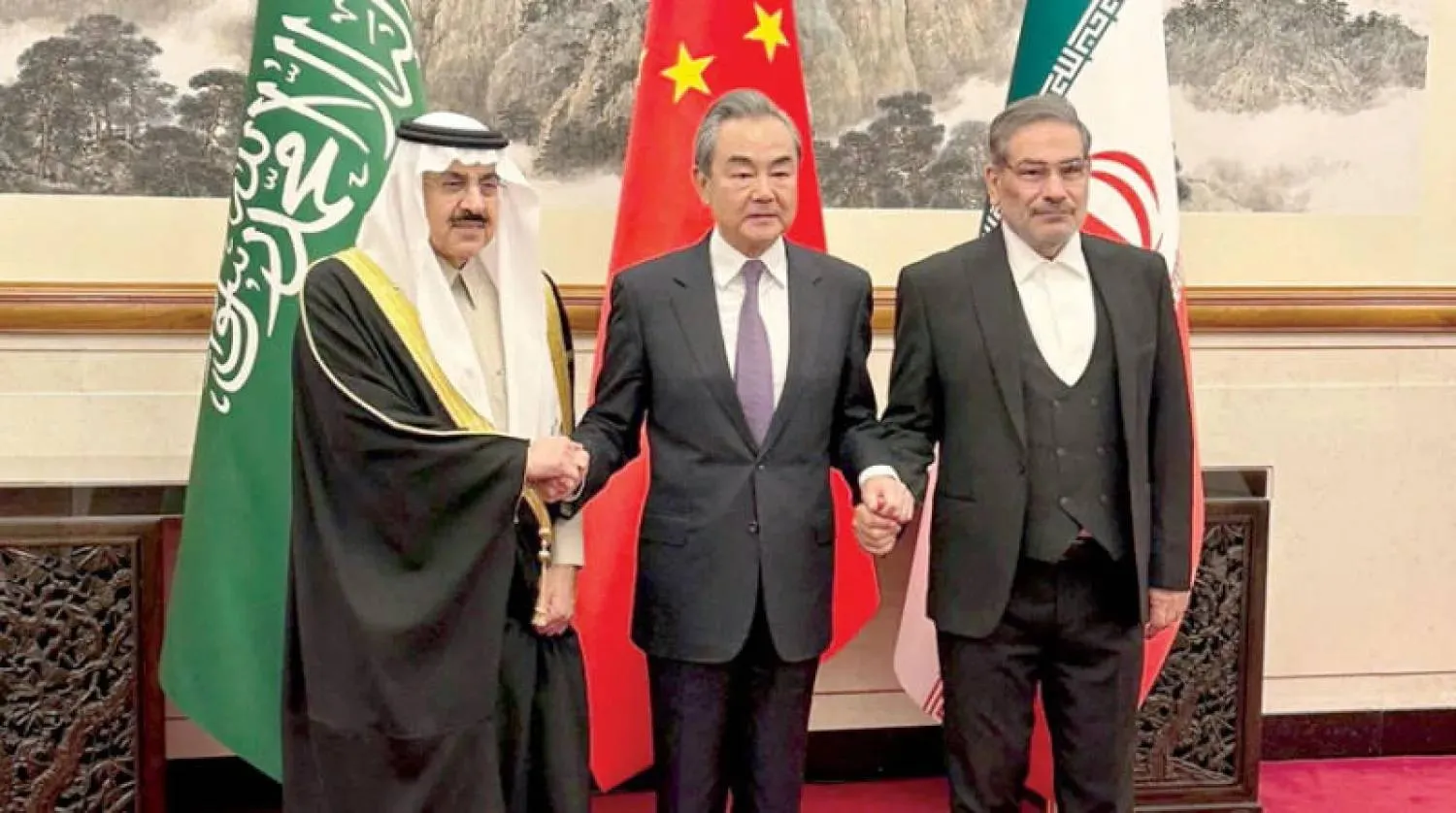
Analysts: Bab al-Mandab Tests Limits of Saudi-Iranian Reconciliation

Beijing faces a difficult challenge in ensuring Tehran fulfills its commitments under the agreement with Saudi Arabia, according to analysts. (SPA)
TT

Analysts: Bab al-Mandab Tests Limits of Saudi-Iranian Reconciliation

Beijing faces a difficult challenge in ensuring Tehran fulfills its commitments under the agreement with Saudi Arabia, according to analysts. (SPA)

More than three years after Saudi Arabia and Iran signed their agreement in Beijing, brokered by China, the reconciliation between Riyadh and Tehran is facing one of its most difficult tests, amid accusations that Iran is supporting armed groups in Yemen and Iraq that have targeted Saudi Arabia, and as the Houthis move toward the Bab al-Mandab Strait, raising concerns over the Kingdom's security and navigation in the Red Sea.

AFP reported, citing two Houthi military sources, that experts from Iran's Revolutionary Guard Corps had visited the Bab al-Mandab area, the port and airport of Mokha, and the Jabal al-Nar camp east of the city. The sources said the experts had supervised the digging of tunnels in the mountains overlooking Mokha and the Bab al-Mandab Strait and had discussed installing radars near Mokha and on Zuqar Island in the southern Red Sea.

Analysts who spoke to Asharq Al-Awsat said the latest developments not only test Tehran's commitment to its pledges, but also put China's role under scrutiny. The issue is no longer limited to maintaining diplomatic relations between Saudi Arabia and Iran, but also concerns the agreement's ability to curb sources of indirect threats and prevent armed groups from being used to pressure countries in the region.

Riyadh and Tehran signed an agreement in Beijing under Chinese sponsorship to resume diplomatic relations after a break of nearly seven years.

Bab al-Mandab: A Serious Test for the Agreement

Dr. Abdulaziz bin Sager, Chairman of the Gulf Research Center, said the Beijing Agreement, signed in March 2023, was based on three main components: restoring diplomatic relations after seven years of estrangement, reactivating bilateral cooperation agreements, and respecting the sovereignty of states and noninterference in their internal affairs. He described the third component as "the most important and most sensitive."

In an interview with Asharq Al-Awsat, bin Sager said Iran's actions through the Houthis near the Bab al-Mandab Strait "represent a serious test of the Saudi-Iranian agreement" because they violate both its provisions and its spirit, which was based on building trust. He added that the commitments should not be limited to Iran's direct actions, but should also cover the conduct of groups linked to the Iranian Revolutionary Guard Corps.

"There is no meaning to any agreement with Iran that does not cover the actions of its regional proxies that threaten regional and international security," he said, considering support for the Houthis or incitement to threaten the Kingdom's security a "blatant violation" of the commitment to respect sovereignty and refrain from interference.

Abdulaziz Al-Shaibani, a researcher and adviser on Chinese and Asian affairs, takes a different view. He said Iranian actions near the Bab al-Mandab Strait test the Beijing Agreement but do not mean that it has collapsed. The agreement was designed primarily to restore relations and open channels for dialogue, not to end the rivalry between Riyadh and Tehran or establish a strategic partnership between them.

The Proxy Policy

Saudi political analyst Dr. Khalid Al-Habbas said the militia policy is one of Tehran's most important tools for expanding its regional influence. He said the Iran Revolutionary Guard Corps supports, trains, and organizes these groups, enabling them to play roles that serve Iranian objectives when needed.

Al-Habbas places the latest Houthi moves, as well as the earlier activities of Iran-aligned factions in Iraq, within the context of growing military and economic pressure on Tehran and its efforts to open alternative fronts of pressure. He said moves toward the Bab al-Mandab Strait could threaten maritime navigation, drive up energy prices, and disrupt supply chains.

Dr. Khalid cautioned against relying on Houthi pledges not to target ships, saying that the experience of the Red Sea since late 2023 has demonstrated otherwise. He stressed that protecting maritime navigation "is an international responsibility, not one that falls on the Kingdom alone," given the global importance of the waterway.

According to Al-Habbas, Saudi Arabia, while remaining committed to resolving disputes peacefully and keeping the door to diplomacy open, has the right to defend itself under Article 51 of the United Nations Charter. It also has the right to "demand that Iran comply with the terms of the agreement and review it in light of the extent to which Tehran has honored its commitments."

Has the Testing Period Ended?

Dr. Samir Salha, a professor of international law and international relations at Istanbul University, takes a more forceful position. "We have moved beyond the question of testing the understandings. It is clear that the Iranian side has departed from their spirit and begun pursuing a regional policy different from what it had pledged," he said.

He added that the central question is no longer simply whether Tehran is complying, but who is arming the Houthis, training them, and directing their operations.

"The threats appear Houthi on the surface, but at their core they are Iranian," he said, arguing that the mobilization of Iran-aligned groups in Yemen, Iraq, and Lebanon reflects an Iranian priority that has not changed despite the restoration of relations with Riyadh.

In Salha's assessment, Saudi Arabia will not base its options solely on waiting for China to act. Instead, it will continue exploring strategic alternatives to ensure its security while keeping the diplomatic track open, a process he said has already begun in recent months.

Beijing: Opening the Way Is Not Enough

The analysts agree that China has significant tools for influencing Iran, given the depth of their economic, political, and military ties. But they say Beijing is being called upon to move from its symbolic role as sponsor of the agreement to a more decisive role in monitoring its implementation.

Bin Sager said Beijing "is capable of verifying Iranian conduct that violates the agreement," but tends to favor ambiguity and avoids taking decisive positions when crises do not directly affect its national security. What is needed now, he said, is a clear mechanism for verifying Tehran's compliance and restraining its proxies.

Salha, meanwhile, said China faces a difficult choice between simply protecting its relationship with Iran and defending its broader interests with the Gulf states and the trade routes that pass through the Red Sea. "This is primarily a test for Iran, but secondarily a test for Beijing," he said.

"Beijing faces a difficult, sensitive, and delicate situation. There have been positive indications in its positions and political messages toward Iran recently, but betting that Tehran will accept and heed what Beijing says is difficult," he added.

Dr. Samir noted that "Beijing succeeded in opening the way for a new test in Saudi-Iranian relations, but it now needs to go further if it wants to protect its interests and relations with the Gulf states."

Al-Shaibani, for his part, said Beijing tends to favor diplomacy and avoid direct intervention, and is not expected to decisively side with either party. He concluded that the future of the agreement will depend on China's ability to keep dialogue open and contain crises, while Saudi Arabia retains the right to protect its security and interests through its own capabilities and regional partnerships.


Syria Says Killed Leader of Armed Cell in Tartus

Members of Syria's Internal Security Forces. (SANA)
TT

Syria Says Killed Leader of Armed Cell in Tartus

Members of Syria's Internal Security Forces. (SANA)

Syrian authorities said on Tuesday that they had killed the leader of an armed cell linked to the former government and wounded another member during an operation in the countryside of Tartus.

In a statement, the Internal Security Forces said they had carried out a "carefully planned ambush" after monitoring the four-member group, which was allegedly planning to carry out "terrorist attacks and armed robberies".

The forces said the ensuing clash resulted in the "neutralization of the cell's leader" and the wounding of another member.

The forces confirmed that specialized units are continuing intensive sweep and pursuit operations across the surrounding rural areas to locate and apprehend the remaining fleeing members of the cell.

State security authorities reiterated their commitment to maintaining public order, eliminating remnants of illegal armed groups, and safeguarding civilian lives and property across all Syrian provinces.


Airstrikes, Artillery Fire Wear Down Houthis as Yemeni Army Seizes Strategic Positions

Yemeni army fighters on the Jabal Han front near the city of Taiz. (AFP)
TT

Airstrikes, Artillery Fire Wear Down Houthis as Yemeni Army Seizes Strategic Positions

Yemeni army fighters on the Jabal Han front near the city of Taiz. (AFP)

Yemeni government forces pressed ahead with Operation Dawn of Yemen on Tuesday, stepping up airstrikes, drone attacks and artillery fire against Houthi positions and reinforcements across several fronts, as troops seized more ground in Al-Jawf and fighting continued in Taiz, Dhale and Marib.

Government forces struck Houthi military vehicles and fighter concentrations on several fronts in Al-Jawf.

Combat units from the Emergency Forces and Nation's Shield forces also captured new strategic positions and commanding heights in the province, military spokesman Majed al-Nuzaili said.

The gains were part of an operation aimed at expanding government control in Al-Jawf, he added.

Houthi attacks repelled in Taiz, Dhale

Government forces in Dhale repelled a Houthi assault on their positions in the Hajar sector in the province's northwest, clashing with attackers below Jabal al-Hasha.

A military source said government troops beat back the assault, inflicting casualties and equipment losses and forcing the Houthi militants to retreat.

In Marib, artillery units shelled Houthi positions and vehicles on the northern front. Emergency Forces also struck Houthi fighters and gatherings, killing 16 and wounding others, according to military sources.

In the besieged city of Taiz, government troops and Popular Resistance fighters thwarted Houthi attacks on the Al-Aqroud and Al-Shaqab fronts southeast of the city on Monday.

A military source said Houthi fighters attempted to advance on army positions in Kahlan, but were repelled and suffered losses.

The Houthis also resumed shelling residential neighborhoods in east and north of Taiz, wounding a civilian and damaging homes and residential buildings.

Government forces retake strategic positions

Yemen's military said its latest operations included 17 airstrikes, 123 drone attacks, 60 rocket launcher strikes and 782 artillery attacks against Houthi positions and military assets.

Warplanes carried out 17 strikes against Houthi positions and military capabilities, while drones conducted 123 attacks across Al-Jawf, Marib, Al-Mudaribah and the southwestern front.

Rocket launcher units carried out 60 strikes, while field artillery launched 782 attacks targeting Houthi fortifications, artillery emplacements, sniper positions, troop concentrations and reinforcements.

Spokesman Al-Nuzaili said the strikes inflicted heavy casualties and equipment losses on the Houthis, forcing dozens of fighters to flee their positions in Al-Jawf, Marib and Taiz.


G7 Agrees on Need to Avoid ‘Security Void’ in Lebanon After UN Force Mandate Ends

Under US pressure, the UN Security Council voted last year to end UNIFIL's mandate on December 31, 2026. (AFP)
TT

G7 Agrees on Need to Avoid ‘Security Void’ in Lebanon After UN Force Mandate Ends

Under US pressure, the UN Security Council voted last year to end UNIFIL's mandate on December 31, 2026. (AFP)

G7 foreign ministers agreed on "the need to avoid a security void" in Lebanon after UN peacekeepers pull out, French Foreign Minister Jean-Noel Barrot said on Tuesday after a meeting of the group in Paris.

They also backed "the need to move quickly toward a new security architecture" after the mandate of United Nations peacekeeping forces in Israel's neighbor expires at the end of the year, he said.

But Barrot acknowledged there had been no breakthrough on what should replace the United Nations Interim Force in Lebanon (UNIFIL), which has been in place since 1978 and now counts some 7,500 personnel from nearly 50 countries.

Under US pressure, the UN Security Council voted last year to end UNIFIL's mandate on December 31, 2026.

EU foreign policy chief Kaja Kallas told AFP in October that the bloc favored a UN peacekeeping mandate in south Lebanon.

Lebanese group Hezbollah drew the country into the broader Middle East war by attacking Israel, which responded with massive airstrikes and a ground invasion that Lebanon says have killed more than 4,300 people.

"I am hopeful that we will reach a consensus," said Barrot. "The objective is widely shared: the withdrawal of Israel (from southern Lebanon), the disarmament of Hezbollah (which is pro-Iranian), and the restoration of a strong state that holds a monopoly on the use of arms -- a state capable of ensuring the security and prosperity of all the populations and all the communities in Lebanon."

Israel now maintains troops in a self-declared occupied "security zone" running around 10 kilometers (six miles) inside Lebanon along the border.

"We underscored the need for a robust, credible, and long-lasting security architecture in Lebanon in support of the Lebanese Armed Forces," the ministers said in their final communique.

US Secretary of State Marco Rubio said on Monday that he had discussed the issue with President Emmanuel Macron and suggested that what replaces UNIFIL "doesn't have to be a military mission, it could be a civilian mission."

"We need a verification system trusted by everyone and trusted by both sides that both sides are complying with their obligations under the agreements that are in place," Rubio said.

A transitional mechanism utilizing UNIFIL forces is among the options on the table, a European diplomat said, asking not to be named.

But this could require a UN Security Council resolution and thus run into an American veto, the diplomat warned.

The Europeans are also pushing a proposal for an international military coalition tasked with supporting the Lebanese Armed Forces in their mission to disarm Hezbollah.

However, the formation of such a coalition faces hesitation from Italy, which "remains strongly committed to its presence in Lebanon but appears reluctant to join an ad hoc coalition", partly due to cost concerns, as such missions are not funded by the UN, diplomats said.