Turaif Governorate Adorned in Green in Preparation for Saudi National Day

The governorate is also hosting a diverse array of national, cultural, and artistic events - SPA
TT

Turaif Governorate Adorned in Green in Preparation for Saudi National Day

The governorate is also hosting a diverse array of national, cultural, and artistic events - SPA

Turaif Governorate in Northern Borders Region has been adorned in green in preparation for Saudi National Day.

The municipality showcased its preparations by decorating the streets with flags and green lighting, SPA reported.

The governorate is also hosting a diverse array of national, cultural, and artistic events, combining patriotic performances and entertainment programs with activities tailored for families and children.


Astronomers Observe a Huge Puffy Star Merge with Smaller Companion

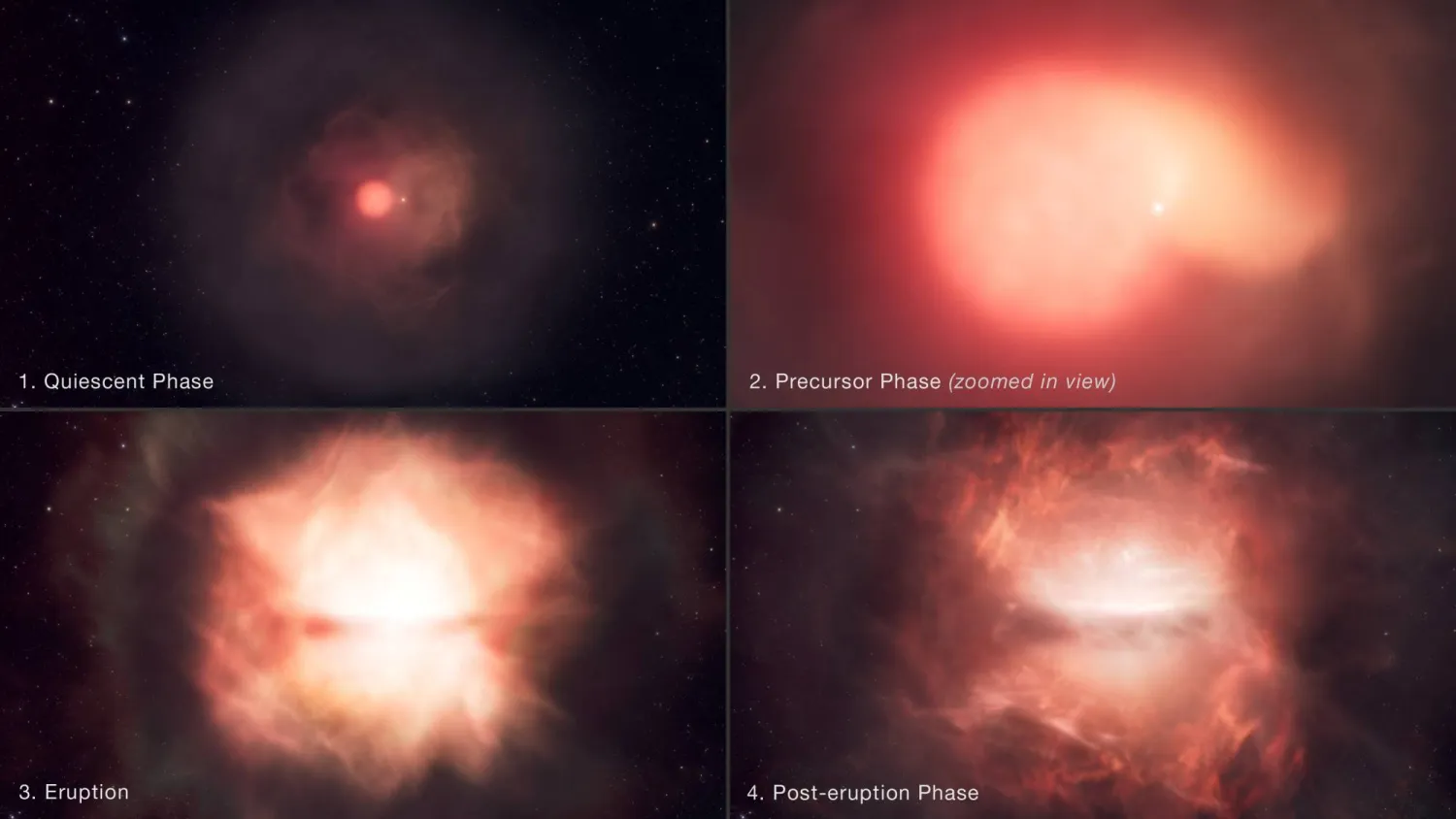
An artist's concept depicts, clockwise from top left, two stars in the Andromeda Galaxy surrounded by a dust shell before their merger. NASA, ESA, CSA, STScI, Leah Hustak (STScI); Science: Viraj Karambelkar (Columbia)/Handout via REUTERS
TT

Astronomers Observe a Huge Puffy Star Merge with Smaller Companion

An artist's concept depicts, clockwise from top left, two stars in the Andromeda Galaxy surrounded by a dust shell before their merger. NASA, ESA, CSA, STScI, Leah Hustak (STScI); Science: Viraj Karambelkar (Columbia)/Handout via REUTERS

Astronomers have observed a large dying star, seven times more massive and 18,000 times brighter than the sun, engulfing a smaller companion in a stellar merger unlike any other previously witnessed.

The merger involved a pair of stars that were bound gravitationally — known as a binary system — in which the larger one greatly expanded in its death throes into what is called a puffy supergiant and enveloped the smaller one, with the two stars then combining into one.

This cosmic connection occurred about 2.5 million light-years from Earth on the outskirts of the Andromeda Galaxy, one of our Milky Way's closest galactic neighbors. A light-year is the distance light travels in a year, 5.9 trillion miles (9.5 trillion km).

The researchers identified the impending engulfment nearly three years before it occurred and then watched as the merger unfolded, step by step.

"Giant stars engulfing their companion stars have been theorized for many decades, and understanding the outcomes of this process has important implications for explaining a wide range of ⁠systems that we ⁠see today in the universe," said Viraj Karambelkar, a postdoctoral researcher and NASA Hubble Fellow at Columbia University in New York, lead author of the research published in the journal Nature.

"The system presented in this study provides the first direct observations of this process happening — the first time a giant star engulfing its companion was caught in the act," Reuters quoted Karambelkar as saying.

Large stars near the end of their lifespan can swell up as their cores run out of fuel and shrink while the inner stellar heat pushes the outer layers outward. The larger star in this study puffed up to 350 times the sun's diameter. ⁠The smaller star, whose diameter was about 70% that of the sun, orbited its companion at roughly the same distance as between Mars and the sun, and was engulfed in the bigger star's expansion.


The researchers detected brightening when this occurred in 2018, and the smaller star began to spiral inward toward the core of the bigger star over the next seven years. Toward the end of 2025, the smaller star finally merged with the core of the larger one, triggering an eruption a million times brighter than the sun in what Karambelkar called "a unification event."

"This violent collision set off a bomb inside the star, producing the bright eruption that we saw," Karambelkar said.

The researchers first spotted the stars using data from the infrared WINTER telescope at Palomar Observatory in California and NASA's NEOWISE space telescope, then watched the events with the orbiting SPHEREx and James Webb space telescopes and various ground-based observatories.

"We have observed mergers of ⁠stars in the past," ⁠said Columbia astrophysics professor and study co-author Kishalay De.
"The difference is in the nature of the stars that merged. In the past, stellar mergers were observed from two stars that were fairly small and compact, and their merger was almost inevitable once they came into physical contact. However, the bigger star in this event was a very puffed-up star where its outer envelope was loosely bound. This configuration is exactly the kind in which a merger may or may not happen," De said.

In some cases, an engulfed smaller star might release enough energy to blow away the larger star's puffy outer layers, leaving behind the remaining core of the original bigger star orbiting the smaller one, De said.

While the larger of the two stars in this instance was nearing the end of its life, the merger may have produced a rejuvenated star with a new lease on life, the researchers said.

The researchers gave the merged star the nickname Bao, the name of popular steamed buns in Chinese cuisine.

"The auto-assigned name to this eruption was AT2025abao — 'Astronomical Transient in 2025 abao.' We called it Bao as an affectionate term derived from this. The similarity with the Chinese buns definitely encouraged us to adopt the nickname," Karambelkar said.


Cincinnati Zoo's Famed Fiona the Hippo Dies Days After Eating a Hat

Fiona the Hippo enjoys the sunshine with Tucker in Hippo Cove at the Cincinnati Zoo in Cincinnati, Ohio, US, April 18, 2025.  Liz Dufour/USA TODAY NETWORK via Imagn Images via REUTERS
Fiona the Hippo enjoys the sunshine with Tucker in Hippo Cove at the Cincinnati Zoo in Cincinnati, Ohio, US, April 18, 2025. Liz Dufour/USA TODAY NETWORK via Imagn Images via REUTERS
TT

Cincinnati Zoo's Famed Fiona the Hippo Dies Days After Eating a Hat

Fiona the Hippo enjoys the sunshine with Tucker in Hippo Cove at the Cincinnati Zoo in Cincinnati, Ohio, US, April 18, 2025.  Liz Dufour/USA TODAY NETWORK via Imagn Images via REUTERS
Fiona the Hippo enjoys the sunshine with Tucker in Hippo Cove at the Cincinnati Zoo in Cincinnati, Ohio, US, April 18, 2025. Liz Dufour/USA TODAY NETWORK via Imagn Images via REUTERS

Fiona, the hippo whose premature birth and fight for survival at the Cincinnati Zoo turned her into a global sensation nearly a decade ago, died Thursday from complications after swallowing a knit hat that was accidentally flung into her enclosure. She was 9 years old.

“It is with extreme sadness that we share with you the devastating news that Fiona did not make it after multiple attempts from our amazing vets and keeper team to help her through what ended up being a medical emergency,” The Associated Press quoted the zoo as saying in a statement.

The zoo said Monday that it was providing Fiona with round-the-clock care after she swallowed the hat more than a week ago. Specialists had advised that surgery wasn’t an option for a full-grown hippo like Fiona.

Before she died, veterinarians had been keeping Fiona hydrated, giving her treats and monitoring her every move, the zoo said. They borrowed a vibration plate from a horse farm, encouraging her to stand on it several times a day in the hopes that the shaking would help move the hat through her digestive tract.

“Despite multiple attempts to move the hat out of her system, it was ultimately too much to overcome,” the zoo said.

Within an hour of the announcement, visitors began leaving flowers and cards by a hippo statue outside the zoo. “Forever our Fiona,” one note read.

Fiona captivated people worldwide after her premature birth in 2017. Her presence was felt all around the zoo, which was scheduled to stay open late Thursday for the first night of its Festival of Lights.

Amy Haacke, a special educator from Dayton, said outside the Cincinnati Zoo that she’s been a “huge fan” of Fiona since she was born because she likes underdogs. Haacke said she uses the Fiona book series in her classroom and owns three Fiona shirts.

“We were coming here anyway, but it kind of means a lot to be here,” Haacke said Thursday. “We were here when she was first born and, I guess, now we’re here when she’s gone.”

Yolanda Gould, who works more than 80 miles (130 kilometers) away in Covington, said she and others in her office left early to travel to the zoo after learning about Fiona’s death. She said outside the zoo that she was feeling “a little devastated” after following Fiona since she was born.

Cincinnati Mayor Aftab Pureval said on social media that Fiona was “a symbol of perseverance and joy” in the city. Ohio Gov. Mike DeWine called her “a true icon.” The Cincinnati Bengals also expressed condolences, dubbing Fiona “the queen of the Queen City.”

In a joint post with US Vice President JD Vance on Instagram, second lady Usha Vance shared a photo of one of their children face-to-face with Fiona through a glass wall of her enclosure. The family has a home in Cincinnati.

“We are so sad to hear the news about Fiona,” she said in the caption. “Our family loved visiting her at the Cincinnati Zoo.”

Fiona swallowed the hat about 11 days ago after a zoo visitor tossed it in the air. A ceiling fan caught and deflected the hat into the hippo enclosure through a small opening above the area’s viewing windows.

It was an accident, zoo spokesperson Michelle Curley said.

Before Fiona died, Mike Wenninger, the zoo’s director of animal health, said veterinarians had sedated her twice to evaluate her condition.

An ultrasound on Tuesday showed some bunching of her intestines, Wenninger said. They also conducted a colonoscopy using a 9-foot (2.7-meter) scope but were unable to detect anything, he said.

The Association of Zoos and Aquariums, the accrediting body for facilities, said in a statement Thursday that the Cincinnati Zoo provided “extraordinary 24/7 care for Fiona throughout this heartbreaking event.”

Surgery would have been a major logistical challenge — multiple incisions would have been needed during a very long surgery, as hippos are notoriously difficult to anesthetize and have thick skin, said Jack Kottwitz, assistant professor at Michigan State University’s College of Veterinary Medicine.

The hat and its blend of fibers posed a particular danger despite its relatively small size.

Experts said hippos have a multichambered stomach for digesting plants, and the system makes for a very large gastrointestinal tract through which anything would have to travel.

Jan Hawkins, doctor of veterinary medicine at North Carolina State University, said Fiona’s situation was difficult because it would have been hard to tell where in her body the hat was.

“You can’t do the normal imaging and things that you can do in some of the smaller animals, or even horses,” Hawkins said.


Kenya Says Two Hippos Died After Eating Maize, Fishing Nets

FILE PHOTO: A Hippo yawns at dusk on Lake Baringo, one of Kenya's Rift Valley Lakes July 10, 2012. REUTERS/Goran Tomasevic
TT

Kenya Says Two Hippos Died After Eating Maize, Fishing Nets

FILE PHOTO: A Hippo yawns at dusk on Lake Baringo, one of Kenya's Rift Valley Lakes July 10, 2012. REUTERS/Goran Tomasevic

Two Kenyan hippopotamuses died after ingesting fishing nets and maize stalks, the Kenya Wildlife Service (KWS) said, joining a spate of deaths of wildlife after adverse contacts with humans.

A post-mortem examination had revealed one hippo, a young adult female, had "a compacted mass of discarded synthetic fishing nets that had caused a complete physical blockage at the junction between the stomach and small intestine," KWS said ⁠in a statement on ⁠X on Thursday.

According to Reuters, KWS said an examination of the other hippo, an adult female, showed gas buildup in the animal's stomach had severely compressed its lungs.

"Maize stalks were observed among the stomach contents ⁠and may have contributed to dietary overload and excessive fermentation," KWS said.

KWS appealed to fishermen and local communities to avoid irresponsible handling and disposing of fishing nets and exposure of wildlife to dangerous food materials. It did not say when the animals, from Lake Naivasha in central Kenya, had died.

In August, Kenya said at least 18 elephants ⁠had ⁠likely died from cyanide poisoning due to the ingestion of pesticide-contaminated tomatoes from farms bordering Kenya's Amboseli ecosystem.

Fiona, a Nile hippo who became a viral online sensation after the Cincinnati Zoo chronicled her survival following premature birth nearly a decade ago, died on Thursday after eating a winter hat that fell into her habitat last week.