
Battles, Airstrikes Exhaust Yemen’s Houthis

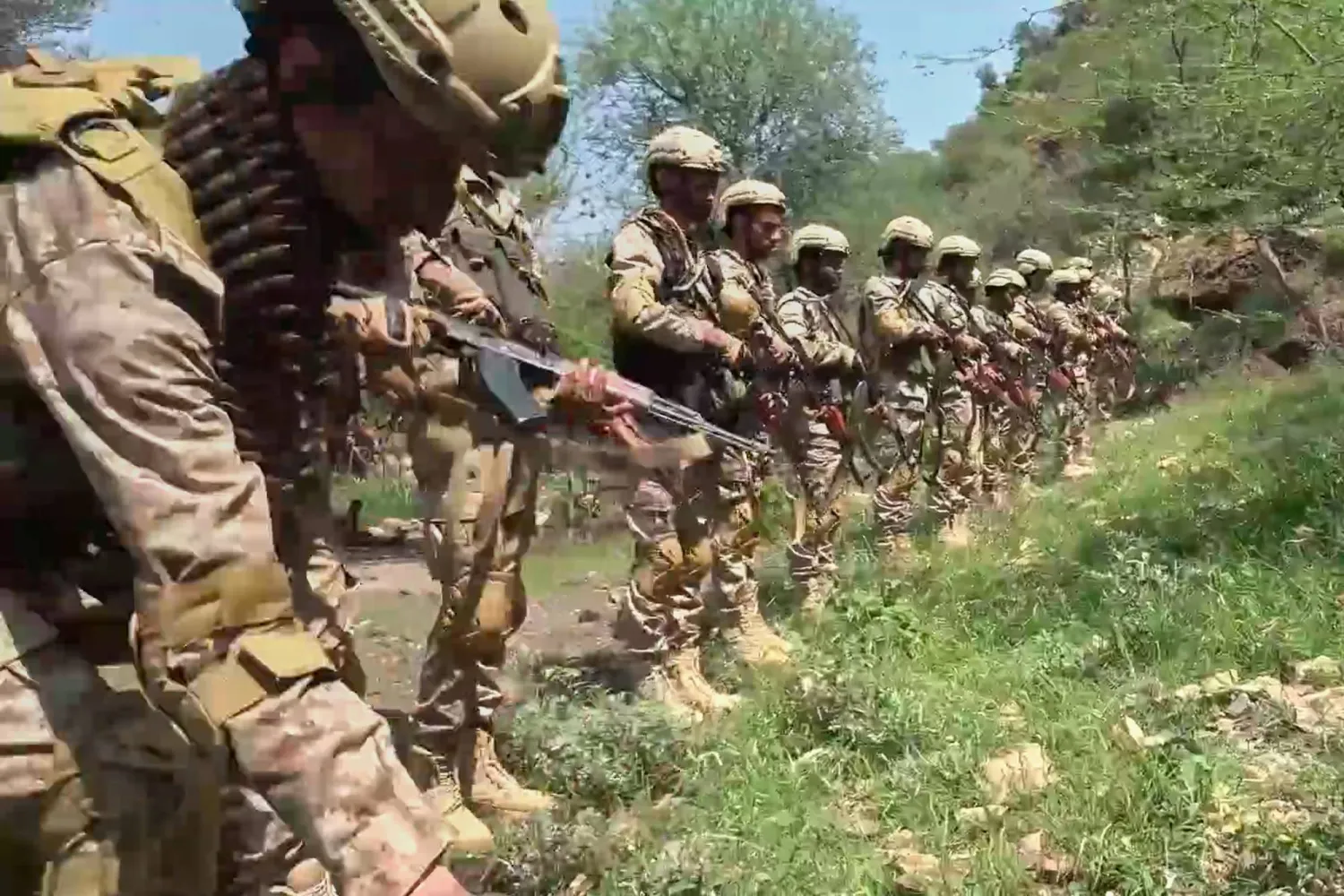
Houthi fighters standing in formation in an area of clashes with government forces in Yemen. (AP)
TT

Battles, Airstrikes Exhaust Yemen’s Houthis

Houthi fighters standing in formation in an area of clashes with government forces in Yemen. (AP)

Fighting between Yemeni government forces and the Houthis continued across interconnected fronts stretching from western Taiz to Lahj and the west coast, with clashes intensifying on high ground overlooking the Bab al-Mandab strait and routes leading to the coast.

Government forces reported recapturing positions, repelling attacks and shooting down drones as airstrikes targeted Houthi fortifications and reinforcements.

The fighting has centered on an area extending from Ras al-Ara and Al-Mudaribah in Lahj through Al-Wazi’iyah and Kahbub to the southern countryside of Taiz, where the two sides are battling for high ground overlooking supply routes and coastal areas.

Government forces reported repelling a Houthi attack in the strategic Kahbub mountain range and regaining large parts of contested positions, while limited Houthi pockets remained in some sectors.

Strategic mountain retaken

In southern rural Taiz, government forces said they had taken full control of Jabal Qarfan in the Harad Jirdad area of Al-Shamayatayn district after fierce fighting with the Houthis.

Maj. Gen. Abdulaziz al-Majidi, chief of staff of the Taiz Military Axis, said government troops, backed by fighters from Bani Omar, seized the mountain, which he described as a strategic position in the range overlooking Al-Wazi’iyah.

The government forces said more than five Houthi fighters were killed and around 20 wounded in the clashes.

The high ground around Al-Wazi’iyah and Kahbub is strategically important because it overlooks parts of the coast and roads leading to it. Government forces say the Houthis use valleys, ravines and dense vegetation around Al-Wazi’iyah to conceal fighters and equipment and maintain supply lines toward the west coast.

Field sources said Houthi reinforcements continued to arrive, particularly in Al-Wazi’iyah, as the intensity of fighting shifted between fronts.

Government denial

Separately, government forces and the Houthis traded accusations over the deaths of government prisoners in Al-Jawf province.

Yemeni Armed Forces spokesman Col. Majed al-Nazili rejected a Houthi account claiming prisoners had been killed at a detention facility in Al-Hazm district, calling it “false and misleading” and accusing the group of trying to blame government forces for their deaths.

Al-Nazili maintained that no strike had been carried out inside Al-Hazm city, whose military sites he said were under Houthi control. He called on the group to ensure the safety of prisoners and detainees, keep them away from combat zones and inform the International Committee of the Red Cross of detention locations.

He also accused the Houthis of seeking to exploit the prisoners’ case to mislead public opinion, linking it to what he described as a Houthi attack on a market in Lahj province.

Government forces also announced strikes against Houthi personnel and equipment in the city of Mokha in Taiz province and in Al-Bayda, saying the operations were aimed at limiting the group’s ability to attack troops and civilians.

Displacement could top 230,000

The fighting comes as the latest escalation fuels a growing displacement crisis.

The UN refugee agency warned that the number of people internally displaced by the recent escalation could exceed 230,000 if the current pace of fighting and displacement continues.

UNHCR Yemen representative Armen Yedigaryan noted that more than 130,000 people had fled their homes since the beginning of September. More than 3,000 people have also reached Djibouti, while hundreds have fled to Somaliland and Puntland in Somalia.

The latest displacement comes on top of a protracted crisis that had already forced more than 5.2 million people from their homes, according to UNHCR.

Yedigaryan said more than 22 million people in Yemen require humanitarian assistance, including around 65,000 refugees and asylum-seekers, while aid operations face severe constraints from insecurity, movement restrictions, communications disruptions, damaged roads and infrastructure, and funding shortages.

Taiz accounts for more than 60 percent of the latest displacement, UNHCR revealed, with additional displacement reported in Al-Jawf, Marib and Hodeidah.

According to UNHCR spokesman Babar Baloch, some mothers had reported being displaced for the fourth time since the war began more than 12 years ago.

Norway Gives Additional $13 Million in Aid to Palestinians

Palestinian motorists wait in line to cross the Beit Furik military checkpoint, east of Nablus, West Bank, 20 September 2026. EPA/ALAA BADARNEH
TT

Norway Gives Additional $13 Million in Aid to Palestinians

Palestinian motorists wait in line to cross the Beit Furik military checkpoint, east of Nablus, West Bank, 20 September 2026. EPA/ALAA BADARNEH

Norway's government said on Thursday it will give an additional 125 million Norwegian crowns ($13.17 million) in aid to the occupied Palestinian territories through the United Nations and the World ⁠Bank, including public sector ⁠budget support.

Norway recognized a Palestinian state in 2024 and chairs the international donor ⁠group for the Palestinians.

Norway's Foreign Minister Espen Barth Eide said in a statement the need for international support was "greater than ever.”

Eide also criticized Israeli settlement activity ⁠in ⁠the occupied West Bank.

Norway is providing around 1 billion Norwegian crowns in assistance to the Palestinians in 2026.


Postwar Arrangements Top al-Zaidi’s New York Talks

Lebanese Prime Minister Nawaf Salam (L)speaks with Iraqi Prime Minister Ali al-Zaid during a Gulf Cooperation Council (GCC) multilateral meeting on the sidelines of the 81st United Nations General Assembly in New York on September 22, 2026. (Photo by Brendan SMIALOWSKI / AFP)
TT

Postwar Arrangements Top al-Zaidi’s New York Talks

Lebanese Prime Minister Nawaf Salam (L)speaks with Iraqi Prime Minister Ali al-Zaid during a Gulf Cooperation Council (GCC) multilateral meeting on the sidelines of the 81st United Nations General Assembly in New York on September 22, 2026. (Photo by Brendan SMIALOWSKI / AFP)

Iraqi Prime Minister Ali al-Zaidi is seeking to restore normal relations with neighboring and regional countries through a series of meetings in New York, where he is attending the UN General Assembly.

Al-Zaidi met US President Donald Trump on Wednesday to discuss strengthening bilateral cooperation and regional developments. The prime minister’s media office said the talks covered economic and investment partnerships between Baghdad and Washington, as well as joint efforts to bolster regional and international security and stability.

Al-Zaidi’s talks in New York have drawn particular attention, including his participation in a multilateral meeting with Trump to discuss postwar regional arrangements and his meeting with Syrian President Ahmad al-Sharaa.

Baghdad says it has been hurt by the closure of the Strait of Hormuz because of the war, but faces sharp contradictions at home because parties in the ruling Coordination Framework and armed factions are allied with Iran, one of the parties to the conflict with the United States.

Government spokesman Haider al-Aboudi said Iraq was pursuing an important program to coordinate positions and create opportunities for cooperation, noting that al-Zaidi had held several meetings in New York to coordinate policies and safeguard shared interests.

“Iraq has listened to the proposals of world leaders, but it has its own vision for producing solutions to secure energy supplies and stabilize the region,” al-Aboudi told reporters.

He explained that Iraq was guided by legal and constitutional principles of good-neighborly relations and non-interference in internal affairs while pursuing greater cooperation and integration to promote stability.

Al-Zaidi and Al-Sharaa

Al-Aboudi’s remarks followed a series of meetings al-Zaidi held with world leaders, most notably Syrian President Ahmad al-Sharaa.

Before a multilateral meeting convened by Trump on the sidelines of the UN General Assembly, journalists captured al-Sharaa and al-Zaidi shaking hands for the first time since the Iraqi premier took office.

Al-Zaidi’s office later confirmed that the two leaders met on the sidelines of the 81st UN General Assembly.

According to the statement, the talks covered regional and international developments, bilateral relations and ways to strengthen them in line with mutual interests, as well as efforts to promote de-escalation and ease regional tensions.

Al-Sharaa, for his part, told reporters that Damascus was working to provide a safe corridor for Iraqi oil exports through Syrian ports. He pointed to a strategic project to build an oil pipeline from Iraqi fields to Syrian ports, bypassing the Strait of Hormuz.

The Syrian president described Damascus’ relations with Iraq’s Kurdistan region as “very good,” citing shared interests in several areas. He also highlighted Kurdistan Democratic Party leader Masoud Barzani’s role in stabilizing Syria and integrating the Syrian Democratic Forces (SDF) into the state.

Postwar arrangements

Al-Zaidi also joined a multilateral meeting attended by Trump following what was described as a “productive” meeting between US and Iranian officials on Tuesday evening.

Al-Zaidi’s office reported that the meeting addressed security and stability, protecting global trade, securing supply chains and preserving development levels in regional economies.

Participants also discussed proposed strategies and arrangements for the postwar period and ways to advance peace and stability by prioritizing dialogue and diplomatic solutions.

The meeting included delegation heads from Saudi Arabia, Bahrain, Kuwait, the United Arab Emirates, Qatar, Oman, Jordan, Lebanon, Syria, Egypt and Türkiye, as well as the United States.

Baghdad political science professor Talib Mohammed Karim described al-Zaidi’s meetings as “an opportunity to give Baghdad greater room to build a more balanced foreign policy.”

The Iraqi government, he told Asharq Al-Awsat, was seeking security and economic cooperation and ways to protect shared interests at a complex geopolitical moment, without allowing regional relationships to become extensions of Iraq’s internal conflicts.


Al-Sharaa: Syria Has Begun ‘Journey of Recovery and Revival,’ Ending 47 Years of Isolation

Syrian President Ahmad al-Sharaa speaks during the 81st session of the UN General Assembly in New York (AP)
TT

Al-Sharaa: Syria Has Begun ‘Journey of Recovery and Revival,’ Ending 47 Years of Isolation

Syrian President Ahmad al-Sharaa speaks during the 81st session of the UN General Assembly in New York (AP)

Syrian President Ahmad al-Sharaa said Wednesday that Syria had begun a “journey of recovery and revival,” marking the end of 47 years of isolation, while insisting the Israeli-occupied Golan Heights “will remain Syrian.”

Addressing the 81st UN General Assembly in New York, al-Sharaa recalled appearing before the gathering a year earlier, representing his country for the first time in nearly 60 years.

“In Syria’s struggle between good and evil, the war has ended, the bloodshed has stopped, and the destruction has ceased,” he declared. “Syria has begun its journey of recovery and revival.”

The Syrian president said his country was rebuilding its international standing by expanding relations and partnerships “from a solid foundation of sovereignty.” Since what he called Syria’s “liberation,” nearly 100 countries had opened channels with Damascus through around 4,000 meetings, contacts and other interactions, while the capital now hosts some 60 diplomatic missions.

Turning to chemical weapons inherited from former President Bashar al-Assad’s government, al-Sharaa highlighted the launch of the “Breaths of Freedom” team in cooperation with seven countries, the destruction of 42 chemical bombs and the restoration of Syria’s rights within the Organization for the Prohibition of Chemical Weapons.

Damascus was also cooperating with the International Atomic Energy Agency “with the utmost transparency” and had helped dismantle 90 international networks involved in human trafficking, drugs and crime, he added.

On sanctions, the president argued that improved security and stability had created a reality in which “the walls of isolation are collapsing,” pointing to the repeal of the Caesar Act, the gradual lifting of European and British sanctions, the restoration of Syria’s cooperation agreement with the European Union and the closing of the chapter on its designation as a state sponsor of terrorism.

He described those developments as “marking the end of 47 years of isolation.”

The Golan Heights also featured prominently in his address. Al-Sharaa maintained that attempts to impose a new reality could not undermine Syrian state legitimacy, the rule of law or international law.

“The Golan will remain Syrian land,” he stressed, adding that “all annexation measures are null and void” under UN Security Council Resolution 497.

Despite continuing Israeli attacks, the Syrian leader held out the prospect of a political solution, saying there remained an opportunity for “a just peace that preserves everyone’s rights.”

Speaking separately outside the General Assembly meetings, al-Sharaa revealed that direct dialogue with Israel had begun about a year ago and that several rounds of negotiations had produced understandings on “around 90 percent of the issues.”

A final agreement, however, remained uncertain.

“We must protect Syrians’ security and rights before we can talk about peace,” he cautioned, proposing an international committee to assess Israeli security concerns and distinguish between “perceptions” and concerns Israel considers genuine.

Al-Sharaa also recounted joking with US President Donald Trump during an earlier White House discussion about US recognition of Israeli sovereignty over the Golan.

“Why don’t you think about giving New Jersey to the Israelis?” he recalled telling Trump. “You don’t own the Golan to give it away today, but you do own New Jersey, because it is full of Democrats and they don’t vote for you.”

On Lebanon, the Syrian president affirmed Damascus’ support for state authority and institutions, restricting weapons to state control and strengthening economic cooperation between the two countries.