


US Senate Rejects Resolution to Halt the Iran War as Gas Prices Upend Midterms

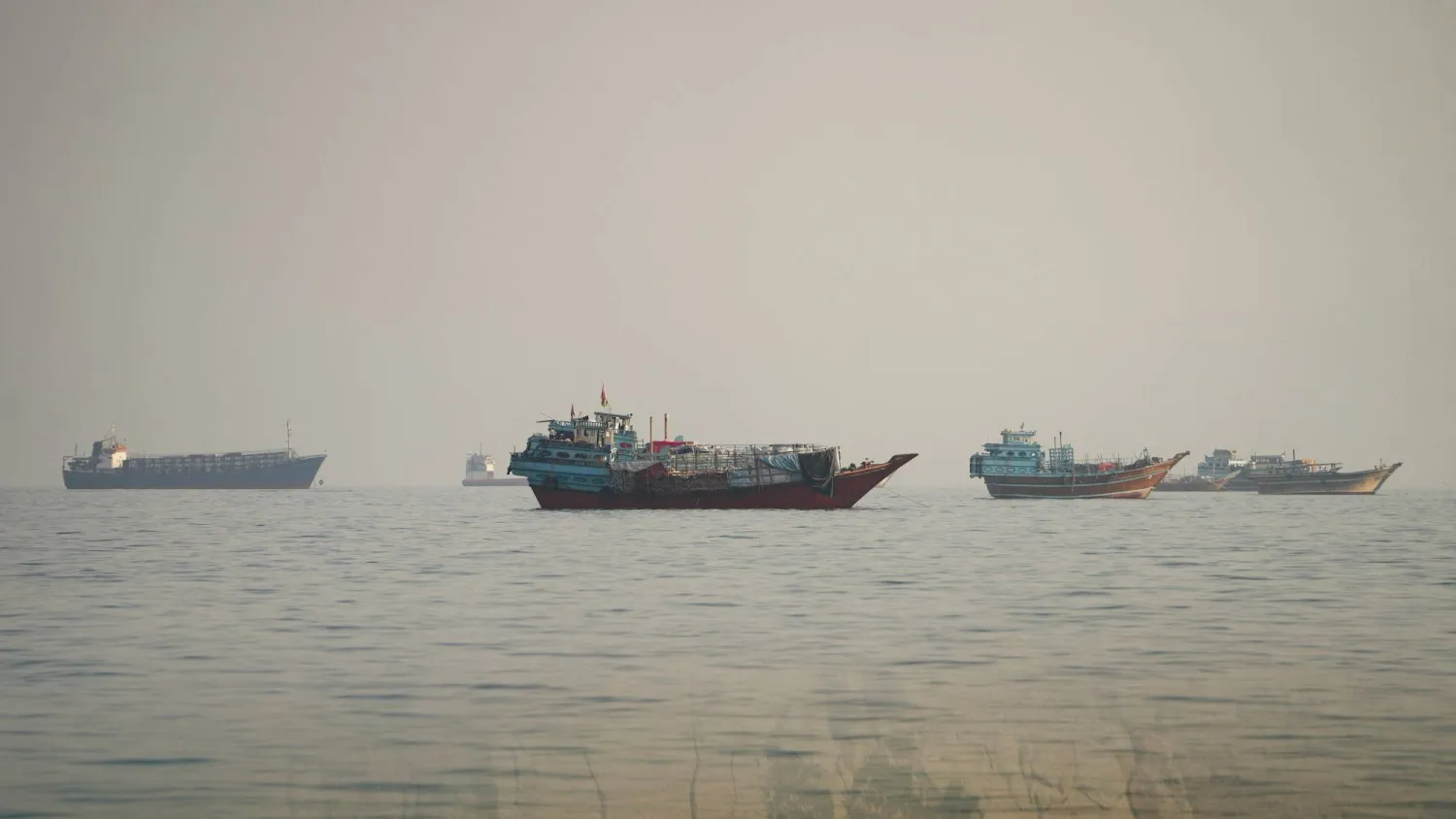
 Vessels at the Strait of Hormuz, as seen from Musandam, Oman, September 23, 2026. (Reuters)
Vessels at the Strait of Hormuz, as seen from Musandam, Oman, September 23, 2026. (Reuters)
TT

US Senate Rejects Resolution to Halt the Iran War as Gas Prices Upend Midterms

 Vessels at the Strait of Hormuz, as seen from Musandam, Oman, September 23, 2026. (Reuters)
Vessels at the Strait of Hormuz, as seen from Musandam, Oman, September 23, 2026. (Reuters)

Despite rising political anxiety over the Iran war, senators on Thursday narrowly rejected a war powers resolution seeking to halt President Donald Trump 's military action, which has been largely blamed for the spike in gas prices and become a flashpoint in the midterm election.

The Senate tally, 49-50, coming days after Trump's bombastic address to the United Nations in which he threatened to “annihilate” Iran, was likely the last chance for lawmakers to go on record about the war ahead of November.

More Republicans are peeling way from the president as the war drags on, a rare slap back to Trump, as they campaign for control of Congress. The Senate outcome fell short, with four GOP senators joining most Democrats in favor of the resolution.

“They have been carrying water for this ridiculous and illegal war for months and months and months and not listening to their constituents,” said Sen. Tim Kaine, D-Va., who pushed the war powers resolution forward.

About half of rural American voters believe the economy is worse off now than when Trump returned to office, according to a new survey from The Associated Press in partnership with KFF. The costs of groceries, gas and healthcare rank as top pain points for the rural voters.

"We’ve got to break the cycle,” said Sen. Thom Tillis, R-N.C., who joined in voting yes.

Republican Sens. Susan Collins of Maine, Lisa Murkowski of Alaska, Rand Paul of Kentucky also voted for the resolution to end the war, as they have in many previous tallies, and Democratic Sen. John Fetterman voted against.

This was the 14th time the Senate has considered a war powers resolution, since Trump launched the conflict on Feb. 28.

War powers resolutions are largely political statements, without the full force of law, but stand among the sharper tools the House and Senate have to express disapproval of the White House, short of halting funds for Trump's military actions. As resolutions, they do not go to the president's desk for his signature.

As gas prices climb, Republicans start to question the war

Republicans in control of Congress have shied away from directly confronting Trump over the war, now stretching past the seven-month mark. But their unrest is surfacing as stubbornly high gas prices leave voters in a cash crunch back home.

Diesel costs, in particular, have almost doubled, topping $6 a gallon, according to AAA.

Just returning from a swing through Iowa, Kansas and Nebraska stumping for GOP candidates who are suddenly at risk in their elections, Sen. John Kennedy of Louisiana called on Trump to hold a prime-time address to the nation to explain the Iran war strategy and the end game.

“People are confused about the war and upset about the cost of living,” he said.

But he and others were not yet ready to vote against the war.

“My own view is that the focus right now needs to be on attacking the cost of living issues,” said Sen. Josh Hawley, R-Mo., who opposes the war powers resolution and believes the president is acting within his authority to conduct the military action.

House Democratic Leader Hakeem Jeffries scoffed at the handful of Republicans now trying to distance themselves from what he called Trump's failed economy. “Now all of a sudden they’re waking up,” he said.

Democrats keep pushing war powers votes in Congress

Earlier this month, the House for a third time approved a war powers resolution, this time with seven Republicans joining the Democrats, including two from battleground Iowa, Rep. Zach Nunn and Rep. Mariannette Miller Meeks, where affordability issues among rural voters are dominating the campaigns.

Senators, though, have rarely been able to confront Trump by passing a war powers resolution.

In June, the Senate approved a war powers resolution after four GOP senators joined Democrats, but Republicans abruptly reversed course the next day after Trump berated them during a private lunch over the outcome.

At the time, Sen. Bill Cassidy of Louisiana, stood up to defend his vote only to end up in a shouting match with Trump. He later switched to oppose the war powers resolution after receiving a personal briefing from the White House.

Thursday's vote was on a resolution that had passed the House in July with GOP support. Rep. Pramila Jayapal, D-Wash., who authored the House resolution, said the Senate outcome was "a slap in the face to the millions of American people who want this war to end."

Other options to halt the Iran war

As the war drags on, costing $43.5 billion so far, Congress is also seeking other ways to force Trump to rethink his military strategy in Iran.

Rep. Thomas Massie, the renegade Republican from Kentucky, pushed forward articles of impeachment against Secretary of Defense Pete Hegseth before the GOP leadership abruptly adjourned the House and sent lawmakers home to campaign for the election, avoiding any potential vote on the matter.

Lawmakers also have the power of the purse to curtail military spending, something Republicans have been reluctant to do but Democrats are sure to tackle if they win power in the midterm election. The White House's request for an additional $87.6 billion funding package for the war and other needs has idled in Congress.

First created in the aftermath of the Vietnam War as a way to hold a president accountable for military actions, the war powers act has long posed a test of the balance of power between the executive and legislative branches of government.

While the Constitution says only Congress can declare war, the president as commander-in-chief is also able to engage the military. The war powers act seeks to provide clarity by requiring the president, within 60 days of any such action, to seek approval — or risk disapproval — from Congress.



Iran Threatens to Expand War to Indian Ocean if US Attacks Again

People walk past a billboard about the Strait of Hormuz, on a building in Tehran, Iran, September 16, 2026. Majid Asgaripour/WANA (West Asia News Agency) via Reuters
TT

Iran Threatens to Expand War to Indian Ocean if US Attacks Again

People walk past a billboard about the Strait of Hormuz, on a building in Tehran, Iran, September 16, 2026. Majid Asgaripour/WANA (West Asia News Agency) via Reuters

An adviser to Iran's supreme leader Mojtaba Khamenei warned on Thursday that Tehran may expand the Middle East war to the Indian Ocean if the US attacks again.

"Since the conflict has spread from the Gulf and Strait of Hormuz to the Red Sea, it is possible that, in response to more war, the front will expand even further, reaching the Indian Ocean and perhaps beyond," said Yahya Rahim Safavi in a video released by Iran's Fars news agency.

Yemen's Houthis, fighting government forces, recently took control of the Red Sea coastline, tightening their grip on the strategic Bab al-Mandab Strait, which links Asia to Europe via the Suez Canal.

Iran has long provided military support to the Houthis but denies any involvement in the Yemen conflict.

Tehran has also locked down the Strait of Hormuz off the Iranian coast, in retaliation for US-Israeli strikes that triggered the Middle East war at the end of February.

Iran and the United States are now vying for control of Hormuz, through which much of the world's oil and gas passed before the war.

Iranian officials had already threatened to expand the geographic scope of the conflict if US strikes resume.

But Thursday's warning is the first time an adviser to Iran's supreme leader explicitly mentioned the Indian Ocean, home to a strategic US-British military base at Diego Garcia, nearly 4,000 kilometers from Iran.

Officials from both countries held talks in New York this week on the sidelines of the UN General Assembly in a further attempt to end the conflict.

Iran has put forward its conditions for ending the war, including the lifting of sanctions targeting its economy and the unconditional release of its frozen assets abroad.

In an exclusive interview with AFP on Tuesday, a spokesman for Iran's Revolutionary Guards, Hossein Mohebi, also mentioned ending the war in Yemen.


Rich Nations Should Foot Climate Bill, Says Nepal Minister

People hold onto a cage on a makeshift zip line as they cross the Trishuli River from Devighat following deadly flash floods that damaged bridges and temporarily stranded residents, in Nuwakot district, Nepal, September 21, 2026. (Reuters)
TT

Rich Nations Should Foot Climate Bill, Says Nepal Minister

People hold onto a cage on a makeshift zip line as they cross the Trishuli River from Devighat following deadly flash floods that damaged bridges and temporarily stranded residents, in Nuwakot district, Nepal, September 21, 2026. (Reuters)

Wealthy nations must pay for climate disasters that devastate countries that are least responsible for the crisis, yet bear its brunt, Nepal's foreign minister told AFP on Thursday.

The Himalayan nation suffered one of the worst catastrophes in its history late last month when a tsunami-like flood, triggered by a high-altitude glacial mountain collapse along the Nepal-China border, cut a swathe of destruction.

More than 1,400 people died, 6,000 are still missing, and the economic devastation runs in the billions of dollars.

"What we're trying to convey to the world is this: these issues of climate change are not theoretical anymore," Minister of Foreign Affairs Shisir Khanal said in an interview at Nepal's permanent mission, during the United Nation's high-level week.

"These are becoming real, and the frequency of such disasters are likely to happen more often over the next few years as the temperature rises, as the glaciers melt."

Scientists from the World Weather Attribution (WWA) have described the event as a "compound crisis" in which local geological instability combined with long-term warming that has led to glacier retreat and permafrost thaw.

Nepal has contributed negligibly to the breakdown of the global climate system, Khanal added.

More than 90 percent of its electricity comes from hydropower, over 70 percent of new cars sold are electric, and the nation contributes just 0.1 percent of global greenhouse gases.

"So why should we, who have not had any contribution to this issue, only bear the burden?"

- $5 billion disaster cost -

Khanal said his meetings in New York had been productive, with the United States announcing $31 million in new flood recovery support.

The G7 informally promised support at a meeting on Wednesday, he said, and Britain has also vowed to help.

Still, the scale of the challenges is enormous: preliminary estimates by his government put the cost of the disaster at $5 billion.

Nepal has asked the UN's Loss and Damage fund for $20 million, the maximum allowed, but a tiny fraction of what it needs.

The fund, established in 2022 in the aftermath of catastrophic floods in Pakistan, has yet to make even its first disbursement and is dramatically underfunded -- and observers see Nepal as a key test.

Khanal said, however, he had been encouraged by cash assistance and rescue teams sent by Nepal's neighbors, as well as the Nepalese diaspora who had sent money directly to the Prime Minister's Relief Fund.

Previously, he said, Nepalis preferred to donate to international organizations and local nonprofits -- but that has changed since the election of new Prime Minister Balendra Shah, a former rapper who won power on the back of a youth-led movement.

Jeremy Konyndyk, a former USAID official under Joe Biden, has criticized President Donald Trump's administration for sweeping aid cuts to Nepal after it took office, including for flood prediction and glacier inventories.

"There's no early warning system that probably exists in the world right now to imagine a compounded disaster of that nature," Khanal said. "But obviously what USAID and other institutions used to provide us is financial and technical assistance."

Nepal now needs more such assistance from the world to develop more complex systems involving satellites to monitor the rate of glacial melt and provide advance warnings, he said.


White House Reinstates Access to CNN, MS NOW and Politico Following Judge’s Order

Marine One lifts off from the South Lawn of the White House after President Donald Trump and China's President Xi Jinping toured the helicopter, Thursday, Sept. 24, 2026, in Washington, during a state visit. (AP)
TT

White House Reinstates Access to CNN, MS NOW and Politico Following Judge’s Order

Marine One lifts off from the South Lawn of the White House after President Donald Trump and China's President Xi Jinping toured the helicopter, Thursday, Sept. 24, 2026, in Washington, during a state visit. (AP)

The White House said on Thursday it has reinstated journalists from CNN, MS NOW and Politico after a federal judge deemed US President Donald Trump's ban of the three news outlets likely unconstitutional and ordered their access immediately restored.

The midday reinstatement came after a chaotic few hours earlier on Thursday when the journalists continued to be blocked from entering the White House grounds. That prompted the three news organizations to request an immediate hearing before US District Judge Tim Kelly, who issued his decision overnight.

Kelly, acting in a lawsuit brought by CNN, MS NOW and Politico on Monday, ordered a halt to Trump's ban for 14 days in a press freedom case that has played out over the past week in the courtroom and White House grounds.

Kelly found that the revocation of the White House credentials of the journalists "likely violated their constitutional due process rights."

The judge, who Trump appointed in 2017 during his first presidential term, also raised doubts about the US Justice Department's national security arguments for justifying the ban, noting that Trump himself had said the action was due to what the president alleged was false or negative coverage.

Hours after Kelly issued his order, CNN, MS NOW and Politico told the judge they remained ‌barred, and asked for ‌the emergency hearing. Politico said its reporter's credentials were confiscated. An MS NOW reporter said she was blocked from the White ‌House. CNN ⁠said some ⁠of its staff members were denied entry onto the grounds.

In response, Micah Stopperich, the director of press operations at the White House, said in a court filing that the White House began the process of reinstating press badges for affected reporters at 7:25 a.m., and that the "White House press team dropped badges at the entry gate for members of the press to pick up around 9:55 a.m."

After receiving Stopperich's declaration, the judge denied the request by the news organizations for an emergency hearing but gave them an opportunity to inform him of any factual developments later in the day.

The sharpest conflict yet between Trump and the press played out during a key diplomatic moment for the US president: his appearance at the United Nations General Assembly in New York and his hosting of Chinese President Xi Jinping on Thursday.

A source familiar with the White House television press pool said its members would not reinstate their coverage ⁠until the White House formally reinstates CNN to the pool. Earlier this week, they had suspended pooled coverage in solidarity with CNN.

There ‌were no TV pool cameras set up for Xi's arrival on the White House's South Lawn on Thursday ‌morning, and FOX News, MS NOW and CNN did not air the two leaders' arrival ceremony live.

During Trump's welcome of Xi to the White House, the president made a joke to ‌photographers in the Oval Office about the Chinese having the friendliest press corps.

CNN is one of the five news organizations – along with ABC, CBS, FOX News and ‌NBC – that make up the primary White House television pool. They share the costs of covering the president, take turns organizing coverage and provide footage to other outlets.

CNN had been scheduled to cover Trump's trip to New York for the General Assembly on Monday, but was not able to provide a pool feed.

NATIONAL SECURITY CONCERNS

Trump announced the ban on Friday on his social media platform, saying those news organizations "shouldn't be able to constantly write or report FICTION and LIES when they're covering the President of the United States." Trump framed their reporting as a threat to US national ‌security.

The three outlets sued Trump and other members of his administration, saying the ban violated the US Constitution's First Amendment protections for free speech and a free press, as well as their due process rights. A coalition of press freedom groups ⁠and dozens of news organizations, including Reuters, later ⁠filed a legal brief supporting the three news outlets.

Kelly ordered the Trump administration to immediately return the outlets' press passes and stop enforcing the ban for two weeks. The judge rejected the administration's stated national security concerns.

"The record lacks factual support for defendants' contention that the revocation of plaintiffs' hard passes will in fact protect national security or that national security will be endangered if the court orders their passes reinstated while this litigation proceeds," Kelly wrote.

In a filing on Tuesday, the Justice Department accused the outlets of threatening national security with their coverage, citing stories about US missile stockpiles, construction of Trump's White House ballroom and turnout at the recent Republican midterm convention.

Theodore Boutrous, an attorney for the three outlets, welcomed the judge's decision in a statement, saying: "This is a strong ruling vindicating freedom of the press, due process and the rule of law. We greatly appreciate the court's swift action."

TENSIONS WITH THE PRESS

Although other presidential administrations have battled with the press, Trump's campaign against the media has been unprecedented.

Upending decades of tradition, his White House had denied basic access to many major news organizations, launched personal attacks on journalists and filed multiple lawsuits against news organizations.

Kelly's ruling came a day after Trump experienced another legal setback.

On Wednesday, an Iowa judge dismissed Trump's 2024 lawsuit against the Des Moines Register newspaper and pollster J. Ann Selzer.

Trump sued the Register, its parent company Gannett and Selzer over a poll published ahead of the November 2024 US election that showed Democratic presidential candidate Kamala Harris leading him in Iowa. Trump accused the newspaper and its longtime pollster of fraudulently misleading readers.

In his ruling Wednesday, Iowa District Judge Scott Beattie said the poll was legally protected speech.