US Treasury Chief Claims Successes in Isolating Iran
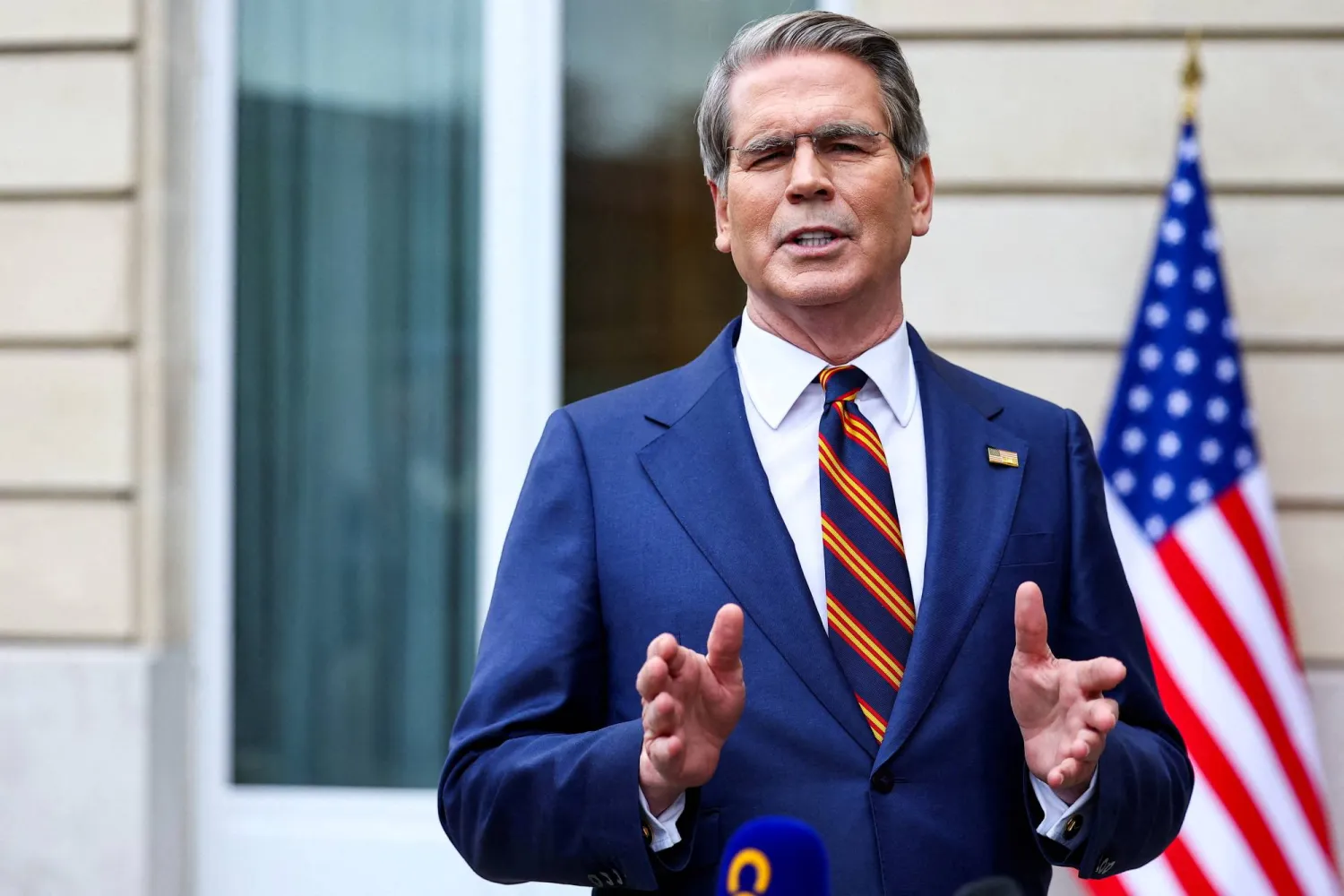
FILE PHOTO: US Treasury Secretary Scott Bessent speaks to the media after two days of meetings with a Chinese delegation, in Paris, France March 16, 2026. REUTERS/Abdul Saboor/File Photo
TT
TT
US Treasury Chief Claims Successes in Isolating Iran
FILE PHOTO: US Treasury Secretary Scott Bessent speaks to the media after two days of meetings with a Chinese delegation, in Paris, France March 16, 2026. REUTERS/Abdul Saboor/File Photo
US Treasury Secretary Scott Bessent said on Saturday that he had sent envoys around the world to pressure countries to economically isolate Iran, hailing new restrictions targeting the country's airlines and banks.
"At my direction, teams were dispatched across the globe to engage with countries and demand action against the Iranian regime," he said on X. "These efforts are delivering results."
Bessent noted that Türkiye and Oman have halted incoming flights from private carrier Mahan Air, while the United Arab Emirates has stopped all flights by Iranian airlines.
Dubai, the UAE's commercial hub, is a major destination for Iran's carriers, with multiple daily flights, a large Iranian community and close business links.
Iran's ISNA news agency, citing officials, reported that five countries had revoked the Iranian republic's flight permits: Azerbaijan, Georgia, Iraq, Oman and the UAE.
But it said flights were still operating to China -- which is refusing to yield to US pressure -- and Russia via the two main airlines, national carrier Iran Air and Mahan.
Mahan had announced that it would no longer serve Türkiye at the request of the Turkish authorities, but flights continue several times a day in both directions, via Iran Air or smaller Iranian carriers, according to the Tehran and Istanbul airport websites.
ISNA said Afghanistan, Armenia, Belarus, Malaysia, Pakistan and Tajikistan were still also being served.
Bessent had said on Monday that all Iranian airlines "will be shut down around the world".
He also highlighted new banking restrictions.
On Wednesday, the UAE central bank blocked transactions to and from Iran by branches of Iran's Bank Melli, accusing it of violating laws on money laundering, terrorism and arms proliferation.
Last week, Türkiye revoked the license of Iran's Bank Mellat, a semi-private financial entity that has been subject to Western sanctions for years.
A Wall Street Journal article shared by Bessent said Jonathan Burke, the Treasury's assistant secretary for terrorist financing, traveled across the Middle East and Europe over two weeks to push the plan to impose what Bessent called "economic D-Day" on Tehran.
The US Treasury has held discussions with more than 50 countries, the Journal reported.
Arada Enters Saudi Property Market with $13.3 Billion Portfoliohttps://english.aawsat.com/business/5331886-arada-enters-saudi-property-market-133-billion-portfolio
Arada Enters Saudi Property Market with $13.3 Billion Portfolio
The Saudi capital, Riyadh (SPA)
Property developer Arada is entering Saudi Arabia through a partnership with local firm XTOPIA, gaining access to a SAR 50 billion ($13.3 billion) land and development portfolio as the Kingdom continues to attract international investment despite global economic uncertainty.
The new venture, Arada KSA, will launch its first project in Riyadh’s Al Rimal district, a SAR 14 billion residential development comprising around 3,500 villas and townhouses.
Arada KSA Chairman Mohammed AlDhabaan told Asharq Al-Awsat that the investment reflected long-term confidence in Saudi Arabia’s economic prospects, supported by Vision 2030 reforms, infrastructure development and growing housing demand.
The Kingdom’s clear economic policies, sustained reforms and improving investment environment provide the certainty needed for long-term commitments, he explained.
“Our investment in the Kingdom is not tied to temporary market conditions but rests on firm confidence in its future and the economic transformation driven by Vision 2030 with government support,” AlDhabaan said.
He described the Riyadh development as an investment in the future rather than simply a response to current demand, marking the beginning of a lasting commitment to the Saudi market.
Arada KSA Chairman Mohammed AlDhabaan (Asharq Al-Awsat)
Housing demand and prices
AlDhabaan expressed optimism about the sector’s prospects, citing population growth, the formation of new households, urban expansion and government initiatives to increase homeownership and improve quality of life.
The next phase of growth, he argued, would be measured not only by the number of homes built but also by developers’ ability to create communities that meet residents’ everyday needs.
Location, affordability, access to financing, infrastructure and confidence in developers would shape demand, while land and construction costs would remain key factors influencing prices.
“No single project can determine market prices. They are influenced by supply and demand, land and construction costs, and financing,” he noted.
“However, increasing supply, diversifying housing products and improving development efficiency can strengthen competition and give buyers more options.”
Developers that combine quality design and construction with integrated facilities and reliable delivery would have a competitive advantage, he added.
First project in Riyadh
Arada KSA’s inaugural development in northeastern Riyadh will feature approximately 3,500 villas and townhouses alongside educational, retail and sports facilities, a community center and green spaces incorporating around 100,000 trees.
The company will work with relevant government authorities to prepare a master plan aligned with the capital’s urban development requirements.
The project will be financed through an investment structure regulated by Saudi Arabia’s Capital Market Authority and managed by a licensed financial company. Construction and sales are scheduled to begin in 2027.
Design model for one of the company’s projects in Saudi Arabia (Asharq Al-Awsat)
Partnership and expansion
Established with XTOPIA, Arada KSA will have access to a 10 million-square-meter land portfolio across Riyadh, Jeddah and Makkah, providing opportunities for further residential developments in the coming years.
AlDhabaan, who also chairs XTOPIA, will lead the new company, bringing together Arada’s international experience in developing residential communities and its Saudi partner’s knowledge of the local market.
He believes the combination will allow the venture to build a lasting presence in the Kingdom while contributing to Vision 2030’s housing and quality-of-life objectives.
The Saudi expansion forms part of Arada’s broader international strategy. Its development portfolio is valued at approximately SAR 189 billion ($50.4 billion) across five markets: Saudi Arabia, the United Arab Emirates, the United Kingdom, Australia and Syria.
The company has more than 70,000 residential units in its portfolio, including around 17,000 already completed, according to its figures.
Green Riyadh initiative
The Al Rimal development also aligns with Saudi Arabia’s efforts to improve urban living standards and expand green spaces.
Through the Green Riyadh initiative, the Royal Commission for Riyadh City aims to plant 7.5 million trees across the capital and increase green space per resident from 1.7 square meters to 28 square meters by 2030.
Arada’s entry comes as local and international developers compete to meet rising housing demand and offer buyers a wider range of residential options.
UK Debt Hits $4.01 Trillion as Inflation Rate Jumpshttps://english.aawsat.com/business/5331850-uk-debt-hits-401-trillion-inflation-rate-jumps
UK Debt Hits $4.01 Trillion as Inflation Rate Jumps
FILE PHOTO: People walk past the Bank of England building in London, Britain, September 16, 2026. REUTERS/Corey Rudy/File Photo
Britain's government borrowed more than expected again in September and public debt surpassed £3 trillion ($4.01 trillion), according to official data that underscored finance minister John Healey's challenge in his first budget next week.
Borrowing hit £24.52 billion last month, pushed up by spending on debt interest. A Reuters poll of economists had pointed to a deficit of £23.85 billion in the month.
Over the first six months of the 2026/27 financial year, the shortfall stood at £97.8 billion, down by £4.4 billion from a year earlier but above the forecast of £91.8 billion made by the Office for Budget Responsibility before the Iran war began.
Healey is expected to raise taxes on banks among other measures on October 28 in order to stay on track to meet his fiscal rules.
However, his margin for error is expected to have narrowed sharply in large part due to the rise in borrowing costs for government debt around the world since the start of the conflict in the Gulf.
Wednesday's data showed public sector debt was estimated to have exceeded £3 trillion for the first time. However, as a proportion of the economy, debt was lower than a year earlier, the Office for National Statistics said.
Britain's annual inflation rate also accelerated by more than expected in September, rising to 3.5 percent on elevated energy prices, official data showed.
The Consumer Prices Index jumped from a rate of 3.1 percent in August, the Office for National Statistics said.
Analysts' consensus forecast had been for inflation to reach 3.4 percent in September.
Japan Records Trade Deficit as Oil Imports Soar Due to Mideast Warhttps://english.aawsat.com/business/5331846-japan-records-trade-deficit-oil-imports-soar-due-mideast-war
A person looks at an electronic stock board showing Japan's Nikkei index at a securities firm Tuesday, Oct. 20, 2026, in Tokyo. (AP Photo/Eugene Hoshiko)
Japan Records Trade Deficit as Oil Imports Soar Due to Mideast War
A person looks at an electronic stock board showing Japan's Nikkei index at a securities firm Tuesday, Oct. 20, 2026, in Tokyo. (AP Photo/Eugene Hoshiko)
Japan’s trade deficit reached 2.81 trillion yen ($17.8 billion) for the first fiscal half, according to government data released Wednesday, as the war in Iran sent oil import prices soaring.
The Finance Ministry’s preliminary data showed that Japan’s exports for the April-September period grew 18.4% from the same period the previous year to 63.5 trillion yen, while imports soared to 66.3 trillion yen, up 20.4% year-over-year.
Both were record highs for Japan. The soaring price of oil affects a wide range of sectors, including plastic goods and shipping costs.
Resource-poor Japan imports virtually all its oil and has relied on access to the Strait of Hormuz in the Middle East for its oil shipments. That’s now basically blocked, and Japan has had to pay more to get shipments from other routes.
Brent crude, the international standard, has soared from $70 a barrel in February to about $100 a barrel lately, after shooting up to above $110 a barrel in recent months. Analysts say prices are unlikely to ease soon.
For the month of September, Japan’s trade deficit totaled 536.6 billion yen, marking the fifth month of deficits, but down from 1.1 trillion yen in August.
Japan’s September imports grew 18.9% from the previous year, while exports rose 16.7%, The Associated Press reported.
One sore point is the weakening yen, which drives up the cost of imports. The US dollar is lately trading at 150-yen levels.
The central bank, which kept borrowing costs at below or near zero for years to help keep a shaky economy going, has been gradually raising interest rates, in part to prop up the yen.
Last month, the Bank of Japan raised the benchmark interest rate to 1.25% from 1.0%, a 31-year high. Its monetary policy board meets again next week. The bank has an inflation target of about 2%.
The Japanese government has repeatedly stressed it’s working closely with the Bank of Japan. The government of Prime Minister Sanae Takaichi is promising a tax cut on food to 1% from 8% to help lower-income families cope with soaring prices. That bill is now being debated in Parliament.
لم تشترك بعد
انشئ حساباً خاصاً بك لتحصل على أخبار مخصصة لك ولتتمتع بخاصية حفظ المقالات وتتلقى نشراتنا البريدية المتنوعة