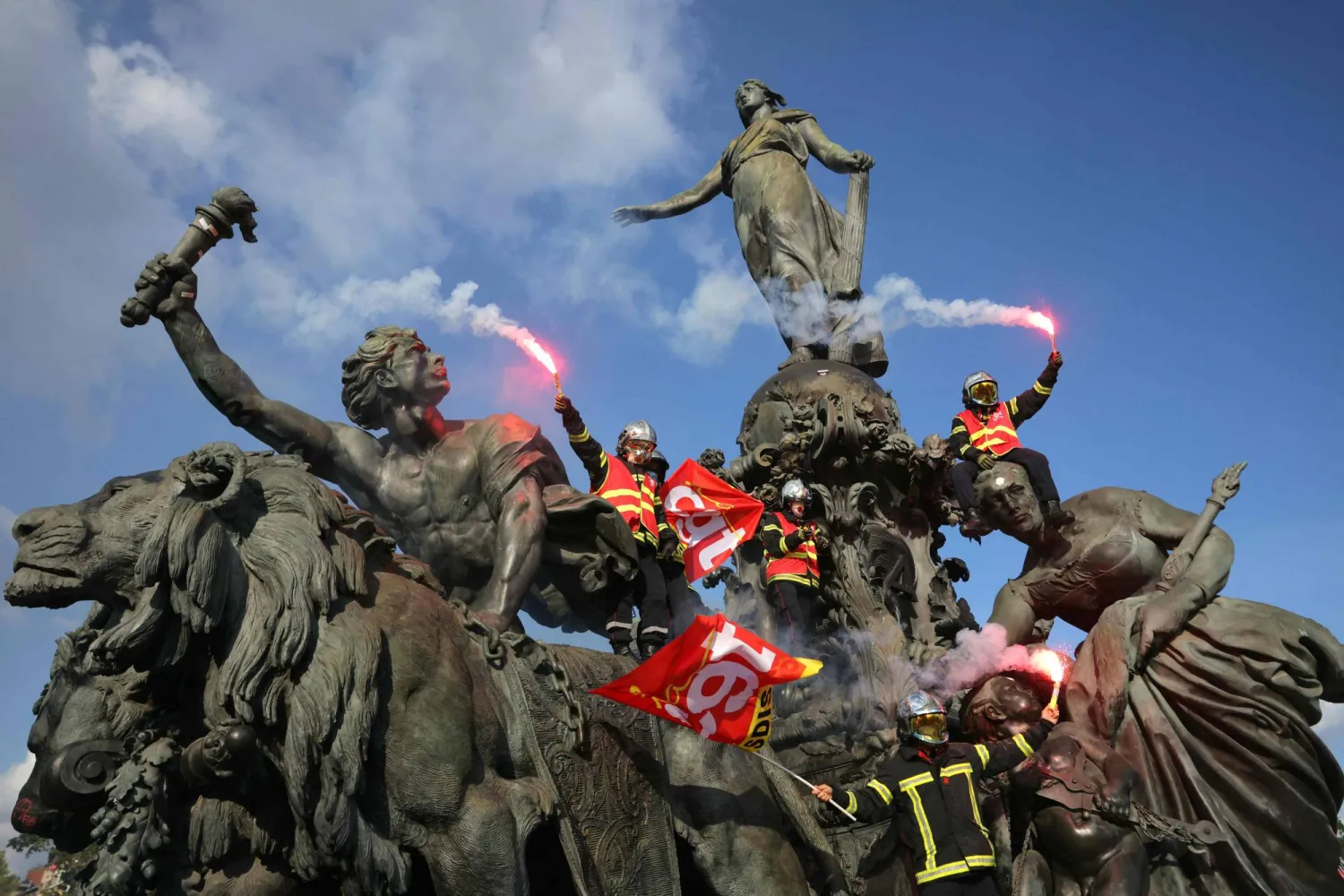
France Faces a Difficult Triple Challenge: Stagnant Economy, Debt and Angry Streets

Firefighters wave flares and French trade union General Confederation of Labour (CGT) flags as they climb on the statue 'The Triumph of the Republic' at Place de la Nation during a rally  (Photo by Thomas SAMSON / AFP)
Firefighters wave flares and French trade union General Confederation of Labour (CGT) flags as they climb on the statue 'The Triumph of the Republic' at Place de la Nation during a rally (Photo by Thomas SAMSON / AFP)
TT

France Faces a Difficult Triple Challenge: Stagnant Economy, Debt and Angry Streets

Firefighters wave flares and French trade union General Confederation of Labour (CGT) flags as they climb on the statue 'The Triumph of the Republic' at Place de la Nation during a rally  (Photo by Thomas SAMSON / AFP)
Firefighters wave flares and French trade union General Confederation of Labour (CGT) flags as they climb on the statue 'The Triumph of the Republic' at Place de la Nation during a rally (Photo by Thomas SAMSON / AFP)

With an economy barely growing, public finances drained by debt, and the streets returning to protest, France faces a highly complex equation. The government is under pressure to address demands over wages, purchasing power, and public services, while preparing an austerity budget expected to cut spending by billions of euros. At the same time, the country is approaching a presidential election, making any economic decision more politically sensitive.

It is difficult to find positive indicators when reviewing the performance of the French economy this year, as official figures reflect the scale of the pressures facing the country. On the ground, a new wave of demonstrations and strikes began on September 29, with marches and gatherings by firefighters who played a key role in fighting last summer's wildfires. Public-sector workers then joined in response to union calls, followed by public secondary school students demanding improved study conditions. The list of demands does not appear likely to stop there.

Unions are planning to escalate their action on October 17, with protests over the rising cost of living and declining purchasing power, alongside demands for a general wage increase, higher budgets for schools and hospitals, more hiring, and improved working conditions. At the same time, activists from the Yellow Vest movement are preparing to return to the streets and traffic roundabouts, protesting rising energy prices and demanding that they be frozen and that higher taxes be imposed on companies operating in the sector.

The movement recalls the wave of protests France witnessed in 2018 and 2019 under the banner of the Yellow Vests, which at various stages turned into clashes, violence, fires, property damage, and confrontations with security forces. Those scenes remain present in the French public memory, adding sensitivity to the return of protests, particularly amid the economic and financial pressures facing the country.

A Government With Little Room to Maneuver

As social demands expand, the government of Prime Minister Sébastien Lecornu finds itself with little room to respond, while fearing that the wave of protests could coincide with the political mobilization ahead of the presidential election scheduled for spring 2027.

This comes as inflation regains momentum. The National Institute of Statistics and Economic Studies (INSEE) said France's inflation rate rose from 2.6 percent in August to 3.4 percent in September. Rising prices are increasing pressure on households, particularly lower-income groups, as their purchasing power erodes.

In response to rising fuel prices, the government has provided financial assistance to those affected by increases in gasoline and diesel prices, while pressure from gas and electricity prices has continued.

At the same time, the government is preparing to present its 2027 budget bill on Thursday, as it moves toward austerity and spending cuts. This makes it difficult for the new fiscal measures to meet most of the demands raised by protesters.

The government aims to achieve savings of €54 billion by cutting spending and targeting items it considers unnecessary. Its proposed measures also include pensions.

Financing needs reveal the scale of the pressure on France's public finances. Paris is preparing to borrow around €340 billion in 2027, while its debt is approaching €3.6 trillion, according to government sources, an increase of around €60 billion from its level at the end of March.

This leaves the government facing a difficult equation: containing social pressures at a time when the state of public finances requires spending cuts, while the approaching election increases the sensitivity of decisions involving wages, services, and social spending.

The Cost of Debt Tightens the Squeeze

Weak growth and deteriorating public finances are also increasing the cost of France's borrowing in financial markets, with some bond yields reaching around 4.8 percent. This comes as French economic growth is expected to reach only around 0.05 percent in 2026, one of the weakest growth rates in the European Union.

At the same time, debt has reached around 119 percent of GDP, far exceeding the 60 percent ceiling set by European Union rules. The cost of servicing the debt is also rising, with interest payments expected to reach around €79 billion by the end of this year.

The scale of the shift becomes clear when compared with the situation in French debt markets between 2019 and 2021, when yields on some government bonds fell into negative territory. That environment allowed Paris to borrow at extremely low cost, while investors in some cases accepted a negative return for holding French bonds.

Today, however, France's borrowing costs have risen to levels exceeding those recorded by several European economies that have traditionally faced greater pressure in debt markets, including Greece, Spain, and Italy. The gap between French and German bond yields has also widened to more than 1.2 percentage points, indicating a higher risk premium demanded by investors to finance France.

As debt continues to rise and growth remains weak, France's public finances are becoming increasingly sensitive to interest rates. The higher the cost of borrowing, the larger the share of the budget allocated to debt servicing, leaving less room for spending on public services, social policies, and investment.

Challenges in Passing the 2027 Budget

The pressures facing the French budget cannot be separated from the energy crisis, which increased its cost by around €9 billion in 2026, with no signs that these pressures will ease in the near term.

Prime Minister Sébastien Lecornu is likely to face a difficult task in securing parliamentary approval for the 2027 budget bill, particularly in the National Assembly, as the presidential election approaches and political calculations intensify.

As the election approaches, political blocs may face increasing pressure to consider the impact of any austerity budget on their electoral bases, opening the door to difficult negotiations and conflicting parliamentary demands.

This is particularly significant in light of last year's experience, when two governments fell after failing to secure the majority needed to pass the 2026 budget. Lecornu was then forced to make concessions to Socialist Party lawmakers in an effort to secure the support needed for its passage.

A Major Economy and Political Weight

Despite the financial pressures, the French economy retains significant weight at both the European and global levels.

According to 2025 World Bank data, France ranks second among European Union economies by GDP, after Germany, with output of around $3.366 trillion, compared with $5.051 trillion for Germany. Across Europe more broadly, France ranks third after Germany and Britain, whose GDP stood at around $4.003 trillion.

Globally, France ranks seventh by GDP, according to the same data, behind the United States, China, Germany, Japan, India, and Britain.

Its economic weight, along with its permanent seat on the UN Security Council and nuclear capabilities, gives France political influence that extends beyond the weight reflected by the size of its economy alone.

However, the current financial and economic pressures could make it more difficult to maintain this weight within the European Union, where France and Germany have for decades formed a central axis in advancing European integration.

As President Emmanuel Macron's second term approaches its end in spring 2027, the next presidential election is becoming increasingly important for French economic and fiscal policies. At the same time, the rise of the nationalist right, led by the National Rally, raises the possibility of changes in several areas, including fiscal and economic policy.


Netanyahu Says ‘Toppling’ Iran Government Only Way to End Threat

Israeli Prime Minister Benjamin Netanyahu and Defence Minister Israel Katz attend a graduation ceremony of new Israeli army officers at a base near Mitzpe Ramon, Israel, October 21, 2026. (Reuters)
TT

Netanyahu Says ‘Toppling’ Iran Government Only Way to End Threat

Israeli Prime Minister Benjamin Netanyahu and Defence Minister Israel Katz attend a graduation ceremony of new Israeli army officers at a base near Mitzpe Ramon, Israel, October 21, 2026. (Reuters)

Israeli Prime Minister Benjamin Netanyahu said on Wednesday that the only way to remove the threat posed by Iran was to topple its government.

"Iran wanted to destroy us; we stopped them. They wanted to produce nuclear bombs; we stopped them... Yet they persist," he said during an election rally in the southern town of Dimona. "Therefore, there is only one way to end this: by toppling this regime."

"This is the directive I have issued to the Israel Defense Forces, to the Mossad, and to all our security branches," he added, without specifying when or how that directive would be executed.

The saber-rattling came as the premier headed into the last week of a tight race for re-election.

Netanyahu had instructed the Israeli military to plan for resumed strikes against Iran earlier this month, according to sources cited by the Financial Times on Wednesday, but US President Donald Trump reportedly objected to the idea.

The US leader has publicly said that he does not intend to restart the war, which Washington started in February alongside Israel, before the US mid-term elections early next month.

This week, Netanyahu thanked Trump in a video for his endorsement in the Israeli election, and said that the two leaders have "a job to finish" in Iran.

Israeli Defense Minister Israel Katz also warned against a potential threat from Iran.

Speaking at an officers' graduation ceremony in southern Israel on Wednesday, he said that "the Iranian regime is at its weakest point ever, and we recognize that this weakness could lead it to take the most extreme steps".

"If Iran attacks Israel, Iran will burn!" he said.

Katz also warned against unspecified attempts by Israel's enemies to disrupt the upcoming vote.

"In recent days, we have identified attempts by our enemies -- led by Iran and its proxies -- to advance attacks that could affect the outcome of Israel's elections," he said.


US Democratic Congressional Candidate Lander Detained by Israeli Authorities in West Bank

 Members of Israeli forces block a road, preventing Palestinians from harvesting olives in their groves in the West Bank village of Deir Jarir, Wednesday, Oct. 21, 2026. (AP)
Members of Israeli forces block a road, preventing Palestinians from harvesting olives in their groves in the West Bank village of Deir Jarir, Wednesday, Oct. 21, 2026. (AP)
TT

US Democratic Congressional Candidate Lander Detained by Israeli Authorities in West Bank

 Members of Israeli forces block a road, preventing Palestinians from harvesting olives in their groves in the West Bank village of Deir Jarir, Wednesday, Oct. 21, 2026. (AP)
Members of Israeli forces block a road, preventing Palestinians from harvesting olives in their groves in the West Bank village of Deir Jarir, Wednesday, Oct. 21, 2026. (AP)

Brad Lander, a US Democratic Party candidate for Congress, was detained by Israeli forces in the occupied West Bank on Wednesday, along with other Americans, Israelis and Palestinians taking part in the annual olive harvest, rights groups said.

The incident took place in Nahalin, a village south of Bethlehem, as Palestinians were gathering olives accompanied by around 80 volunteers, according to Israeli organization Rabbis for Human Rights and Jewish North American organization T'ruah.

Lander, a Jewish American and former New York City comptroller and mayoral candidate, wrote on X that he had been detained along with a group of rabbis and volunteers.

"We were simply harvesting olives in a grove near Nahalin in the West Bank. The occupation is a crime under international law. Harvesting olives isn't a crime under any law I know."

Lander, who is an ally of New York Mayor Zohran Mamdani and has been critical of Israel's conduct in the war in Gaza, was later released, according to Rabbis for ‌Human Rights and T'ruah.

Lander, ‌who is running for New York's 10th Congressional District in the US House of Representatives ‌in ⁠the November 3 midterm ⁠elections, was not immediately available for comment.

Israeli police said it had detained Palestinian olive harvesters and dozens of Israeli and foreign activists gathering olives near the fence of an Israeli settlement, saying it was prohibited. One of the foreign nationals was later released once it became known he was a congressional candidate, police said.

The military said harvesting in that area required prior coordination, which had not happened, and that those present had been detained. It did not say harvesting there was prohibited.

Lander is the only one released so far, while the others are expected to be interrogated, according to Rabbis for Human Rights Acting Director Anton Goodman.

"I would suggest to all activists go out there and get yourself elected," he said.

HARVEST ⁠AREA DECLARED A CLOSED MILITARY ZONE

The volunteers were accompanying local farmers gathering olives who often ‌are faced with the threat of violence from Israeli settlers, as an act of ‌solidarity in what is known as protective presence.

Israeli settler violence against Palestinians is surging, while the Israeli military continues to curb Palestinian freedoms, including access to ‌farmland.

Olives are the backbone of Palestinian agriculture, a sector that accounts for around 8% of GDP and more than 60,000 jobs, according ‌to the Palestinian Authority's agriculture ministry.

Rabbis for Human Rights and T'ruah said Israeli military and police forces arrived around two hours after the Palestinians and volunteers began gathering olives and informed them that they were in a closed military zone and would be detained.

Goodman said they were not aware the area had been declared a closed military zone since it had only been issued that morning, but they told the Israeli forces they would respect ‌the order and leave.

"However, we were told that we cannot leave because we have been disturbing the public order," he said by phone, speaking from a police station in the Israeli Betar Illit ⁠settlement.

"If you would have come ⁠to our harvest earlier today, you would have found a place that was quiet and peaceful and respectful and definitely not harming any of the public order."

Among those detained were over 30 US citizens, as well as UK and Canadian citizens, according to Rabbi Jill Jacobs, chief executive of T'ruah, who is among those who have been detained.

"We were obviously not doing anything violent but just the very act of picking olives together with Palestinian farmers was apparently disturbing for some," Jacobs, a 51-year-old rabbi from Manhattan, told Reuters by phone.

A spokesperson for the US Embassy in Jerusalem said it was aware of reports that US citizens had been detained and was monitoring the situation but declined further comment, citing privacy and other considerations.

"The Trump administration has no higher priority than the safety and security of Americans," he said.

Israeli settler attacks against Palestinians and other civilians in the West Bank over the weekend prompted a call by US Secretary of State Marco Rubio on Saturday for Prime Minister Benjamin Netanyahu's government to crack down on the violence.

An American photojournalist for the Washington Post covering a Palestinian olive harvest on Friday was beaten by Israeli settlers, while European diplomats and a French mayor were attacked at another Palestinian olive harvest by settlers on Saturday.

Palestinians were attacked by settlers in both incidents.

Israeli police announced on Monday it had made 10 arrests in connection with the weekend violence.


Greek Students, Teachers, Civil Servants Plan Protests

Protesters take part in a rally organized by teachers and students demanding improvements to education and measures to address the rising cost of living in Athens, Greece, Wednesday, Oct. 21, 2026. (AP Photo/Thanassis Stavrakis)
TT

Greek Students, Teachers, Civil Servants Plan Protests

Protesters take part in a rally organized by teachers and students demanding improvements to education and measures to address the rising cost of living in Athens, Greece, Wednesday, Oct. 21, 2026. (AP Photo/Thanassis Stavrakis)

Students, teachers and civil servants will rally in Greece on Wednesday to protest against the high cost of living, saying they face the same problems that sparked violent demonstrations in France at the weekend.

Gatherings are expected around midday (0900 GMT) in Athens and Thessaloniki, the country's second-largest city.

"In Greece like in France, we are demanding public, free education," Katia Koubousidou, head of a student union at the Aristotle University of Thessaloniki, told AFP.

"This will not be a one-off protest. We have a plan to continue our demonstrations."

Dozens of students set up tents in Syntagma Square, facing Parliament, in Athens, and on a pedestrian street in Thessaloniki on Tuesday.

The civil servants' union has also called for a work stoppage and a gathering in Athens.

Secondary school pupils and teachers are protesting about a lack of infrastructure, a shortage of staff and increased public spending on education.

The conservative Greek government has sought in recent days to avoid any parallel with the protests and violence in France.

Prime Minister Kyriakos Mitsotakis said on Monday that the country would "never return to the era of great social unrest" during the financial crisis over a decade ago, marked by unpopular austerity measures.

French cities were hit by some of the country's worst rioting in recent years on Saturday, with public buildings torched, hundreds of shops looted and more than 2,000 people arrested.