Sea Levels to Rise in California as Coastal Wave Surges Up West Coast

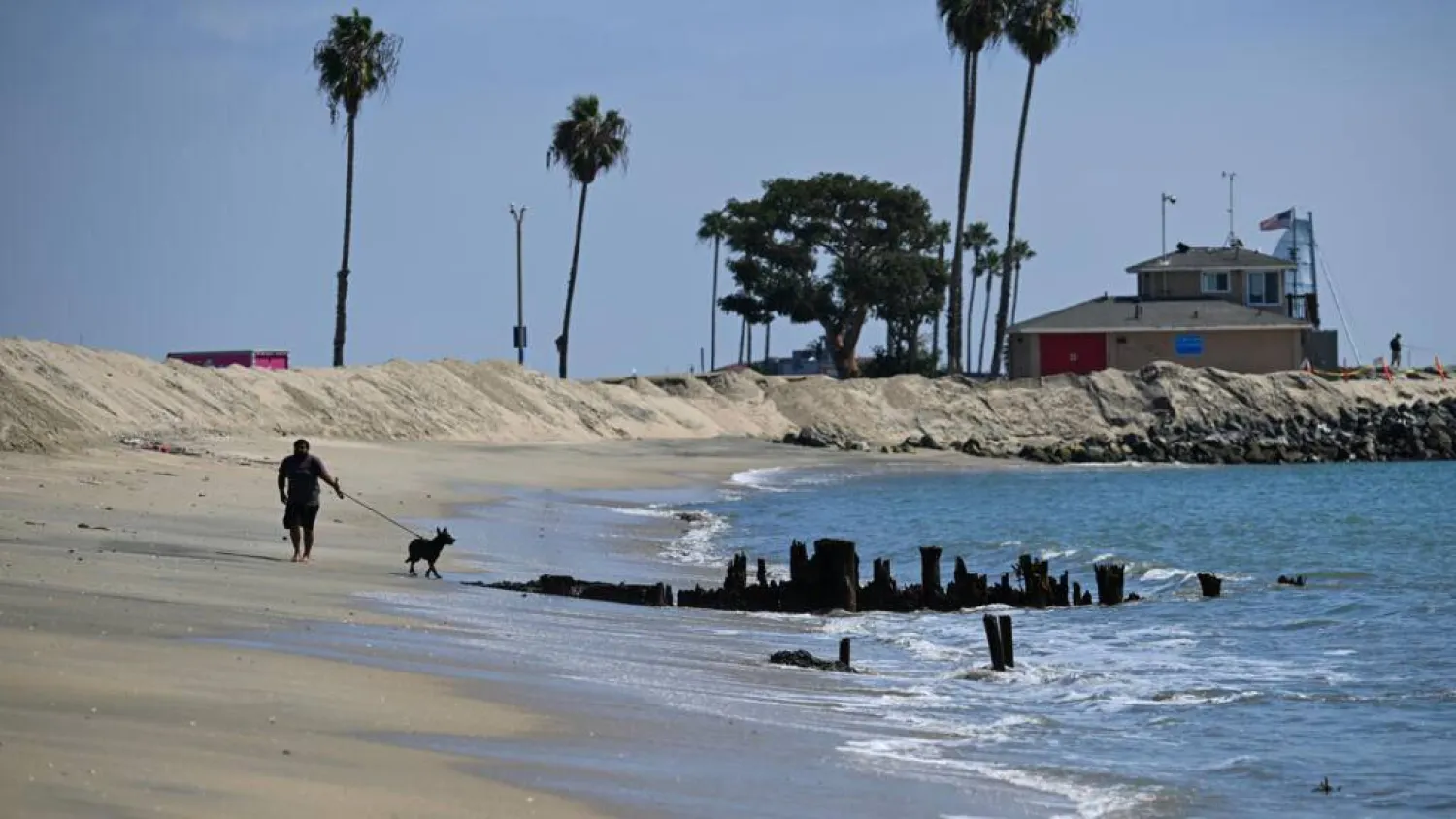
Sand berms have been built along beaches in Southern California in anticipation of storms hitting the area. Patrick T. Fallon / AFP
TT

Sea Levels to Rise in California as Coastal Wave Surges Up West Coast

Sand berms have been built along beaches in Southern California in anticipation of storms hitting the area. Patrick T. Fallon / AFP

Sea levels in California are set to rise by as much as a foot (30 centimeters) in the coming days as an enormous wave washes up the US West Coast.

The huge surge of energy, known as a "coastal trapped wave" or a "Kelvin wave," is part of El Nino, a months-long phenomenon in the Pacific Ocean that scientists say could generate powerful storms and floods in some parts of the world, while leaving others in drought, reported AFP.

The Kelvin wave is not anything like a tsunami; nor does it crash on beaches. Rather it is a sustained bulge of excess water up to 30 kilometers (18 miles) wide that will hug the coastline as it travels all the way up to Alaska.

Dillon Amaya, an oceanographer at North Carolina State University, said the elevated sea levels could collide with other natural phenomena to create problems for coastal communities.

"What this wave is doing is it's raising sea states, and then when... you combine this wave with things like storm surge from passing weather, large swells, or things like astronomically high tide....(you) elevate your risk for things like flooding and also beach erosion," Amaya told AFP by telephone.

"The general rule of thumb is that every two to four inches (5-10 centimeters) of sea level rise that we see in that background state essentially doubles your flood risk.

"So it doesn't sound like a lot, but because it's over a huge volume of water, and it's combined with these other factors, you start to get the flood risk."

In recent weeks parts of Southern California have been hit by storm surges that have eaten away at beaches or damaged properties.

In Dana Point and Laguna Beach, south of Los Angeles, several houses have been left uninhabitable, and at least one has completely collapsed.

In Malibu, an enormous sink hole emerged in the driveway of a home belonging to Hollywood actor Nicolas Cage when pounding waves from a nearby hurricane eroded the coastline.

- El Nino -

The Kelvin wave is essentially both a cause and a symptom of El Nino, said Amaya, and originates in waters near Indonesia when trade winds die down.

"Those trade winds hold up a ton of really warm water in the Western Equatorial Pacific because they're pushing on the surface waters as they blow.

"If they weaken for too long... water is then able to effectively slosh back along the equatorial strip from Indonesia all the way to South America."

As this wave makes it way over the Pacific, it suppresses the cold water that usually comes up from the deep ocean, making the surface temperature higher.

It is this ocean warming that we call El Nino.

"So these Kelvin waves are, in many ways, the driving force of El Nino. They help El Nino grow and mature over the course of several months," said Amaya.

As the equatorial Kelvin wave hits South America, the energy converts into a coastal Kelvin wave, and heads both north and south along the continents.

The wave going towards the US is currently somewhere north of Cabo, Mexico, and travelling around six miles (10 kilometers) an hour, said Amaya, who expects it to reach San Diego within the next week.

While Kelvin waves are common -- there are five or six during every El Nino -- this one arrives at a delicate time, said Amaya, with sea temperatures already elevated.

"When it gets really warm, that water expands... which causes sea levels to rise just because the water is warm, so you get an additional additive increase in sea level," he said.

"Southern California... just got battered by offshore tropical cyclones, which led to flooding events already and beach erosion, so there's lots of anxiety about extra flood risk coming from El Nino and these waves."


Japan Space Probe Changes Target Over Engine Trouble

This undated image provided by the European Space Agency on Nov. 5, 2026 and taken by the Hera spacecraft, shows asteroid Didymos. (European Space Agency via AP)
TT

Japan Space Probe Changes Target Over Engine Trouble

This undated image provided by the European Space Agency on Nov. 5, 2026 and taken by the Hera spacecraft, shows asteroid Didymos. (European Space Agency via AP)

A Japanese probe that returned precious asteroid dust to Earth six years ago has changed course in its extended mission, officials said Tuesday, citing issues in its aging engines.

The unmanned Hayabusa-2 probe brought back pristine materials from the asteroid Ryugu in 2020, supporting discoveries linked to clues on the origin of life.

In July, the probe flew 400 meters (1,312 feet) from a near-Earth asteroid, making the closest approach ever recorded in such a mission, Japan Aerospace Exploration Agency (JAXA) has said.

It was then headed for its main target, an asteroid called 1998 KY26 that will be some 300 million kilometers away from Earth when the probe would have reached it in 2031.

However, 12 years since its launch, "the deterioration of the onboard equipment... is becoming increasingly evident", Yuya Mimasu, team leader of the extended mission, told reporters.

With the main engines suffering repeated malfunctions, "we decided to revise the plan to one that could be safely implemented", AFP quoted him as saying.

The probe will now head towards an asteroid called 2015 BM510, aiming for a flyby -- passing close to it at high speed -- in April 2028, according to the team leader.

"Because it is a dark, small asteroid... it will be one of the world's most difficult flyby missions," Mimasu said.

The new target is between 17 meters and 74 meters in diameter, completing a rotation every 49 minutes.

The revised operation can help "future planetary defense" missions aimed at deflecting asteroids that might otherwise collide with Earth, Mimasu said.


Wildlife Whereabouts Lost as Russian Researchers Cut Off from Satellite Tracking

Freshwater seal Kroshik carries a satellite-tracking transmitter on the shore of Lake Ladoga in the Leningrad region, in this still image from video released November 10, 2026. Fund of Friends of the Baltic Seal/Handout via REUTERS
TT

Wildlife Whereabouts Lost as Russian Researchers Cut Off from Satellite Tracking

Freshwater seal Kroshik carries a satellite-tracking transmitter on the shore of Lake Ladoga in the Leningrad region, in this still image from video released November 10, 2026. Fund of Friends of the Baltic Seal/Handout via REUTERS

You could follow Kroshik the rescue seal with little dots on a map. There he was: hunting for fish on the dangerous southern shore of Lake Ladoga, then swimming back to safer waters. Then suddenly, he was gone.

"We will know nothing more of Kroshik’s adventures," conservationist Vyacheslav Alexeyev wrote last week on the social media feed where he had been sharing the seal's whereabouts with thousands of fans. Hundreds of commenters responded with crying emojis and broken hearts.

This month, Russian researchers were cut off from the main satellite system they have used for years to track wildlife across some of the world's largest wildernesses, in the latest example of Moscow's scientific isolation due to sanctions and war.

The Argos system, run by French firm CLS, has been used to track rare migratory birds across Russia's Far East, wild reindeer in northern forests, bearded seals in the White Sea and Atlantic walruses around ⁠Franz Josef Land.

A ⁠CLS spokeswoman confirmed the suspension of services to Russian clients, due to "the evolving international context and the arising constraints".

Fans of Kroshik, or Little Crumb, had been following the playful freshwater ringed seal's movements across Lake Ladoga in northern Russia, thanks to updates pinged via satellite from a transmitter glued to his fur. He had gained fame for repeatedly returning to his carers after failed releases, before making it back to the wild in September.

"All of that will now have to be stopped, so our feelings about it are extremely negative," Alexeyev, who runs a shelter near St ⁠Petersburg that rescued Kroshik as a pup, cared for him for a decade and released him this year, told Reuters.

The satellite cut-off adds to an unravelling of decades of scientific cooperation between Russia and the West since Moscow's launch of its full-scale war in Ukraine in 2022.

Since then, partnerships with institutions such as the European Space Agency and the European Organization for Nuclear Research (CERN) have ended, while joint Arctic research has been curtailed.

Losing access to Argos for Russian researchers "is really going to lead to lacking information on priority species and conservation and management actions," said Philipp Maleko, a PhD candidate at the University of Wisconsin-Madison, who has used it to study endangered shorebirds that fly between Russia's Far East and Southeast Asia, such as the spotted greenshank.

"So many birds depend on Russia's Arctic boreal ecosystems for reproducing, for really sustaining viable populations," he told Reuters.

Russia's Lake Baikal ⁠Foundation, a conservation group dedicated ⁠to the huge Siberian lake that holds nearly a quarter of the world's unfrozen fresh surface water, warned in October that losing the data threatened wildlife research across Russia.

The suspension would disrupt programs monitoring Baikal’s endemic seal and a tiny population of endangered forest reindeer, its head was quoted as saying by news agency TASS.

Researchers say no other available system is quite as useful as Argos at tracking how animals move across Russia's far-flung regions, away from cellphone towers and human settlements.

CLS did not say how many users it had in Russia, but its website says it was nearly the only system used by Russian scientists to study marine and terrestrial wildlife migration in northern regions.

In October, Russia's state-run Agency for Strategic Initiatives said it was in talks to develop a Russian alternative.

At the St Petersburg shelter a plump, velvety seal glided past Alexeyev by the outdoor pool. Alexeyev said he did not think Argos could be replicated: "It is the only satellite constellation of its kind."

He was grateful the company had worked with Russia as long as it did, "despite all the difficulties and the generally hostile attitude towards us in Europe."


South Korea Tightens Exam Security After AI Cheating Scandal

AI glasses are placed at an optical shop in Seoul, South Korea, Monday, Nov. 16, 2026. (AP)
TT

South Korea Tightens Exam Security After AI Cheating Scandal

AI glasses are placed at an optical shop in Seoul, South Korea, Monday, Nov. 16, 2026. (AP)

South Korea will deploy thousands of extra personnel to prevent cheating on its college entrance exam sites this week and may introduce tougher penalties, Prime Minister Han Seong-sook said Tuesday.

The announcement comes after an individual confessed on Sunday to cheating on the national tax accountant exam using artificial intelligence tools, an admission that brought panic ahead of the college test.

Known as the Suneung, the intense once-a-year exam -- widely seen as a ticket to well-paid jobs and even better marriage prospects -- will bring much of South Korea to a standstill on Thursday to minimize distractions.

As a measure to detect phones that have not been handed over, an emergency alert will be sent before the exam begins, Han said at a press conference.

Students will also be ordered to place their glasses on their desks so supervisors can verify they are not smart devices.

"We also strongly urge students to avoid wearing clothing with buttons wherever possible," Han said.

Students "will be asked to roll up both sleeves, and collars, buttons and other areas will also be checked to determine whether electronic devices, including miniature cameras, are concealed", she added.

Those caught cheating could be banned from taking the Suneung for 10 years, up from the current one-year restriction, Han said.

The government will also file criminal complaints over serious cases of cheating, including those involving smart devices.

In addition to the 75,000 supervisors deployed to 1,312 test centers nationwide, an additional 8,400 personnel will be deployed this year.

"You may feel nervous and intimidated by the unfamiliar atmosphere inside and outside examination centers and the stricter inspection procedures," said Han, addressing the 550,000 students who will take the Suneung.

The extra staff "are minimum safeguards designed to protect the value of the hard work you have put in over the years and to guarantee a fair competition in which everyone can hold their head high", she added.

At a meeting held Sunday, officials decided to investigate all suspected cases of cheating involving AI across national qualification examinations.

The individual who confessed to cheating said he had photographed the exam questions with a miniature camera before using AI and checking the answers on his smartphone.

Han said the government "will define such cheating as a 'social evil'".