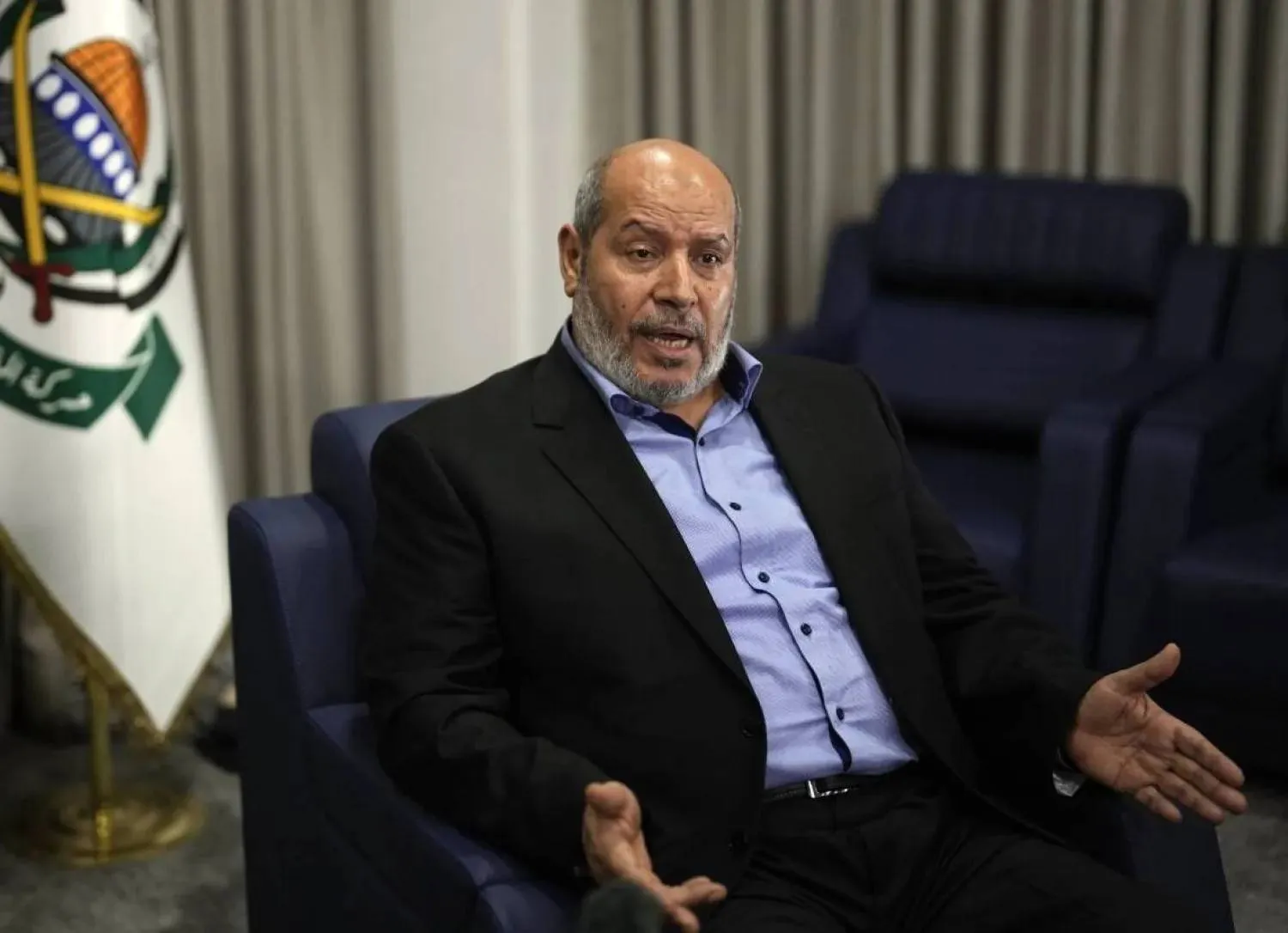
Khalil al-Hayya: Hamas’ Unexpected Leader at a Turning Point

Hamas political bureau chief Khalil al-Hayya (File photo/AP)
TT

Khalil al-Hayya: Hamas’ Unexpected Leader at a Turning Point

Hamas political bureau chief Khalil al-Hayya (File photo/AP)

Before Oct. 7, 2023, Khalil al-Hayya, now about 65, was a prominent figure in Hamas. But few inside or outside the movement saw him as a leading contender for its top job.

“Al-Aqsa Flood” changed that.

The attack reshaped the roles and fortunes of Hamas leaders, along with Gaza and the landscape beyond it. Hayya now heads the movement’s political bureau, steering it through one of the most sensitive turning points in its history.

His victory over Khaled Meshaal, a former Hamas leader and one of its best-known figures, was announced in July. It surprised some outside the movement. Others inside had seen it coming, as leaders from Gaza tightened their hold on key portfolios and senior posts.

When “Al-Aqsa Flood” began, Hayya was deputy to Hamas’ Gaza leader, Yahya Sinwar. He handled contacts with Palestinian factions, UN bodies and mediators over conditions in Gaza and its recurring rounds of escalation with Israel.

Hayya first rose to prominence when Hamas contested the 2006 parliamentary election, before seizing military control of Gaza in 2007.

He moved through leadership posts in Gaza City, then across the territory, before joining the movement’s wider leadership. Along the way, he drew sustained support from commanders of Hamas’ military wing in Gaza, including Ahmed al-Jaabari and Izz al-Din al-Haddad.

Where was he — and what did he know?

Before the Oct. 7 attack, Sinwar asked Hayya and other members of Hamas’ Gaza political bureau to leave the territory to handle specific matters abroad. None knew the full extent of his plans.

Hamas sources told Asharq Al-Awsat that Hayya knew more about some aspects of the attack than other political bureau members.

“But his information was neither complete nor precise. Only Sinwar knew the full details, while commanders in the military wing knew specific elements of the attack,” one source said.

In an interview published in April 2024 by the Hamas-affiliated Palestinian Information Center, Hayya said “the Oct. 7 attacks that ignited the Gaza war were intended to be a limited operation by Hamas to capture a number of soldiers and exchange them for Palestinian prisoners.”

“The Gaza Division of the Zionist army collapsed completely,” he added, referring to the Israeli military.

A senior Hamas source abroad told Asharq Al-Awsat that Hayya knew a relatively large-scale attack was being prepared, but did not know its timing or all its details.

“He was among the leaders who voted in favor of the attack. But everyone who voted believed it would be a limited operation, including Ismail Haniyeh, who was then head of the political bureau,” the source said.

Haniyeh was preparing to travel from Türkiye to Iraq with Hayya, Meshaal and other leaders on their first visit to the country.

Personal losses, a depleted leadership

The bloodshed since Oct. 7 has reached deep into Hayya’s family. Three years of fierce Israeli war have inflicted devastating losses on Gaza — and on Hayya, even while he was abroad.

In May, he mourned his son Azzam, following the death of another son, Hammam, in September. Israel killed them in separate attacks. Two other sons, Hamza and Osama, were killed by Israel in 2008 and 2014, respectively.

A Hamas source inside Gaza said repeated Israeli attacks on Hayya’s home, and the killing of several of his sons, particularly during the latest war, had strengthened his standing and positioned him to lead the movement ahead of other longstanding figures.

Another Hamas source pointed to the gaps left by the killing or absence of senior leaders.

“The assassination of Ismail Haniyeh and Saleh al-Arouri, then Yahya Sinwar’s unexpected death in fighting inside Gaza, the assassination of figures such as Rawhi Mushtaha and Osama al-Mazini, and the absence of others for health reasons, including Mahmoud al-Zahar — all of this made Hayya the most prominent figure available to take on responsibility,” the source said.

Leaders from Gaza also held key posts in the political bureau and Shura Council, the source added.

“This does not diminish Hayya’s own standing. He proved his ability to lead and shoulder responsibility in the many portfolios and posts he held,” the source said.

“He became very close to Ismail Haniyeh in Gaza, and later when he joined him abroad. He also faced previous assassination attempts, most notably in Doha in September 2025, while reviewing a US ceasefire proposal with other leaders.”

Hayya’s consistent backing for Sinwar’s plans, inside and outside the movement, also broadened his support, the source said — particularly among Sinwar’s close associates and supporters, and the leadership of the Qassam Brigades.

The Qassam leadership in Gaza backed Hayya for the top job and pushed for his election.

“They saw him as an important choice representing Gaza’s leadership, which they believed should be honored and continue to lead the movement after leading the ‘Al-Aqsa Flood’ battle and sacrificing its senior leaders,” the source said.

Ties with Iran

Within Hamas and among Palestinian factions, Hayya is known for backing Sinwar’s drive, supported by the Qassam leadership, to rebuild ties with the so-called “axis of resistance,” particularly Iran.

That appears to have been a key factor in his growing influence. He handled contacts with Syria’s former government and visited Damascus to meet Bashar al-Assad in October 2022 — the first visit by a Hamas official since the movement left in 2012 amid mounting popular protests against Assad’s rule.

A senior source from Gaza said the territory’s political and military leaders agreed on the need to restore relations with Iran.

Hayya and Sinwar threw their weight behind renewed ties with Tehran, backed overwhelmingly by the Qassam Brigades’ longstanding leadership, from Mohammed Deif and Mohammed Sinwar to all members of its military council.

Some within Hamas supported the move with reservations, a source abroad said.

“There were voices that backed this step cautiously, given the difficulties the movement had faced in its relationship with Iran at certain times, and demands that it support Iran-aligned parties in other arenas,” the source said.

“The movement rejected this and insisted on the independence of its positions.”

Hayya’s path as Hamas leader is strewn with thorns.

In Gaza, he must work to end the war and confront immense humanitarian pressures after the killing of more than 70,000 people and the occupation of more than 60% of the territory.

That task carries a price. He is negotiating through mediators with Israel, which says it will not compromise on disarming Gaza — a demand that would mark one of the most consequential shifts in Hamas’ history.

Hayya and Hamas face a difficult equation: preserving the movement’s existence and cohesion while confronting the possible loss of its weapons, one of its strongest sources of leverage.

The path to political participation is also obstructed. Hamas would need to abide by the Palestinian Authority’s agreements with Israel, a red line for the movement.

Hayya’s rise was a striking and unexpected shift. His tenure now brings a further test, one likely to determine his own fate and the course of the movement he leads.


Egypt Keeps Communication Channels Open Over Mediterranean Maritime Disputes

Egyptian Foreign Minister Badr Abdelatty and his Turkish counterpart Hakan Fidan during a previous meeting (Egyptian Foreign Ministry). 
TT

Egypt Keeps Communication Channels Open Over Mediterranean Maritime Disputes

Egyptian Foreign Minister Badr Abdelatty and his Turkish counterpart Hakan Fidan during a previous meeting (Egyptian Foreign Ministry). 

Egypt said it remains in contact with Türkiye, Libya, Cyprus and Greece to resolve maritime boundary disputes through dialogue and international law, despite its rejection of a disputed Turkish-Libyan maritime agreement.

Cairo’s remarks came after Ankara renewed its offer to negotiate a maritime boundary agreement with Egypt that would serve both countries’ interests. The proposal followed Egypt’s rejection of the Libyan parliament’s ratification last week of a maritime memorandum signed with Türkiye in late 2019.

Egyptian Foreign Ministry spokesman Ambassador Nader Zaki told Asharq Al-Awsat that Cairo believes maritime differences must be resolved through “serious dialogue, adherence to international law and mutual respect for sovereign rights.”

“Channels of communication remain open with all parties, including Cyprus, Greece, Türkiye and Libya,” he said, citing Egypt’s commitment to its longstanding ties with countries on both shores of the Mediterranean.

Zaki stressed that those relations must be built on respect for international law and sovereign rights that “cannot be compromised,” while avoiding disputes that could undermine stability and relations among Mediterranean states.

Cairo Reaffirms Rejection of Turkish-Libyan Agreement

Libya’s House of Representatives voted last week to approve two agreements with Türkiye covering maritime boundaries and security cooperation, prompting Cairo to reiterate its rejection of the maritime deal as “absolutely null and void.”

Zaki said Egypt’s latest objection was consistent with its position since 2019, arguing that the memorandum infringes on its sovereign rights in the exclusive economic zone and continental shelf.

“Egypt’s position on this invalid memorandum is based on national interests and the rejection of any infringement upon them,” he said.

The spokesman also challenged the agreement’s legal basis, saying it violates several binding principles of international law, including the principle that treaties do not create obligations for third parties.

“An agreement signed by two states is not binding on other states,” he explained.

Zaki also cited the prohibition against infringing on the rights of third countries and the principle of equitable maritime delimitation, arguing that the memorandum disregards these established legal rules.

“Egypt’s legal position is extremely strong and is shared by many countries,” he said.

Erdogan Calls for Regional Dialogue

The Turkish-Libyan memorandum has also drawn objections from Greece, Cyprus and the European Union.

Responding to criticism on Monday, Turkish President Recep Tayyip Erdogan said Ankara was not seeking political gains at the expense of any party in the Eastern Mediterranean.

He called for dialogue with all countries in the region and pledged to maintain Türkiye’s relations with all parties involved in Libya.


Türkiye, Egypt to Hold Naval Drills Amid Eastern Mediterranean Tensions

Egypt and Türkiye resumed the Sea of Friendship naval exercises in September 2025 after a 13-year suspension. (Turkish Defense Ministry)
TT

Türkiye, Egypt to Hold Naval Drills Amid Eastern Mediterranean Tensions

Egypt and Türkiye resumed the Sea of Friendship naval exercises in September 2025 after a 13-year suspension. (Turkish Defense Ministry)

Türkiye and Egypt will hold joint naval exercises in Alexandria from November 4 to 9, Ankara announced, amid renewed tensions over a disputed maritime boundary agreement between Türkiye and Libya.

The announcement follows the Libyan parliament’s ratification of the 2019 agreement, drawing objections from Egypt, Greece, Cyprus, the European Union and Israel.

The Turkish Defense Ministry said the Sea of Friendship 2026 exercises would involve naval units and personnel from both countries in surface warfare, anti-submarine operations, air defense and underwater assault training involving combat divers.

Defense Ministry spokesman Zeki Akturk said the Turkish warship TCG Burgazada would visit Alexandria from November 1 to 3, following a port call in Souda, Greece, from October 25 to 28.

Growing military cooperation

The exercises reflect expanding military cooperation between Cairo and Ankara, including defense industry agreements, technology transfers, high-level military exchanges and joint training.

Turkish Land Forces Commander Gen. Metin Tokel visited Egypt on October 26 and 27, although the ministry provided no details about his meetings or itinerary.

The two countries resumed the Sea of Friendship exercises in September 2025 at the Aksaz naval base in Mugla, southwestern Türkiye, following a 13-year suspension amid tensions over the ouster of Egypt’s Muslim Brotherhood government. Cairo designates the Brotherhood a terrorist organization.

The drills had previously been held annually from 2009 to 2013.

Following the normalization of relations in 2024, Egypt and Türkiye signed a letter of intent on defense cooperation in July 2026 during Egyptian Defense Minister Ashraf Salem Zaher’s visit to Ankara.

Zaher held talks with his Turkish counterpart, Yasar Guler, on expanding military cooperation, particularly in joint training, defense manufacturing, technology transfer and exchanges of expertise.

The two countries have since conducted several joint exercises, including Golden Eagle, involving Egyptian paratroopers and commandos alongside Turkish special forces, as well as air force training.

Egyptian aircraft also participated in the annual Anatolian Eagle 2026 exercise in Konya, central Türkiye, in June, alongside Azerbaijan and a NATO airborne early warning aircraft.

Regional tensions

The exercises come against a backdrop of renewed tensions following the Libyan House of Representatives’ October 20 ratification of a maritime boundary memorandum signed on November 27, 2019, between Türkiye and Libya’s former Government of National Accord, led by Fayez al-Sarraj.

The agreement remains contested by neighboring countries and the European Union.

Ankara has renewed its offer to negotiate maritime boundaries with Egypt, saying that an agreement with Türkiye would give Cairo more than 15,000 additional square kilometers of maritime jurisdiction compared with a potential deal with Greece.

Greek Foreign Minister Giorgos Gerapetritis rejected the proposal’s underlying approach, telling the newspaper Kathimerini that maritime zones were “not up for auction.”

He reaffirmed Greece’s strategic ties with Egypt and their shared commitment to international law, warning that disregarding maritime rules could have repercussions for global trade, food and energy security, and ocean protection.

Gerapetritis also pointed to a joint statement issued Monday by the UN representatives of Egypt, Greece, Cyprus, Bahrain, the United Arab Emirates and the European Union opposing the Türkiye-Libya agreement.

He noted that Egypt’s permanent representative to the United Nations stood alongside him in New York as he delivered the statement.

Despite the maritime dispute, Türkiye and Greece are continuing military confidence-building efforts.

Akturk said the commander of Greece’s Tactical Air Force and an accompanying delegation would visit Türkiye’s Combat Air Force Command from November 3 to 5 under the two countries’ confidence-building plan.


Lebanese Forces Boycott Cabinet Meeting Over Hezbollah Explosives Case

Prime Minister Nawaf Salam chairs a cabinet meeting in the absence of Lebanese Forces ministers. (Prime Minister’s Office)
TT

Lebanese Forces Boycott Cabinet Meeting Over Hezbollah Explosives Case

Prime Minister Nawaf Salam chairs a cabinet meeting in the absence of Lebanese Forces ministers. (Prime Minister’s Office)

Ministers from the Lebanese Forces party boycotted a cabinet meeting on Thursday over the government’s failure to refer a case involving Hezbollah explosives seized in Dahr al-Baidar to Lebanon’s Judicial Council.

The boycott marked an escalation in the dispute after the case was left off the agenda of a meeting chaired by Prime Minister Nawaf Salam at the Grand Serail and devoted to waste management.

Lebanese Forces sources told Asharq Al-Awsat that the party could continue boycotting cabinet sessions as long as its demands remained unmet, although it might participate in meetings addressing matters of major strategic importance.

The standoff follows the cabinet’s decision at its previous meeting to postpone a ruling on whether to refer the case to the Judicial Council, pending further progress in the investigation.

Hezbollah has acknowledged responsibility for the explosives shipment, but the Lebanese Forces argue that the seriousness of the case warrants an immediate referral.

Ahead of Thursday’s meeting, Justice Minister Adel Nassar, who is affiliated with the Lebanese Forces, vowed to press the issue.

“I will raise the question of referring the Dahr al-Baidar explosives case to the Judicial Council. There will be no concessions or compromise,” he declared.

Nassar added that he would demand a date for discussing the referral if Salam refused to address it during the session.

Lebanese Forces sources accused the government of repeatedly avoiding a decision on the explosives case.

“The waste management issue is certainly important, but there are more pressing priorities today, foremost among them a case of the magnitude of the Dahr al-Baidar explosives,” they told Asharq Al-Awsat.

They criticized the repeated postponements, arguing that successive Cabinet meetings had failed to produce a decision on referring the case to the Judicial Council.

The party had taken a clear position against attending Cabinet sessions until the matter was resolved, the sources explained.

“A case of this magnitude cannot continue to be handled through repeated delays while meetings are held to discuss other issues, however important they may be,” they added.

The Lebanese Forces stepped up criticism of the judicial investigation, accusing authorities of overlooking public admissions by senior Hezbollah officials while pursuing lower-ranking operatives who lacked the authority to order the explosives shipment.

In a statement, the party’s media office noted that senior Hezbollah officials, including lawmakers and party leaders, had publicly acknowledged that the group was transporting the explosives and that they belonged to it.

The Lebanese Forces described the Dahr al-Baidar case as a matter of national security affecting all Lebanese citizens.

Whatever justification was offered for transporting the explosives, the shipment posed a serious danger even if Hezbollah’s claim that the materials were intended for use against Israel proved true, it added.

The explosives represented a grave threat to residents of South Lebanon in particular and to the Lebanese population as a whole, the statement warned.