


Condemnation in Sweida as Hijri Followers Rally for Israel on Oct. 7 Anniversary

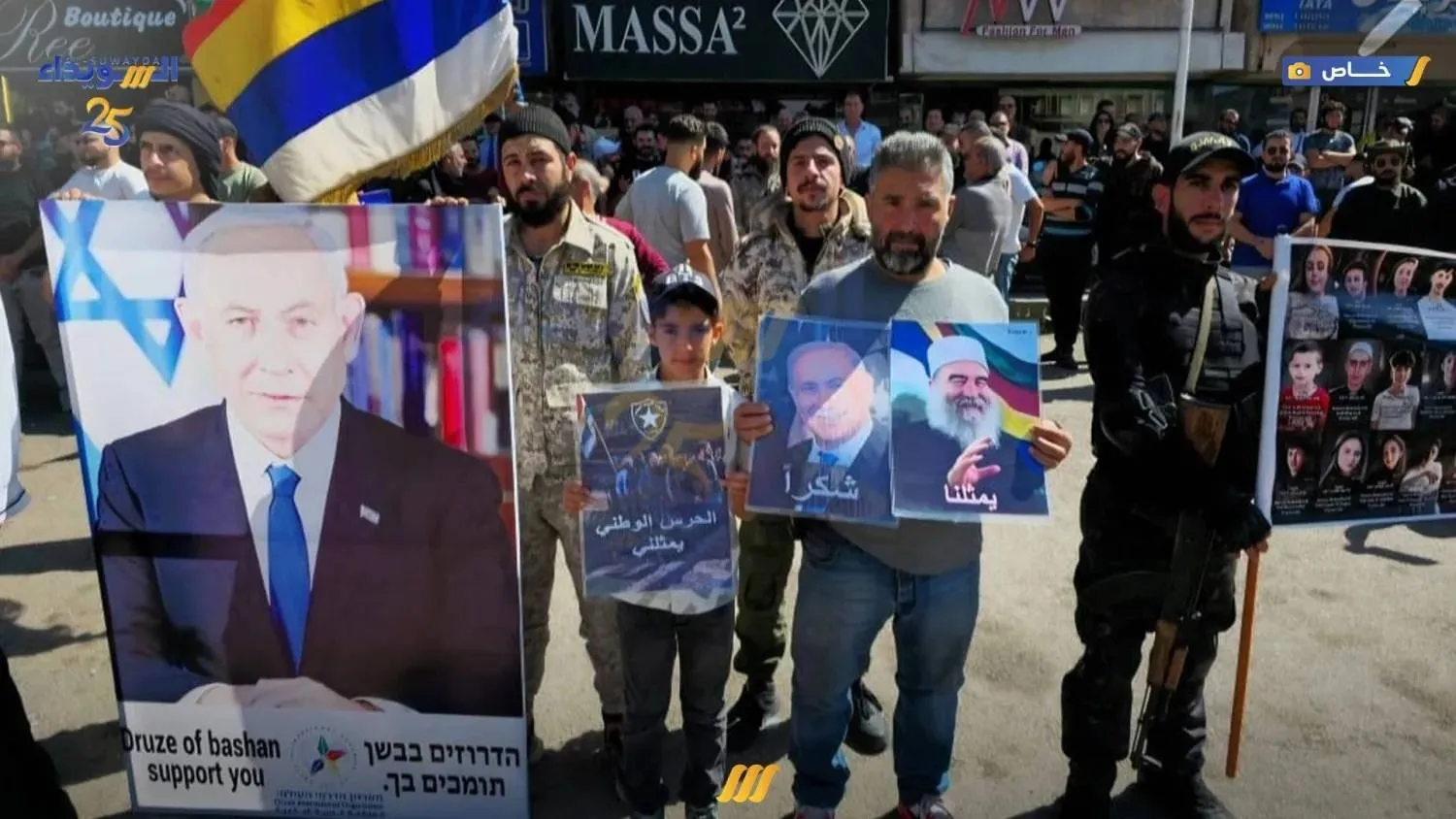
A rally in Sweida’s al-Sayr Square, formerly al-Karama Square, in solidarity with Israel and Netanyahu on the anniversary of the Oct. 7 attacks. (Pro-Hijri websites)
TT

Condemnation in Sweida as Hijri Followers Rally for Israel on Oct. 7 Anniversary

A rally in Sweida’s al-Sayr Square, formerly al-Karama Square, in solidarity with Israel and Netanyahu on the anniversary of the Oct. 7 attacks. (Pro-Hijri websites)

Sources in Syria’s predominantly Druze province of Sweida condemned rallies held by followers of Druze spiritual leader Sheikh Hikmat al-Hijri on Wednesday in solidarity with Israel on the anniversary of the Oct. 7 attacks.

A Druze figure mediating between the Syrian government and the Druze told Asharq Al-Awsat that an alternative to Hijri’s movement had been formed.

Demonstrators and a car procession in Sweida city displayed Israeli flags and portraits of Israeli Prime Minister Benjamin Netanyahu and Hijri, whose affiliated “National Guard” controls much of the province, including the city. Hijri previously announced what he called the “State of Bashan.”

The rallies marked the anniversary of the Oct. 7, 2023, attacks that triggered the Gaza war.

Sources in Sweida city described participants as “Hijri’s thugs,” telling Asharq Al-Awsat the events were another way of throwing themselves into Israel’s arms. Solidarity, they said, would have been better directed toward the thousands of children Israel has killed in Gaza.

Separately, a Druze source mediating an end to Sweida’s crisis, which has persisted since the bloody events of July 2025, said an “Emergency Committee” had 15 members and a broad advisory body representing families, sheikhs, academics and cultural figures in the province.

The source requested anonymity to protect the mediation’s confidentiality at this stage and the safety of those involved.

The committee brings together Druze figures living in Sweida, elsewhere in Syria and abroad, the source said.

A Syrian-led solution

The government and Sweida residents share a tacit understanding that Hijri has become part of the problem and is no longer part of the solution, the source said.

Both sides agree in principle that “any solution must be Syrian-led. There will be no compromise on that.”

The source said Sweida residents knew the government had accepted almost all their demands before the July 2025 events and remained ready to offer more to safeguard their security and dignity.

Both sides share the same interests, the source said: preserving Syrian sovereignty over all its territory and ensuring the Druze have a voice in national decisions, particularly those affecting their areas.

But the source faulted the government for sidelining strong, patriotic Druze figures who disagreed with it on some aspects of how to resolve Sweida’s crisis.

“The Syrian government backed figures from the province whom the Druze see as unable to truly represent them and firmly demand their rights from Damascus,” the source said. “It therefore failed to engage with leaders who represent the community’s concerns, interests and fears.”

The government must correct that, the source said, and work with Druze figures who are “neither agents of foreign powers nor subservient to the government, and who firmly defend the interests of both the country and the community.”

“There is considerable hope of resolving Sweida’s crisis, but the problem lies with Israel,” the source said. “The two issues are closely linked. They must be separated, and Sweida’s crisis resolved through a Syrian-led solution.”

Mediation now centers on what the government will offer and what Sweida residents will accept. The government has responded positively to the demands, the source said.

The two sides broadly agree that their interests as Syrians are inseparable: what harms the Druze harms Syria, and what harms Syria harms the Druze.

But progress hinges on how to deal with those blocking any solution in the province — the leaders of the “Security Office,” run by Hijri’s son Salman, the source said.

The security obstacle

Many solutions are on the table, the source said. Agreement will come when mediation gives way to direct negotiations at the same table.

“The talks have shown that the political and social issues have been resolved, with understandings reached on many matters,” the source said. “The only remaining obstacle is purely a security one: who will deal with the ‘thugs,’ and how to support and strengthen that patriotic group with funding, equipment and media backing.”

For the committee to go public, the source said, the influence of those “the U.S. envoy and the international community have described as gangs” must end.

“That is the problem now being examined, and this is where the Israeli factor comes in.”

The source added, however, that “Israel has sent no financial support to Hijri since the beginning of 2026.”

The United States is putting enormous pressure on Israel over Syria as a whole, the source said, with Sweida only a small part of Syrian-US-Israeli relations.

The source repeatedly distinguished between those described as “gangs and thugs” and those whose hands were not stained by treason, direct collaboration with foreign powers or collusion against the country. The latter would have a place in Sweida and, in the future, in state institutions.

Rifts within the “National Guard”

Signs of growing divisions among “National Guard” factions emerged when Bassem Abu Fakhr, a leader of the Men of Dignity Movement, accused Hijri and his supporters of dragging Sweida’s residents into a “project of bloodshed,” without naming them.

The movement is one of Sweida’s largest local armed factions, with an estimated 8,000 fighters.

“They dragged people into a project of bloodshed and mobilized hundreds of accounts to provoke others, promote the vilest people and smear honorable ones, until they turned truth into falsehood and falsehood into truth in the minds of those they had misled,” Abu Fakhr wrote on Facebook.

Asharq Al-Awsat learned that families belonging to the Abu Fakhr clan were asked to disavow the statements made in their name in the post. Most refused.

Israelis Mark Three Years Since October 7 as Palestinians Mourn Gaza’s Destruction

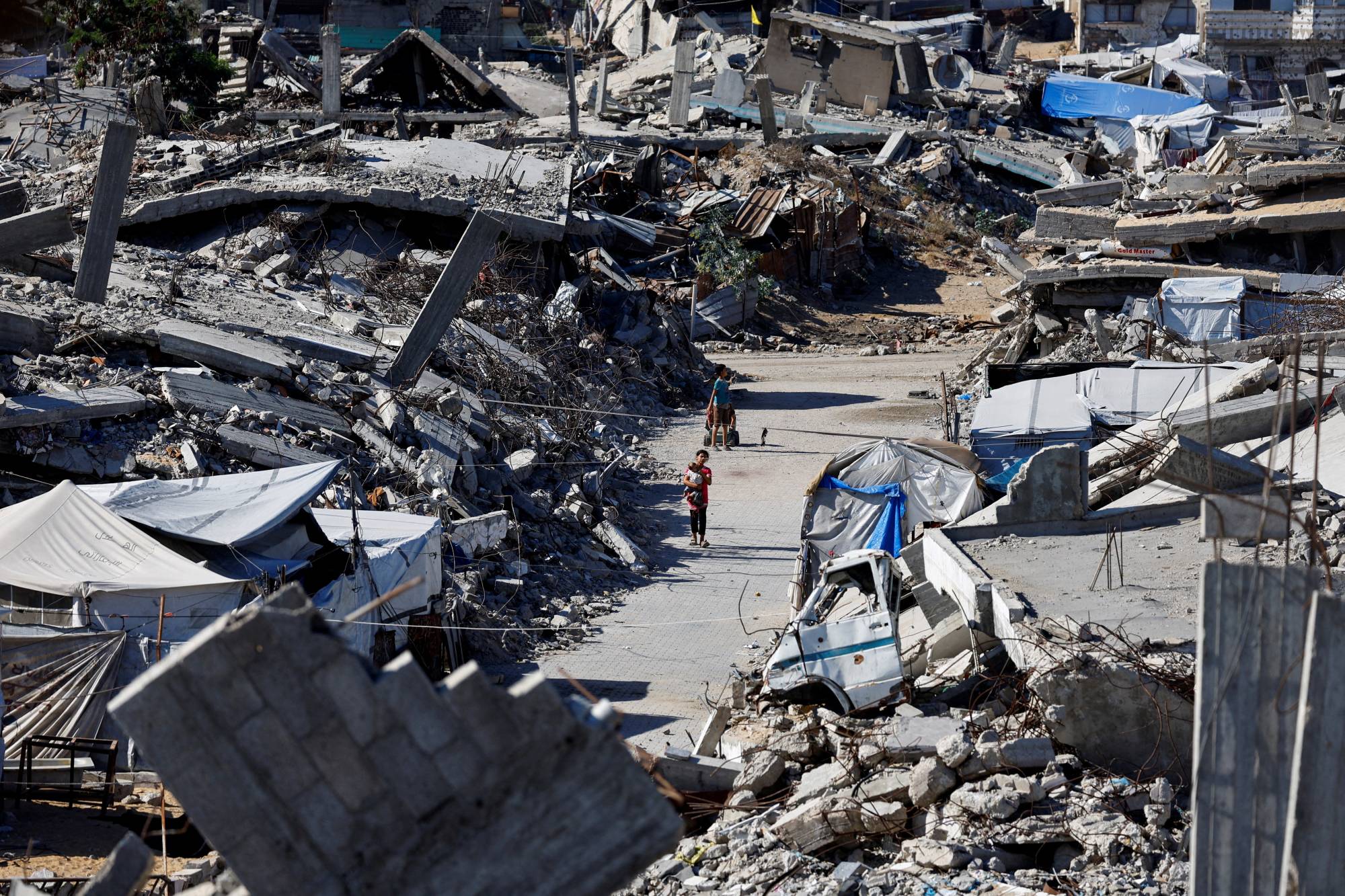
A Palestinian man works amid the rubble of a building damaged during the war, overlooking a makeshift tent camp at the Islamic University, in Gaza City, October 3, 2026. (Reuters)
TT

Israelis Mark Three Years Since October 7 as Palestinians Mourn Gaza’s Destruction

A Palestinian man works amid the rubble of a building damaged during the war, overlooking a makeshift tent camp at the Islamic University, in Gaza City, October 3, 2026. (Reuters)

Israelis gathered in silence on Wednesday in a kibbutz near the Gaza border that was overrun by Hamas on October 7 three years ago, mourning victims of attacks that set off Israel's assault in Gaza and plunged the Middle East into war.

In the Gaza Strip, devastated by three years of Israeli bombardment, Palestinians sheltering among the ruins of destroyed cities recalled life before a war that displaced nearly the entire population and tore apart families.

The attacks of October 7, 2023, were the deadliest day in Israel's history. Militants led by Hamas killed 1,200 people and took 251 hostages, a cross-border incursion that traumatized Israelis who have demanded government accountability.

Israel's subsequent bombardment and ground operations in Gaza have killed more than 74,000 people, including at least 1,400 killed in the past year since a US-brokered ceasefire, which halted major fighting but has failed to stop Israeli attacks or secure the disarmament of Hamas.

Palestinian children walk amid the rubble of buildings destroyed during the war in Gaza City, October 7, 2026. (Reuters)

'A ‌VERY DIFFICULT DAY'

In ‌Kfar Aza, where Hamas fighters killed dozens of Israelis before taking 19 hostages back into Gaza, ‌residents ⁠held a vigil for ⁠those killed, standing in silence as a trumpet played a solemn bugle call. A resident read out a roll call of the dead.

Zion Regev, a community leader in the kibbutz, said most residents remain displaced and have yet to return, the trauma of October 7 continuing to shape their lives.

"This is the first time we are doing all the things here in the kibbutz," Regev said of the vigil. "It's a very emotional day, it's a very difficult day for our community, three years after October 7th."

Elsewhere in Israel, protesters against what they view as a lack of accountability for the security failure gathered outside parliament in Jerusalem, blaming Prime Minister Benjamin Netanyahu for refusing an independent inquiry into the attack.

Some protesters held ⁠signs reading: "The people will remember October 7 on October 27," a reference to an Israeli general election ‌20 days away that is being viewed as a referendum on Netanyahu's long tenure ‌in power.

"We need the change and we need hope and we need to know that we have a government that cares about the public ‌and doesn't work also only for themselves," said protester Shaked Arrad.

Netanyahu has rejected blame for the security breach and resisted calls for an independent ‌investigation. That has frustrated many in Israel, including families of those killed in the attacks, some of whom have joined the election race.

In a statement released by his office, Netanyahu said: "The nation unites on this day in the longing for our dear ones."

Referring to his country's ongoing attacks in Gaza, he added: "We will complete the mission: we have settled the score and will continue settling the score with all the murderers."

Election polls show neither Netanyahu nor ‌his main competitors would muster enough seats in parliament to form a coalition if a vote were held today.

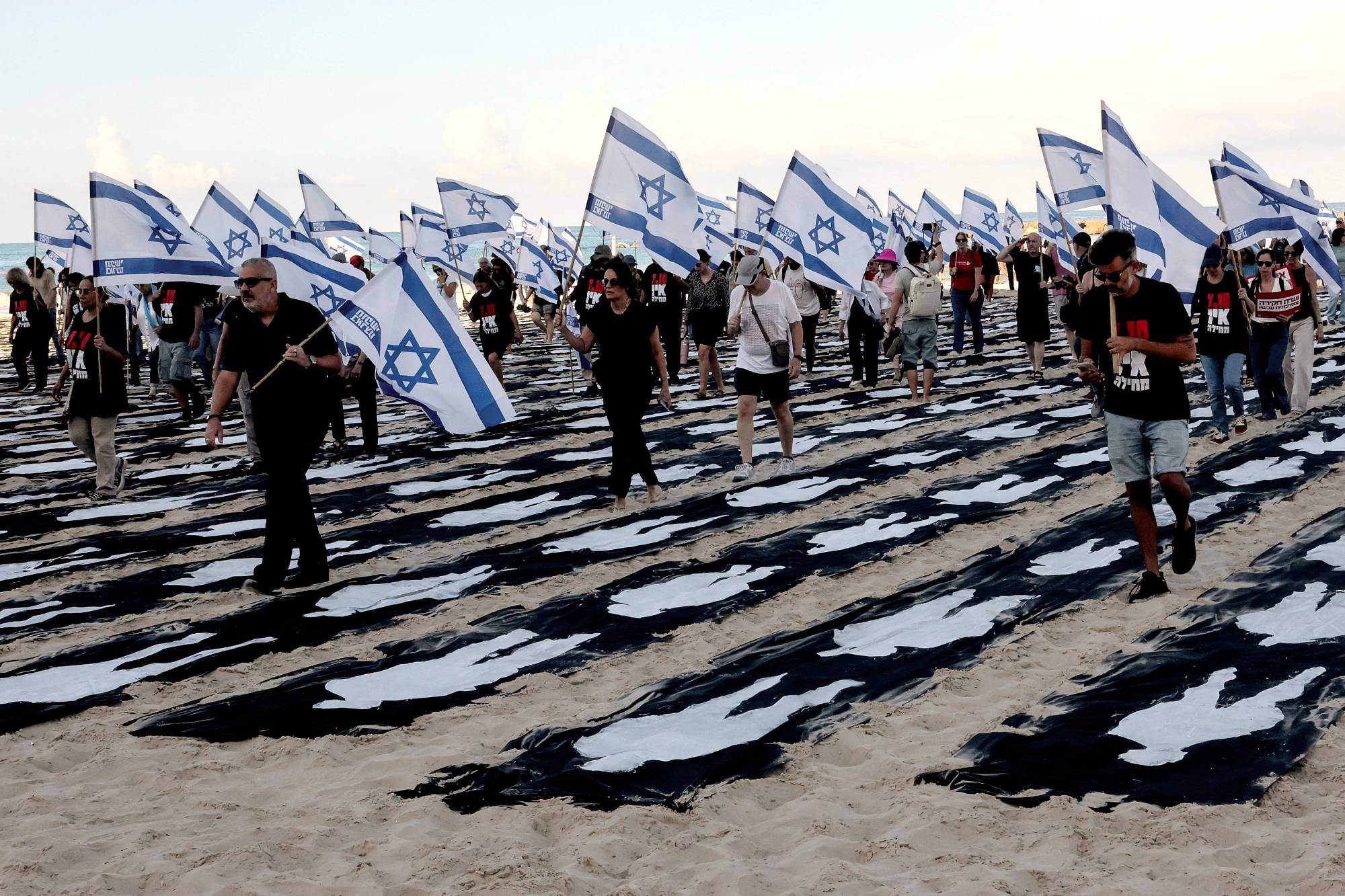
People carrying Israeli flags walk through a commemorative installation set up on the beach in Tel Aviv to mark the third anniversary of Hamas's October 7 attack on Israel, on October 7, 2026. (AFP)

DISPLACED GAZANS RECALL LIFE BEFORE ISRAELI ASSAULT

The anniversary is the first since the ⁠October 10, 2025, ceasefire deal, which has ⁠left Israel in control of around two-thirds of Gaza, where it has demolished remaining buildings and ordered residents out.

Hamas controls the remaining third of the territory, a narrow strip on the coast where the 2 million population mostly live in makeshift tents and bombed-out buildings.

In the latest violence, Gaza medics said on Wednesday Israel's military had carried out air strikes in Beit Lahia in northern Gaza and in Khan Younis in the south, killing at least two Palestinians and wounding others.

The Israeli military said it struck and killed two people it described as militants with Hamas, which did not immediately provide comment. The military did not provide comment on the strike in Khan Younis.

Umm Mohammad, a mother of five displaced from Gaza City and now living with her husband and children in a tent encampment in Deir Al-Balah, said the war had ripped her family apart.

"We were one happy family. The war displaced us. My son left Gaza, the other went to a separate tent, my daughters left with their husbands to other parts of the Strip and we rarely meet," she said.

On this day, she said, "we recall how happy, despite all problems, we were before the war broke out, destroying everything we loved."


Syria Says Northeast Pipeline Damaged in Sabotage Attack

Security forces in Syria. (SANA file)
TT

Syria Says Northeast Pipeline Damaged in Sabotage Attack

Security forces in Syria. (SANA file)

Syria's state petroleum company said on Wednesday that an oil pipeline in the country's northeast was damaged in a "sabotage attack", the third such incident in recent weeks.

Years of civil war before the fall of longtime ruler Bashar al-Assad in late 2024 devastated Syria's oil, gas and electricity sectors, with the country becoming heavily reliant on imports to meet its needs.

In a statement, the Syrian Petroleum Company said the pipeline near "the Tal Hamis area in Al-Hasakeh Governorate was subjected to a sabotage attack at 6:00 am on Wednesday, October 7, resulting in damage to the pipeline".

It added that maintenance crews were working to "isolate the damaged section and begin repair and maintenance work".

The company said authorities arrested the alleged perpetrators and referred them to the judiciary.

On September 29, sabotage targeting a gas pipeline in eastern Syria caused an explosion, according to state news agency SANA.

In early October, an explosion at a gas pipeline near the capital Damascus took three power stations offline.

The incidents come after demonstrations last month over rising fuel prices, which authorities linked to price hikes caused by the Middle East war.


IMF Announces Policy Advisory Program for War-Ravaged Yemen

An internally displaced Yemeni woman cooks a meal for her children at a makeshift camp for the internally displaced who fled their homes due to renewed clashes between Yemen's government forces and the Houthi militants in the northern Hajjah governorate on October 7, 2026. (AFP)
TT

IMF Announces Policy Advisory Program for War-Ravaged Yemen

An internally displaced Yemeni woman cooks a meal for her children at a makeshift camp for the internally displaced who fled their homes due to renewed clashes between Yemen's government forces and the Houthi militants in the northern Hajjah governorate on October 7, 2026. (AFP)

The International Monetary Fund said Wednesday it had approved an 18-month program to help war-ravaged Yemen achieve economic stabilization and strengthen its macroeconomic frameworks, even as its war rages on.

The IMF's "Staff-Monitored Program" offers technical assistance but does not have a financial component.

Yemen is among the poorest countries in the world and has been combatting a Houthi coup for years. The war has caused a humanitarian crisis that has left most of the population dependent on aid to survive.

The Iran-backed Houthis, who control most of northwest Yemen, captured swathes of coastal land from Yemen's pro-government forces in September after the war reignited in July.

The new fighting has displaced more than 200,000 people within the country, the United Nations said Wednesday. In total, the country has more than 5.2 million internally displaced people, with nearly two-thirds of the total population in need of humanitarian aid.

Yemen's legitimate government says it is aiming to retake all Houthi-controlled territory.

The IMF noted that Yemen's economic outlook was "challenging," after five straight years of contraction.

Real GDP contracted by 1.5 percent in 2026 "amid deteriorating terms of trade linked to the conflict in the Middle East, persistent energy shortages, and weak domestic demand," the Fund said in its statement.

The IMF noted that the country remained heavily dependent on remittances and donor assistance to finance its humanitarian-driven import bill.

The country's reserves are slated to remain below adequate levels, even with Saudi budgetary support.

The Fund said the new program aims to "strengthen public finances" in the next year, focusing on increasing domestic revenue mobilization and rationalizing government spending.

Even before the latest round of violence and displacement, Yemeni faced one of the most serious humanitarian crises in the world, according to the UN.

More than 18 million people nationwide face acute food insecurity, with around 2.2 million children under five classified as acutely malnourished, as per World Food Program figures.

The WFP warned on Friday of an "absolutely devastating" food crisis and said it needed $109 million to provide emergency food and nutrition assistance for up to 1.5 million people affected by the escalation.
