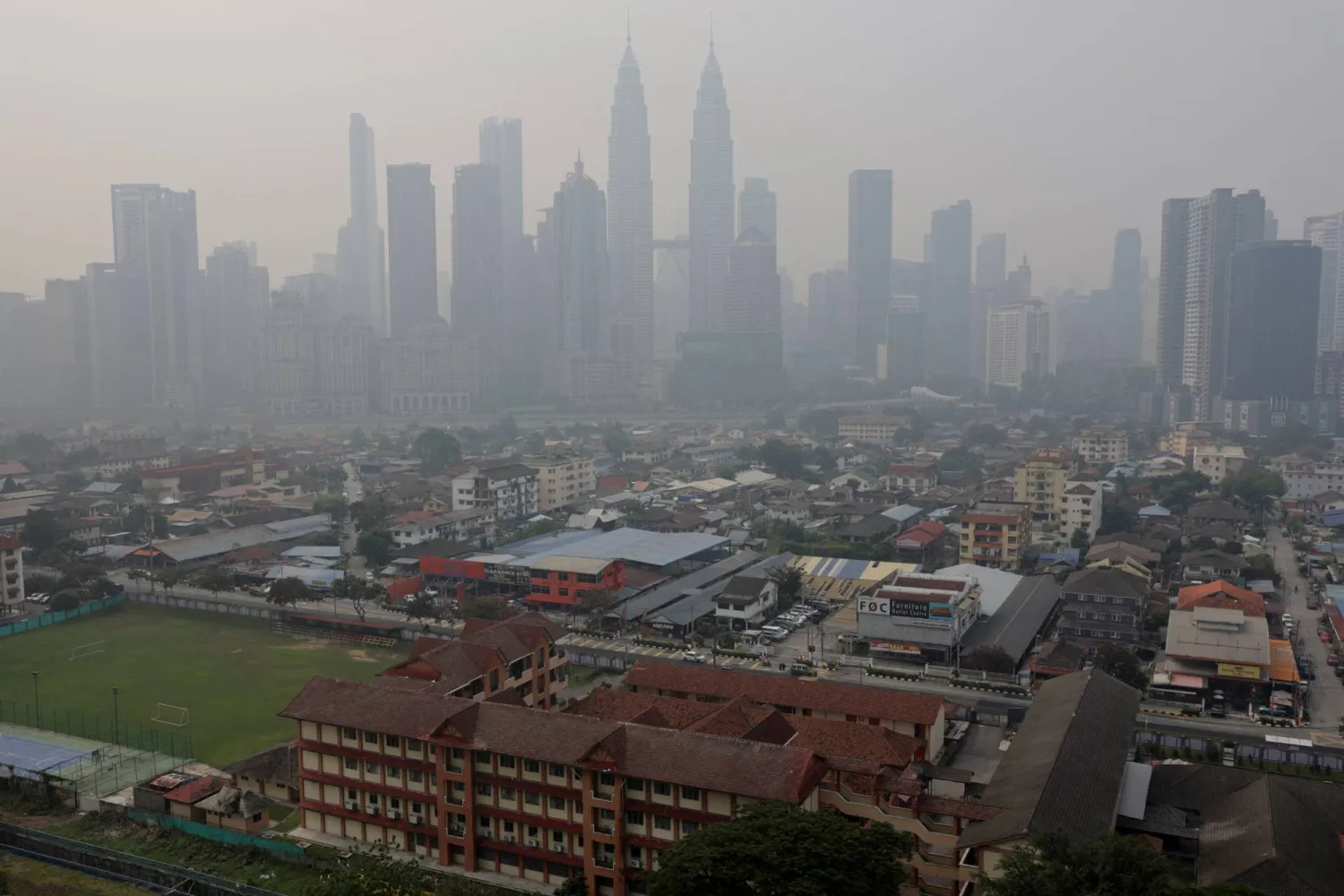
Malaysia Closes Schools in Capital, Parts of Country Due to Haze

Kuala Lumpur's skyline shrouded in haze from regional wildfires, in Kuala Lumpur, Malaysia, October 9, 2026. REUTERS/Hasnoor Hussain
TT

Malaysia Closes Schools in Capital, Parts of Country Due to Haze

Kuala Lumpur's skyline shrouded in haze from regional wildfires, in Kuala Lumpur, Malaysia, October 9, 2026. REUTERS/Hasnoor Hussain

Malaysia closed schools in Kuala Lumpur and other parts of the country on Friday, as haze from fires in neighboring Indonesia again plunged local air quality to among the world's worst.

Toxic smoke from peatland and forest fires has shrouded cities in the region for more than a month, sending respiratory complaints skyrocketing.

The school closures came as Malaysia's leader discussed the choking smoke with his Indonesian counterpart and called for an urgent regional meeting.

Air quality in Kuala Lumpur has been firmly in "unhealthy levels" this week, with a Swiss-based air quality monitor ranking the Malaysian capital among the world's most polluted cities on most days.

Malaysia's Education Minister Fadhlina Sidek said she has instructed whole school closures in four states and two federal territories as well as one partial closure in the central Pahang State.

"In the future, we will ensure that any decision to close schools is notified in advance so that parents have sufficient time to prepare," Fadhlina said late on Thursday.

Malaysia's King Sultan Ibrahim weighed in on the matter on Thursday, saying schools should be closed as air quality readings reached 150 or higher on the Air Pollutant Index (API).

Under Malaysian guidelines, API readings above 100 are classified as unhealthy, above 200 as very unhealthy, above 300 as hazardous, while readings beyond 500 constitute the threshold for declaring a local emergency.

Kuala Lumpur on Friday showed a reading of around 170 API.

The city was the second-most polluted globally behind neighboring Singapore on Friday morning, Swiss-based air monitor IQAir said.

Malaysia's Prime Minister Anwar Ibrahim said Thursday he discussed the fire situation with the Indonesian leader Prabowo Subianto.

"The haze issue is indeed at a worrying level. And I have personally contacted President Prabowo," AFP quoted Anwar as saying.

"And he also agreed to take the necessary steps," Anwar said, without going into specific details.

He said Malaysia has been taking measures to combat the haze, including increasing attempts to trigger rain via cloud seeding.

Experts said the flames are being fanned by a turbo-charged El Nino weather phenomenon, causing the worst pollution conditions in years.

Anwar said he asked Malaysia's Foreign Minister Mohamad Hasan to contact the 11-nation Association of Southeast Asian Nations' secretariat for an urgent meeting between environmental ministers to discuss the matter.

"So these are all the steps we are taking, but we are monitoring and will try the measures that we ought to take next," Anwar said.

Singapore's air quality levels too dipped into the "very unhealthy" range with a reading of 205 on the Air Quality Index, according to the IQAir website.

The AQI converts measurements of pollutants into a single figure indicating air quality and potential health risks.

Readings above 150 are classified as unhealthy, while levels above 300 are considered hazardous.


Iconic New York Figure Was Likely ‘Major Player’ in Murderous Pirate's 1695 Heist

A person walks by the water at Jones Beach in Wantagh, N.Y., May 21, 2020. (AP)
TT

Iconic New York Figure Was Likely ‘Major Player’ in Murderous Pirate's 1695 Heist

A person walks by the water at Jones Beach in Wantagh, N.Y., May 21, 2020. (AP)

An amateur historian has stumbled upon a provocative clue to the enduring mystery of what became of a notorious pirate who raided a royal Indian treasure ship centuries ago, implicating a co-conspirator whose name is familiar to many New Yorkers.

James Bailey, who five years ago made headlines after unearthing ancient coins believed to be linked to English pirate Captain Henry Every, now says that colonial-era documents suggest the “King of the Pirates” and his violent crew got an assist from Thomas Jones, the namesake of Jones Beach, New York’s most visited state park after Niagara Falls.

“You have millions of visitors and generations of New Yorkers going to this beach,” Bailey said. “Nobody knew that he was actually a major player in arguably the biggest heist in the history of piracy.”

Since his big find, Bailey has pored through documents to dig even deeper into the bloody 1695 raid of the Ganj-i-Sawai on the Red Sea and the mystery of what happened to Every.

The pirate crew is said to have tortured, killed and raped those aboard the royal ship, sparking global outrage and what is considered the first worldwide manhunt, according to AP.

Some were caught and executed, but many others, including Every, were never heard from again and are believed to have scattered to Europe and the American colonies.

Documents, including depositions from Every’s associates, suggest Jones was recruited to serve as a “wheelman,” helping the pirates evade authorities after they made off with tens of millions of dollars' worth of gold and silver, according to Bailey.

Other documents show that New York’s governor, charged by the British crown to crack down on piracy, investigated Jones years later after he’d remade himself as the wealthy proprietor of a whaling operation on the barrier beach on Long Island that now bears his name.

Bailey’s research, which he hopes to have published, sheds light on a part of Jones’ checkered past long alluded to but never quite fleshed out in local history books, says John Hanc, author of “Jones Beach: An Illustrated History,” which includes a chapter on Jones.

Jones was a major in the English military before moving to the American colonies, initially settling in Rhode Island before eventually becoming a prominent businessman and landowner in New York. Jones owned thousands of acres of land on early Long Island, then just a rural expanse well east of the rapidly growing New York City.

But rumors of how he’d initially made his fortune persisted long after his death in 1713. Before it was demolished in the early 1800s, his crumbling mansion was said to be haunted by ghosts and strange occurrences. Jones’ grave was repeatedly desecrated by robbers searching for buried treasure before it was relocated to a family burial plot behind a nearby church.

A family history published in 1906 by one of Jones’ descendants dismissed the pirate tales as “slander” and “improbable fictions.”

“People were disposed to cast slurs upon his memory, either for mischievousness, or a spirit of malice,” Thomas Floyd-Jones wrote. “These myths were cherished for over a century after his death, which ignorance and superstition did not fail to magnify.”

Hanc and other experts say it wasn’t too far-fetched for Jones to have at least dabbled in piracy.

After serving in the British military, Jones made a career as a privateer, or a seafarer authorized by the English crown to raid the commercial ships of its rivals during wartime, said Meagan Schulman, a Fordham University doctoral candidate who specializes in 17th century piracy and wasn’t involved in Bailey’s research.

But when the conflict ended, privateers like Jones lost their special status, she said. Those that continued the high seas raids were branded pirates.

“The reality was that privateers were pirates, just sponsored by a certain government or patron,” explained Schulman, who grew up going to Jones Beach. “So maybe the short answer is, yes. Jones can be called a pirate, by some people, but he probably did not ever see himself as one.”

After helping Every and his crew evade capture, the documents cited by Bailey show Jones briefly returned to Rhode Island.

Then in 1696, Jones’ father-in-law, Thomas Townsend, a wealthy New Yorker, gifted him and his wife a significant tract of land on Long Island’s south shore, property records show.

Bailey, who recently retired from Rhode Island's corrections department, posits that allowed Jones a fresh start, as authorities continued to scour pirate-friendly New England for Every and his accomplices.

On Long Island, Bailey says Jones built a homestead and raised a family, but his pirate past was never far behind.

Three years after the Ganj-i-Sawai heist, Richard Coote, New York's colonial governor, described how one of his efforts to root out piracy had led him to Jones.

Citing witness depositions, the governor wrote in 1698 that a certain “barrel of money” traveled from the city to Long Island, where it ended up at Jones’ house. But Jones, who the governor described as “formerly a pirate,” testified that he knew nothing about the barrel.

Bailey’s findings are compelling but shouldn’t be considered conclusive, cautions Richard Blakemore, maritime history professor at the University of Reading in the United Kingdom who also wasn’t involved with Bailey’s work. After all, he said, Thomas Jones is a fairly common name.

If anything, Jones’ possible ties to Every underscore how piracy provided “foundational and multi-generational wealth” for many of the prominent families in the Northeast, says Kevin McDonald, a history professor at Loyola Marymount University in Los Angeles who wrote a book about colonial-era piracy but wasn’t involved in Bailey’s research.

“Popular images of pirates show them as outcasts, but many historians have argued the opposite, based on evidence like this,” agreed Blakemore. “It may surprise readers to find just how much early British colonies were both socially and economically connected to piracy.”


Hong Kong Logs Hottest October on Record

An evening view of the financial Central district and Victoria Harbour in Hong Kong, China, May 9, 2023. (Reuters)
TT

Hong Kong Logs Hottest October on Record

An evening view of the financial Central district and Victoria Harbour in Hong Kong, China, May 9, 2023. (Reuters)

Hong Kong experienced its hottest October since records began, data from the city's weather service showed on Tuesday.

The Hong Kong Observatory logged a monthly mean temperature of 27.6C -- a 0.2C increase from last year's already record-breaking figure for the same period.

Hong Kong began recording weather observations in 1884, according to the observatory.

This year's exceptionally strong El Nino has driven up temperatures around the world, with global forecasters warning for months that this would likely become the strongest ever observed.

El Nino is the warming phase of a natural climate cycle, and temporarily raises sea temperatures in the tropical Pacific, triggering changes in weather that can increase the risk of drought and flooding, and exacerbate man-made global warming.

Hong Kong observed its highest temperature ever of 36.9C in August as Typhoon Dolphin swept warm air over the city.


Monarch Butterflies Get Tiny Trackers to Help Scientists Follow Their Mysterious Migration

Monarch butterflies rest on their way to Mexico, Sept. 12, 2023, in Cleveland. (AP)
TT

Monarch Butterflies Get Tiny Trackers to Help Scientists Follow Their Mysterious Migration

Monarch butterflies rest on their way to Mexico, Sept. 12, 2023, in Cleveland. (AP)

As a child, Rebeca Quiñonez-Piñón wondered where monarch butterflies stop for a meal and a night's rest on their long migrations across North America. Now she and other scientists are attaching tiny tracking devices to hundreds of butterflies to find those critical stopover locations before they disappear.

Swarms of dazzling orange-and-black monarchs use environmental cues to travel some 3,000 miles (4,800 kilometers) from as far as southern Canada to spend the winter in forests of oyamel fir trees in central Mexico, a protected biosphere reserve that's also a World Heritage site.

For decades, however, scientists have struggled to build a clear picture of the butterflies' routes, how far they fly each day and where they settle at night. Solar-powered radio tags attached to nearly 1,750 monarchs this year are helping provide answers.

As habitat loss, pesticides and climate change pummel monarch populations, the research could help their numbers rebound. Quiñonez-Piñón said the uniquely famous monarch butterfly helps draw attention to the threats facing insects and their vital role in sustaining plant life across the continent.

“Pollinators are crucial to protect and ensure that our ecosystems remain healthy,” she said, “and also to have the sources of food that we require as humans.”

The public can follow the progress of individual butterflies on the free app called Project Monarch Science.

Tracking monarch butterflies in the ‘Texas funnel’ and beyond

Quiñonez-Piñón is the senior scientist at the National Wildlife Federation, a nonprofit that recently joined a tri-national science team to track monarchs. She’s leading a study that mixes real-time migratory tracking with community science to better understand where they stop in Texas.

Only some monarchs migrate. Of the ones that do, a big portion of the butterflies east of the Rocky Mountains fly through a narrow corridor known as the “Texas funnel” every fall and spring, when they head north again to lay their eggs before dying.

But depending on the year, they might favor different parts of the Lone Star State, based on where they can find water, nectar and overnight shelters like trees. It’s a detail that has fascinated scientists, including Quiñonez-Piñón.

Since the tracking started last year, scientists have found the first evidence of a butterfly in Utah, west of the Rockies, joining eastern monarchs in central Mexico. Others migrated down the Eastern Seaboard to Florida, jumped the Gulf of Mexico and are now tracking across Mexico, a connection scientists hadn’t seen before in such numbers.

“There’s just all these unique stories of their paths, connections between the population, that we didn’t know existed or we hypothesized but couldn’t prove,” said Emma Pelton, senior conservation biologist with the Xerces Society for Invertebrate Conservation.

“We’re a year into it, and I think we’re all just thrilled,” she said, especially since older tracking devices proved too big or heavy.

Since their migration started this year, about 175 tagged butterflies have been detected in Mexico.

Only some monarch butterflies get tracking devices

The new $200 tags weigh about as much as a drop of water and were developed by Cellular Tracking Technologies. If the person attaching the tag is properly trained and puts it on correctly, Quiñonez-Piñón said, “the monarch will be completely safe.”

Not all monarchs are good contenders for the tags. To ensure they’re not overburdened, most of the butterflies that get a tag weigh more than 400 milligrams (about as much as a standard pill), said David La Puma, vice president of global market development for Cellular Tracking Technologies and coordinator of the Project Monarch Collaboration, the team the National Wildlife Federation recently joined. Other researchers and community scientists look for longer-winged monarchs to tag.

Many monarchs are caught with nets and kept in cool temperatures to calm them before they're tagged, which requires delicacy and care. The insect is positioned in the middle of a special board, its legs and antennae protected, where adhesive is cotton-swabbed onto its abdomen and the tag. Then the transmitter is gently pressed to its body and the butterfly is eventually released.

Louie Yang, an insect ecologist at the University of California, Davis, said the technology is “pretty remarkable” because “we haven’t previously been able to see what path they take or how quickly they’re moving over different parts of that journey.”

But there are also limitations. The technology doesn't tell us a butterfly's exact location, he said, but rather where there was a receiver that detected it. And just because a butterfly was detected doesn't mean it's still alive.

Yang also said further studies will be needed to understand how and if the tags impact butterfly behavior.

Pesticides and climate change are pervasive threats

Monarchs typically live two to six weeks, but the butterflies that migrate to Mexico can live up to nine months and spend their lives moving south, waiting out the winter and migrating north again before breeding in the spring. The monarch’s feat has made it a symbol for the rights of international migrants.

Since the mid-1990s, the population of eastern monarchs has dropped more than 80%, and in the west by about 95%. Pesticides are a pervasive threat to milkweed, the plant where monarchs lay their eggs and the exclusive food source for its caterpillars.

Human-caused climate change — driven by burning coal, oil and gas — is also a primary threat year-round, said Tierra Curry, senior scientist and endangered species codirector with the Center for Biological Diversity.

“One of the problems now is that it stays too hot too long in the northern areas, and so they don’t get the cues to migrate. And then if the temperature freezes, they’re probably not going to make it to Mexico,” she said. “The later they start, the less the chances that they’re going to get all the way to the forest.”

Prolonged drought can dry up the water and nectar flower sources they need. They get hit by cars and trucks. And out in California, forests where western monarchs fly for the winter are being razed for development.

Late last year, the Trump administration delayed a decision on federal protections for monarchs. Several groups filed a lawsuit, and a court ordered the government to make a final decision by 2030.

However, conservationists are pushing ahead with new ways to protect the dwindling monarch population.

In Texas, nets on some highways are encouraging butterflies to fly higher so they don't get smashed, especially at night when they fly down to roost. Other efforts involve mass plantings of milkweed and pollinator plants in gardens, along roadsides and transportation corridors, Curry said. Several studies show they're boosting local populations.