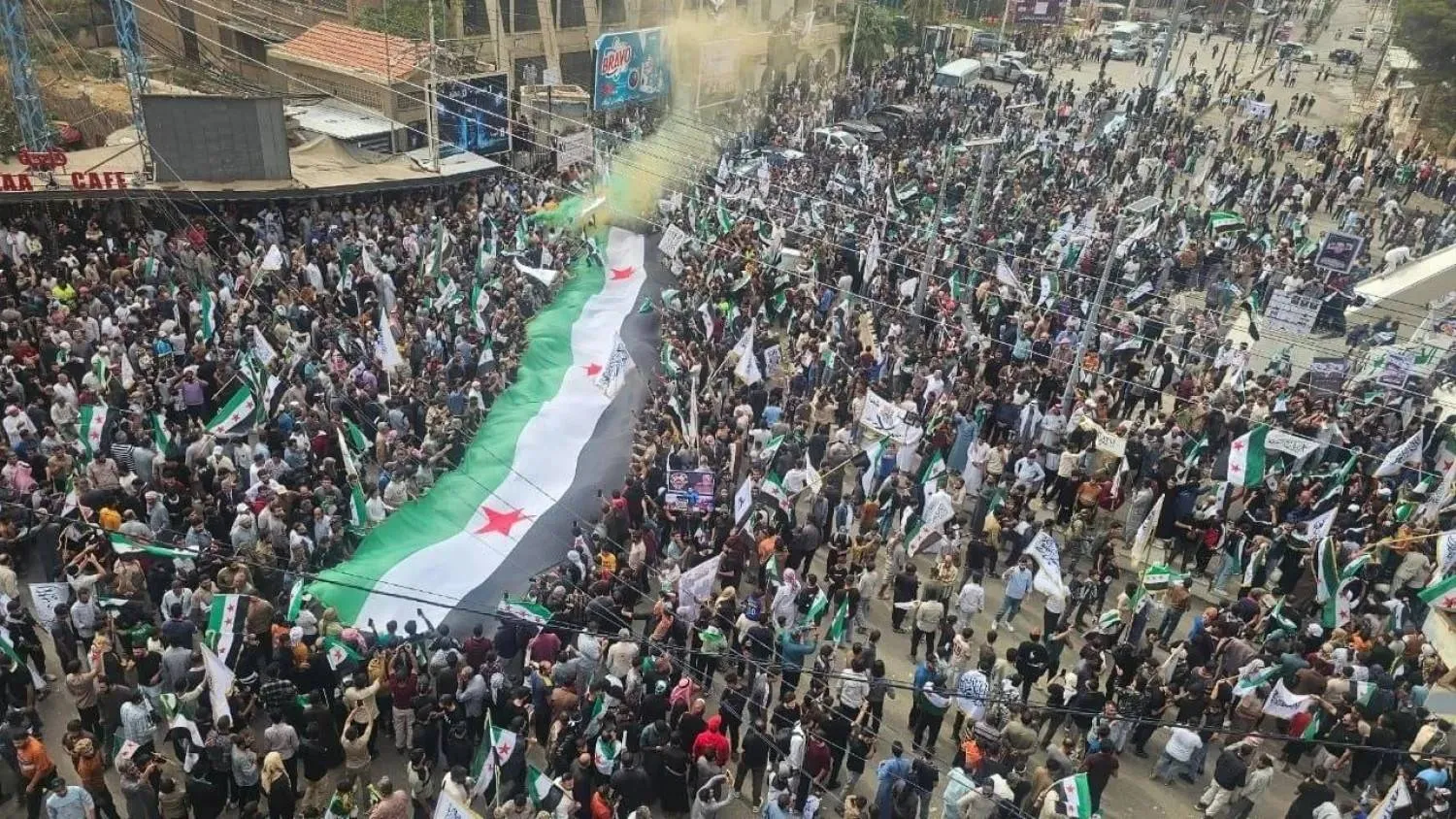
Mass Protests in Hasakah Under ‘Friday of the Syrian Flag’ Banner

The Syrian flag at a protest in Hasakah (Social media)
TT

Mass Protests in Hasakah Under ‘Friday of the Syrian Flag’ Banner

The Syrian flag at a protest in Hasakah (Social media)

Thousands of residents of Syria’s Hasakah province rallied after Friday prayers to demand state authority across the province and the release of detainees and people forcibly disappeared in prisons run by the dissolved Syrian Democratic Forces (SDF).

In scenes described as the “greatest celebration” and the “Hasakah flood,” protesters gathered in Freedom Square in the city center under the slogan “Friday of the Syrian Flag.”

They called for state sovereignty and a stronger presence for its institutions, a day after the national flag was raised on the square’s tallest flagpole before a large gathering of residents and officials.

The protests capped a week of rapid developments in Hasakah over the implementation of a Jan. 29, 2026, agreement between the Syrian government and the SDF.

The deal called for the former Kurdish Autonomous Administration’s civilian, security and military institutions to be integrated into state structures.

Arabs, who make up the province’s population majority, have complained that the SDF remains dominant despite its announced dissolution in late August.

Residents began arriving early in the morning from Hasakah’s al-Aziziya, al-Kallasa and al-Nashwa neighborhoods and from other towns, including al-Shaddadi, Markada, al-Hol and al-Arisha.

They gathered outside Abu Bakr al-Siddiq Mosque in Ghweiran before marching after Friday prayers to the city’s main square, known as Liberation Square, carrying Syrian national flags.

Government internal security forces reinforced their presence across the city from midnight Thursday to protect protesters, residents and public and private property. The deployment followed indiscriminate gunfire by “outlaw” gunmen in several neighborhoods.

Activists accused a Kurdish group referred to as “Revolutionary Popular” of stirring tensions to impose a curfew and block the demonstrations. Internal security forces restored calm that night, Syria’s Al-Ikhbariya television channel reported.

Protesters carried national flags, photographs of SDF detainees and pictures of “martyrs of the Syrian revolution.”

They chanted, “One, one ... the Syrian people are one,” seeking to reassure the province’s Arab, Kurdish and Christian communities that all were subject to the law and equal in rights and duties.

Their demands included extending state sovereignty and authority across Hasakah, restoring state institutions and making them operational, releasing detainees forcibly disappeared in SDF prisons, and allowing their sons to join the internal security forces. They also called for an end to the province’s dual authorities and the presence of Revolutionary Youth.

Videos posted on social media showed protesters removing Kurdistan Workers’ Party (PKK) and SDF flags and banners from streets and buildings.

Sohaib al-Yaarubi, an activist from the province’s Arab tribes and one of those who called for the protests, said the message was clear: the overwhelming majority in Hasakah supported the Syrian state, wanted its sovereignty extended across the province and wanted only the flag of the Syrian Arab Republic flown there.

Yaarubi told Asharq Al-Awsat the demonstrations were “successful” and the demands “patriotic and legitimate.” He said there were no tensions or provocations apart from one incident involving Revolutionary Youth members, which protesters defused.

Ibrahim al-Halabi, another activist from the province’s Arab tribes, described the crowds in Liberation Square as “awe-inspiring, beautiful and truly wonderful.” The peaceful demonstrations lasted about two hours.

He said the raising of the national flag brought overwhelming joy, stirring emotions that recalled the early days of the Syrian revolution against the former government in 2011.

“Some described the demonstrations and the crowds in Liberation Square as the greatest celebration in Hasakah, a city denied the chance to celebrate the victory achieved when the ousted government fell nearly two years ago,” Halabi said.

Delegations from other provinces, including Deir Ezzor, joined the Hasakah protests.

Similar demonstrations took place in several provinces in support of its residents’ demands.

The Friday rallies followed Thursday’s raising of the national flag on the tallest flagpole in central Hasakah before a large gathering of residents and officials. Government officials also inspected the courthouse to “create suitable conditions for making the judicial system operational.”

Internal security forces had deployed around the courthouse after members of the dissolved SDF vacated their positions there, while the government strengthened its security presence across the city.

On Tuesday, the SDF’s counterterrorism forces had handed over their positions to internal security forces.

Maj. Gen. Abdul Qader Tahhan, head of Syria’s General Intelligence Service, and Brig. Gen. Abdul Rahman al-Dabbagh, head of foreign intelligence, subsequently arrived in Hasakah with a large security delegation.

The developments followed mass peaceful protests after prayers the previous Friday in several towns and cities across Hasakah province, demanding state authority and a stronger presence for its institutions throughout the province.


Aoun: Israel, Iran Are 2 Main Obstacles to Lebanon’s Full Independence

Lebanese national flags line a highway ahead of the country's 83rd Independence Day celebrations in the Dbayeh coastal suburb, north of Beirut, Lebanon, 20 November 2026. EPA/WAEL HAMZEH
TT

Aoun: Israel, Iran Are 2 Main Obstacles to Lebanon’s Full Independence

Lebanese national flags line a highway ahead of the country's 83rd Independence Day celebrations in the Dbayeh coastal suburb, north of Beirut, Lebanon, 20 November 2026. EPA/WAEL HAMZEH

Lebanese President Joseph Aoun said on Saturday that Israel and Iran represent the two principal obstacles to the completion of Lebanon’s sovereignty and independence, stressing on the eve of Independence Day that the country must not remain captive to either project.

Aoun said Lebanon is facing a critical and defining test, arguing that the two challenges are inextricably linked.
He identified them as “the Israeli occupation of parts of our territory” and “foreign interference in our internal affairs, particularly by influential actors within the Iranian regime, through weapons and decision-making structures that operate outside the authority of the Lebanese state.”

According to Aoun, each of these realities serves to justify and perpetuate the other. “Each obstacle invokes the other, derives legitimacy from it, and provides it with a pretext,” he said, adding that “in both cases, Lebanon is the one that pays the price.”

The president said his administration has advanced a national rescue plan based on addressing both issues simultaneously.
“Our vision is founded on the parallel and simultaneous resolution of both problems: no occupation under any circumstances, and no weapons outside the authority of the (Lebanese) state that take orders from, or serve the interests of, any foreign power, whoever that power may be.”

Addressing the issue of Hezbollah’s arsenal, Aoun acknowledged the group’s past role while arguing that its continued possession of arms has come at a heavy cost.

“Hezbollah’s weapons served their purpose during an earlier period, and there were genuine sacrifices and achievements associated with them. In a later phase, however, they exhausted its community, its social environment, its people, and the country as a whole. They imposed immense losses on them, and on all of us, once they became openly dedicated to causes that were not Lebanese.”

He concluded with a direct appeal: “The weapons must be handed over.”


Iraq Refers Oil Smuggling Case to Judiciary as Security Forces Deploy in Jurf al-Sakhar

20 November 2026, Iraq, Jurf Sakhar: Iraqi security forces take up positions in Jurf al-Sakhar, in Babil province, south of Baghdad, during the establishment of a new military command centre in the area, a strategic stronghold of the Iran-backed Kataib Hezbollah militia, as the government moves to strengthen its control over armed groups. Photo: Ameer Al-Mohammedawi/dpa
TT

Iraq Refers Oil Smuggling Case to Judiciary as Security Forces Deploy in Jurf al-Sakhar

20 November 2026, Iraq, Jurf Sakhar: Iraqi security forces take up positions in Jurf al-Sakhar, in Babil province, south of Baghdad, during the establishment of a new military command centre in the area, a strategic stronghold of the Iran-backed Kataib Hezbollah militia, as the government moves to strengthen its control over armed groups. Photo: Ameer Al-Mohammedawi/dpa

The Iraqi government announced on Saturday that it had referred an oil smuggling case to the judiciary, with possible arrests of individuals suspected of involvement, as security forces redeployed in Jurf al-Sakhar in northern Babil province under an agreement providing for the gradual withdrawal of Kataib Hezbollah, which has dominated the area for more than a decade.

Government spokesperson Haider al-Aboudi said Saturday that protecting oil pipelines was the government's responsibility and a priority across the country. He noted that security agencies had submitted reports and intelligence to the prime minister concerning suspected smuggling operations and that the case had been referred to the judiciary.

In remarks carried by the Iraqi News Agency (INA), al-Aboudi said the investigations could lead to the arrest of individuals involved and that anyone named in the probe would face judicial accountability. He did not identify any suspects or groups, nor did he disclose details of the smuggling operations under investigation.

According to officials, the government's recent measures in Jurf al-Sakhar have gone beyond replacing the forces deployed in the area. They also include securing oil pipelines and facilities and reorganizing the administration of a territory that has remained largely outside effective government control for years.

Security forces began redeploying in Jurf al-Sakhar on Friday under an agreement calling for the phased withdrawal of Kataib Hezbollah's three brigades from the area.

Where Will Kataib Hezbollah's Forces Go?

Saad Maan, head of Iraq's Security Media Cell, said Saturday that the first battalion of the 45th Brigade had begun withdrawing and that the 72nd and 79th brigades of the Popular Mobilization Forces (PMF) would take over their duties. The troop rotation is expected to be completed in less than a month.

Maan added that Kataib Hezbollah's three brigades would be assigned duties in other areas.

A senior official told Asharq Al-Awsat that the faction had begun redeploying its forces south of al-Qaim in Anbar province. Under the agreement, two battalions would withdraw each day in succession as government security forces moved in, with no obstacles reported so far.

However, the withdrawal was not yet complete. Videos circulating on Saturday showed Kataib Hezbollah members still stationed at the entrance to the area from the al-Fadhiliya side, even as the al-Fadhiliya overpass reopened to civilian traffic after nearly 12 years of closure.

Reporters on the ground also said armed members of the faction remained deployed along dirt roads in the area, obstructing the movement of official security units.

Avoiding a Confrontation

The ongoing arrangements reflect an effort by Prime Minister Ali al-Zaidi's government to bring the area under the control of official security institutions without triggering a direct confrontation with the armed faction.

Addressing security forces entering Jurf al-Sakhar, al-Zaidi said the approach was based on "containment, not exclusion," stressing that everyone would operate under one flag, one command and one law. He also reiterated his opposition to any weapons outside state control.

Security researcher Fadel Abu Ragheef said al-Zaidi's remarks indicated that the government was not pursuing a confrontation with any faction and that the current arrangements aimed to resolve the situation through troop rotations and adherence to the law.

He noted that Kataib Hezbollah had alternative positions in other areas, as well as positions within PMF brigades, adding that a limited contingent could remain in Jurf al-Sakhar under the agreement.

Rehabilitation and the Return of Displaced Residents

The return of residents to Jurf al-Sakhar remains one of the government's biggest challenges. Thousands of displaced people have been unable to return to their homes since military operations ended with the recapture of the area from ISIS in 2014.

Since then, Jurf al-Sakhar has become a heavily militarized area where Kataib Hezbollah wields considerable influence, amid persistent disputes over land administration and the return of residents.

Al-Aboudi said the command headquarters established in the area was intended to facilitate its full reopening and allow residents to return home.

He added that the government would take Jurf al-Sakhar's particular circumstances into account when preparing the 2027 budget, stressing that it did not want areas of the country to continue giving the impression of instability.

However, the return of residents requires measures beyond replacing military units.

A PMF commander stationed in the Jurf al-Sakhar sector said rehabilitating the area would take approximately one month, including completing the troop rotation and clearing landmines. He described mine clearance as a major undertaking that must be completed before arrangements for the return of displaced residents can begin.

Government plans also include addressing unauthorized housing built along oil pipeline routes.

Al-Zaidi instructed provincial governors to identify, document and address these violations, while ensuring that eligible residents of the affected properties are covered by the Watan housing initiative, which includes a project to provide one million residential plots.

The Interior Ministry has also secured more than five kilometers of oil pipelines.

Security affairs researcher Hussein Allawi said the government's actions were linked to intelligence reports concerning violations involving oil resources, not only in Jurf al-Sakhar but also in other oil-producing provinces.

He added that the government was seeking to bring the sector under federal institutional oversight while addressing the aftermath of the war against ISIS. These efforts include conducting security screenings of displaced residents, clearing remnants of war and reorganizing agricultural land.

Allawi suggested that the command headquarters could eventually evolve from a security body into a broader civilian and administrative structure, with an official appointed to coordinate with local authorities and relevant agencies in neighboring provinces.

A Test of State Authority

The developments come amid disputes between Kataib Hezbollah and Asaib Ahl al-Haq, led by Qais al-Khazali.

Meanwhile, a video circulated on social media showing a group of masked men announcing the formation of a new faction called Asaib al-Jihad and its affiliation with the so-called Resistance Coordination Committee.

The group's identity and affiliations remain unclear, and no independently verified information has established a connection between its emergence and the dispute between the two factions.

However, a security source told Asharq Al-Awsat that the appearance of the new group came amid efforts to reorganize certain armed factions.

The source also spoke of Iranian efforts to establish new armed groups in Iraq, but provided no evidence that could be independently verified.


Taiz Faces Collapse in Essential Services as Houthi Siege Nears Third Month

Closure of the last remaining supply routes into Taiz (Local media)
TT

Taiz Faces Collapse in Essential Services as Houthi Siege Nears Third Month

Closure of the last remaining supply routes into Taiz (Local media)

Yemen's city of Taiz is approaching its third month under a Houthi-imposed siege, with essential supplies dwindling and food and fuel prices soaring. The crisis has spread beyond markets to hospitals and healthcare services, threatening residents' ability to meet their daily needs.

United Nations data show that deliveries of medicines and water to the city have fallen by as much as 90%, while fuel and cooking gas supplies have dropped by approximately 97%. The sharp declines have resulted from bottlenecks caused by road closures and blocked supply routes, which have severely disrupted the transport of goods and essential materials.

According to the UN Information Centre, these restrictions have driven food prices up by 60% and fuel and cooking gas prices by around 300%, while transportation costs have quadrupled. The increases have placed further strain on household budgets and reduced residents' ability to afford basic necessities.

The siege has affected not only the availability and prices of goods but also the healthcare sector, which faces severe shortages of fuel, surgical supplies and anesthetic medicines, according to Health Cluster data.

Healthcare workers warn that continued supply disruptions threaten emergency services and hinder surgical procedures, the operation of medical equipment and the production of oxygen needed in intensive care units.

Hospitals are facing growing difficulties maintaining their services as medical needs increase and supplies remain limited. The risk of being unable to treat critically ill and injured patients is also rising, particularly those requiring urgent surgery and specialized care.

Limited Supplies

In an effort to ease shortages, the World Health Organization (WHO) delivered 19.6 metric tons of medicines and medical supplies to three health facilities in Taiz, while humanitarian organizations are planning additional support for two hospitals.

However, the crisis extends beyond healthcare facilities inside the city. Reports indicate shortages of medical and surgical supplies at facilities along the front lines, including areas controlled by the de facto authorities.

These conditions are prompting humanitarian organizations to explore alternative aid delivery routes while intensifying negotiations to secure humanitarian access. The aim is to ensure supplies reach hospitals on both sides of the front lines and prevent disruptions to medical services.

The supply bottlenecks have also coincided with a deterioration in municipal services. The closure of roads leading to the waste incinerator has caused garbage to accumulate inside the city, further demonstrating that the impact of blocked access routes extends beyond the movement of goods, fuel and medicines.

Gaps in Trauma Care

Health Cluster data reveal major gaps in trauma treatment and referral services. Funding has been secured for only four of the 35 planned trauma stabilization points, with none funded in Aden or the areas of Lahj province toward which the front lines are advancing.

Medical referral services also lack the necessary funding as burn injuries increase. Many hospitals can provide only first aid, stabilize patients and dress wounds, without the capacity to deliver the specialized care required.

Mental health services, psychosocial support and rehabilitation remain among the weakest components of the healthcare response. This leaves many patients and injured people at risk of interrupted treatment and inadequate comprehensive care, particularly given the limited resources available.

On the epidemiological front, Health Cluster data showed a decline in cholera cases across the five most affected governorates, with suspected cases falling from 638 in epidemiological week 40 to 321 in week 45.

However, the city of Tarim in Wadi Hadramout has reported a concerning development, recording 172 cases of acute diarrhea since week 43.

Of those cases, 78 tested positive using rapid diagnostic tests, while 22 were confirmed through laboratory cultures, amid suspicions of contamination of food and water sources.

Preparations are underway to establish a diarrhea treatment center in the city to contain the outbreak and provide medical care to affected patients. The developments are placing additional pressure on healthcare services and epidemic control efforts.

Funding Shortages

Alongside the worsening humanitarian and health conditions, funding shortages have emerged as one of the main challenges to sustaining relief operations in Yemen, raising concerns about the impact of limited resources on services provided to civilians.

According to humanitarian data, funding for the 32 WHO-supported medical teams is available only through January 2027, raising uncertainty over the future of their services as health and humanitarian needs continue to grow.

The WHO is also finalizing its third request for $2.4 million in funding from the United Nations Central Emergency Response Fund (CERF).

The request includes support for mobile medical sites and teams, along with supplies proposed by the United Nations Children's Fund (UNICEF) and the International Organization for Migration (IOM).