Palestinians Await Announcement of Election Postponement

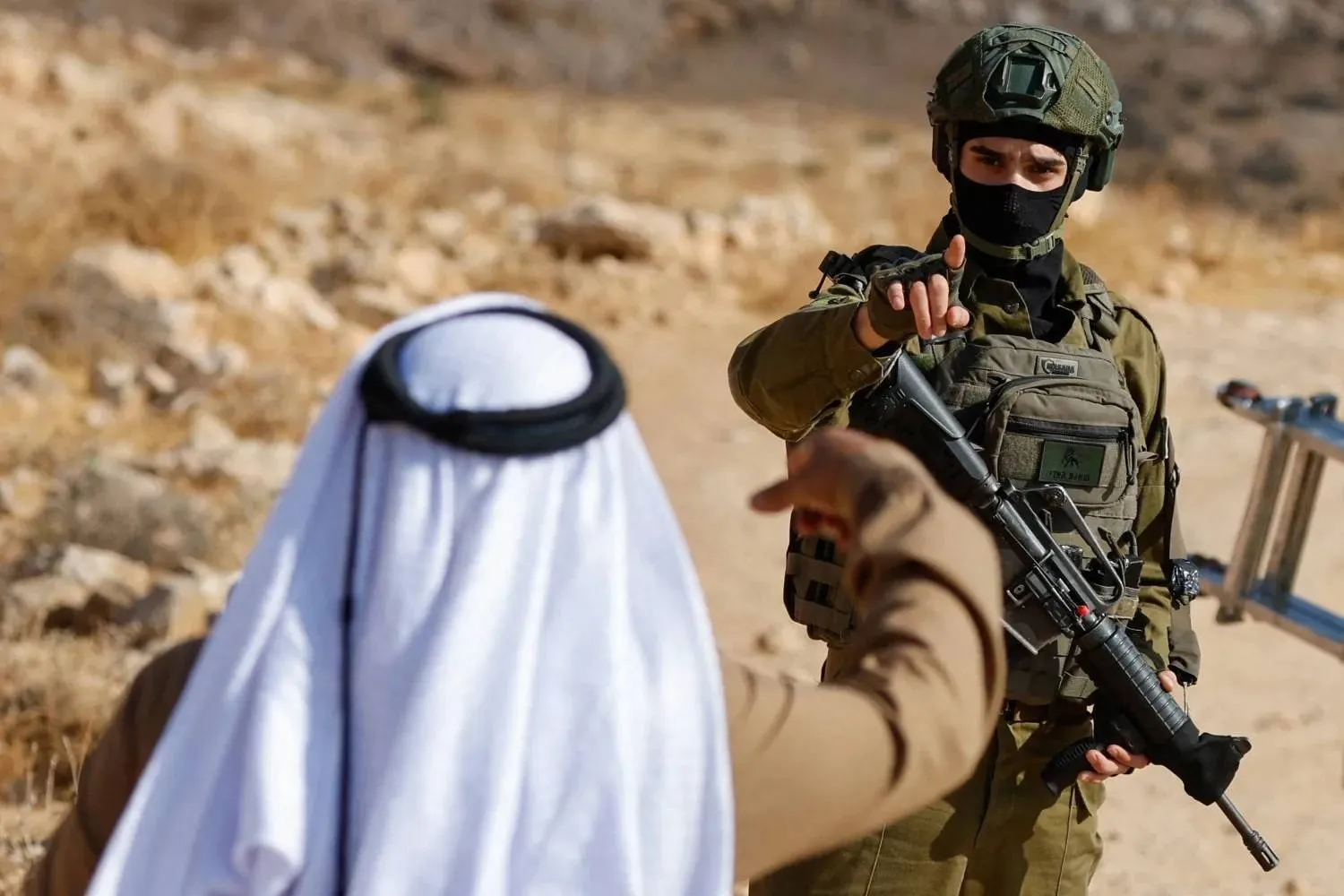
An Israeli soldier gestures toward a Palestinian while standing guard during the demolition of a Palestinian building near Hebron in the Israeli-occupied West Bank. (File photo/Reuters)
TT

Palestinians Await Announcement of Election Postponement

An Israeli soldier gestures toward a Palestinian while standing guard during the demolition of a Palestinian building near Hebron in the Israeli-occupied West Bank. (File photo/Reuters)

Palestinians are awaiting an official announcement by President Mahmoud Abbas postponing elections scheduled for Nov. 28, after his Fatah movement agreed on the delay with Palestinian factions, a move that came as little surprise.

An informed Palestinian source told Asharq Al-Awsat that a postponement had been expected from the moment Abbas issued the election decree.

“The decree came in response to external requests and pressure to renew political mandates and carry out reforms. No one here was ready for that, neither Fatah, Hamas nor the other factions were ready for elections,” the source said.

“Although everyone publicly supported holding these elections, everyone pushed to postpone them ... So far, no major faction has formed its electoral list and submitted it to the election commission.”

The source said the Palestine Liberation Organization’s Executive Committee, which meets on Saturday, was expected to recommend that Abbas postpone the elections to give national dialogue a chance, citing complex political and security conditions unsuitable for a vote at present.

It was unclear whether Abbas would set a new date or announce that the elections would take place in the final quarter of next year, as many sources expect.

Palestinian Vice President Hussein al-Sheikh has already informed France that the polls would be postponed for several months because of deteriorating conditions in the Palestinian territories, according to a letter seen by Reuters.

"The assessment concluded that the anticipated political, security and economic conditions, on which the scheduling of the legislative elections for 28 November 2026 was based, have not materialized," said the letter, which was addressed to French Foreign Minister Jean-Noel Barrot and dated October 8.

It added that "holding them under the current circumstances faces fundamental obstacles affecting their inclusiveness, freedom of participation and the integrity of the electoral process."

Palestinians have not held presidential elections since 2005 or legislative elections since 2006.

Those votes took place before Hamas seized control of the Gaza Strip and expelled forces loyal to Abbas, who had announced that legislative elections would take place in November as part of sweeping Palestinian Authority reforms he launched after Oct. 7, 2023.

These included reconstituting the Central Elections Commission, creating the posts of deputy chairman of the PLO Executive Committee and vice president of the State of Palestine, and forming a committee to draft an interim constitution for the transition from the PA to statehood.

The reforms also included appointing new heads of nearly all the security services, retiring hundreds of officers with the rank of brigadier general by presidential decree, and local elections in the West Bank and Gaza, followed by elections for Fatah’s leadership.

Despite these reforms, Palestinians remained skeptical that presidential and legislative elections would take place.

Sheikh’s letter confirmed that the elections would be postponed.

The letter said Palestinian officials had expected conditions to improve through the implementation of US President Donald Trump's peace initiative and a UN Security Council resolution, including the deployment of international forces and Palestinian police in Gaza, the disarmament of Hamas and the withdrawal of Israeli troops.

It said the Palestinians had ⁠also anticipated US efforts to prevent further annexation of Palestinian territory in the West Bank and East Jerusalem, curb settler violence and secure the release of nearly $7 billion in Palestinian funds withheld by Israel.

"However, these steps, understandings and promises have not materialized. Rather, conditions have worsened throughout the Palestinian territory," the letter said, outlining in detail security issues in Gaza and the West Bank.

Based on their assessment, Palestinian officials recommended to Abbas "that the date of the legislative elections be adjusted by several months, and that dialogue continue to prepare the internal conditions", the letter said.

It added that Abbas had been advised to issue a decree adjusting the date for holding elections to the first half of September 2027.

Fatah divisions and factional concerns

Beyond the reasons cited by Sheikh, other sources told Asharq Al-Awsat that divisions within Fatah were a major factor behind the move to postpone the elections.

The sources said there was no clear agreement with senior Fatah leader Marwan Barghouti, who had launched an initiative ahead of the elections to “unite Fatah, with all its blocs and currents.” There were concerns that he might push to form a separate electoral list.

Barghouti intends to run for president rather than the legislature, but his support for a list competing with Fatah’s official slate could reshape the contest.

Fatah also faced a challenge from the reformist faction led by former movement official Mohammed Dahlan, who had agreed with Hamas to form a joint electoral list that would include other factions. It was unclear whether he might later join Barghouti if the latter formed his own list.

Some disgruntled Fatah officials had also already begun forming their own lists.

Fatah wants to contest the elections on a single list, which will require more time and internal consultations.

An earlier attempt to reconcile with Dahlan’s faction also failed, despite regional efforts to resolve the dispute by bringing it back into Fatah or having it form a new Palestinian political party.

Hamas, meanwhile, had yet to make a final decision and needed a broad, strong alliance after pledging not to contest the elections under its own name or through its known leaders and members.

Hamas and Islamic Jihad also supported postponing the elections. Before the other factions, the Popular Front for the Liberation of Palestine had called for a delay to give national dialogue a chance.

“Everyone was pushing for a postponement. This is not just about the Palestinian Authority and Fatah,” the source said.

Palestinians cannot decide on elections alone; Israel also has a decisive say.

The Israeli government refused to allow the Palestinian Central Elections Commission to enter Gaza and Jerusalem to oversee election preparations.

An official Palestinian source told the official WAFA news agency on Tuesday that Israel’s refusal to allow the commission into Gaza and Jerusalem had created a direct obstacle to holding elections across all Palestinian territories.


Israel Accuses Hamas of Tightening its Grip on Gaza

Palestinians inspect the damage after an Israeli military operation in the Maghazi refugee camp in central Gaza on Thursday (dpa)
TT

Israel Accuses Hamas of Tightening its Grip on Gaza

Palestinians inspect the damage after an Israeli military operation in the Maghazi refugee camp in central Gaza on Thursday (dpa)

Israel pressed ahead with attacks across the Gaza Strip, killing and wounding more Palestinians as Israeli media reports accused Hamas of rebuilding its military strength, restoring its governing authority and planning fresh attacks.

Israeli troops unexpectedly moved to surround the densely populated Qasatna neighborhood in central Gaza's Maghazi refugee camp on Friday afternoon, bringing the area under fire after advancing into the nearby village of al-Masdar and southern parts of the camp.

The incursion was accompanied by heavy gunfire and extensive bulldozing.

At least seven Palestinians were wounded by artillery shelling, sniper fire and indiscriminate fire from Israeli military vehicles and drones. Some were critically injured, including a woman and her son after a shell struck their family's apartment.

Mass funeral for 70 people whose bodies were recovered by civil defense teams from beneath rubble across northern Gaza, November 14.

Israeli ground forces moved into the same areas that armed gangs had repeatedly infiltrated in recent days. Troops swept through neighborhoods, raided homes to check for possible Hamas ambushes and questioned residents before releasing them.

The ground operation coincided with a series of airstrikes.

Three Palestinians were wounded around midday when an Israeli strike hit a tent sheltering displaced people on Al-Ishrin Street in central Gaza's Nuseirat refugee camp.

Earlier, an airstrike targeted a field operative from the Al-Qassam Brigades, Hamas' armed wing, in the Sabra neighborhood of southern Gaza City. He was critically wounded, along with others walking along the street at the time.

Shortly after midnight on Thursday into Friday, an elderly Palestinian man was killed in a strike that directly targeted him in Nuseirat.

A field source told Asharq Al-Awsat that the victim, Diab Radi, owned a currency exchange business that had previously been bombed. His son was also killed in an airstrike more than a year ago.

Sources could not establish whether Radi had links to Hamas. Israel has recently pursued money changers and traders it accuses of working for the group and transferring millions of dollars to it from abroad.

Around the same time, another airstrike targeted two Palestinians walking through the Daraj neighborhood in eastern Gaza City, wounding them and several others, one seriously.

A second field source said the strike targeted an Al-Qassam Brigades field operative.

Israeli forces also carried out large-scale demolitions overnight and throughout Friday, while drones dropped booby-trapped boxes across several parts of the enclave.

On Thursday evening, an Al-Qassam Brigades operative was killed in a strike on a tent near the Saraya area in central Gaza City.

Two other Palestinians were killed by gunfire and artillery shelling in the Zeitoun neighborhood in southeastern Gaza City.

Israeli Media Spotlight Hamas' Resurgence

The intensifying attacks have been accompanied by a sharp escalation in Israeli media coverage, with reports alleging that Hamas is rebuilding its strength and tightening its grip on areas beyond Israeli military control.

Israeli forces currently control more than 65% of the Gaza Strip.

Israel's Yedioth Ahronoth newspaper reported on Friday that Hamas was systematically working to restore its rule and expand its influence across the enclave.

The newspaper said the developments challenged the Israeli security establishment's portrayal of a movement crippled by military blows, suggesting that Hamas remained far from collapse despite suffering heavy losses.

Figures cited by the newspaper showed Hamas had restored operations at 22 of Gaza's 25 municipalities, while all 17 government ministries had resumed work.

The group retains 50,000 government employees and 30,000 members serving in the Al-Qassam Brigades, the newspaper said, adding that Hamas was recruiting new members.

The report also described efforts by Hamas to regain control of Gaza's economy.

It said the group had established a special financial committee to collect taxes retroactively from merchants and business owners, including for the war years.

Hamas-affiliated security agencies were summoning traders and companies involved in bringing goods into Gaza and demanding hefty payments for their activities, the newspaper alleged.

It also said Hamas was pushing businesses to use cash payments as part of a broader effort to reclaim control over private economic activity and secure revenue to sustain its operations.

The newspaper published several other allegations against Hamas, including claims involving hospitals. The group has repeatedly denied such accusations, including those concerning tax collection.

Yedioth Ahronoth described the overall picture as complex.

On one hand, it said, Hamas had suffered devastating losses during three years of war. Its infrastructure had been destroyed, its pre-October 7, 2023, military structure almost completely dismantled, and Gaza left facing widespread destruction.

Yet Hamas was simultaneously reviving municipalities, government ministries, security agencies and economic institutions, while recruiting new members and seeking to preserve its influence over the population, the newspaper said.

Hamas in 2026 was no longer the organization it had been before October 7, the report added, but the figures showed it remained far from collapse.

Without an effective alternative government in Gaza, Hamas would continue to fill the vacuum, rebuild its control and seek to turn its military and organizational survival into a path back to power, the newspaper said.

Meanwhile, Israel's Channel 12 reported that Hamas was renovating tunnels and installing cameras near the "Yellow Line" to confront Israeli troops operating in the area and launch attacks.

"We are also destroying tunnels, both inside and outside the Yellow Line, and working to eliminate militants at all levels to weaken Hamas," a senior officer in Israel's Southern Command said.

Senior Israeli officers voiced frustration over the current security situation, saying it had failed to produce a decisive outcome against Hamas.

They stressed the need for a decision that would prevent the group from exploiting the period of tension to rebuild its capabilities.

Hamas has repeatedly rejected such Israeli media reports, accusing Prime Minister Benjamin Netanyahu's government of obstructing ceasefire agreements.

The group maintains that it remains committed to all agreed terms, including arrangements concerning weapons, provided Israel fulfills its own obligations.


Arab Lawmakers Receive Death Threats as Racist Incitement Escalates in Israel

Arab citizens demonstrate in Israel against rising crime in Arab towns (File photo: AFP)
TT

Arab Lawmakers Receive Death Threats as Racist Incitement Escalates in Israel

Arab citizens demonstrate in Israel against rising crime in Arab towns (File photo: AFP)

Arab political leaders in Israel have received death threats by text message and on social media amid a campaign led by Prime Minister Benjamin Netanyahu and his allies to discredit Arab parties and brand their lawmakers "supporters of terrorism."

Netanyahu, along with several ministers, lawmakers and pro-government media figures, has spearheaded the campaign, which Arab leaders say is fueling a wave of attacks by racist right-wing militias.

Recent incidents include the torching of a mosque in the village of al-Dahi, near Nazareth, a car-ramming attack in Kafr Qasim, a march to "impose Jewish sovereignty" over the Arab city of Lod, and "Death to Arabs" graffiti scrawled on walls in an Arab neighborhood of Karmiel.

Arab political leaders warned of a dangerous deterioration in the safety and security of Arab citizens in Israel. They accused the government of retaliating against a community whose political influence has weakened its grip on power and could potentially bring it down.

Fearing further escalation and potentially disastrous consequences, the secretariat of the High Follow-Up Committee for Arab Citizens of Israel convened an emergency meeting in Lod on Thursday evening.

"We are going through difficult times. The threats we face are serious and growing by the day," committee chairman Jamal Zahalka told the meeting.

"We hold the Israeli government, particularly its prime minister and chief instigator, Benjamin Netanyahu, fully responsible for the racist incitement that is turning into acts of terrorism, as we have seen in Lod, Kafr Qasim and al-Dahi."

Zahalka also blamed the government for a surge in crime across Arab communities, where he said killings had become a daily occurrence, citing recent cases in Kafr Manda, Arara and elsewhere.

He said the threats went beyond violence and incitement to include the targeting of Arab residents in the Negev, home demolitions and land confiscation plans.

"We are a community facing serious and escalating threats that meet all internationally recognized criteria for a 'community at risk,'" he said, calling for international intervention to confront what he described as the tyranny of Israel's ruling establishment and its "terrorist militias."

The committee agreed to seek talks with foreign embassies to brief diplomats on the plight of what it called a "community at risk" and urge them to pressure the Israeli government to reverse its "disastrous policies."

It also agreed to prepare three briefing papers covering racist incitement and attacks, crime and violence, and the situation in the Negev.

The committee strongly condemned the campaign of incitement as "fascist and racist," saying it had targeted every Arab political party and leader, as well as the wider Arab community.

Early Thursday, unidentified assailants entered al-Dahi, a hilltop village in the Jezreel Valley near Nazareth, set fire to its mosque and scrawled anti-Arab slogans in Hebrew at the site.

In Kafr Qasim, eight people, including three women, suffered injuries of varying severity on Wednesday evening when a Jewish settler drove into pedestrians at three separate locations.

The driver arrived near a wedding hall before striking people along the streets, according to the account.

The municipality and the local popular committee called the incident a "terrorist attack" and warned against what they described as police claims that the driver had been under the influence of drugs.

"Kafr Qasim witnessed a serious incident, a car-ramming attack at three locations that injured four residents," Mayor Haitham Taha said in a video released by the municipality.

"One is in serious condition, two suffered moderate injuries and one sustained minor injuries. This is the result of incitement against the Arab community in this country and against Arab lawmakers."

In Lod, about 20 settlers from outside the city marched down its main street earlier in the week, waving Israeli flags and chanting demands for the imposition of state sovereignty.

Some hurled stones and shouted racist insults at Arab residents, sparking clashes and tensions in several areas and leaving people injured.

Israeli police said they arrested 11 suspects, including minors and a woman, as local officers and Border Police moved to disperse crowds and restore order.

In the Negev, lawmaker Hassan al-Nasasra of the National Democratic Assembly (Balad), part of the Joint List, confronted police officers over their alleged assault and violent, humiliating arrest of a young man.

"These practices are not isolated incidents but part of the broader approach police take toward Arab citizens," al-Nasasra said.

"They reflect a policy of repression and intimidation that has intensified under the fascist minister Itamar Ben-Gvir, who has provided political cover for such conduct."


Sanaa's GPC Faces Test of Military Loyalty to Houthis

A scene from an event organized by the Houthi-aligned wing of the General People's Congress in Sanaa (Facebook)
TT

Sanaa's GPC Faces Test of Military Loyalty to Houthis

A scene from an event organized by the Houthi-aligned wing of the General People's Congress in Sanaa (Facebook)

The Houthis have intensified pressure on their political allies in Sanaa, demanding that the local wing of the General People's Congress (GPC) supply hundreds of party members for military training and pay to arm and equip them for deployment to the front lines.

The move is aimed at replenishing the group's depleted ranks amid mounting manpower losses while forcing its political partners to shoulder part of the war's costs.

GPC sources in Sanaa told Asharq Al-Awsat that officials from the Houthis' so-called political bureau visited Sadeq Abu Ras, head of the party's Sanaa wing, at his home several days ago.

Senior party figures, including Abdulaziz bin Habtoor, Yahya al-Rai and Khaled al-Sharif, attended the meeting, during which the Houthi officials demanded concrete action in response to the military escalation, rather than political statements and symbolic activities.

The demands come amid growing tensions between the Houthis and the GPC leadership over what the group considers a failure to participate in military mobilization and recruitment drives, a refusal to send party members to the front lines and a reluctance to provide financial and material support for what it calls the "war effort."

According to the sources, the Houthis ordered GPC leaders to draw up lists of hundreds of members and party officials from Sanaa, its surrounding countryside and other Houthi-controlled provinces for immediate enrollment in open-ended combat training courses.

The recruits would undergo military training and receive weapons before being dispatched to the front lines.

But the Houthis want more than fighters. They have also demanded that GPC leaders finance recruitment, training, weapons and supplies, while Houthi supervisors would control the training programs and decide where the recruits would be deployed.

Houthi leader steps up pressure

Party sources said the Houthis justified their demands by citing leader Abdul Malik al-Houthi's continued dissatisfaction with the GPC leadership's response to battlefield developments and the group's mounting losses.

The message, according to the sources, was that political backing alone was no longer enough. The Houthis wanted direct participation in combat and a commitment to sharing the financial burden of the war.

The demands came with stern warnings and accusations that GPC leaders and members were loyal to Yemen's internationally recognized government and the coalition supporting it.

They were also accused of evading demands to send party members to the front lines and withholding financial and material contributions to the war.

The mounting pressure reflects the scale of the Houthis' manpower and military losses on the fronts in Taiz, Lahj, Marib, al-Dhalea and al-Jawf, the sources said.

Those losses have driven the group to seek fresh recruits and funding, even from political parties and forces under its own control.

Fears of forced recruitment

The demands have alarmed members of the GPC's Sanaa wing, who fear the recruitment lists could be used to single out party members and force them into military training before sending them to fight battles in which they have no stake.

Some party members oppose joining Houthi mobilization programs, describing them as another attempt to subjugate the remaining political parties in areas under the group's control.

They say the Houthis are seeking to curb the parties' political role and turn their activities into platforms for promoting the group's military and sectarian agenda.

Mahmoud, a GPC activist, told Asharq Al-Awsat that the latest recruitment drive followed a wave of media attacks and accusations of disloyalty against party leaders and members in Sanaa.

He said Houthi-aligned activists and media outlets carried out the attacks at the behest of senior Houthi figures to pave the way for further pressure on the party.

The campaign, he added, was part of a broader policy aimed at bringing political parties to heel, stripping them of their independence and turning their members into instruments of the Houthis' military project.

The GPC's Sanaa leadership has faced years of pressure and harassment aimed at forcing it to comply with Houthi decisions and initiatives and provide political cover for the group's actions.

The party's room for independent political action has steadily narrowed as its leadership has become increasingly subject to Houthi dictates.

The Houthis previously pressured GPC leaders in Sanaa to reverse a decision to suspend their participation in the group's internationally unrecognized government and withdraw objections to the so-called "Code of Professional Conduct."

They also forced decisions to remove Ahmed Ali Abdullah Saleh, son of Yemen's late president, from his position as GPC deputy chairman, and imposed restrictions on national holiday celebrations and events marking the anniversary of the party's founding.