

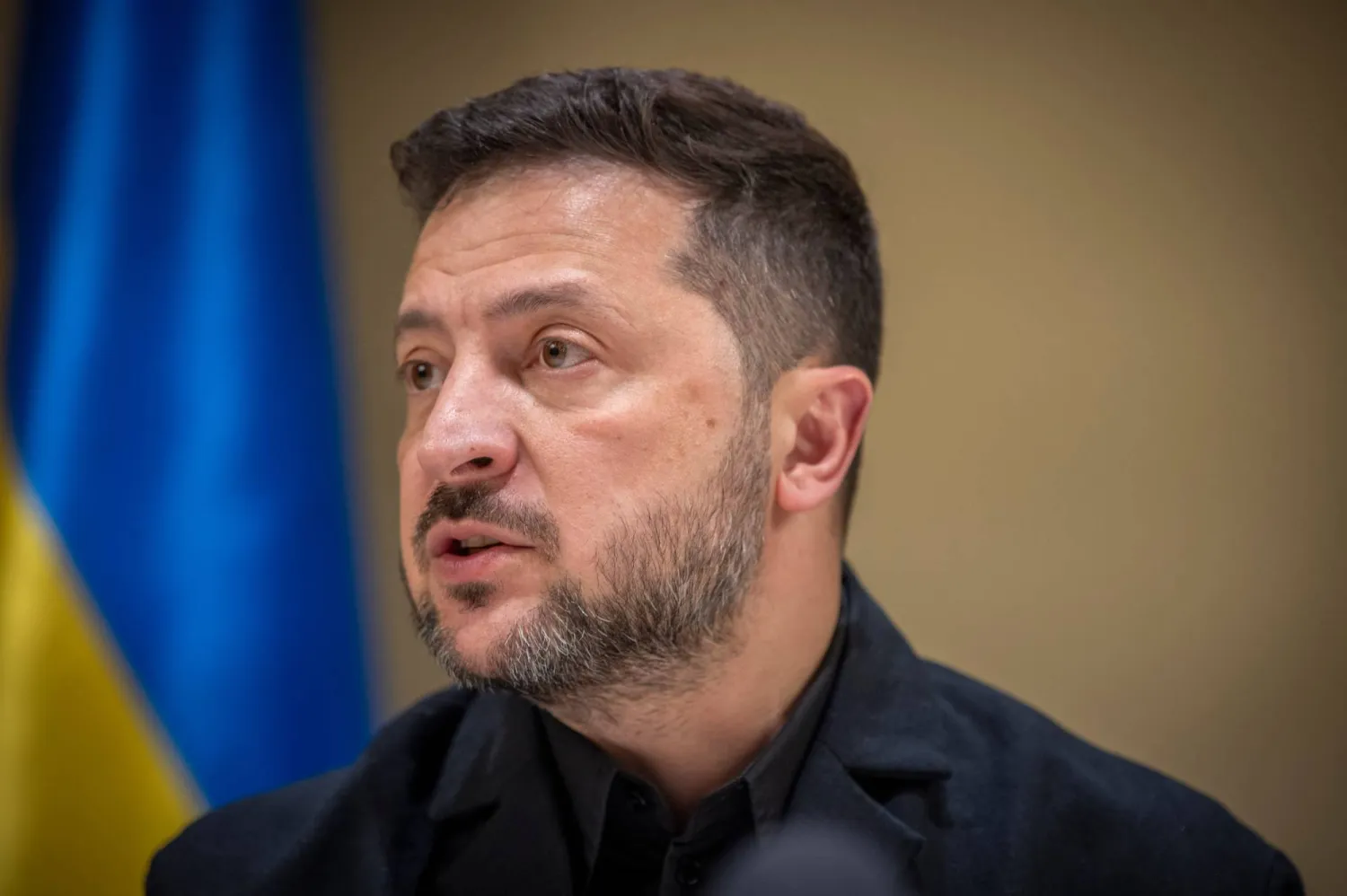

Zelenskyy Says Russia Strikes Energy Facilities despite Trump Claim of an Energy Ceasefire

Ukrainian President Volodymyr Zelenskyy speaks to the media after a German-Ukrainian business forum in Kyiv, Ukraine, Sunday, Oct. 4, 2026. (AP Photo/Dan Bashakov)
TT

Zelenskyy Says Russia Strikes Energy Facilities despite Trump Claim of an Energy Ceasefire

Ukrainian President Volodymyr Zelenskyy speaks to the media after a German-Ukrainian business forum in Kyiv, Ukraine, Sunday, Oct. 4, 2026. (AP Photo/Dan Bashakov)

Ukrainian President Volodymyr Zelenskyy said Monday that Russia has continued to strike Ukraine's energy facilities even after US President Donald Trump said a day earlier that the warring countries had agreed on an energy ceasefire in the 4 1/2-year-old war.

Speaking at the Warsaw Security Forum in Poland, Zelenskyy said Ukraine had learned through media reports that Trump had secured an energy ceasefire deal with Russia which would involve a mutual pause in strikes on energy sites. Zelenskyy said he would be willing to honor such an agreement, if Moscow did the same.

“We support it, but I have not heard approval of this proposal from the Russian side,” Zelenskyy said.

Trump’s brief social media post on Sunday claiming the purported agreement offered few details but said that the energy ceasefire took effect immediately, adding: “Do not break it!”

Yet Zelenskyy said Ukraine had been “horribly surprised" that following Trump's "sudden but very important post,” Russia had struck numerous energy facilities including a power plant in the northeastern city of Kharkiv, as well as a gas production facility and a civilian gas station.

“It was clear that (Russian President Vladimir) Putin does not read Truth Social,” Zelenskyy said, referring to Trump's social media platform.

Energy strikes have caused pain for both Ukraine and Russia Trump previously announced a similar agreement on ceasing energy strikes that did not come to fruition. In a social media post on Sept. 14, he said both countries had agreed “not to hit” each other’s energy infrastructure, but offered no details on that proposal either.

Russia has used attacks on energy facilities in order to deny Ukrainian civilians power, heat and running water during the war, hoping to wear down public resistance to Moscow’s full-scale invasion. Ukrainian officials describe the strategy as “weaponizing winter," and fear Russia could ramp up such attacks as cold weather approaches.

Ukraine, meanwhile, has launched strikes against Russian energy sites like oil refineries, sometimes deep within Russian territory, prompting Trump to blame Zelenskyy for high diesel prices on world markets. On Friday, Trump struck a deal with Putin to import Russian diesel in an attempt to address high fuel prices just weeks ahead of US midterm elections.

On Monday, Zelenskyy said Kyiv was ready to comply with Trump's requests to stop striking Russian refineries if Moscow halted attacks on Ukraine’s energy system, and asked Trump to press the Kremlin to agree. He added that if Moscow does not agree to an energy ceasefire this winter, “we will respond.”

“We are waiting for the details of the conversation between the Americans and the Russians, and we are waiting to see what specific steps the Americans are ready to take," he said. “This energy ceasefire can work, and it can become a major step toward ending the war.”

EU foreign policy chief skeptical of energy ceasefire

The European Union’s top diplomat on Monday welcomed the prospect of a pause in energy strikes in Ukraine, but said she sees no sign that Russia would be willing to respect it.

“We haven’t yet seen that also Russia will stick to it,” EU foreign policy chief Kaja Kallas said at a meeting of the bloc's foreign ministers in Luxembourg. “Personally, I would also welcome that the ceasefire would include people not being killed, not only energy.”

Trump's deal with Putin to purchase diesel from Russia dismayed officials in the US, Ukraine and around Europe. A bipartisan group of six senators, including four Republicans, called on the Trump administration on Sunday to “immediately reverse course” on the deal, saying the US should “not provide Putin with a financial lifeline” while Russia is killing Ukrainian civilians.

Estonian Foreign Minister Margus Tsahkna told reporters in Luxembourg on Monday that he doesn’t believe the deal would meaningfully affect fuel prices, and that it is ”much more connected to the domestic situation in the US."

Kallas also pushed back on Trump's comments on Saturday that it was time for Ukraine to get a new president and that Zelenskyy has not done enough to end the war. She said that now is not the time to hold elections in Ukraine, at least not without a ceasefire.

On Monday, Zelenskyy said holding elections in Ukraine was impossible during war time, especially with new Russian tactics involving attacks during both the day and night. He added, however, that he would be ready to work towards doing so if Ukraine secured a full ceasefire lasting at least 60 days.

Russian attack kills 3 and injures others, including children Two people were injured in Russian daytime strikes on Kyiv on Monday, according to the city's military administration, while falling debris from Russian attacks sparked a fire in a private residential building in the capital's Darnytskyi district.

Debris also fell in an open area near private residential buildings in the Solomianskyi district, and on a warehouse building in the Darnytskyi district, with emergency services dispatched to the scene.

A Russian drone attack on the village of Pisochyn in the Kharkiv district on Sunday evening killed three people and injured nine others, including children, according to the Kharkiv Regional Prosecutor’s Office. Investigators said the attack struck a densely populated area near apartment buildings and grocery stores and sparking a fire.

Ukrainian air defense forces shot down or suppressed 89 of 121 Russian drones overnight Monday, Ukraine’s Air Force said in a Telegram post. The attack involved one Kh-59 guided air-to-surface missile and 121 drones, including 76 jet-powered Shahed-type drones, the statement said.

Strikes were recorded at 15 locations in Ukraine, while debris from downed drones fell at four locations.

The Russian Defense Ministry on Monday said its air defenses overnight intercepted 151 Ukrainian drones over Russian regions as well as the illegally annexed Crimea and the waters of the Black Sea. 

In a separate statement, the ministry said its forces overnight carried out drone strikes on Ukraine’s unspecified port infrastructure and a bulk carrier heading to Ukraine's port city of Odesa with military cargo on board. 


Eisenkot Backs Netanyahu Opponents: No Urgent Need to Attack Iran Now

Former military chief Gadi Eisenkot, leader of the Yashar party arrives to speak at the Knesset, Israel's parliament in Jerusalem, November 23, 2026. REUTERS/Ronen Zvulun
TT

Eisenkot Backs Netanyahu Opponents: No Urgent Need to Attack Iran Now

Former military chief Gadi Eisenkot, leader of the Yashar party arrives to speak at the Knesset, Israel's parliament in Jerusalem, November 23, 2026. REUTERS/Ronen Zvulun

Israeli military and security chiefs, who believe a third war with Iran is only a matter of time, have gained support from Gadi Eisenkot, leader of the Yashar party and the politician tasked with forming Israel's next government, as well as senior figures in his political camp.

Their backing has strengthened the security establishment's position against outgoing caretaker Prime Minister Benjamin Netanyahu, with Eisenkot arguing that another war with Iran is not an urgent necessity.

The disagreement over Iran spilled into the media after Netanyahu and Eisenkot clashed over a potential strike against Tehran.

Netanyahu accused his political rival of downplaying the security threats facing Israel for political reasons after Eisenkot openly questioned whether Iran posed an immediate threat.

Netanyahu

Speaking at a Likud faction meeting in the Knesset, Netanyahu said: "Our ability to ensure the existence of the state in the face of the major threats surrounding us depends on our unity. Anyone who mocks or downplays these threats is doing so for political reasons."

His remarks came amid reports that he is pushing to resume military operations against Iran, a move opposed by military and security officials who believe he wants to trigger a confrontation to delay the formation of a new government.

Eisenkot

Eisenkot openly backed military and security leaders, telling a meeting of his Yashar faction that he saw no immediate Iranian threat requiring military action before the new government is sworn in.

He argued that rather than conducting further military operations, Israel should focus on Iran's stockpile of enriched uranium.

"The gravest threat from Iran is the 440 kilograms of enriched uranium that have still not been destroyed or removed. We must focus on that," he said.

The dispute between Netanyahu and Eisenkot reflects part of the broader political and security debate in Israel.

Israeli public broadcaster Kan reported that while Netanyahu is pushing for war with Iran, the security establishment believes alternatives remain available.

These include the possibility of reaching an agreement, maintaining the blockade and economic pressure, or undertaking military action in coordination with the United States.

An informed source told Kan that US President Donald Trump is not inclined to make such a decision at present, as Iran's economic difficulties have strengthened the position of those advocating continued economic pressure rather than war.

A second reason Trump and others oppose an immediate war is the assessment that another strike would not bring down the government in Tehran.

Beyond Eisenkot, other figures in Israel's pro-change political camp have criticized Netanyahu and warned against taking the country into another war, particularly with Iran.

Lieberman

The Maariv newspaper quoted Yisrael Beytenu leader Avigdor Lieberman as saying during a closed meeting of the Knesset Foreign Affairs and Defense Committee's intelligence subcommittee, attended by military Chief of Staff Eyal Zamir and Knesset Speaker Matan Kahana, that any war against Iran at this stage would be driven by political and personal considerations.

"Reports have emerged that Iran is seeking to acquire chemical weapons. If true, this constitutes a serious threat, but it neither requires nor justifies immediate unilateral action without American involvement," Lieberman said.

"The concern is that Netanyahu may see an attack on Iran as his last political way out. If he decides to attack Iran alone, without cooperation with the United States, that would clearly be an illegal act," he added.

Golan

Yair Golan, leader of the left-wing Democrats party, also joined those accusing Netanyahu of attempting to drag Israel into another war with Iran for political reasons.

Netanyahu's position is based on alleged developments in Iran's chemical weapons program, which Mossad chief Roman Gofman reportedly presented to American officials during a visit to Washington approximately two weeks ago.

Eisenkot and military commanders, however, believe the current Iranian threat does not warrant immediate action.

Mossad

Divisions over Iran have also emerged within Mossad.

According to Haaretz, researchers within the intelligence agency concluded during recent discussions that there was no immediate need for military action against Iran.

Their assessment contrasts with the position of Mossad chief Roman Gofman, Netanyahu's former military secretary, who is reportedly advocating renewed strikes against the Islamic Republic.

Military Experts

Experts in Israel estimate that it could take Iran two years or more to develop a system capable of delivering chemical weapons to Israel.

Writing in Maariv on Tuesday, military commentator Avi Ashkenazi said the Israeli military remains on high alert, both defensively and in its preparations for potential offensive operations.

According to Ashkenazi, the military believes it could be called upon to launch an offensive under one of three scenarios.

The first would involve Iran initiating military action. The second would see Trump ordering the start of a military campaign in the near future. The third, considered the least realistic, would involve Israel launching a military campaign on its own.

"At present, there is a consensus within the Israeli military and security establishment that there is no urgent need to enter into a confrontation with Iran alone," Ashkenazi wrote.

He added that a confrontation would eventually come, as Israel would have to undertake military action to inflict cumulative damage capable of destabilizing the Iranian government, setting back its offensive capabilities and weakening it militarily, economically and politically.

He emphasized that Israel would prefer to enter such a confrontation alongside the Americans.

Ashkenazi also argued that Trump is in no hurry to act because the blockade and sanctions are producing results.

With winter approaching and Iran facing an energy crisis, the situation is likely to become increasingly complicated, he said.

"The paradox is that the party most eager for war to break out at this stage is the Iranian regime itself, which sees war as a dual opportunity to remove the noose from around its neck," Ashkenazi concluded.


Iran Insists No Talks with the US Until Its Conditions Are Met

 Vessels at the Strait of Hormuz, as seen from Musandam, Oman, November 23, 2026. (Reuters)
Vessels at the Strait of Hormuz, as seen from Musandam, Oman, November 23, 2026. (Reuters)
TT

Iran Insists No Talks with the US Until Its Conditions Are Met

 Vessels at the Strait of Hormuz, as seen from Musandam, Oman, November 23, 2026. (Reuters)
Vessels at the Strait of Hormuz, as seen from Musandam, Oman, November 23, 2026. (Reuters)

Iran repeated Tuesday that there'll be no talks with the United States to end the conflict unless several conditions are met.

Iran’s chief negotiator and parliament speaker Mohammad Bagher Qalibaf said Tehran wouldn't negotiate with the US "until Iran’s seven conditions are met,” according to Iranian state television.

Iranian authorities haven't publicly stated what those conditions are. But Iranian state media have said they include the lifting of sanctions, the ending of the US naval blockade of Iranian ports and the release of seized Iranian assets.

He also warned that Iran would “shift the geographical scope of the conflict should the enemy make a mistake.”

Meanwhile, the naval arm of Iran’s Revolutionary Guard said the three oil tankers struck the naval mines because they were “in violation of regulations” regarding passage through the Strait of Hormuz.

The Guard’s navy said in a post on Telegram Monday that the strait “is not a place to test unauthorized routes or to disregard maritime warnings.”

It said the tankers were “engulfed in flames” after hitting the mines despite being under US aerial escort.


Iran Currency Plunges After Fresh US Sanctions

Iranians shop at a street market in Tehran, Iran, 23 November 2026, as the country faces an economic crisis amid ongoing US-Iran tensions. (EPA)
TT

Iran Currency Plunges After Fresh US Sanctions

Iranians shop at a street market in Tehran, Iran, 23 November 2026, as the country faces an economic crisis amid ongoing US-Iran tensions. (EPA)

Iran's currency plunged on the black market on Tuesday after Washington announced fresh sanctions, which the central bank governor said targeted a regular platform for registering transactions.

The US Treasury announced sanctions on Monday against more than two dozen Iranian exchange houses, alleged front companies and individuals said to be part of the country's "shadow banking" network. It said the network was "overseen" by the central bank.

By Tuesday afternoon, the US dollar was trading at around 2.82 million rials, up about five percent from around 2.68 million the day before, according to websites monitoring black market rates.

The euro also rose to around 3.07 million rials, up from 2.94 million on Monday, the websites said. Iranians use black market rates as the central bank rate is usually much lower.

Central Bank governor Abdolnaser Hemmati dismissed the sanctions, saying the US appeared to have "run out of targets" and had resorted to targeting a legitimate platform.

The sanctioned Iran Currency and Gold Exchange center "is merely a platform for registering transactions" and "is there for everyone to see," said Hemmati, according to Tasnim news agency.

The US Treasury's Office of Foreign Assets Control (OFAC) said it connects exporters earning foreign currency from overseas sales with importers seeking foreign currency to buy goods, facilitating tens of billions of dollars in trade annually.

"While Iran's shadow banking system moves the funds generated by Iran's international trade, the Iran Center for Exchange plays matchmaker and guides these funds to their ultimate destination inside Iran," OFAC said.

The latest sanctions were announced nearly nine months into the Middle East war, which broke out on February 28 when US-Israeli strikes killed Iran's supreme leader Ali Khamenei.

The conflict expanded after Iran retaliated with missile and drone strikes across the region, while armed groups it backs in Lebanon, Yemen and Iraq also entered the fray.

Washington has ramped up sanctions since August as part of an "economic asphyxiation" campaign, and launched a task force to disrupt land routes into Iran.

It has also maintained a naval blockade on Iranian ports to choke off the country's oil revenue in retaliation for Iran's effective blockade of the Strait of Hormuz, a vital global energy conduit.
