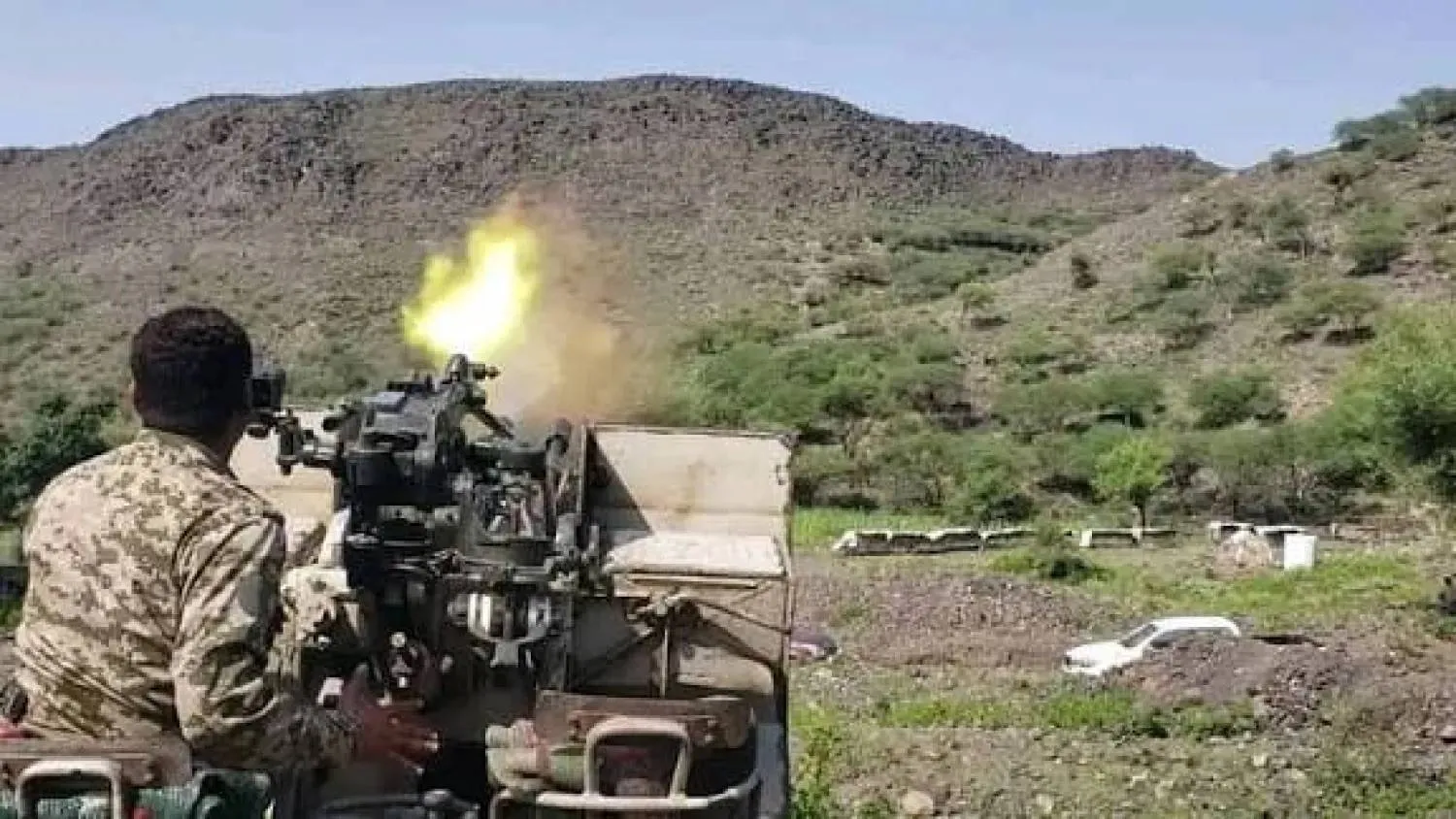
Yemeni Forces Repel Fierce Houthi Attacks on Taiz Fronts

Yemeni government forces repel intensified Houthi attacks on the Taiz fronts (Military Media)
TT

Yemeni Forces Repel Fierce Houthi Attacks on Taiz Fronts

Yemeni government forces repel intensified Houthi attacks on the Taiz fronts (Military Media)

Yemeni government forces and Popular Resistance fighters battled intensified Houthi attacks across Taiz province on Tuesday as Operation Dawn of Yemen entered its ninth day, with airstrikes targeting the group’s positions and reinforcements.

Fighting also extended to Marib and Al-Jawf, while the Southern Giants Brigades deployed reinforcements to the Al-Mudaraba front in Lahj province to counter Houthi movements threatening Al-Subaiha tribal areas.

The deployment came amid concerns that the Houthis were attempting to open an alternative route toward the western coast and break the encirclement of their fighters near the strategic Bab al-Mandab strait.

Yemen’s armed forces announced 1,879 military targeting operations in recent hours, claiming that preliminary assessments showed around 950 Houthi fighters had been neutralized and 380 military vehicles and pieces of equipment destroyed or disabled.

Armed forces spokesman Col. Majed al-Nuzaili said the operations involved warplanes, drones, artillery, rocket launchers and sniper units.

Targets included fortifications, defensive positions, command-and-control centers, artillery and rocket-launcher emplacements, observation posts, troop concentrations, weapons depots and supply vehicles.

Nuzaili added that airstrikes in Taiz had hit Houthi reinforcements and convoys, dispersing fighters and disrupting efforts to reinforce positions and regroup.

Fierce fighting around Taiz

Clashes were concentrated on the Al-Dhabab front west of Taiz city and the al-Aqroudh and al-Shaqab fronts in the province’s south.

Government forces reported repelling Houthi attacks in Al-Dhabab and al-Aqroudh, forcing the attackers to retreat after suffering casualties and losing military vehicles.

Warplanes also struck Houthi positions and concentrations across the province, including Al-Dhabab and al-Misrakh.

The Taiz Military Axis Command reported additional strikes on positions in Milat, Tabbat al-Khalwa, al-Tabba al-Sawda and Tabbat al-Karba, west of the city. Government military statements said the strikes damaged vehicles and weapons, including a tank and artillery pieces, and killed or wounded Houthi fighters.

Clashes continued in Al-Dhabab, where government troops carried out ambushes targeting Houthi fighters, vehicles and military equipment.

The simultaneous attacks on the western and southern fronts underscored mounting pressure on government forces, which, backed by Popular Resistance fighters and air support, sought to prevent Houthi breakthroughs and the establishment of new positions.

Reinforcements sent to Al-Subaiha

On the western coastal front, the Southern Giants Brigades reinforced their deployment in Al-Mudaraba district of Lahj province, which borders al-Wazi’iyah district in western Taiz.

The reinforcements were intended to counter possible Houthi advances toward Al-Subaiha tribal areas.

Airstrikes targeted Houthi positions, troop concentrations and vehicles in al-Wazi’iyah and Al-Mudaraba as fighting intensified following a Houthi attack on government positions Monday evening, according to military sources. The front is strategically important because it connects Lahj with areas along the western coast.

Houthi movements there are viewed as a possible attempt to establish an alternative route toward the coast and relieve pressure on fighters surrounded near Bab al-Mandab. Government reinforcements aim to block advances through Al-Subaiha territory and secure routes linking the coastal fronts.

Operations expand to Marib and Al-Jawf

In Marib, government forces targeted Houthi positions and troop concentrations with artillery and drones, while airstrikes hit reinforcements and fortifications on several fronts.

Military statements said troops from the Third Military Region attacked Houthi positions on the southern fronts, inflicting casualties.

Fighting also continued in areas under the Seventh Military Region’s command in northern Marib.

Warplanes struck Houthi reinforcements and defensive positions on Marib’s southern and northwestern fronts.

Further airstrikes targeted Houthi positions and troop concentrations east of Al-Hazm district in Al-Jawf province, extending the campaign across multiple fronts.

Alongside the fighting, the armed forces said military engineering units were continuing to clear recaptured positions and areas of landmines and explosive devices to secure them for troops and prepare for the return of civilians.


French Judges Probe War Crimes Complaint against Israeli Army in Lebanon

File: Israeli heavy machinery bulldozes houses in Mansouri, as seen from Hinniyeh, Southern Lebanon, September 19, 2026. (Reuters)
TT

French Judges Probe War Crimes Complaint against Israeli Army in Lebanon

File: Israeli heavy machinery bulldozes houses in Mansouri, as seen from Hinniyeh, Southern Lebanon, September 19, 2026. (Reuters)

France has opened a judicial investigation into a war crimes complaint over an Israeli strike on a residential building in Lebanon, a lawyer told AFP on Tuesday.

French-Lebanese artist Ali Cherri, whose parents were killed in the Beirut strike in 2024, filed the complaint as a civil party this year with the International Federation for Human Rights, Cherri's lawyer Clemence Bectarte explained.

The crimes against humanity unit of the Paris Judicial Court has appointed two investigating judges to the case, she added, hailing the move as "a first".

Lebanese militant group Hezbollah, an ally of Palestinian militants Hamas, opened a front against neighboring Israel at the start of the Gaza war after Hamas attacked Israel on October 7, 2023.

The hostilities, which escalated into open war in September 2024, have left more than 4,000 dead in Lebanon and forced more than a million people to flee.

Seven civilians, including Cherri's father and mother, aged 87 and 77, were killed in the bombing of their 12-storey apartment building in central Beirut on November 26, 2024, according to the complaint seen by AFP. Three floors were destroyed.

The strike occurred "just a few hours before the ceasefire agreement between Israel and Hezbollah came into effect," the complaint stated, citing detailed research by Amnesty International and Forensic Architecture into the incident.

AFP has reached out to the Israeli military for comment.

Cherri told AFP he had taken legal action "for the dignity of all civilian victims".

"For nearly two years, I have been fighting... to ensure that the Israeli bombing that killed my parents and five other civilians does not go unpunished," he said.

"What happened to my parents is not an isolated case... I hope this investigation will help break the impunity enjoyed by Israeli officials responsible for attacks against civilians in Lebanon and Palestine," he added.

- Several investigations underway -

While the judicial investigation marks a first over alleged war crimes by Israeli forces in Lebanon, other cases are pending.

French-Lebanese man Mohamad H., represented by lawyer Emmanuel Daoud, has sought action after losing his mother, sister, and two nephews in strikes on the southern city of Tyre during the night of April 16-17.

In another case, a French entrepreneur born in Lebanon has accused the Israeli army of uprooting 600-century-old olive trees belonging to his family in a village in southern Lebanon.

France's National Anti-Terrorism Prosecutor's Office (PNAT), which handles war crimes, has opened an investigation into allegations of torture and war crimes related to the Israeli forces' interception of humanitarian flotillas bound for Gaza in 2025 and 2026.

The PNAT also asked a Paris judge to open a war crimes investigation into the deaths of two French children in an Israeli bombing in Gaza in October 2023, while ruling out charges of genocide and crimes against humanity, according to sources close to the case.


Sudan Files Complaint Against Ethiopia at UN Security Council Over Drone Attacks

UN Secretary-General Antonio Guterres meets Sudanese Foreign Minister Mohieddin Salem in New York on September 24 (UN). 
TT

Sudan Files Complaint Against Ethiopia at UN Security Council Over Drone Attacks

UN Secretary-General Antonio Guterres meets Sudanese Foreign Minister Mohieddin Salem in New York on September 24 (UN). 

Sudan has filed complaints against Ethiopia with the UN Security Council and the African Union Peace and Security Council over what Khartoum described as attacks on civilian facilities by drones launched from Ethiopian territory, according to a statement from the Sudanese Foreign Ministry.

Khartoum accuses Addis Ababa of siding with the Rapid Support Forces (RSF), which have been fighting the Sudanese army for more than three years, leaving the country divided into areas controlled by the rival forces.

Ethiopia, for its part, accuses Sudan of supporting rebels in its Tigray region.

The attacks exchanged between the two sides have fueled unprecedented tensions between the neighboring countries, raising fears that Sudan’s war could spill across its borders.

Sudan’s Foreign Ministry declared that “the terrorist militia’s use of Ethiopian territory to target Sudanese territory constitutes a hostile act that places Ethiopia before international law.”

Sudan’s Sovereignty Council, headed by army chief Abdel Fattah al-Burhan, had previously reported that more than 180 drones launched from Ethiopian territory had attacked Sudan this year.

According to a council report, the attacks killed or wounded around 500 civilians, striking residential areas, hospitals, power stations and fuel facilities.

Both sides in Sudan’s war rely heavily on drones, with direct confrontations declining as aerial attacks intensify in the country’s west and south.

The United Nations has warned of an increase in drone attacks, which have killed more than 1,100 people since the beginning of the year, including more than 300 in the past month alone.

The war, now in its fourth year, has killed tens of thousands of people and displaced millions within Sudan and beyond its borders, while famine has spread across several areas.

Recent attacks on power stations in army-controlled areas have caused widespread electricity outages in Khartoum, Al-Jazira, White Nile and Gedaref states.

Reports indicated that around 15 power stations were targeted between October 20 and November 1, while the Emergency Lawyers group announced on Sunday that 15 stations had been targeted in October alone.


Lebanese Army Rejects Direct Coordination with Israel Before Withdrawal from South

The entrance to the village of Zawtar al-Gharbiyeh in South Lebanon as the Lebanese Army deployed following the withdrawal of Israeli forces on July 21, 2026. (Reuters)
TT

Lebanese Army Rejects Direct Coordination with Israel Before Withdrawal from South

The entrance to the village of Zawtar al-Gharbiyeh in South Lebanon as the Lebanese Army deployed following the withdrawal of Israeli forces on July 21, 2026. (Reuters)

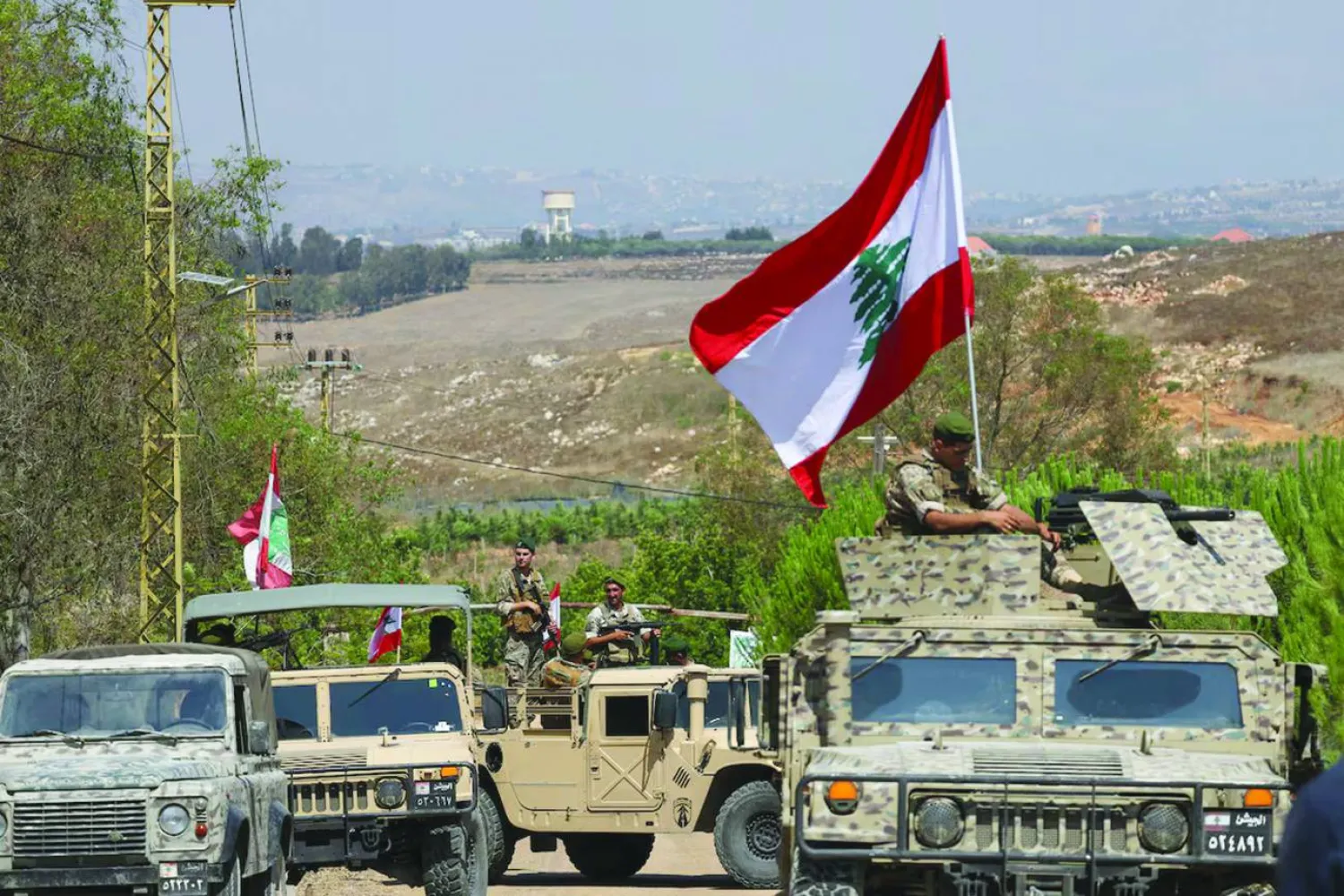
The Lebanese Army has rejected Israeli demands for direct military coordination while Israeli forces continue to occupy Lebanese territory, fearing the move could undermine negotiations and draw the military into domestic political disputes.

The army wants to preserve the trust it has built with communities in South Lebanon, even as it cracks down on gunmen and weapons traffickers and expands its deployment in areas outside Israeli control.

Washington has conveyed Israel’s demand for direct coordination between the two armies, which would replace the existing US-mediated mechanism, the Military Coordination Group for Lebanon (MCG4L).

The group oversees implementation of the “framework agreement”, coordination arrangements and assistance with military deployments, beginning in designated pilot areas.

Israel repeated its demand during the eighth round of military-only talks in Tampa, Florida.

President Joseph Aoun backs the army’s refusal. Visitors to the president told Asharq Al-Awsat that he had personally instructed the military not to establish direct contact with Israeli forces.

“It is still far too early to discuss such a step,” Aoun told his visitors. “Under the current circumstances, direct communication is impossible while the Israeli army continues to occupy our territory and attack it every day.”

Indirect coordination

Sources familiar with contacts between the army and Lebanon’s political leadership explained that the military insists coordination with Israel remain indirect, either through the US military or the United Nations, as under previous UN-chaired tripartite and five-party committees.

The army wants an international witness to any discussions, particularly after what the sources described as negative experiences with Israel.

They cited Israel’s refusal to acknowledge the Lebanese Army’s progress in implementing the first phase of the government’s plan to bring weapons under exclusive state control south of the Litani River before fighting resumed on March 2.

Political and domestic concerns

The army’s position also reflects Israel’s continued occupation of Lebanese territory and its refusal to withdraw, halt attacks or offer political concessions that could strengthen Beirut’s negotiating position, according to the sources.

They stressed that the military does not oppose negotiations and has participated in US-mediated talks in Rome and the United States under the framework agreement.

But the army is determined to avoid becoming a target of domestic political disputes over direct negotiations with Israel.

“The military wants to preserve its standing as a national institution trusted across Lebanon’s political and sectarian divides,” the sources explained.

They warned that “direct coordination could expose the army to criticism whenever Israeli forces carried out attacks or violations, weakening public confidence in the institution.”

“Such divisions could also obstruct its mission to implement Cabinet decisions on bringing all weapons under state control and extending government authority across Lebanese territory.”

US praise

The sources reported that the Lebanese Army had faced no opposition from residents south of the Litani River while implementing the first phase of the government’s weapons-control plan.

It collected 2.7 million weapons and pieces of ammunition without coordinating with any domestic party, including Hezbollah, they noted.

The army also pursued and arrested gunmen, people who opened fire and those transporting weapons, while maintaining local support.

US Central Command praised its operations and recognized the difficulties of working in heavily damaged areas, according to the sources.

These included clearing roads, restoring basic living conditions and helping residents return to their villages, particularly in designated pilot areas.

The sources highlighted US military support for the army’s civil-military operations, which have enabled it to carry out its mission without confrontation with local communities.