


New Four-lane Bridge Opens Between China, North Korea

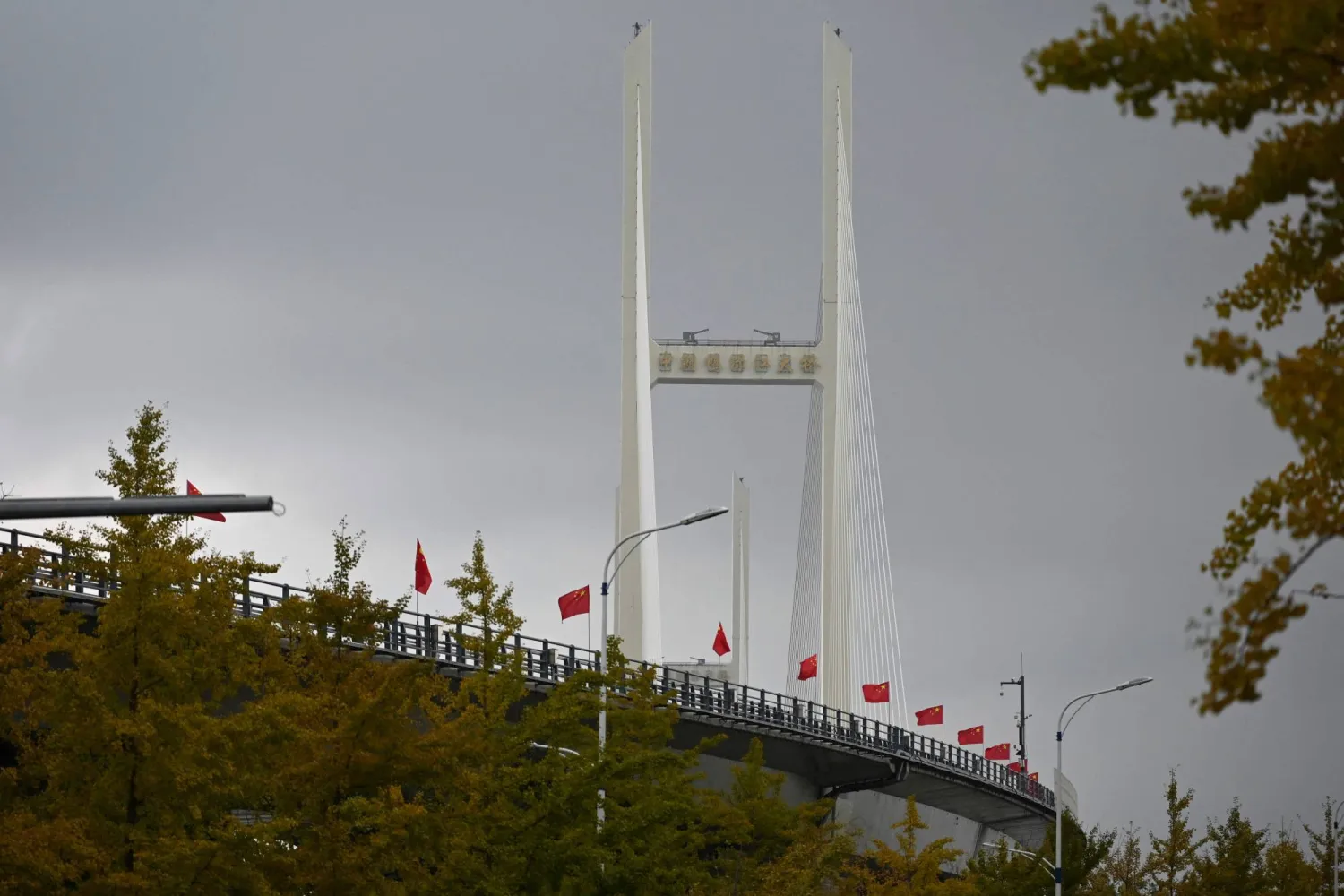
A general view shows the new cross-border bridge linking China and North Korea in Dandong, Liaoning Province, on October 15, 2026. (Photo by Michael ZHANG / AFP)
TT

New Four-lane Bridge Opens Between China, North Korea

A general view shows the new cross-border bridge linking China and North Korea in Dandong, Liaoning Province, on October 15, 2026. (Photo by Michael ZHANG / AFP)

A new four-lane road bridge linking China and North Korea finally opened on Thursday, 12 years late, enabling the Asian giant and its isolated nuclear-armed neighbor to step up cross-border trade substantially.

China is its neighbor's largest trading partner and a vital diplomatic and political backer, although relations have not always been smooth with the ruling Kim dynasty.

Hundreds of people gathered on Thursday in the northern Chinese border town of Dandong, taking selfies in front of the 3,026-meter (9,927-feet) New Yalu River vehicle bridge before it opened.

Trucks bearing the nations' flags began moving in both directions late morning, AFP reporters at the scene said, some of the North Korean vehicles decorated with flowers.

"It's great," one woman who came to watch told AFP in the town dotted with Chinese as well as Korean shops and restaurants, where residents were relieved the bridge had finally open.

"It's already been over 10 years. It's certainly going to be good for business," she said, without wishing to be named, accompanied by her friend and her dog.

"I hope the standard of living in North Korea can rise to the level we have here," Dandong local Yu Shuyan, who before the pandemic had visited North Korea, told AFP.

Chinese Premier Li Qiang said that the bridge symbolized Beijing's friendship with Pyongyang and that relations were "entering a new stage and opening a new chapter".

"Thanks to the joint efforts of both sides, the successful opening of the bridge will not only strongly boost economic and trade cooperation between the two countries, but will also further facilitate people-to-people exchanges and tighten the bonds of affection between the two peoples," Li said by video link at the opening ceremony, Xinhua reported.

A truck bearing a North Korean flag crosses the new cross-border bridge linking China and North Korea in Dandong, Liaoning Province, on October 15, 2026. (Photo by Michael ZHANG / AFP)

The structure was completed in 2014 but its opening was delayed due to a lack of connecting roads and customs facilities on the North Korean side, South Korea's Yonhap news agency reported.

North Korea also sealed its borders during the Covid-19 pandemic, and train journeys between the East Asian neighbors only restarted in March after a six-year halt.

The new bridge is not the only border crossing between the two countries. But the new structure will supersede the "extremely narrow" rail-and-road Sino-Korean Friendship Bridge downstream on the Yalu River, said Lim Eul-chul, a North Korea expert at Kyungnam University.

"Previously, transporting heavy cargo such as industrial machinery, raw materials, construction materials and energy-related supplies required extreme caution because of safety concerns surrounding the ageing bridge," Lim told AFP.

"The new crossing will make such shipments much easier and more efficient," he said, calling it a "groundbreaking development" that will triple or quadruple cargo traffic.

The opening came a day after North Korea test-fired two types of cruise missile from a submarine, according to the official Korean Central News Agency (KCNA).

The two Koreas have engaged in a tit-for-tat series of missile tests this month, with both sides test-firing hypersonic weapons.

Seoul and Pyongyang remain technically at war as the Korean conflict ended in 1953 with a truce rather than a peace treaty.

South Korea's unification ministry told AFP that Seoul is "closely monitoring" the situation regarding the new bridge.

North Korea has not yet resumed issuing tourism visas to Chinese citizens, who once made up the bulk of its overseas visitors.

The opening of the new bridge comes just more than a month after North Korea and Russia opened their first road bridge, with Pyongyang lauding it as a sign of closer ties.

Since Russia launched its full-scale invasion of Ukraine in 2022, Pyongyang has become a key Kremlin ally, sending troops to support Moscow's war effort in return for economic benefits and military technology.



Israeli Defense Minister Says Iran Developing Chemical Weapons

Israeli Foreign Minister Israel Katz waits for his British and French counterparts ahead of a meeting, amid the conflict between Israel and Hamas, in Jerusalem August 16, 2024. (Reuters)
TT

Israeli Defense Minister Says Iran Developing Chemical Weapons

Israeli Foreign Minister Israel Katz waits for his British and French counterparts ahead of a meeting, amid the conflict between Israel and Hamas, in Jerusalem August 16, 2024. (Reuters)

Israeli Defense Minister Israel Katz said on Tuesday that Iran is developing chemical weapons, and vowed to stop Tehran from obtaining them.

"Iran is in the process of developing chemical weapons," Katz said in a briefing to Israeli reporters, according to public broadcaster KAN and other national outlets.

"The State of Israel will not allow them to reach that capability."


Eisenkot Backs Netanyahu Opponents: No Urgent Need to Attack Iran Now

Former military chief Gadi Eisenkot, leader of the Yashar party arrives to speak at the Knesset, Israel's parliament in Jerusalem, November 23, 2026. REUTERS/Ronen Zvulun
TT

Eisenkot Backs Netanyahu Opponents: No Urgent Need to Attack Iran Now

Former military chief Gadi Eisenkot, leader of the Yashar party arrives to speak at the Knesset, Israel's parliament in Jerusalem, November 23, 2026. REUTERS/Ronen Zvulun

Israeli military and security chiefs, who believe a third war with Iran is only a matter of time, have gained support from Gadi Eisenkot, leader of the Yashar party and the politician tasked with forming Israel's next government, as well as senior figures in his political camp.

Their backing has strengthened the security establishment's position against outgoing caretaker Prime Minister Benjamin Netanyahu, with Eisenkot arguing that another war with Iran is not an urgent necessity.

The disagreement over Iran spilled into the media after Netanyahu and Eisenkot clashed over a potential strike against Tehran.

Netanyahu accused his political rival of downplaying the security threats facing Israel for political reasons after Eisenkot openly questioned whether Iran posed an immediate threat.

Netanyahu

Speaking at a Likud faction meeting in the Knesset, Netanyahu said: "Our ability to ensure the existence of the state in the face of the major threats surrounding us depends on our unity. Anyone who mocks or downplays these threats is doing so for political reasons."

His remarks came amid reports that he is pushing to resume military operations against Iran, a move opposed by military and security officials who believe he wants to trigger a confrontation to delay the formation of a new government.

Eisenkot

Eisenkot openly backed military and security leaders, telling a meeting of his Yashar faction that he saw no immediate Iranian threat requiring military action before the new government is sworn in.

He argued that rather than conducting further military operations, Israel should focus on Iran's stockpile of enriched uranium.

"The gravest threat from Iran is the 440 kilograms of enriched uranium that have still not been destroyed or removed. We must focus on that," he said.

The dispute between Netanyahu and Eisenkot reflects part of the broader political and security debate in Israel.

Israeli public broadcaster Kan reported that while Netanyahu is pushing for war with Iran, the security establishment believes alternatives remain available.

These include the possibility of reaching an agreement, maintaining the blockade and economic pressure, or undertaking military action in coordination with the United States.

An informed source told Kan that US President Donald Trump is not inclined to make such a decision at present, as Iran's economic difficulties have strengthened the position of those advocating continued economic pressure rather than war.

A second reason Trump and others oppose an immediate war is the assessment that another strike would not bring down the government in Tehran.

Beyond Eisenkot, other figures in Israel's pro-change political camp have criticized Netanyahu and warned against taking the country into another war, particularly with Iran.

Lieberman

The Maariv newspaper quoted Yisrael Beytenu leader Avigdor Lieberman as saying during a closed meeting of the Knesset Foreign Affairs and Defense Committee's intelligence subcommittee, attended by military Chief of Staff Eyal Zamir and Knesset Speaker Matan Kahana, that any war against Iran at this stage would be driven by political and personal considerations.

"Reports have emerged that Iran is seeking to acquire chemical weapons. If true, this constitutes a serious threat, but it neither requires nor justifies immediate unilateral action without American involvement," Lieberman said.

"The concern is that Netanyahu may see an attack on Iran as his last political way out. If he decides to attack Iran alone, without cooperation with the United States, that would clearly be an illegal act," he added.

Golan

Yair Golan, leader of the left-wing Democrats party, also joined those accusing Netanyahu of attempting to drag Israel into another war with Iran for political reasons.

Netanyahu's position is based on alleged developments in Iran's chemical weapons program, which Mossad chief Roman Gofman reportedly presented to American officials during a visit to Washington approximately two weeks ago.

Eisenkot and military commanders, however, believe the current Iranian threat does not warrant immediate action.

Mossad

Divisions over Iran have also emerged within Mossad.

According to Haaretz, researchers within the intelligence agency concluded during recent discussions that there was no immediate need for military action against Iran.

Their assessment contrasts with the position of Mossad chief Roman Gofman, Netanyahu's former military secretary, who is reportedly advocating renewed strikes against the Islamic Republic.

Military Experts

Experts in Israel estimate that it could take Iran two years or more to develop a system capable of delivering chemical weapons to Israel.

Writing in Maariv on Tuesday, military commentator Avi Ashkenazi said the Israeli military remains on high alert, both defensively and in its preparations for potential offensive operations.

According to Ashkenazi, the military believes it could be called upon to launch an offensive under one of three scenarios.

The first would involve Iran initiating military action. The second would see Trump ordering the start of a military campaign in the near future. The third, considered the least realistic, would involve Israel launching a military campaign on its own.

"At present, there is a consensus within the Israeli military and security establishment that there is no urgent need to enter into a confrontation with Iran alone," Ashkenazi wrote.

He added that a confrontation would eventually come, as Israel would have to undertake military action to inflict cumulative damage capable of destabilizing the Iranian government, setting back its offensive capabilities and weakening it militarily, economically and politically.

He emphasized that Israel would prefer to enter such a confrontation alongside the Americans.

Ashkenazi also argued that Trump is in no hurry to act because the blockade and sanctions are producing results.

With winter approaching and Iran facing an energy crisis, the situation is likely to become increasingly complicated, he said.

"The paradox is that the party most eager for war to break out at this stage is the Iranian regime itself, which sees war as a dual opportunity to remove the noose from around its neck," Ashkenazi concluded.


Iran Insists No Talks with the US Until Its Conditions Are Met

 Vessels at the Strait of Hormuz, as seen from Musandam, Oman, November 23, 2026. (Reuters)
Vessels at the Strait of Hormuz, as seen from Musandam, Oman, November 23, 2026. (Reuters)
TT

Iran Insists No Talks with the US Until Its Conditions Are Met

 Vessels at the Strait of Hormuz, as seen from Musandam, Oman, November 23, 2026. (Reuters)
Vessels at the Strait of Hormuz, as seen from Musandam, Oman, November 23, 2026. (Reuters)

Iran repeated Tuesday that there'll be no talks with the United States to end the conflict unless several conditions are met.

Iran’s chief negotiator and parliament speaker Mohammad Bagher Qalibaf said Tehran wouldn't negotiate with the US "until Iran’s seven conditions are met,” according to Iranian state television.

Iranian authorities haven't publicly stated what those conditions are. But Iranian state media have said they include the lifting of sanctions, the ending of the US naval blockade of Iranian ports and the release of seized Iranian assets.

He also warned that Iran would “shift the geographical scope of the conflict should the enemy make a mistake.”

Meanwhile, the naval arm of Iran’s Revolutionary Guard said the three oil tankers struck the naval mines because they were “in violation of regulations” regarding passage through the Strait of Hormuz.

The Guard’s navy said in a post on Telegram Monday that the strait “is not a place to test unauthorized routes or to disregard maritime warnings.”

It said the tankers were “engulfed in flames” after hitting the mines despite being under US aerial escort.