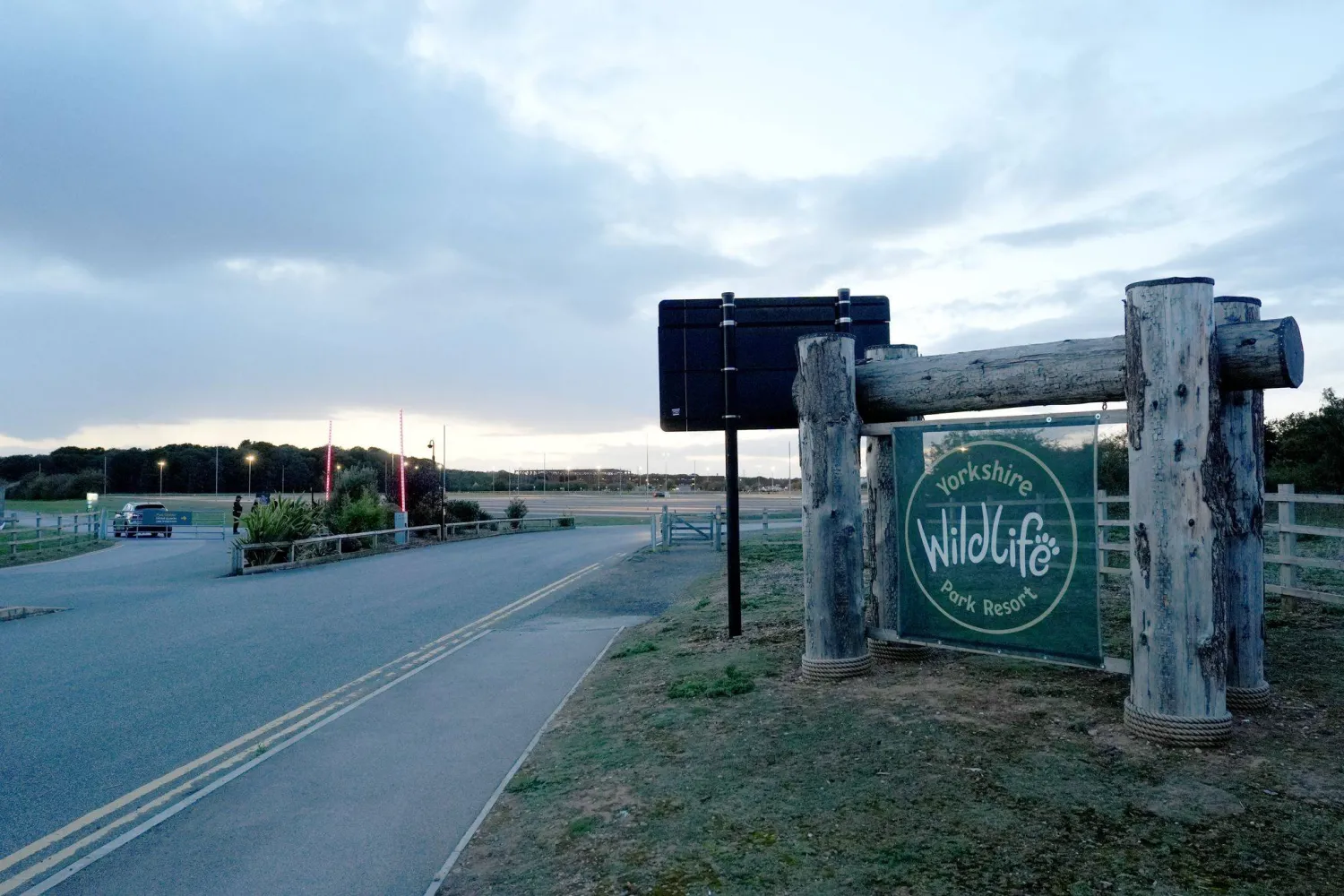
'Distressed' Family of UK Man Killed by Tiger Urge End to Online Posts

10 October 2026, United Kingdom, Doncaster: A view of the entrance to Yorkshire Wildlife Park in Doncaster, where a man has died after suffering serious injuries in a tiger enclosure at Yorkshire Wildlife Park. Photo: Annabel Lee-Ellis/PA Wire/dpa
TT

'Distressed' Family of UK Man Killed by Tiger Urge End to Online Posts

10 October 2026, United Kingdom, Doncaster: A view of the entrance to Yorkshire Wildlife Park in Doncaster, where a man has died after suffering serious injuries in a tiger enclosure at Yorkshire Wildlife Park. Photo: Annabel Lee-Ellis/PA Wire/dpa

The family of a mentally ill man killed by a tiger at a UK wildlife park have urged people to stop posting "deeply offensive media content" of the attack, as US President Donald Trump uploaded disturbing footage online.

William Chapman, 23, died from his injuries after being attacked by a tiger when he entered its enclosure on Saturday at the Yorkshire Wildlife Park, near the northern English city of Doncaster.

In an online tribute, his family late Tuesday described Chapman as a "bright, warm and engaging young man" who had been suffering from "significant mental illness over a number of years.”

And they questioned whether the strong medication he was prescribed may have played a role in the incident, while the park remained closed for a fifth day on Wednesday.

"The family are utterly devastated by their loss and are struggling to come to terms with what has happened," AFP quoted them as saying.

"The publication and circulation of deeply offensive media content is causing them severe distress at an exceptionally vulnerable time. We ask people to stop doing this."

Trump posted footage to his 13 million followers on his Truth Social account on Tuesday of Chapman being fatally mauled by the male Amur tiger, sparking a backlash on social media.

Trump, who regularly posts provocative material on social media, captioned his post "Don't ever mess with nature!.”

The 41-second clip was also later shared by the White House's "Rapid Response 47" account on X.

And Trump followed it with a video clip of apparently AI-generated visuals of individuals being mauled by big cats.

Later Tuesday, Trump doubled down and posted an AI-generated video of himself wrestling and befriending a smiling tiger, to the tune of "The Lion Sleeps Tonight.”

Users on X, where the "Rapid Response 47" account has 2.3 million followers, questioned the president's judgment, with one calling the post "sick.”

"I'm a big supporter but not a fan of this post. To each his own," wrote another.

An inquest into Chapman's death is due to open on Thursday in Doncaster.

He was visiting the zoo alone and it remains unclear how he entered the enclosure. He was pronounced dead at the scene after emergency services were called.

According to videos posted online, Chapman appeared to have filmed the inside of the enclosure with his mobile phone and the moment he approached the tiger.

Visitors to the park had also filmed the incident from a raised 300-meter (985-feet) long walkway which looks down on to the park's "Land of the Tigers" feature.

The walkway allows visitors to view the park's Amur tigers, also known as Siberian tigers, in their enclosure featuring woodland, grassland and a waterfall pool.

There are estimated to be only around 500 of the endangered subspecies left in the wild.

The park has said the tiger involved, called Atai, was safe and well, and would not be put down.


Six Measures Could Save 1.6 Million Lives a Year, Says WHO

Tedros Adhanom Ghebreyesus, Director General of the World Health Organization (WHO), speaks to the media in Geneva, Switzerland, on July 16, 2026. (AP)
TT

Six Measures Could Save 1.6 Million Lives a Year, Says WHO

Tedros Adhanom Ghebreyesus, Director General of the World Health Organization (WHO), speaks to the media in Geneva, Switzerland, on July 16, 2026. (AP)

Implementing a few climate and health measures could save nearly 1.6 million lives a year and generate trillions of dollars for the economy, the World Health Organization said on Wednesday.

The UN agency's report, released days before the COP31 climate change conference kicks off, proposed heat-health warning systems and climate-resilient infrastructure for drinking water and sanitation.

Improved hand hygiene, cleaner household energy sources and more efficient fossil fuel pricing were also on the list.

"The climate crisis is a health crisis, but much of the harm it causes can be prevented with tools we already have," WHO chief Tedros Adhanom Ghebreyesus said in a statement.

The WHO's report said rolling out six concrete measures could provide "a triple dividend" of "healthier people, lower emissions, and stronger economies".

As well as saving lives, the measures could help avoid 16.7 billion tons of carbon dioxide emissions each year, the report said.

The measures could also generate up to $5.4 trillion in fiscal benefits each year, as well as a nearly $4 trillion economic boost by saving lives, avoiding disasters and reducing healthcare costs.

The WHO acknowledged the study relied on ambitious scenarios and that there were data gaps and inherent uncertainties in the projections.

But Tedros maintained that the report showed how "scaling up proven, affordable actions could save millions of lives, with the greatest gains in the countries that need them most".

As global leaders prepare to head to the COP31 in Türkiye next week, he urged them to ensure that protecting health is at "the center of climate action".


‘Fewer and Fewer’: Dry Summer Hits Italy Truffle Season

Truffle hunter Giuseppe Esposito shows a black truffle harvested from the truffle plantation of Boido Tartufi in Pietra Marazzi, near Alessandria, northern Italy on October 27, 2026. (AFP)
TT

‘Fewer and Fewer’: Dry Summer Hits Italy Truffle Season

Truffle hunter Giuseppe Esposito shows a black truffle harvested from the truffle plantation of Boido Tartufi in Pietra Marazzi, near Alessandria, northern Italy on October 27, 2026. (AFP)

After an excessively dry summer, black truffles are becoming few and far between in the misty hills of the Piedmont region in northern Italy.

"The moon is perfect, and yet I only found two little ones last night," Giuseppe Esposito, 69, told AFP as he searched with his dog Attila.

"We needed rain in July or August," he said of the spots where he usually hunts -- the precise location of which he keeps a closely guarded secret even from his wife.

Truffle gathering is an important tradition in rural Italy, and often a source of untaxed supplementary income for local residents, with white truffles worth several thousand euros per kilogram and premium black truffles typically selling for hundreds of euros per kilogram.

Most black truffles now come from truffle plantations or cultivated truffle grounds, where trees have had their roots soaked in a truffle-based slurry to encourage the fungus to grow.

In his woods in Pietra Marazzi, Marco Boido, 49, a truffle dealer and restaurateur in nearby Alessandria, is also disappointed and worried.

"We started the season in a terrible way, we're at minus 50 percent in production," he said -- a month in from the start of the season.

"This year they're much smaller, and more fragrant, that's true," he said.

"If this drought continues, there will be fewer and fewer in our area," Boido said.

- 'Gives you goosebumps' -

A truffle hunter who works for Boido and preferred to remain anonymous said the production of white truffle was also "off kilter" this year.

"The unseasonal heat has dried out the banks of the streams and the dampest valleys," he said.

Another truffle hunter in Umbria in central Italy said that better areas for truffles this year were "more enclosed, cooler mountain valleys, where the moisture held" during the summer.

"The aroma is exceptional and the texture very firm, which is keeping market prices high."

For several years now, Italy has also had to contend with the growing strength of the Spanish truffle industry, where farmers have planted vast truffle orchards and slashed costs.

In 2025, the Italian government once again tried to reform the truffle sector by encouraging more production in truffle plantations.

But the bill faced strong opposition from traditional "trifulai" -- the word for truffle hunters -- and it remains stuck in the Senate.

"We need policies to shift the calendars and to manage the land, so as not to block the water that runs down with the plants," said Fabio Cerretano, president of the Italian federation of truffle gatherers' associations.

In Piedmont, Esposito said he hoped his tradition would continue and spoke of the "emotion" of truffle hunting.

"When you catch the scent of the truffle, when the dog starts digging, and he plants himself there and doesn't give up... it gives you goosebumps."


Iconic New York Figure Was Likely ‘Major Player’ in Murderous Pirate's 1695 Heist

A person walks by the water at Jones Beach in Wantagh, N.Y., May 21, 2020. (AP)
TT

Iconic New York Figure Was Likely ‘Major Player’ in Murderous Pirate's 1695 Heist

A person walks by the water at Jones Beach in Wantagh, N.Y., May 21, 2020. (AP)

An amateur historian has stumbled upon a provocative clue to the enduring mystery of what became of a notorious pirate who raided a royal Indian treasure ship centuries ago, implicating a co-conspirator whose name is familiar to many New Yorkers.

James Bailey, who five years ago made headlines after unearthing ancient coins believed to be linked to English pirate Captain Henry Every, now says that colonial-era documents suggest the “King of the Pirates” and his violent crew got an assist from Thomas Jones, the namesake of Jones Beach, New York’s most visited state park after Niagara Falls.

“You have millions of visitors and generations of New Yorkers going to this beach,” Bailey said. “Nobody knew that he was actually a major player in arguably the biggest heist in the history of piracy.”

Since his big find, Bailey has pored through documents to dig even deeper into the bloody 1695 raid of the Ganj-i-Sawai on the Red Sea and the mystery of what happened to Every.

The pirate crew is said to have tortured, killed and raped those aboard the royal ship, sparking global outrage and what is considered the first worldwide manhunt, according to AP.

Some were caught and executed, but many others, including Every, were never heard from again and are believed to have scattered to Europe and the American colonies.

Documents, including depositions from Every’s associates, suggest Jones was recruited to serve as a “wheelman,” helping the pirates evade authorities after they made off with tens of millions of dollars' worth of gold and silver, according to Bailey.

Other documents show that New York’s governor, charged by the British crown to crack down on piracy, investigated Jones years later after he’d remade himself as the wealthy proprietor of a whaling operation on the barrier beach on Long Island that now bears his name.

Bailey’s research, which he hopes to have published, sheds light on a part of Jones’ checkered past long alluded to but never quite fleshed out in local history books, says John Hanc, author of “Jones Beach: An Illustrated History,” which includes a chapter on Jones.

Jones was a major in the English military before moving to the American colonies, initially settling in Rhode Island before eventually becoming a prominent businessman and landowner in New York. Jones owned thousands of acres of land on early Long Island, then just a rural expanse well east of the rapidly growing New York City.

But rumors of how he’d initially made his fortune persisted long after his death in 1713. Before it was demolished in the early 1800s, his crumbling mansion was said to be haunted by ghosts and strange occurrences. Jones’ grave was repeatedly desecrated by robbers searching for buried treasure before it was relocated to a family burial plot behind a nearby church.

A family history published in 1906 by one of Jones’ descendants dismissed the pirate tales as “slander” and “improbable fictions.”

“People were disposed to cast slurs upon his memory, either for mischievousness, or a spirit of malice,” Thomas Floyd-Jones wrote. “These myths were cherished for over a century after his death, which ignorance and superstition did not fail to magnify.”

Hanc and other experts say it wasn’t too far-fetched for Jones to have at least dabbled in piracy.

After serving in the British military, Jones made a career as a privateer, or a seafarer authorized by the English crown to raid the commercial ships of its rivals during wartime, said Meagan Schulman, a Fordham University doctoral candidate who specializes in 17th century piracy and wasn’t involved in Bailey’s research.

But when the conflict ended, privateers like Jones lost their special status, she said. Those that continued the high seas raids were branded pirates.

“The reality was that privateers were pirates, just sponsored by a certain government or patron,” explained Schulman, who grew up going to Jones Beach. “So maybe the short answer is, yes. Jones can be called a pirate, by some people, but he probably did not ever see himself as one.”

After helping Every and his crew evade capture, the documents cited by Bailey show Jones briefly returned to Rhode Island.

Then in 1696, Jones’ father-in-law, Thomas Townsend, a wealthy New Yorker, gifted him and his wife a significant tract of land on Long Island’s south shore, property records show.

Bailey, who recently retired from Rhode Island's corrections department, posits that allowed Jones a fresh start, as authorities continued to scour pirate-friendly New England for Every and his accomplices.

On Long Island, Bailey says Jones built a homestead and raised a family, but his pirate past was never far behind.

Three years after the Ganj-i-Sawai heist, Richard Coote, New York's colonial governor, described how one of his efforts to root out piracy had led him to Jones.

Citing witness depositions, the governor wrote in 1698 that a certain “barrel of money” traveled from the city to Long Island, where it ended up at Jones’ house. But Jones, who the governor described as “formerly a pirate,” testified that he knew nothing about the barrel.

Bailey’s findings are compelling but shouldn’t be considered conclusive, cautions Richard Blakemore, maritime history professor at the University of Reading in the United Kingdom who also wasn’t involved with Bailey’s work. After all, he said, Thomas Jones is a fairly common name.

If anything, Jones’ possible ties to Every underscore how piracy provided “foundational and multi-generational wealth” for many of the prominent families in the Northeast, says Kevin McDonald, a history professor at Loyola Marymount University in Los Angeles who wrote a book about colonial-era piracy but wasn’t involved in Bailey’s research.

“Popular images of pirates show them as outcasts, but many historians have argued the opposite, based on evidence like this,” agreed Blakemore. “It may surprise readers to find just how much early British colonies were both socially and economically connected to piracy.”