Cold War Missile Tucked Away in Field Hides Love Story
Adrian said he bought a tank in his wife’s memory and then “it all just snowballed and I got carried away”
A 20ft-long Cold War era missile perched on the back of a truck in a field has become a hit on TikTok - and revealed a love story behind it, according to BBC.
Photos and videos of the striking sight near Llangollen, Denbighshire, spread across social media, prompting speculation, theories and curious comments from people wondering how it got there and why.
But for the man who owns it, the story has nothing to do with secret military operations or preparations for war - it is about him using an unusual hobby to honor his late wife.
Military enthusiasts Adrian Hyde, 59, and his wife Janette spent years talking about owning a military vehicle and planned to buy a tank as a joint 50th birthday present.
“We had all the area and ground ready, the driveway ready. We knew exactly where we were going to buy it from. We were going to buy a Russian one from Poland,” said Adrian.
But this dream was put on hold when Janette was diagnosed with cancer in 2016.
Despite having cancer three times, Adrian said she never lost her determination and the couple “kept saying ‘we’ll eventually get that tank.’ I think that’s what kept us going.”
Janette died in January 2025 at the age of 57, and Adrian found himself returning to their shared dream and bought the tank three months later, according to BBC.
Adrian bought a CVRT scimitar and had it restored by “some military guys in Rugby” who made it road legal.
He named it Janbabes, after his wife.
Then, after getting a call from a military vehicles company telling him they had an armored Land Rover, he bought that as well.
Adrian said word got round about his collection, leading to a call from a friend saying he had a 1957 AFS Bedford RL missile launcher and a Thunderbird missile for sale.
But because the driveway was full, he asked his friend John if he could put the missile launcher in his field, about 100 yards from his house and he said yes.
Adrian said the bug then got him and he bought a Special Forces Polaris 6 MRZR 4, which is a project for next summer, with the collecting and restoration helping him cope with his grief.
“I’ll be in the front room and look at the tank and think: ‘That’s part of you dear. That’s Janbabes sitting there’.”
The unusual sight quickly attracted attention locally before exploding online after a video posted by a hiker and content creator went “absolutely viral” on TikTok and Instagram.
While many may see his military collection as odd, Adrian said it represented a dream he and Janette talked about for years, but never had the chance to realize together.
“It's quite emotional because it was our dream for 10 years. Janette would have loved it.”
But the military equipment is not the only way Adrian has honored his wife.
Following her death, he bought and donated an ambulance to cat charity Candy Tibby Trust in Wrexham, filling it with cat food and raising £3,000 in Janette's memory.
He hopes the sale of the missile and truck can do something similar as his wife was a cat lover.
As for what's next on the list, Adrian said he “doesn't know what yet. There are always plans to go buy something. It all depends on what crops up.”
Whatever arrives next, its origins can be traced back to a husband keeping alive a dream he once shared with his wife.
Even Pizza is Eaten with a Fork… Dutch Butler School Promises Entry Into Gilded Worldhttps://english.aawsat.com/varieties/5345380-even-pizza-eaten-fork%E2%80%A6-dutch-butler-school-promises-entry-gilded-world
Even Pizza is Eaten with a Fork… Dutch Butler School Promises Entry Into Gilded World
The eight-week program promises entry into a gilded world (Pexels)
The students wear dark suits and white gloves. They call each other “Mr.” and “Ms.” even outside school hours. They sleep in single beds and share bathrooms in the long hallways of a 19th-century Dutch monastery.
At mealtimes, they sit together at a long rectangular table under eight chandeliers where everything, even pizza, is eaten with a fork and knife.
This is the International Butler Academy in the Netherlands, where — in the school’s words — “dreams take flight and professionalism is cultivated,” according to The New York Times.
This month, 29 students finished an intensive course to learn how to be full-fledged butlers.
Salvatore Fenu was among those in a recent cohort at the International Butler Academy.
The butlers-to-be, ages 21 to 65, came from all over — Bulgaria, Germany, Guadeloupe, the United States — to a 135-room estate.
The eight-week program promises entry into a gilded world.
The International Butler Academy is betting that in a world where the rich are getting richer, the demand for butlers will only increase.
“Statistically, there have never been this many people who are this rich,” said Niels Deijkers, 37, the academy’s general manager, who finished the course with high marks in 2023. Many of them, he reasoned, need people to run their households.
To get into the academy in Simpelveld, a town near the borders with Belgium and Germany, applicants have to be at least 18, have a solid grasp of English and nearly $14,000 to pay for the program. No prior butling experience is required.
Roughly 60 people graduate each year from the International Butler Academy.
Salvatore Fenu, 32, a Spanish student, said he came to learn “how to be a gentleman” and to “become a better person.”
Having worked as a butler in villas on the Spanish island of Ibiza, he hoped for a job with an “old-money family” with the goal of retiring at 50.
Days at the academy start early and end late. Deijkers’s comments are often harsh. Pressures mount each week as students clean, iron, arrange flowers, host dinners and measure exact distances between dinner plates, napkins and cutlery. Over the eight weeks, the students have a total of seven days off.
“I’m surprised at how strict they are,” said Eva Barnard, 22, from Indiana, during a flower arranging class.
Impassive professionalism is a must, but Barnard said she was not always able to keep her facial expressions in check. “I have a big personality,” she said. And she was “not used to getting yelled at.”
But the program was worth it to her for the ultimate goal of working in a luxury setting.
“I want to meet new people, discover more of the world,” she said.
Eva Barnard said that keeping the calm demeanor of a butler can be a challenge.
The school was founded by Robert Wennekes, a longtime butler, in 2000. Wennekes had started recruiting butlers for rich and sometimes royal clients and found that he had trouble finding qualified candidates.
The school, citing privacy considerations, generally does not disclose where its graduate butlers go on to work.
But Deijkers said that the school receives requests from retired couples in Europe, executives who travel for business and want help with their wardrobe and packing, and “noble families.”
Butlers can command high salaries (often six figures) and access to a world of luxury, but that does not diminish the workload, Wennekes added. “It isn’t a shortcut to the good life.”
By this point, you may be wondering: Can you fail butler school?
Yes, you definitely can. During a late-night room check, Deijkers inspected each student’s room for violations such as food, alcohol or unmade beds.
Graduation from the academy is based on points. A thousand points is the maximum. Six hundred are needed for a diploma. Between 500 and 600, a student receives a certificate of attendance.
Anything lower than 500 and you’ve flunked right out of butler school.
Students start with the full 1,000 points. They lose them for transgressions and can earn them back with good work. Most of them do not know their score until graduation, when they hear their final result. On average, about 70% of students who do the eight-week course receive a diploma, Deijkers said.
Deijkers keeps score, scribbling his observations in a notebook over the course of the eight weeks. “The points keep you nervous,” Barnard said.
Arnold Ilucz, of Romania, who graduated from the academy in April and took a teaching job as the school’s executive head butler, said, “People are not here to make friends, people are here to learn how to behave.”
Being away from home and separated from his wife doesn’t faze Ilucz, 29. “I’m a product of communism,” he said. “This is not suffering.”
For some students, though, the reality of butling is tougher than it seemed.
“This is the hardest I’ve worked in my life,” said Maximilian Campos, a 21-year-old from Texas. “I had the idea of butler in my head. I didn’t know if it was real.”
In Costa Rica, Simple Rope Bridges Offer Sloths a Lifeline as Forests Disappearhttps://english.aawsat.com/varieties/5345344-costa-rica-simple-rope-bridges-offer-sloths-lifeline-forests-disappear
In Costa Rica, Simple Rope Bridges Offer Sloths a Lifeline as Forests Disappear
A sloth hangs from the branch of a tree Tuesday, Nov. 3, 2026, in Puerto Viejo, Costa Rica. (AP Photo/Ivan Valencia)
Behind a beachfront hotel on Costa Rica’s Caribbean coast, conservationists are installing rope bridges between trees, creating pathways for sloths in a landscape increasingly shared with tourists, hotels and other development.
For sloths, even a small gap in the forest canopy can be dangerous. Unable to jump between trees like monkeys, the slow-moving mammals are often forced to descend to the ground, where they risk being attacked by dogs, struck by vehicles or electrocuted on power lines.
To help them move safely through the treetops, the Sloth Conservation Foundation has installed approximately 410 rope bridges often across areas divided by roads and buildings.
“The wildlife bridges that we install are just made from single ropes, which don’t look very elaborate, but for arboreal species, they work,” said Rebecca Cliffe, a British zoologist who founded the organization and has spent nearly two decades studying sloths.
“It is a lifeline to cross a gap that they otherwise couldn’t cross.”
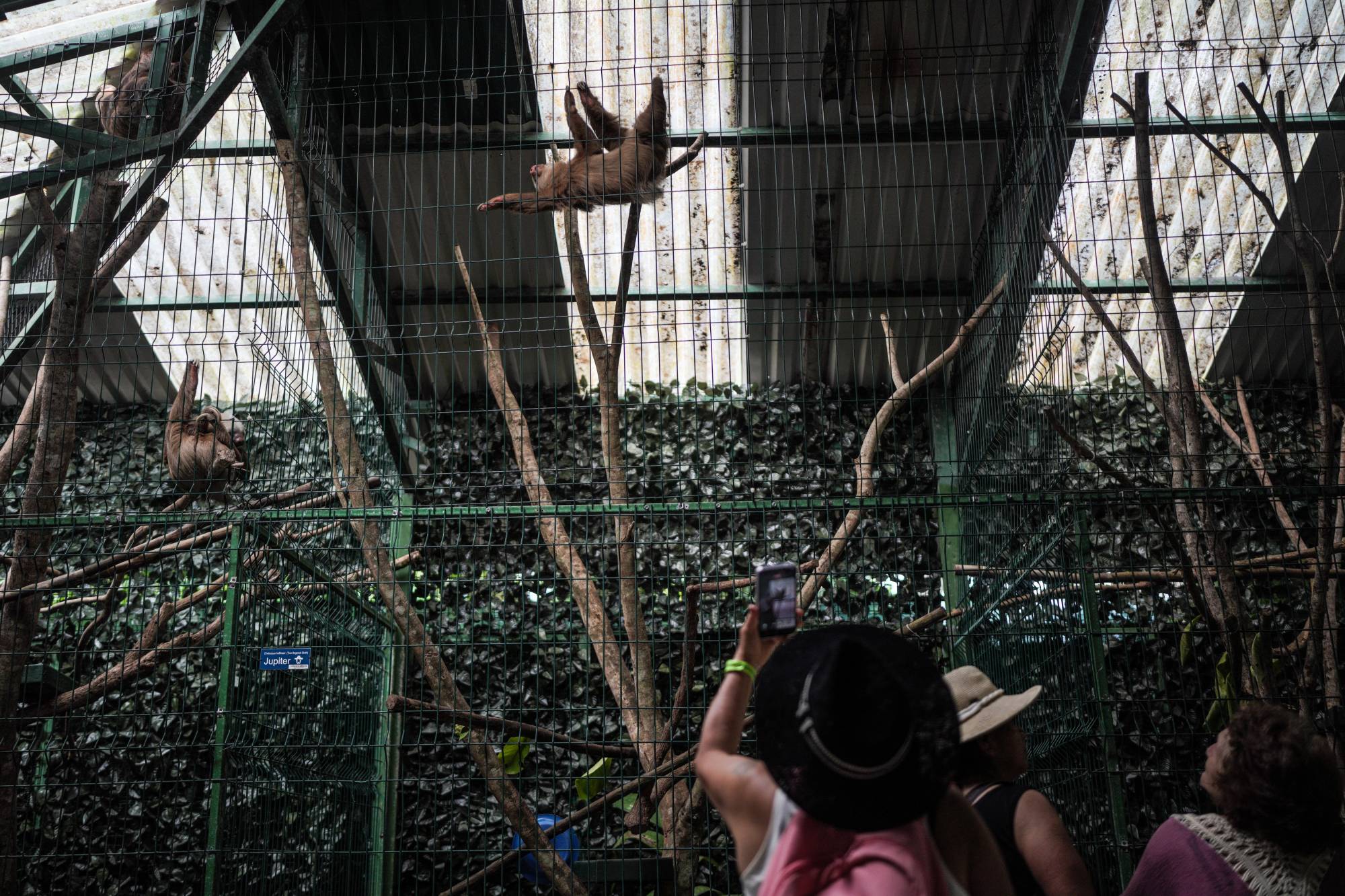
Tourists observe sloths rescued at the Sloths Sanctuary of Costa Rica, Tuesday, Nov. 3, 2026, in Penshurst, Costa Rica. (AP Photo/Ivan Valencia)
Costa Rica has been celebrated for reversing decades of deforestation, with forest cover increasing from an estimated 21% of its territory in 1987 to 59%, according to a 2023 report by the Organization for Economic Cooperation and Development. But the recovery has not eliminated habitat fragmentation, as development and tourism infrastructure continue to put pressure on coastal ecosystems.
Helping sloths avoid roads and power lines Sloths spend much of their lives suspended from branches, relying on familiar routes between trees to find food and shelter.
Even a gap of 2 or 3 meters (about 7 to 10 feet) between neighboring tree canopies can force a sloth to find another way across, a phenomenon Cliffe calls “microfragmentation.”
“They’re creatures of habit,” she said, explaining that sloths tend to follow routes learned early in life, even as their surroundings change.
Cliffe began experimenting with wildlife bridges after working at the Sloth Sanctuary nearly two decades ago, where she repeatedly saw animals arriving with injuries from dog attacks, vehicles and electrical cables.
“I thought, well, the sloths just need a safer way to get somewhere,” she said.
With little funding, she began installing single ropes between trees. Cameras monitoring some of the bridges have since recorded more than 22,000 wildlife crossings, including animals other than sloths, The Associated Press quoted Cliffe as saying.
Today, her team travels to sites where sloths have been spotted, including hotels and other properties along the Caribbean coast. At one beachfront hotel in Puerto Viejo, workers installed bridges among trees near an area frequented by tourists.
The project also involves planting trees and working with property owners to restore natural connections between neighboring plots. But the bridges are not permanent. Cliffe said ropes deteriorate after about four or five years in tropical conditions, requiring replacement.
Forest recovery doesn’t guarantee connectivity Although Costa Rica has regained substantial forest cover, much of that growth has occurred on former pastureland within landscapes fragmented by decades of agricultural expansion, said Carlos Morera Beita, a geographer at the National University of Costa Rica.
Morera said sloths have demonstrated greater adaptability than previously believed, using tree-lined pastures, living fences and riverside vegetation to move between forest patches.
But these connections remain essential. Without them, even recovering forests can leave sloth populations isolated, limiting their access to food, mates and shelter.
Rope bridges can help animals cross specific obstacles, Morera said, but long-term conservation requires protecting existing forests, restoring biological corridors and ensuring new development does not further fragment habitats.
Laynara Do Santos, a member of The Sloth Conservation Foundation, looks for sloths Tuesday, Nov. 3, 2026, in Puerto Viejo, Costa Rica. (AP Photo/Ivan Valencia)
At the Sloth Sanctuary of Costa Rica on the outskirts of the small town of Penshurst, tourists observe sloths that cannot return to the wild because of severe injuries, disabilities or the loss of their mothers before they learned the skills needed to survive independently.
Inside, founder Judy Avey-Arroyo’s bedroom is filled with sloth memorabilia, from stuffed animals and paintings to lamps and ornaments. She and her daughter even have sloth tattoos.
Just beyond a connecting door is a nursery where rescued and orphaned baby sloths are cared for in separate enclosures. Many arrive after their mothers are killed by cars, electrocuted on power lines or attacked by dogs.
The youngest are kept in incubators and fed milk, while older babies are given leaves, outdoor exercise and opportunities to learn to climb.
But Avey-Arroyo said replacing a mother is nearly impossible. Young sloths spend about a year learning which leaves are safe to eat, which plants to avoid and how to navigate the forest along familiar routes. Mothers also teach them which leaves to seek out when suffering from parasites, she said.
Without that knowledge, even apparently healthy orphaned sloths can struggle to survive in the wild.
For Avey-Arroyo, whose work began after she and her husband rescued an orphaned sloth named Buttercup, knowing that some animals will never return to the forest is the hardest part of running the sanctuary.
Climate change could worsen the effects of fragmentation, as rising temperatures and prolonged droughts alter the conditions sloths depend on.
Small forest patches are more exposed to heat, wind and lower humidity than continuous forests, Morera said, reducing habitat quality even where trees remain standing.
Sloths rely on their surroundings to regulate body temperature and metabolism, moving between shaded and sunlit areas of the forest. Cliffe said prolonged periods of extreme heat can deplete their limited energy reserves, while cold conditions can disrupt digestion.
The concern has prompted conservationists to look beyond rope bridges toward broader habitat restoration, including planting trees that provide shade.
“It’s not just bridges that are going to save sloths,” Cliffe said. “You’ve got to provide the connectivity, you also have to provide the thermal refuges.”
Despite their popularity as symbols of Costa Rica’s wildlife, scientists lack reliable estimates of how many sloths live in the country’s forests or how their populations are changing.
Cliffe’s organization is experimenting with thermal imaging drones, trained detection dogs and field surveys to improve estimates. She said two rescue centers in the region receive approximately three sloths a day, although historical data is needed to determine whether rescues are increasing.
In coastal communities like Puerto Viejo de Talamanca, conservationists hope the bridges will eventually be replaced by trees growing close enough together for sloths to move freely through the canopy.
For Cliffe, protecting sloths ultimately comes down to the collective impact of small actions, whether planting a tree, preserving a branch or installing a simple rope bridge.
“It’s the cumulative power of many individual actions,” she said. “That’s what really gives me hope.”
لم تشترك بعد
انشئ حساباً خاصاً بك لتحصل على أخبار مخصصة لك ولتتمتع بخاصية حفظ المقالات وتتلقى نشراتنا البريدية المتنوعة