


Hezbollah Aid to Displaced Families Raises Questions Over Funding Sources

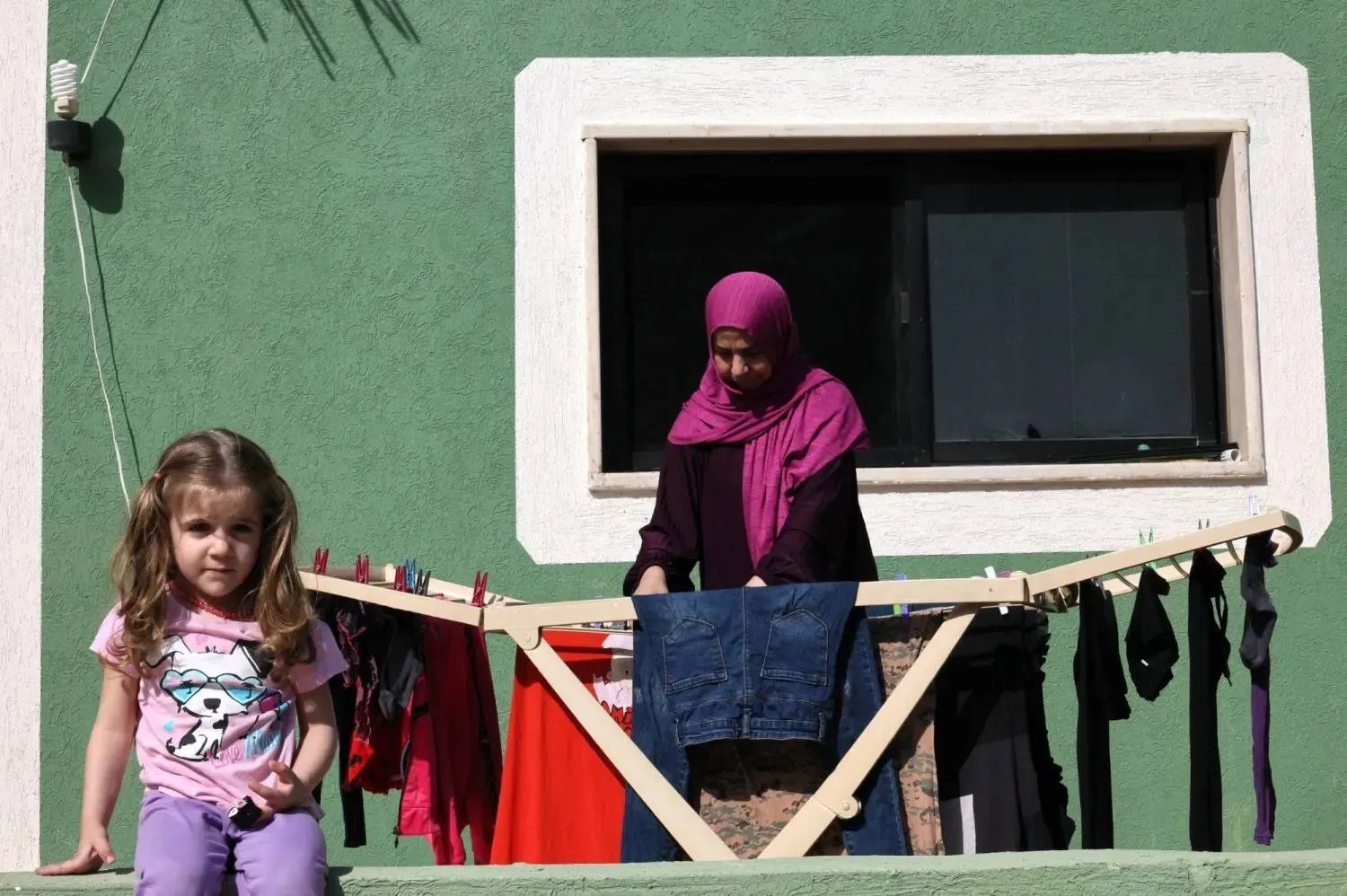
A woman and her daughter, displaced from their home in the South Lebanon village of Aita al-Shaab in 2023, live in a rented apartment in the southern town of Maarakeh (EPA). 
TT

Hezbollah Aid to Displaced Families Raises Questions Over Funding Sources

A woman and her daughter, displaced from their home in the South Lebanon village of Aita al-Shaab in 2023, live in a rented apartment in the southern town of Maarakeh (EPA). 

Hezbollah’s announcement of financial assistance for displaced Lebanese families and those affected by the fighting with Israel has raised questions about where the money comes from and how it is transferred and distributed, amid US sanctions on Iran and tighter Lebanese oversight of funding channels.

The announcement also comes as Lebanese authorities move to place all weapons under the control of legitimate state forces.

Meanwhile, President Joseph Aoun received a telephone call from Iranian Foreign Minister Abbas Araghchi to discuss regional developments. According to the Lebanese presidency, the two agreed on the need to support diplomatic solutions as the best way to end conflicts in the region.

Hezbollah’s funding sources

Hezbollah has traditionally relied on direct Iranian support, donations from sympathizers abroad and commercial activities, as well as illicit sources that US authorities accuse the group of exploiting.

Lebanese authorities, meanwhile, are seeking to strengthen financial regulations and oversight, particularly through proposed amendments to Law No. 44 on combating money laundering and terrorist financing.

The changes aim to identify the beneficial owners of companies and commercial ventures, trace the origins and destinations of funds, and tighten supervision of currency exchange dealers and money transfer companies.

US questions reported Iranian funding

A US State Department spokesperson has questioned, for a second time, reports of money reaching Hezbollah from Iran.

“The money supposedly arriving from Iran simply does not exist,” the spokesperson was quoted as saying.

The official accused Hezbollah of relying on criminal activities, including drug trafficking and partnerships with Latin American drug cartels, to compensate for funds it was not receiving from Tehran.

No detailed public evidence was provided to substantiate the allegations.

The spokesperson described Hezbollah’s aid announcement as an attempt to salvage its reputation rather than help those it had drawn into war. The official also accused the group of dragging Lebanon into war in a “suicidal” manner, arguing that even if Hezbollah had the money, it would use it to purchase weapons to threaten Israel and intimidate its opponents.

Hezbollah’s weapons, the spokesperson added, had brought Lebanon nothing but misery and destruction.

The official said Washington was working with Gulf and European partners on a plan to make billions of dollars available for Lebanon’s reconstruction, without specifying a final amount or implementation timetable.

Disarming Hezbollah was an essential part of efforts to restore stability and prevent renewed conflict, he stressed.

On Tuesday, Hezbollah announced a financial assistance program for displaced families whose homes had been destroyed or damaged and who had no alternative accommodation.

The program covers rent and furniture expenses of up to $14,000, payable over one year.

The announcement came days after Reuters reported that Hezbollah had received $200 million from Iran to assist displaced Lebanese families, a claim also questioned by Washington.

Questions over alternative funding channels

Sami Nader, director of the Middle East Institute for Strategic Affairs, told Asharq Al-Awsat that US skepticism suggested Washington was closely monitoring Hezbollah’s potential funding sources.

However, he did not rule out the possibility that Iran and Hezbollah had recently developed new methods of transferring money, including cryptocurrencies or gold.

Nader said US trade monitoring and tighter financial restrictions posed challenges to such channels, potentially explaining the latest round of sanctions. He stressed the need for Lebanon to enforce its financial laws across all sectors.

“The Lebanese state must enforce the laws as it did with Al-Qard Al-Hassan, and oversight must cover all areas,” he said.

Nader called for scrutiny of cryptocurrency exchange offices to determine whether they complied with Lebanese regulations, adding that new legislation might be needed to address emerging financial mechanisms.

Concerns over Lebanon’s financial standing

Lebanese Forces lawmaker Razi al-Hajj accused Hezbollah of trying to project the same strength it possessed before the two wars, while disregarding the deaths, injuries and economic collapse that followed.

He also accused the group of attempting to shift responsibility onto the government, which he said had already shouldered more than it could manage. While affirming that those affected by the fighting were entitled to assistance, al-Hajj said the central issue was enforcing laws against money laundering and terrorist financing.

He warned that failures in this area could damage Lebanon’s financial standing and international relations.

The deputy argued that Hezbollah’s funding, which he characterized as generally originating from illicit sources, posed a threat to state stability and ties with the international community.

He also warned that Lebanon could move from the Financial Action Task Force’s gray list to its blacklist.

Transparency must apply to everyone

Lawmaker Fouad Makhzoumi said demands for transparency and verification of funding sources, transfer methods and distribution mechanisms should apply to everyone without exception.

Writing on X, he warned of the risks of money laundering and terrorist financing, particularly given Lebanon’s inclusion on the gray list of the Financial Action Task Force (FATF).

Makhzoumi also urged the government to assume responsibility for providing shelter and assistance to displaced families, stressing that no Lebanese citizen should be left to face hardship alone.


UK Sanctions Four Houthi Officials Over Torture, Sexual Violence Abuses

Britain's Foreign Secretary Ed Miliband poses during a meeting with his French counterpart at the Quai d'Orsay in Paris on July 29. (AFP)
TT

UK Sanctions Four Houthi Officials Over Torture, Sexual Violence Abuses

Britain's Foreign Secretary Ed Miliband poses during a meeting with his French counterpart at the Quai d'Orsay in Paris on July 29. (AFP)

Britain on Tuesday sanctioned four ‌senior ‌figures linked ‌to ⁠the terrorist Houthi militia in Yemen, accusing ⁠them of ⁠involvement ‌in ‌torture, rape ‌and ‌other serious abuses ‌against detainees held by ⁠the ⁠militia.

In a statement, the UK government said it is “stepping up its response to the crisis in Yemen targeting those who seek to undermine peace inside the country.”

It announced designations against the Houthis and four top officials, following the group’s decision to resume conflict across the region and inside Yemen.

“The reckless behavior of the Houthis in the Bab al-Mandeb Strait has continued to disrupt global supply chains and has put added pressure on the cost of living for British families,” it added.

“Backed by Iran, the Houthis have increased attacks against Saudi Arabia’s civilian infrastructure and renewed conflict inside Yemen,” it went on to say.

Foreign Secretary, Ed Miliband said: “The Houthis’ renewed aggression targeting our partners and innocent civilians is unacceptable and they must be held to account.”

“This government has today taken steps to do just that. We will not stand by whilst groups like the Houthis take action that drives up the cost of living for the British people while deliberately attempting to undermine the stability of the Middle East,” he said.

“Today’s measures send a clear message to the Houthis - we will always act in support of British values and interests,” he added.

Tuesday’s measures “underline the UK’s commitment to holding those to account who seek to undermine peace and security in Yemen and the region and reaffirm our support for the people of Yemen and Yemen’s internationally recognized institutions,” continued the government statement.

The package of designations also targets those who have been involved “in serious human rights abuses, including the cruel, inhuman and degrading treatment of prisoners in Yemen, which the UK condemns in all forms.”

The designations target Abdulkarim Amir al-Din Hussein Al-Houthi, who served as the so-called Houthi Minister of Interior in the illegal Houthi government in Sanaa since 2019.

He has been responsible for the police, security forces, Criminal Investigation Department, women’s security unit and detention facilities of the Ministry of Interior, in whose custody detainees have been subjected to torture and other cruel, inhuman or degrading treatment, including electric shocks, beatings and sexual violence, said the designation.

Another designation targeted Abdul Hakim Hashem Ali Al-Khaiwani, the Head of the Houthi Security and Intelligence Service and previously served as Houthi as Deputy Minister of Interior, and Mohammed Moufleh, a Houthi-appointed judge in Yemen who has been involved in a serious violation of an individual’s right to liberty and security of a person.

The fourth designation targets Sarim Al-Din Muffadal, a senior Houthi prosecutor in Yemen who is reasonably suspected of having directly perpetrated, or knowingly permitted or acquiesced in, sexual violence including rape, torture and other cruel, inhuman or degrading treatment of women detainees.

Tuesday's package of measures “reaffirms the UK’s position that Houthi aggression is unacceptable and that the group must be held to account, following years of efforts to secure peace and progress through dialogue,” said the government statement,

Alongside this, the UK recently led international efforts to strengthen the UN Yemen sanctions regime, using its role as UN Security Council penholder on Yemen to increase pressure on the Houthis to cease in their aggression.

“This government has repeatedly made clear that the Houthis must end their attacks immediately and allow safe, unimpeded humanitarian access,” it added.

“The decision to restart conflict in Yemen puts the most vulnerable at further risk and has displaced hundreds of thousands of Yemenis,” it stated.

In September, the government responded by announcing £10m in funding for the UN flash appeal as part of our £104 million humanitarian support to Yemen this year.

Moreover, the statement declared: “The UK stands with the Kingdom of Saudi Arabia and the people and government of Yemen in the wake of increased Houthi attacks.”

Minister for the Middle East Stephen Doughty recently visited Saudi Arabia to reiterate the UK’s solidarity to Saudi counterparts and long-standing support to the government of Yemen.


Houthis Expand Spy Network to Tighten Grip on Sanaa

The Houthis continue to recruit new members for their military effort. (Facebook)
TT

Houthis Expand Spy Network to Tighten Grip on Sanaa

The Houthis continue to recruit new members for their military effort. (Facebook)

The Houthis have intensified security measures in the Yemeni capital, Sanaa, expanding their network of informants to monitor residents, track their movements and gauge their views, amid continued airstrikes targeting their leaders and military positions.

The measures are aimed at suppressing potential opposition amid growing fears of security breaches that could expose military positions and leadership movements.

Local sources told Asharq Al-Awsat that the Houthis had deployed additional informants across Sanaa in recent days to track residents’ movements, gatherings and social activities, and collect information about their attitudes toward the militia and its practices before reporting to security and intelligence agencies.

Plainclothes operatives have been deployed along main streets, in working-class neighborhoods and markets, and around institutions as part of a covert surveillance network designed to pursue critics, identify signs of public opposition and detect activities that could threaten Houthi influence.

According to the sources, the measures are intended to instill fear among residents and tighten surveillance.

Most informants are affiliated with various security agencies. They operate within networks overseen by Houthi officials responsible for collecting, exchanging and forwarding information to the relevant authorities.

Sanaa residents say the growing presence of informants reflects Houthi efforts to tighten their grip on society, turning neighborhoods and markets into spaces of constant surveillance and espionage to contain public discontent amid worsening living conditions, escalating abuses and shrinking freedoms.

One resident, speaking on condition of anonymity for fear of persecution, explained that the widespread deployment of informants had prompted many citizens to avoid speaking in public or expressing their opinions, fearing their remarks could be reported to security agencies.

Plainclothes operatives monitoring residents’ movements and gatherings have fostered an atmosphere of suspicion and apprehension, forcing people to exercise caution even in everyday conversations.

A shopkeeper in Sanaa told Asharq Al-Awsat that the Houthis were no longer content with pursuing opponents and activists, but sought to subject society as a whole to a network of surveillance and espionage.

He noted that some informants deliberately monitored conversations and gatherings in markets, reporting their observations to Houthi supervisors, who subsequently passed the information to security agencies.

The expansion of the spy network comes as the Houthis face sustained airstrikes targeting gatherings of their leaders, military positions, and missile and drone launch sites.

According to the sources, the strikes have prompted the group to reinforce security measures, intensify surveillance and pursue what it describes as suspicious activities to prevent its military positions and leadership movements from being exposed.

Meanwhile, the Houthis have stepped up accusations against residents in several parts of Sanaa of spying for the Yemeni government and the Coalition to Restore Legitimacy in Yemen, alleging that they track military movements and relay the coordinates of Houthi positions. Others have been accused of incitement and mobilizing opposition to the group.

Observers believe the expansion of the informant network reflects Houthi fears that growing public discontent could erupt into protests threatening their influence.


Suspects Arrested in Homs Church Robbery, Including Church Guard

Syrian security forces in Homs. (Government media)
TT

Suspects Arrested in Homs Church Robbery, Including Church Guard

Syrian security forces in Homs. (Government media)

Internal security forces in the central Syrian province of Homs announced the arrest of several suspects in connection with the armed robbery of Our Lady of Peace Church in the city’s Bustan al-Diwan neighborhood, including the church’s own guard.

Homs Internal Security Chief Brig. Gen. Bassem Shaaban said in a statement on Telegram that specialized security teams had begun investigating as soon as the crime was reported, tracing leads and gathering information and evidence that led to the arrest of several members of the group implicated in the theft of cash and valuables from the church.

Investigations remain ongoing to establish the full circumstances of the crime, determine each suspect’s role and locate and recover the stolen property.

Security forces are also pursuing the remaining members of the group to bring them before judicial authorities.

Our Lady of Peace Church, the seat of the Melkite Greek Catholic Archeparchy of Homs, Hama, Nabek, Yabroud and surrounding areas, was the target of an armed raid on November 14. The assailants attacked and bound Archbishop Jean-Abdo Arbach before stealing his cross and cash from his office.

The incident sparked widespread outrage and concern among Christians, particularly as it coincided with mounting alarm over the kidnapping of Christians in the Hama countryside and in rural Damascus, with abductors demanding exorbitant ransoms for their release.

The arrests came about a week after the heads of three churches in Syria issued a strongly worded joint statement expressing deep concern over a “series of heinous and recurring attacks targeting the Syrian people, particularly Christians.”

The statement was issued by John X, Greek Orthodox Patriarch of Antioch and All the East; Mor Ignatius Aphrem II, Syriac Orthodox Patriarch of Antioch and All the East; and Youssef Absi, Melkite Greek Catholic Patriarch of Antioch and All the East.

The three patriarchs stressed that the attacks had never been isolated incidents and constituted a violation of the most basic human rights. They warned that their recurrence without deterrence or tangible results from the authorities raised serious questions about the future of Christians in Syria.

The US State Department also expressed concern over attacks and kidnappings targeting Syria’s Christian community, calling for those responsible to be held accountable.

Christians are a historic and integral part of Syria’s social fabric, with their largest communities concentrated in Damascus, Aleppo, Homs, the northeastern Jazira region, coastal areas and the Hama countryside.

Since the outbreak of the Syrian conflict in 2011, their numbers have declined sharply amid waves of displacement and forced migration in search of safety and economic stability.

Following major political changes and the fall of the former regime in late 2024, Syria’s communities entered a new phase of cautious anticipation as they sought constitutional and security guarantees enshrining equal citizenship and protecting religious freedoms.

Despite positive steps by the new administration to return some confiscated church properties and offer assurances aimed at preserving civil peace, persistent security challenges, the proliferation of weapons and deteriorating living conditions continue to fuel genuine concerns.

Religious and civil leaders have called for the firm enforcement of the rule of law to stem the exodus and preserve Syria’s historic diversity.
