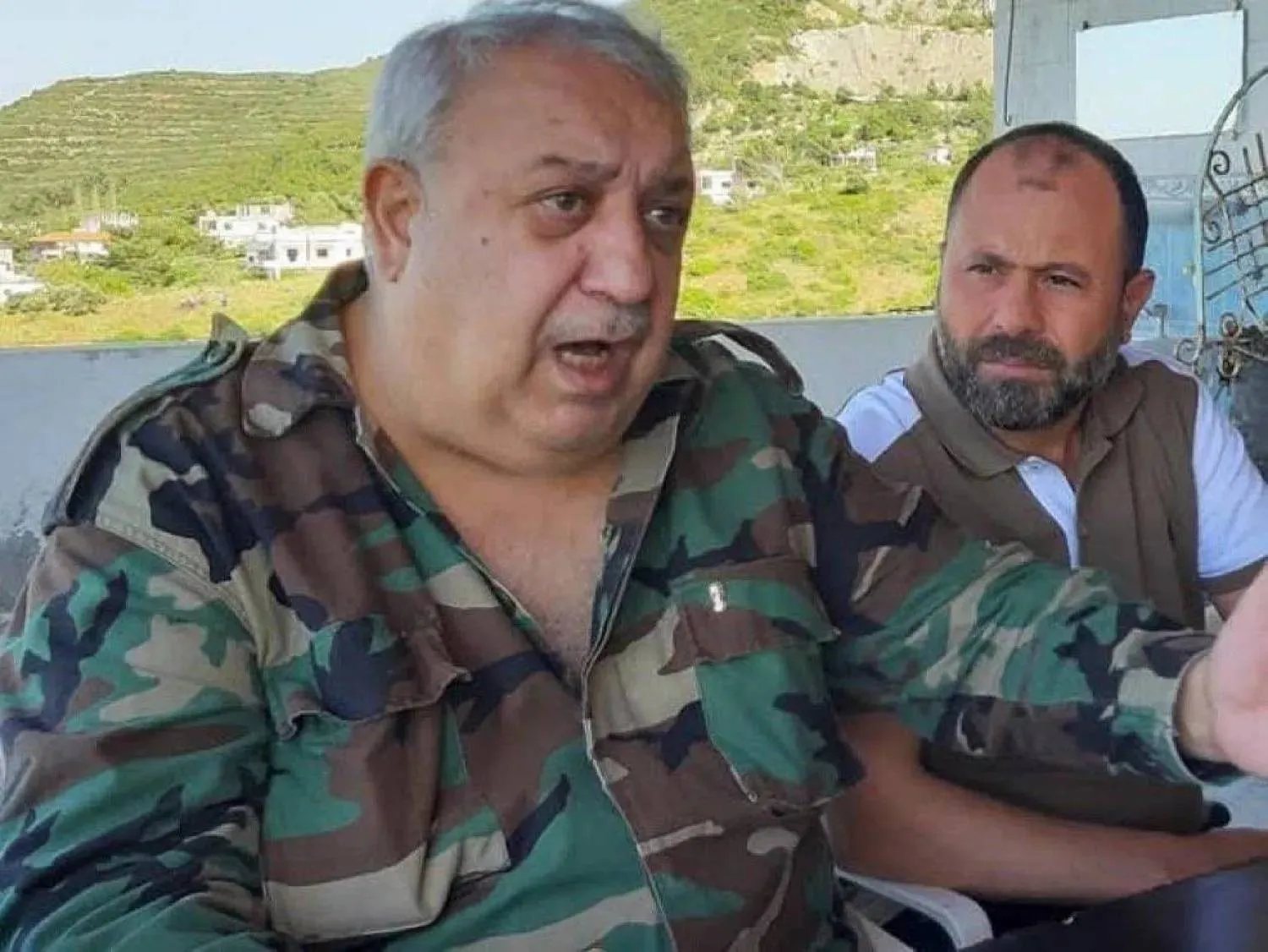

Lebanese judicial and security authorities are investigating the abduction of former Syrian regime officer Ali Kayali, also known as Mihrac Ural, from Mount Lebanon and his transfer to Syria in a covert operation that Lebanese officials say was carried out without their prior knowledge.
Accounts differed over how the operation was carried out and the route taken by those who seized him from the Metn area of Mount Lebanon into Syrian territory.
A day after the Syrian side announced the operation without any prior coordination with the Lebanese state, Public Prosecutor at the Court of Cassation Judge Ahmad Rami al-Haj issued judicial instructions to Lebanese Army Intelligence, the Internal Security Forces’ Information Branch and General Security, tasking them with investigating the circumstances of the operation and identifying those who carried it out.
Four Syrians and one Lebanese
A judicial source said preliminary information indicated that the operation was “carried out by four Syrians and one Lebanese.”
The source told Asharq Al-Awsat that tracking the phones used by those involved in the operation, as well as lines active around Kayali’s home, showed that they seized him inside his residence in Mansourieh before taking the coastal road through Jounieh and Tripoli to the Abboudieh border crossing in Akkar.
The source denied reports that Kayali had been taken to the Syrian Embassy compound in Yarzeh, saying footage from the embassy and surrounding surveillance cameras had been secured and showed that “he was never taken to the embassy.”
Syrian authorities accuse Kayali of responsibility for the 2013 massacres in al-Bayda and Baniyas on Syria’s coast, when he was leading an armed group fighting alongside forces loyal to Bashar al-Assad.
Human Rights Watch documented the execution of at least 248 people in the two areas, including women and children, and described the killings in al-Bayda as among the “deadliest instances of mass summary executions” in the Syrian conflict.
Conflicting accounts
Syrian and Lebanese accounts of the abduction differed.
Agence France-Presse quoted a Syrian security source as saying the operation “took place in coordination with the Lebanese side.”
The Lebanese judicial source, however, denied that Lebanese authorities had prior knowledge of it, saying Lebanese security agencies “were unaware that Kayali was in Lebanon or that he had been abducted until the Syrian side announced it.”
The source said security investigations conducted in recent hours showed that Kayali had entered Lebanon clandestinely with his wife in 2025 and had remained in hiding, moving with extreme caution until he was abducted.
According to information reported by Türkiye’s Anadolu news agency, Kayali was born in 1956 in Hatay province in southern Türkiye, near the Syrian border.
Ankara also accuses him of having led an armed group known as the “Syrian Resistance” and the “Popular Front for the Liberation of the Sanjak of Iskenderun,” and of involvement with Syrian intelligence under Bashar al-Assad in the Reyhanli bombings that killed 53 people.
Officers taking refuge in Lebanon
The incident has again brought attention to the flight of dozens of officers from the former Syrian regime to Lebanon following Bashar al-Assad’s departure and the fall of his government in late 2024.
The Lebanese judicial source said the case could not be separated from the arrest several weeks ago of Suleiman Hilal al-Assad, or the earlier detention of Major General Adel Issa inside the Syrian Embassy in Beirut. Lebanese judicial authorities later decided to hand Issa over to Damascus.
The source said the succession of such cases “indicates the presence in Lebanon of officers and figures from the former regime,” adding that some may be “receiving security protection from parties allied with the Assad regime, such as Hezbollah and others, while some are residing illegally or using forged documents to avoid having their identities discovered.”
The judicial source stressed that Lebanon “is cooperating with the Syrian authorities on correspondence concerning wanted figures from the former regime, and is also cooperating with international bodies on arrest requests and Interpol notices involving Syrian security officials accused of serious violations.”
Among the most prominent are former National Security Bureau chief Major General Ali Mamlouk, former Air Force Intelligence chief Major General Jamil Hassan, and Brigadier General Abdul Salam Mahmoud, former head of the Air Force Intelligence investigation branch.
The source said, however, that “no information has emerged indicating that they are present on Lebanese territory.”