


The Dachshund Is the Muse in an Exhibition Showcasing the Sausage Dog’s History in Art

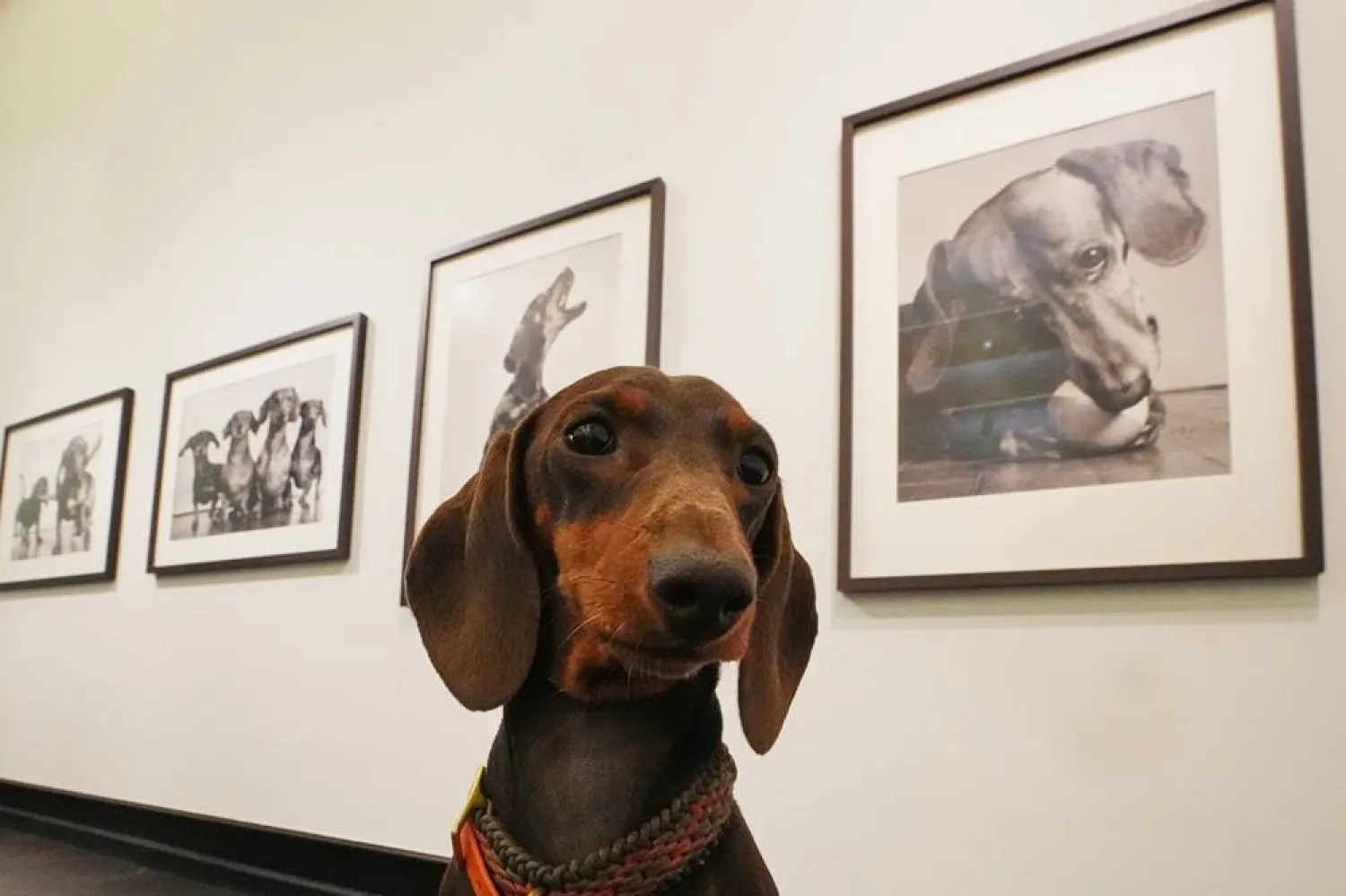
 A dog sits during the exhibition "The Dachshund: An Icon off the Leash," dedicated to dachshunds in art, at Kunsthalle Bremen in Bremen, Germany, Thursday, Oct. 29, 2026. (AP)
A dog sits during the exhibition "The Dachshund: An Icon off the Leash," dedicated to dachshunds in art, at Kunsthalle Bremen in Bremen, Germany, Thursday, Oct. 29, 2026. (AP)
TT

The Dachshund Is the Muse in an Exhibition Showcasing the Sausage Dog’s History in Art

 A dog sits during the exhibition "The Dachshund: An Icon off the Leash," dedicated to dachshunds in art, at Kunsthalle Bremen in Bremen, Germany, Thursday, Oct. 29, 2026. (AP)
A dog sits during the exhibition "The Dachshund: An Icon off the Leash," dedicated to dachshunds in art, at Kunsthalle Bremen in Bremen, Germany, Thursday, Oct. 29, 2026. (AP)

The humble dachshund is taking center stage in a new exhibition in Germany that explores the history of the sausage dog in art — and visitors are welcome to bring their four-legged friends along.

“The Dachshund: An Icon off the Leash" opens at the Kunsthalle Bremen on Saturday, showcasing artwork by dachshund owners and fans including Pablo Picasso, David Hockney and Andy Warhol. In addition to painting, drawing, photography and video, visitors can admire delights such as a wealth of stuffed toy dogs and many other dachshund-themed objects.

Museum director Christoph Grunenberg believes it's the world's first exhibition dedicated to the dachshund in art, rather than dogs in general.

“There are many artists who owned dachshunds, who were inspired by the dachshund, loved the dachshund,” Grunenberg said. “It was like a muse and there is an incredible wealth of representation of the dachshund in very different styles by significant artists.”

“We wanted to take the dachshund as an object, as an inspiration to artists, and trace it through history in all its different forms and important works of art by Picasso, Warhol and Hockney and also ephemera,” he added.

The dog has a long association with Germany. Kaiser Wilhelm II had dachshunds, or Dackel in German; and Britain's Queen Victoria was a fan of the dogs, some brought from Germany. But the show casts its net wider, with exhibits brought in from Edinburgh, Los Angeles and Pittsburgh among others.

German artist Thorsten Brinkmann honored the compact dogs’ reputation as a “handbag dog” with a bronze sculpture that features a handbag on dachshund legs. He also provided the colorful “Toxie Love” installation in the exhibition’s first room, which sets a playful tone for the show.

The dachshund, he said, has “a very curious, very special form, very long — kind of too long, actually, with the short legs — and it looks already surrealistic to me.” He was helped by objects loaned by the Dachshund Museum in Regensburg, in southern Germany.

For several hours on Thursdays and Saturdays, the museum will let dachshunds and other small dogs into three of its eight rooms for a look and a sniff.

Among the conditions: they must have a maximum shoulder height of 30 centimeters (about 1 foot) and an online time-slot ticket. A “Dachshund Lounge” will be offered as a waiting area.

“We want to take the dog seriously as a personality and the dog can walk around, can interact, will be able to watch videos, look outside the window, smell — and of course that’s what the dog really is interested in,” Grunenberg said.

Finnish photographer Elina Brotherus' dachshund, Marcello, already checked out the wares ahead of the opening of the exhibition, which features Brotherus' pictures of the 13-year-old dog.

Marcello has been her model since 2013, Brotherus said. “I did not manage to have children, so then we got him and he’s my baby.”

“There’s something so, like, cute and philosophical and special about these dogs,” she said.

Kelsey Crossman, a business developer who lives in Bremen and originally hails from Florida, was invited to a preview of the show at a dachshund meetup group and explored it with her dachshund, Leonidas, or Leo for short.

She said the dogs' appeal is in “their attitudes — they’re small, but they’re very strong and a little stubborn, probably like myself.” And, of course, they're light enough to be easily transported.

Crossman enjoyed the dachshund collectibles in Brinkmann's installation — “a really cool collection of little dachshunds that you might see at grandma’s house, or collectors' things, and a ton of stuffed animals.”

But, she added: “Leo is not allowed near them because he will certainly grab one from the exhibit.”



Denmark to Propose Mobile Phone Ban in Schools in 2027

22 October 2026, Schleswig-Holstein, Kiel: A man's hand reaches for a smartphone. (dpa)
TT

Denmark to Propose Mobile Phone Ban in Schools in 2027

22 October 2026, Schleswig-Holstein, Kiel: A man's hand reaches for a smartphone. (dpa)

Denmark will propose a ban on mobile phones in its primary and lower secondary school system as well as content filtering on the schools' network starting from the new academic year in 2027, the Danish education ministry said ‌on Monday.

Countries ‌including the Netherlands, ‌South ⁠Korea and Italy have ⁠banned smartphones in schools due to concerns over their impact on concentration and behavior, while Poland and the Czech Republic in June proposed ⁠a similar ban.

"Children ‌should be ‌able to go to school ‌without constantly being distracted by ‌things like social media, online shopping, and gaming," Education Minister Magnus Heunicke said in a statement.

The ‌ban also includes other private electronic devices with internet ⁠access.

⁠Content filters will be implemented to block websites that have no educational or pedagogical relevance, including social media, gaming and shopping sites, during lesson time.

It will be up to each municipality and school to decide which websites should be blocked.


Kuala Lumpur Otters Raise River Revival Hopes

This picture taken on October 19, 2026, shows a smooth-coated otter eating a fish along the bank of the Klang River in Kuala Lumpur. (AFP)
TT

Kuala Lumpur Otters Raise River Revival Hopes

This picture taken on October 19, 2026, shows a smooth-coated otter eating a fish along the bank of the Klang River in Kuala Lumpur. (AFP)

Beneath a tangle of highway in the Malaysian capital Kuala Lumpur, a family of otters rolls around in a patch of riverside sand, delighting the few passersby who notice them.

Small groups of otters are now being seen regularly in parts of the city, including along the once heavily polluted Klang River.

Theories vary on whether the smooth-coated otters, classed as vulnerable by the International Union for Conservation of Nature, have returned to the city or were hiding in plain sight all along.

But their presence has raised hopes that efforts to clean up the Klang may be bearing fruit, and could inspire further improvement.

The Klang was once one of the world's dirtiest waterways, designated a Class 5 severely polluted river under Malaysia's rankings.

Years of work improved it to Class 3, or moderately polluted, which seems to have encouraged the otters to move in, said Malaysian wildlife ecologist Woo Chee Yoong.

"Wherever there are otters, there are fish. Wherever there are fish it means the whole river system... (is) clean, it's healthy for all the communities around. So that's one of the importance of otters," he said.

In recent years, the animals have been filmed sunbathing on the river's concrete banks and swimming in front of elevated metro stations, winning viral fame.

Retired soldier Hasan Ujang, who lives in a riverside apartment, enjoys watching their antics.

"We feel really happy when we watch them playing and playing, like kids swimming," he said.

- 'They have to survive' -

But unlike otters in neighboring Singapore, which are closely monitored by a network of citizen scientists, little is known about Kuala Lumpur's otters.

Woo learned about them from local media reports on sightings in 2019 and the following year co-founded the Malaysian Otter Network (MON) conservation group.

"We don't know how many groups are there, we don't know how actually the otters are moving around," he said.

Even the question of whether the otters have returned to the capital or were simply in less visible city environments before remains a "mystery."

MON hopes to set up a citizen science system for people to report sightings.

Otters have been spotted elsewhere in the city, including at the Tropicana Golf & Country Resort, a high-end housing estate where they are less welcome visitors.

They are accused of raiding at least 12 houses in the past year. Their target: fish ponds.

Resident Yee Sze Mun, 89, said otters killed the beloved -- and expensive -- arowana fish he had nurtured for 15 years.

"They are a nuisance, but I can't blame them, because they are just like us, they have to survive," he said.

Residents say the incursions began last year after a company began clearing forest next door for a new development.

"We have an issue because they're losing their habitat," said residents' association president Joy Appukuttan, who called the otter attacks a "grave concern."

Tropicana's security team believes there are around 25 otters in the forest and the estate brought in Woo to teach residents how to deal with them.

The species is protected in Malaysia, so Woo urges residents to block entry points to their yards and install fences or netting over ponds.

- 'An asset' -

Maimunah Mohd Sharif, a former Kuala Lumpur mayor and now advisor to the city on sustainable urbanization, call the otters an "asset."

"Otters are one of the benchmarks for clean cities," she said.

Like others, she hopes a growing awareness of the Klang River otters can be harnessed to help improve the river further.

Hundreds of garbage traps were installed as part of the government's River of Life project, and solar-powered "interceptors" deployed by a Dutch NGO have collected tens of thousands of tons of waste.

Now Maimunah wants to see more done to stop waste entering the river in the first place, and efforts to make the Klang Class 2B status, clean enough for body contact.

"One day, I want to swim in the Klang River," she said.

Scarlett Koon Si Qi, a community architect and co-organizer of the annual Klang River Festival hopes the waterway can be restored to its natural banks without concrete lining.

"Some parts, maybe yes, you do need concrete to kind of protect and control for floods," she said.

"But I think wherever we can, we should leave it as natural as possible."

That would further benefit the otters, who need some vegetation and natural crevices to hide in, experts said.

The otters are already shifting views on the river, said Faith Foo, who runs the festival.

Growing up, "the teachers would always say that this is a very unsanitary place," he said.

But seeing the otters, "it's a reminder that that is a river."


JFK Anniversary Draws History Buffs to Movie Theater Where Oswald Was Arrested

A moviegoer sits in the seat associated with Lee Harvey Oswald's arrest before a screening of "War Is Hell" at the Texas Theatre in Dallas, Texas, on November 22, 2026, marking the 63rd anniversary of President John F. Kennedy’s assassination. (AFP)
TT

JFK Anniversary Draws History Buffs to Movie Theater Where Oswald Was Arrested

A moviegoer sits in the seat associated with Lee Harvey Oswald's arrest before a screening of "War Is Hell" at the Texas Theatre in Dallas, Texas, on November 22, 2026, marking the 63rd anniversary of President John F. Kennedy’s assassination. (AFP)

Every November 22, Duncan McQueen visits the Texas Theatre as part of his pilgrimage to sites associated with the assassination of President John F. Kennedy in Dallas.

But he never manages to sit in its most famous seat: the one occupied by assassin Lee Harvey Oswald when police arrested him.

"Every time I'm here too late, there's always somebody sitting there," he told AFP.

Located in Dallas's bohemian Oak Cliff neighborhood, the Texas Theatre became entwined with the tragedy through the highly publicized arrest, which took place shortly after the presidential motorcade came under fire a few miles away.

It embraces that connection by organizing "JFK Day," a time capsule marking the somber anniversary.

"That day... we do sort of lean into what happened here and commemorate it," Barak Epstein, who runs the Texas Theatre, told AFP.

In an effort to preserve this piece of American and film history, the theater screens the only surviving fragment of "War Is Hell," along with "Cry of Battle" -- the two movies showing that day, which might otherwise have been forgotten had they not been immortalized in photographs and video footage.

The double feature begins at 1:20 pm (1920 GMT), a few minutes before Oswald entered the theater to hide.

It is preceded by a video in which Johnny Brewer, the man who told police where Oswald was in 1963, warns the audience about the risks of entering without paying.

- 'Much more real' -

The Texas Theatre, which dates to 1931, is an essential stop on tours retracing the day that shook the nation.

It is a few kilometers from Elm Street, where two white X marks on the asphalt indicate where Kennedy was shot, and where dozens of people gathered Sunday to pay tribute on the 63rd anniversary of his death.

The historic building has undergone several alterations, Epstein explained during a tour of its two auditoriums.

Epstein said that, "in theoretical terms," both the second and fifth seats in row S have been identified as Oswald's based on photographs from that day.

But seat number five seems to have claimed that status among history buffs.

"It's symbolic," said Richard Pruett, who was waiting with his son to enter before the doors opened.

"It's a strange feeling because it makes it seem so much more real," Pruett said.

"You no longer have to rely on your imagination so much."

Pruett praised the theater's preservation after years of challenges posed by the growth of streaming, the pandemic and competition from major movie theater chains.

- Silver screen history -

"Today we're seeing this -- the same movie that Oswald was watching at the time he was arrested -- and... it's going to be airing at the same time as it did 63 years ago," he said.

"Most remarkably at the same price that it was airing 63 years ago," he added.

Tickets cost 90 cents, as they did in 1963, and visitors buy them at the original box office at the front of the building, just as audiences did then.

The Texas Theatre features in films such as Oliver Stone's "JFK." Stone sat in the same seat during a screening of his film on the anniversary in 2024.

It also appears in the new film "November 1963," which recounts the assassination from the Mafia's perspective and, as part of the special programming, premiered there on Saturday, with director Roland Joffe in attendance.

"What's very beautiful here is that this movie theater is very much alive," Joffe told AFP. "It has its own history, which makes it even more remarkable."

The theater makes one realize that "we're suddenly aware that history hasn't gone," the two-time Oscar nominee told the audience.

"We're just a part from it, with a slightly different stage, and it's therefore completely alive."