Will Lame Duck Trump Cause a Flap After the Midterms?

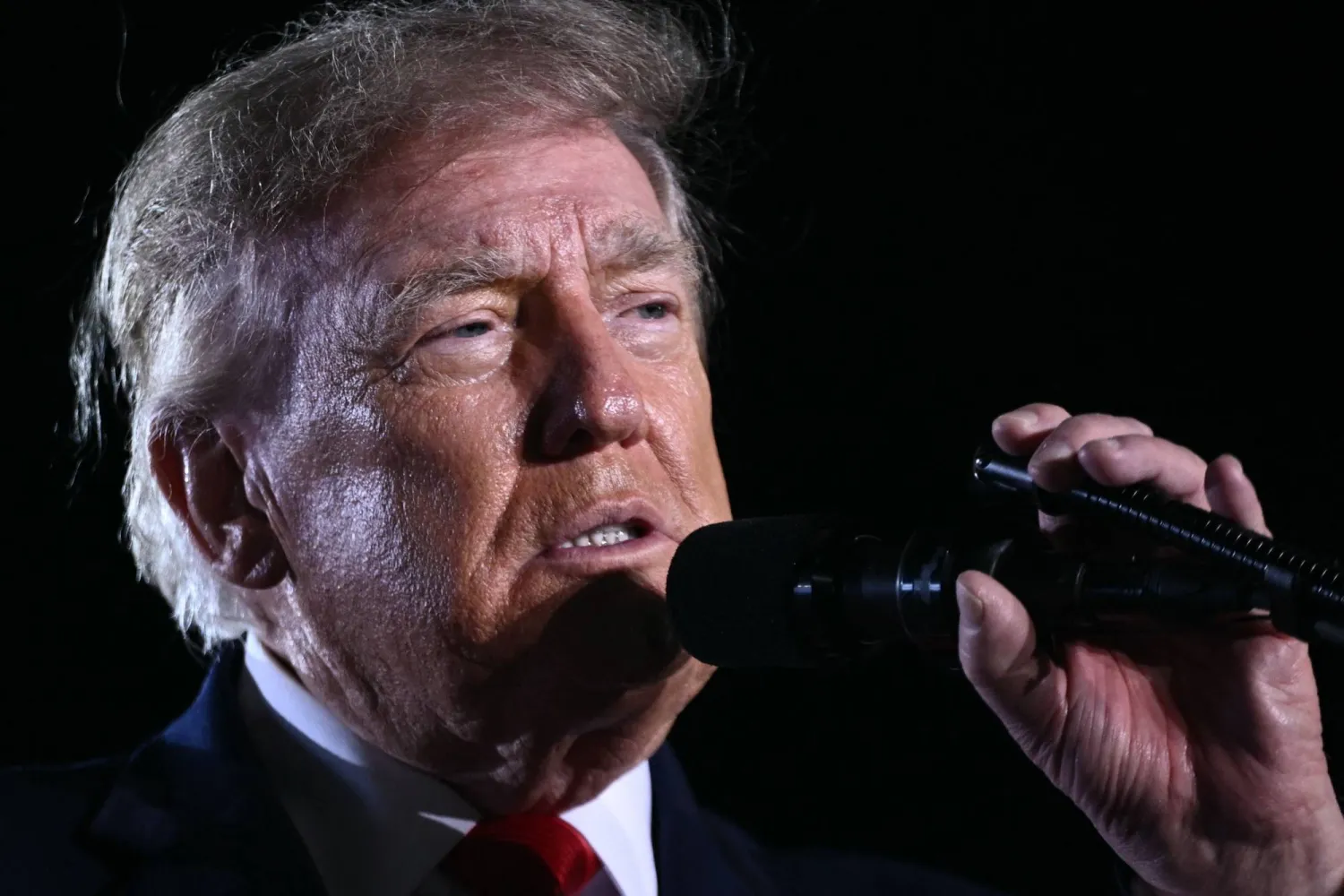
US President Donald Trump speaks at a midterm campaign rally at Salina Regional Airport in Salina, Kansas on November 1, 2026. (AFP)
TT

Will Lame Duck Trump Cause a Flap After the Midterms?

US President Donald Trump speaks at a midterm campaign rally at Salina Regional Airport in Salina, Kansas on November 1, 2026. (AFP)

Donald Trump struck a surprisingly conciliatory tone after the Democratic sweep of the US midterm elections rendered him a lame-duck president. How long that will last is anyone's guess.

From renewed military action against Iran to vetoing Democratic legislation, the volatile 80-year-old could still use his remaining powers to cause major disruption in his last two years in office.

"Every time Trump has been backed into a corner, he has shouted more and come out fighting," Peter Loge, director of George Washington University's School of Media and Public Affairs, told AFP.

- Vetoes -

Trump congratulated the Democrats on Tuesday and said he would be ready to work with them. He may have to, especially if Republicans turn on him over a defeat many of them blame on the Iran war.

But at the same time Trump repeatedly boasted of his executive power to veto any Democratic legislation that crosses his desk in the Oval Office. He even posted a picture of a red baseball cap with the word "VETO."

Trump's administration has reportedly drawn up a plan to use executive orders to push through his hardline immigration policies, much as he did in his first 100 days of his second term.

The twice-impeached Trump, the first convicted criminal ever to be elected president, has said he is also ready to fight back against Democratic-led investigations.

- Iran -

Foreign policy is the one area in which lame-duck US presidents still have wide-ranging powers.

Trump may renew large-scale military operations against Iran, although he indicated on Tuesday that he was still seeking a deal to end the war he launched in February.

"Otherwise, I'll just finish the job," he told Fox News.

"I don't think he wants his legacy to be a warmonger. He wants his legacy to have left America stronger," Ryan Hass of the Brookings Institution told AFP.

Trump also dismissed speculation that he could fire Pentagon chief Pete Hegseth as the Iran war drags on, as part of a cabinet reshuffle.

- Ukraine, detente and trade -

Trump has long wanted to be seen as a peacemaker and is likely to continue to push Ukraine to agree to a settlement with Russia. Fresh trilateral talks are set for next week.

But Trump's leverage with the leaders he views as his great power equals -- Chinese President Xi Jinping and Russian President Vladimir Putin -- may be hit by his midterms defeat.

The election hammering comes less than two weeks before the three could potentially meet at a summit in China later this month.

- Monuments to himself -

Construction tycoon Trump may however choose to step back from confrontation and focus on his favorite subject -- stamping his physical legacy on Washington.

In his closing midterms speech, Trump barely mentioned policy and instead talked about his renovation of the Lincoln Memorial Reflecting Pool and other plans to beautify Washington.

His pride and joy is the giant $400 million ballroom that he is building at the White House, and which is due to be completed in late 2028 -- shortly before he leaves office for good.


Report: Unclassified Info Exposed in CIA Cybersecurity Breach

FILE - The seal of the Central Intelligence Agency is displayed at CIA headquarters in Langley, Va., April 13, 2016. (AP Photo/Carolyn Kaster, File)
TT

Report: Unclassified Info Exposed in CIA Cybersecurity Breach

FILE - The seal of the Central Intelligence Agency is displayed at CIA headquarters in Langley, Va., April 13, 2016. (AP Photo/Carolyn Kaster, File)

A cybersecurity breach at the CIA and the Office of the Director of National Intelligence (ODNI) exposed some unclassified information, US media reported Tuesday.

The New York Times said the recently discovered intrusions targeted an open-source intelligence analysis system, a computer network that sifts through public, unclassified material for insights.

The newspaper, citing US officials and people familiar with the issues, said that classified material was not jeopardized.

The Times quoted an ODNI official as saying that there had been no disruptions to critical capabilities. It said the CIA declined comment.

The report comes several days after the Agriculture Department and FBI were reportedly targeted in cyberattacks, and amid mounting concerns over the security of US computer systems following a wave of major technical outages.

Asked about the reported FBI breach on Saturday, President Donald Trump said he had only recently learned of it.

"I will say that it's not good. I don't like that," he told Fox News.

The outages in recent weeks have disrupted travel, communications and e-commerce for countless users across the United States, even affecting a top-secret network at the National Security Agency.

White House cybersecurity chief Sean Cairncross was fired last week as criticism mounted over the spate of issues.


Israeli Defense Minister Says Iran Developing Chemical Weapons

Israeli Foreign Minister Israel Katz waits for his British and French counterparts ahead of a meeting, amid the conflict between Israel and Hamas, in Jerusalem August 16, 2024. (Reuters)
TT

Israeli Defense Minister Says Iran Developing Chemical Weapons

Israeli Foreign Minister Israel Katz waits for his British and French counterparts ahead of a meeting, amid the conflict between Israel and Hamas, in Jerusalem August 16, 2024. (Reuters)

Israeli Defense Minister Israel Katz said on Tuesday that Iran is developing chemical weapons, and vowed to stop Tehran from obtaining them.

"Iran is in the process of developing chemical weapons," Katz said in a briefing to Israeli reporters, according to public broadcaster KAN and other national outlets.

"The State of Israel will not allow them to reach that capability."


Eisenkot Backs Netanyahu Opponents: No Urgent Need to Attack Iran Now

Former military chief Gadi Eisenkot, leader of the Yashar party arrives to speak at the Knesset, Israel's parliament in Jerusalem, November 23, 2026. REUTERS/Ronen Zvulun
TT

Eisenkot Backs Netanyahu Opponents: No Urgent Need to Attack Iran Now

Former military chief Gadi Eisenkot, leader of the Yashar party arrives to speak at the Knesset, Israel's parliament in Jerusalem, November 23, 2026. REUTERS/Ronen Zvulun

Israeli military and security chiefs, who believe a third war with Iran is only a matter of time, have gained support from Gadi Eisenkot, leader of the Yashar party and the politician tasked with forming Israel's next government, as well as senior figures in his political camp.

Their backing has strengthened the security establishment's position against outgoing caretaker Prime Minister Benjamin Netanyahu, with Eisenkot arguing that another war with Iran is not an urgent necessity.

The disagreement over Iran spilled into the media after Netanyahu and Eisenkot clashed over a potential strike against Tehran.

Netanyahu accused his political rival of downplaying the security threats facing Israel for political reasons after Eisenkot openly questioned whether Iran posed an immediate threat.

Netanyahu

Speaking at a Likud faction meeting in the Knesset, Netanyahu said: "Our ability to ensure the existence of the state in the face of the major threats surrounding us depends on our unity. Anyone who mocks or downplays these threats is doing so for political reasons."

His remarks came amid reports that he is pushing to resume military operations against Iran, a move opposed by military and security officials who believe he wants to trigger a confrontation to delay the formation of a new government.

Eisenkot

Eisenkot openly backed military and security leaders, telling a meeting of his Yashar faction that he saw no immediate Iranian threat requiring military action before the new government is sworn in.

He argued that rather than conducting further military operations, Israel should focus on Iran's stockpile of enriched uranium.

"The gravest threat from Iran is the 440 kilograms of enriched uranium that have still not been destroyed or removed. We must focus on that," he said.

The dispute between Netanyahu and Eisenkot reflects part of the broader political and security debate in Israel.

Israeli public broadcaster Kan reported that while Netanyahu is pushing for war with Iran, the security establishment believes alternatives remain available.

These include the possibility of reaching an agreement, maintaining the blockade and economic pressure, or undertaking military action in coordination with the United States.

An informed source told Kan that US President Donald Trump is not inclined to make such a decision at present, as Iran's economic difficulties have strengthened the position of those advocating continued economic pressure rather than war.

A second reason Trump and others oppose an immediate war is the assessment that another strike would not bring down the government in Tehran.

Beyond Eisenkot, other figures in Israel's pro-change political camp have criticized Netanyahu and warned against taking the country into another war, particularly with Iran.

Lieberman

The Maariv newspaper quoted Yisrael Beytenu leader Avigdor Lieberman as saying during a closed meeting of the Knesset Foreign Affairs and Defense Committee's intelligence subcommittee, attended by military Chief of Staff Eyal Zamir and Knesset Speaker Matan Kahana, that any war against Iran at this stage would be driven by political and personal considerations.

"Reports have emerged that Iran is seeking to acquire chemical weapons. If true, this constitutes a serious threat, but it neither requires nor justifies immediate unilateral action without American involvement," Lieberman said.

"The concern is that Netanyahu may see an attack on Iran as his last political way out. If he decides to attack Iran alone, without cooperation with the United States, that would clearly be an illegal act," he added.

Golan

Yair Golan, leader of the left-wing Democrats party, also joined those accusing Netanyahu of attempting to drag Israel into another war with Iran for political reasons.

Netanyahu's position is based on alleged developments in Iran's chemical weapons program, which Mossad chief Roman Gofman reportedly presented to American officials during a visit to Washington approximately two weeks ago.

Eisenkot and military commanders, however, believe the current Iranian threat does not warrant immediate action.

Mossad

Divisions over Iran have also emerged within Mossad.

According to Haaretz, researchers within the intelligence agency concluded during recent discussions that there was no immediate need for military action against Iran.

Their assessment contrasts with the position of Mossad chief Roman Gofman, Netanyahu's former military secretary, who is reportedly advocating renewed strikes against the Islamic Republic.

Military Experts

Experts in Israel estimate that it could take Iran two years or more to develop a system capable of delivering chemical weapons to Israel.

Writing in Maariv on Tuesday, military commentator Avi Ashkenazi said the Israeli military remains on high alert, both defensively and in its preparations for potential offensive operations.

According to Ashkenazi, the military believes it could be called upon to launch an offensive under one of three scenarios.

The first would involve Iran initiating military action. The second would see Trump ordering the start of a military campaign in the near future. The third, considered the least realistic, would involve Israel launching a military campaign on its own.

"At present, there is a consensus within the Israeli military and security establishment that there is no urgent need to enter into a confrontation with Iran alone," Ashkenazi wrote.

He added that a confrontation would eventually come, as Israel would have to undertake military action to inflict cumulative damage capable of destabilizing the Iranian government, setting back its offensive capabilities and weakening it militarily, economically and politically.

He emphasized that Israel would prefer to enter such a confrontation alongside the Americans.

Ashkenazi also argued that Trump is in no hurry to act because the blockade and sanctions are producing results.

With winter approaching and Iran facing an energy crisis, the situation is likely to become increasingly complicated, he said.

"The paradox is that the party most eager for war to break out at this stage is the Iranian regime itself, which sees war as a dual opportunity to remove the noose from around its neck," Ashkenazi concluded.