Israeli Army Ends Overt Incursion in Central Gaza: What Did It Achieve?

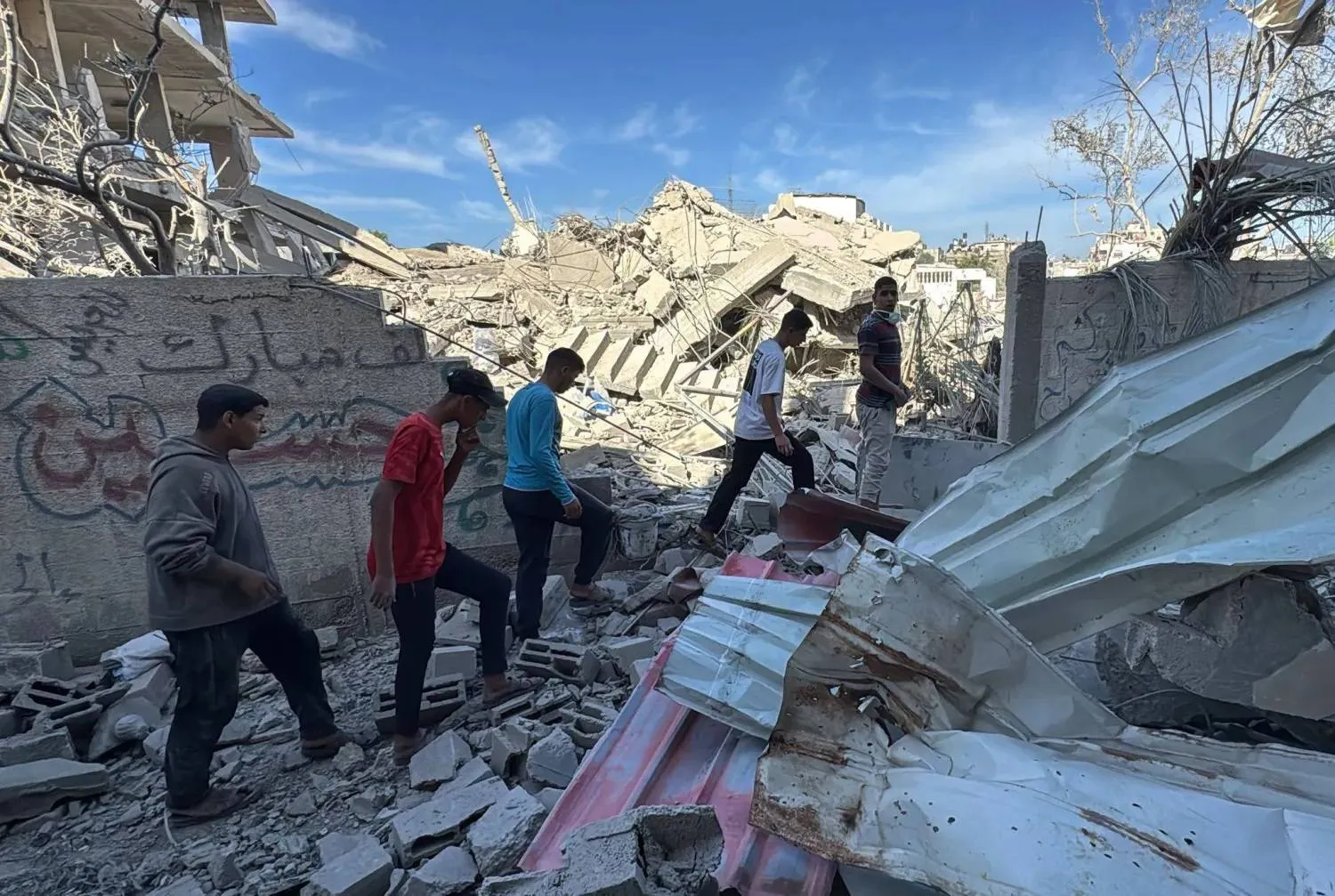
Palestinians inspect widespread destruction to homes and shelters for displaced people on Thursday following an Israeli military incursion east of the Al-Maghazi refugee camp in central Gaza (dpa)
TT

Israeli Army Ends Overt Incursion in Central Gaza: What Did It Achieve?

Palestinians inspect widespread destruction to homes and shelters for displaced people on Thursday following an Israeli military incursion east of the Al-Maghazi refugee camp in central Gaza (dpa)

The Israeli military announced on Wednesday that it had ended an incursion into three areas along the “Yellow Line,” north of the Bureij and Nuseirat refugee camps in central Gaza, after nearly 24 hours of military activity.

Since the ceasefire agreement was announced in October 2025 under US President Donald Trump's plan, an imaginary boundary known as the “Yellow Line” has separated Israeli-occupied areas east of the line, which account for more than 60% of the Gaza Strip, from areas to the west that remain under the partial control of Hamas and other Palestinian factions.

For more than two years, Israel has carried out targeted killings, bombardments and forced displacement, while expanding the territory under its occupation without formally announcing those expansions.

An Israeli military official said troops had completed their operations and reopened Salah al-Din Road, Gaza's main thoroughfare, to traffic after closing it when the incursion began around midday Wednesday.

The official also warned Gaza residents against crossing the “Yellow Line” or approaching Israeli forces operating in the area, saying doing so could endanger their lives.

But eyewitnesses disputed the army's account, saying the road remained closed despite the troop withdrawal. Israeli forces had left earthen barriers in place, preventing vehicles from passing, they said.

A source from a Palestinian faction in Gaza told Asharq Al-Awsat that the barriers could not be removed without bulldozers, whose entry would require security coordination with Israel.

Israeli troops remain stationed just dozens of meters from the site of the incursion, the source said.

Returning residents confront widespread destruction

Hundreds of displaced Palestinians returned to their tents in the Al-Daawa neighborhood north of Nuseirat refugee camp as soon as the Israeli withdrawal was confirmed.

More than 1,500 families, comprising 6,000 people, were forced to flee during the incursion, according to the Hamas-run government media office.

The Israeli operation left extensive damage to homes, industrial facilities and farmland after troops carried out large-scale bulldozing.

Israeli forces also detonated a large explosive charge after withdrawing.

The scale and nature of the blast resembled explosions used by Israeli forces to destroy tunnels, lending weight to an assessment by a source on the ground who told Asharq Al-Awsat on Wednesday that destroying a tunnel was the likely objective.

The source pointed to earlier excavation work in the Ard al-Rayyis area, inside the Yellow Line and near Salah al-Din Road.

Israeli Army Radio reported late Wednesday that the operation was aimed at destroying a tunnel discovered in the area that extended to a newly established Israeli military position inside the Yellow Line and could threaten Israeli troops.

The operation was coordinated with the United States, which had been informed in advance, the radio station said.

Israeli forces had operated extensively in the area throughout the war, carrying out repeated bulldozing operations, but had never announced the discovery of a tunnel there.

Mediators press to halt Israeli operations

Hamas fiercely criticized the incursion, calling it a flagrant breach of the ceasefire and urging Washington and countries guaranteeing the agreement to halt Israeli violations.

The group accused Israel of seeking to confine Gaza's population to a narrow strip in the west of the enclave.

Israeli Army Radio had reported Wednesday that the operation was expected to last several days.

But a senior Hamas official outside Gaza told Asharq Al-Awsat that the group's leadership had contacted mediators, who said they were in talks with the United States and the Board of Peace to stop the violations.

The mediators expressed anger over Israel's military operations and territorial expansion in Gaza, according to the official.

They pledged to press for an end to the violations and greater security stability to improve humanitarian conditions and advance implementation of the agreements already reached.

Before Israeli troops withdrew, Hamas spokesperson Hazem Qassem said the escalation was intended to destroy what remained of Gaza and pave the way for a plan to displace its population.

He called for the implementation of resolutions adopted at Arab summits to confront the plan.

The Board of Peace, which oversees Trump's plan to end the Gaza war, had accused both Israel and Hamas of failing to meet their commitments to end hostilities, warning that the failures were worsening conditions for Palestinians and threatening the ceasefire.

The assessment appeared in a 12-page report seen by Reuters, the second submitted by the board to the United Nations Security Council since the US-backed ceasefire took effect 13 months ago.

The board is expected to present its findings at a Security Council meeting in New York in late November.

"The gap between what was agreed and what is happening on the ground remains the main threat to the process," the report said.

It warned that a ceasefire that fails to deliver tangible results cannot last indefinitely.

Hamas condemned the board's statement, accusing it of drawing an unacceptable equivalence between Israeli aggression and Palestinian victims.

The group said the statement reflected a biased approach that provided political cover for Israeli violations.


Berri: Southern Lebanon Will Not Become a Buffer Zone

The entrance to the village of Zawtar al-Gharbiya in southern Lebanon as the Lebanese army deployed following the withdrawal of Israeli forces on July 21 (File photo: Reuters)
TT

Berri: Southern Lebanon Will Not Become a Buffer Zone

The entrance to the village of Zawtar al-Gharbiya in southern Lebanon as the Lebanese army deployed following the withdrawal of Israeli forces on July 21 (File photo: Reuters)

Calls for sovereignty, the liberation of occupied territory and the protection of national institutions dominated statements by Lebanon's political, military and security officials on the eve of the country's 83rd Independence Day.

Parliament Speaker Nabih Berri stood out for his assertion that southern Lebanon "will never be a buffer zone for any entity. It will belong only to its people and will remain Lebanese."

Equally notable were remarks by Lebanese Army Commander General Rodolphe Haykal, who affirmed that the military was "committed to ensuring the successful implementation of the political leadership's decisions and existing agreements."

His comments followed criticism over earlier remarks in which he referred to the army's "national policy," interpreted by some as suggesting a position distinct from that of the political leadership.

Statements marking Independence Day reflected a broad consensus on the need to restore sovereignty, extend state authority across all Lebanese territory, uphold the decisions of the political leadership and strengthen the role of military and security institutions in safeguarding domestic stability.

Berri: South Lebanon will never become a buffer zone for any entity

Parliament Speaker Nabih Berri said Lebanon's independence would remain incomplete as long as Israel continued to occupy Lebanese territory, stressing that liberating the land, securing the return of displaced residents to their villages, rebuilding devastated areas and freeing prisoners were "national duties."

He reiterated that the south "will never be a buffer zone for any entity. It will belong only to its people and will remain Lebanese."

In a message ahead of the 83rd anniversary of independence, Berri called for the occasion to serve as an opportunity to renew commitment to national priorities, free from sectarian, religious, partisan and regional considerations.

"Occupation, regardless of who carries it out, is the antithesis of independence," he said, adding that liberation from Israeli occupation should not be a matter of disagreement among Lebanese.

Berri stressed the need to liberate occupied territory "by all available means guaranteed under international law," ensure the dignified return of residents to their villages and towns, rebuild damaged areas and secure the release of prisoners.

He said abandoning these responsibilities or relinquishing any of Lebanon's sources of strength, foremost among them national unity, would amount to compromising the country's sovereignty and independence.

In a notable endorsement of the military's role, Berri placed the Lebanese army at the heart of efforts to safeguard independence and sovereignty.

"The Lebanese army, from its commander and officers to its noncommissioned officers and soldiers, is the cornerstone through which independence is preserved and protected," he said.

He called for providing the military with all the resources necessary to fulfill its national duties and warned against campaigns aimed at undermining its credibility or discrediting its role and sacrifices.

Haykal: Army committed to implementing political leadership's decisions and existing agreements

Lebanese Army Commander General Rodolphe Haykal said the military was committed to ensuring the successful implementation of the political leadership's decisions and existing agreements.

He stressed that the army would continue deploying across southern Lebanon and extending state authority throughout the country, a process that requires "placing all weapons exclusively under state control."

Haykal said the military continued to carry out its duties despite difficulties and dangers, while "the Israeli occupation continues to violate these agreements and evade its obligations, obstructing the army's efforts and threatening Lebanon's security and stability."

He said the continued Israeli occupation, attacks and violations made "restoring sovereignty over our entire territory an unwavering national priority."

Haykal also emphasized the need to raise the army's operational readiness, particularly as the United Nations Interim Force in Lebanon (UNIFIL) approaches the end of its mission and preparations get underway for the next phase.

On security matters, he reaffirmed the army's commitment to monitoring and securing Lebanon's northern and eastern borders with Syria, patrolling territorial waters and combating terrorism, organized crime, drug trafficking and smuggling.

He said safeguarding independence also required "strengthening the home front, preserving national unity, stability and civil peace."

Warning against attempts to incite divisions that could threaten Lebanese unity, Haykal stressed that "the military institution stands at an equal distance from all parties."

For his part, Director General of State Security Major General Edgar Lawandos said the current phase required "greater firmness in enforcing the law," readiness to carry out assigned duties and unwavering adherence to the political leadership's decisions "in service of the supreme national interest, without hesitation."

He praised security personnel for their efforts to combat organized crime and drug trafficking and protect state institutions and facilities from corruption.

"Protecting independence begins with protecting the unity of our national institutions," Lawandos said.


Israeli Army Ends Overt Incursion in Central Gaza: What Did It Achieve?

Palestinians inspect widespread destruction to homes and shelters for displaced people on Thursday following an Israeli military incursion east of the Al-Maghazi refugee camp in central Gaza (dpa)
TT

Israeli Army Ends Overt Incursion in Central Gaza: What Did It Achieve?

Palestinians inspect widespread destruction to homes and shelters for displaced people on Thursday following an Israeli military incursion east of the Al-Maghazi refugee camp in central Gaza (dpa)

The Israeli military announced on Wednesday that it had ended an incursion into three areas along the “Yellow Line,” north of the Bureij and Nuseirat refugee camps in central Gaza, after nearly 24 hours of military activity.

Since the ceasefire agreement was announced in October 2025 under US President Donald Trump's plan, an imaginary boundary known as the “Yellow Line” has separated Israeli-occupied areas east of the line, which account for more than 60% of the Gaza Strip, from areas to the west that remain under the partial control of Hamas and other Palestinian factions.

For more than two years, Israel has carried out targeted killings, bombardments and forced displacement, while expanding the territory under its occupation without formally announcing those expansions.

An Israeli military official said troops had completed their operations and reopened Salah al-Din Road, Gaza's main thoroughfare, to traffic after closing it when the incursion began around midday Wednesday.

The official also warned Gaza residents against crossing the “Yellow Line” or approaching Israeli forces operating in the area, saying doing so could endanger their lives.

But eyewitnesses disputed the army's account, saying the road remained closed despite the troop withdrawal. Israeli forces had left earthen barriers in place, preventing vehicles from passing, they said.

A source from a Palestinian faction in Gaza told Asharq Al-Awsat that the barriers could not be removed without bulldozers, whose entry would require security coordination with Israel.

Israeli troops remain stationed just dozens of meters from the site of the incursion, the source said.

Returning residents confront widespread destruction

Hundreds of displaced Palestinians returned to their tents in the Al-Daawa neighborhood north of Nuseirat refugee camp as soon as the Israeli withdrawal was confirmed.

More than 1,500 families, comprising 6,000 people, were forced to flee during the incursion, according to the Hamas-run government media office.

The Israeli operation left extensive damage to homes, industrial facilities and farmland after troops carried out large-scale bulldozing.

Israeli forces also detonated a large explosive charge after withdrawing.

The scale and nature of the blast resembled explosions used by Israeli forces to destroy tunnels, lending weight to an assessment by a source on the ground who told Asharq Al-Awsat on Wednesday that destroying a tunnel was the likely objective.

The source pointed to earlier excavation work in the Ard al-Rayyis area, inside the Yellow Line and near Salah al-Din Road.

Israeli Army Radio reported late Wednesday that the operation was aimed at destroying a tunnel discovered in the area that extended to a newly established Israeli military position inside the Yellow Line and could threaten Israeli troops.

The operation was coordinated with the United States, which had been informed in advance, the radio station said.

Israeli forces had operated extensively in the area throughout the war, carrying out repeated bulldozing operations, but had never announced the discovery of a tunnel there.

Mediators press to halt Israeli operations

Hamas fiercely criticized the incursion, calling it a flagrant breach of the ceasefire and urging Washington and countries guaranteeing the agreement to halt Israeli violations.

The group accused Israel of seeking to confine Gaza's population to a narrow strip in the west of the enclave.

Israeli Army Radio had reported Wednesday that the operation was expected to last several days.

But a senior Hamas official outside Gaza told Asharq Al-Awsat that the group's leadership had contacted mediators, who said they were in talks with the United States and the Board of Peace to stop the violations.

The mediators expressed anger over Israel's military operations and territorial expansion in Gaza, according to the official.

They pledged to press for an end to the violations and greater security stability to improve humanitarian conditions and advance implementation of the agreements already reached.

Before Israeli troops withdrew, Hamas spokesperson Hazem Qassem said the escalation was intended to destroy what remained of Gaza and pave the way for a plan to displace its population.

He called for the implementation of resolutions adopted at Arab summits to confront the plan.

The Board of Peace, which oversees Trump's plan to end the Gaza war, had accused both Israel and Hamas of failing to meet their commitments to end hostilities, warning that the failures were worsening conditions for Palestinians and threatening the ceasefire.

The assessment appeared in a 12-page report seen by Reuters, the second submitted by the board to the United Nations Security Council since the US-backed ceasefire took effect 13 months ago.

The board is expected to present its findings at a Security Council meeting in New York in late November.

"The gap between what was agreed and what is happening on the ground remains the main threat to the process," the report said.

It warned that a ceasefire that fails to deliver tangible results cannot last indefinitely.

Hamas condemned the board's statement, accusing it of drawing an unacceptable equivalence between Israeli aggression and Palestinian victims.

The group said the statement reflected a biased approach that provided political cover for Israeli violations.


5 Arrested Hezbollah Members Deny North Lebanon Plot

Hezbollah supporters chant slogans during the second anniversary commemoration of Hassan Nasrallah’s assassination (dpa)
TT

5 Arrested Hezbollah Members Deny North Lebanon Plot

Hezbollah supporters chant slogans during the second anniversary commemoration of Hassan Nasrallah’s assassination (dpa)

Lebanon’s military judiciary is investigating five suspected Hezbollah members arrested last week in the remote highlands of northern Lebanon, as Lebanese Forces leader Samir Geagea called for a broader investigation into the group's military and security wing.

First Military Investigating Judge Ghada Abu Alwan is expected to question the suspects, who were arrested in the mountainous outskirts of the Batroun and Bcharre districts.

Geagea said the cell was an extension of Hezbollah's military and security wing and accused the authorities of turning a blind eye to an armed group operating outside the law.

Judge Claude Ghanem, the government commissioner to the Military Court, charged the five with forming armed groups equipped with light and medium weapons and military gear, undermining internal state security and possessing weapons without a license. The offenses carry penalties of up to hard labor.

Documents Detail Weapons, Locations

A source familiar with the investigation told Asharq Al-Awsat that prosecutors relied on documents and papers seized from the suspects days after their arrest.

The documents listed towns and pinpointed their locations in the Bcharre, Batroun and Koura districts.

Other documents detailed weapons used by the groups, including rocket-propelled grenades (RPGs), military machine guns, including PKC machine guns, explosive devices and a weapons depot, the source said.

But they did not specify where the weapons were kept.

Suspects Deny Plot, Say Mission Was to Protect Shiite Villages

The five suspects denied during preliminary questioning that they had planned any security operation in the predominantly Christian areas, according to the source.

Instead, they said their mission was to protect Shiite villages in those areas from attacks and counter any Israeli assault or airborne landing operation.

They also said they were tasked with handling the displacement of residents from Shiite areas in southern Lebanon and the Bekaa Valley if another Israeli war broke out.

Prosecutions Stop Short of Hezbollah Leadership

Judicial proceedings have so far targeted Hezbollah members but not the group's leaders.

The same approach has been followed in the Dahr al-Baidar explosives case and a separate case involving a group found at a weapons warehouse in the Ras al-Nabaa area about two months ago.

The source said the judiciary was pursuing the cases under a Lebanese government decision banning Hezbollah's military and security activities. Prosecutions have been limited to those detained.

Asked whether the judiciary could charge Hezbollah as an organization or prosecute its leaders, the source said: "The judiciary cannot take such action as long as the Lebanese state has not designated Hezbollah a terrorist organization."

The investigation could widen if new evidence emerges or additional suspects are identified.

The source said investigators had identified three more Hezbollah members linked to the cell.

The Information Branch is expected to summon them for questioning and take their statements on the instructions of the government commissioner to the Military Court.

But the source doubted they would appear, fearing they could be detained.

Geagea Calls for Hezbollah Military Officials to Be Summoned

Geagea urged authorities to pursue those he described as the officials behind Hezbollah's military and security wing, arguing that the five detainees were part of a much larger armed organization.

In a statement issued by his media office, he cited charges against the five men arrested in a remote area between Bcharre, Koura and Batroun, including forming an armed group, recruiting and equipping members, and supplying them with weapons.

The charges involved offenses against internal state security.

"After these clear and explicit charges, the authorities can no longer continue their policy of leniency and turning a blind eye," Geagea said.

He said the five suspects had admitted belonging to Hezbollah and that party officials had confirmed their affiliation and demanded their release.

Geagea argued that the armed group identified by prosecutors extended well beyond the five detainees.

"The five individuals arrested did not form an armed group on their own," he said. "They are a very small part of a much larger armed group - Hezbollah's military and security wing."

He called on the authorities to take the findings into account and expand the investigation to include officials responsible for that wing.

Those officials, he said, were responsible for an armed group operating outside the law and threatening Lebanon's internal state security.