

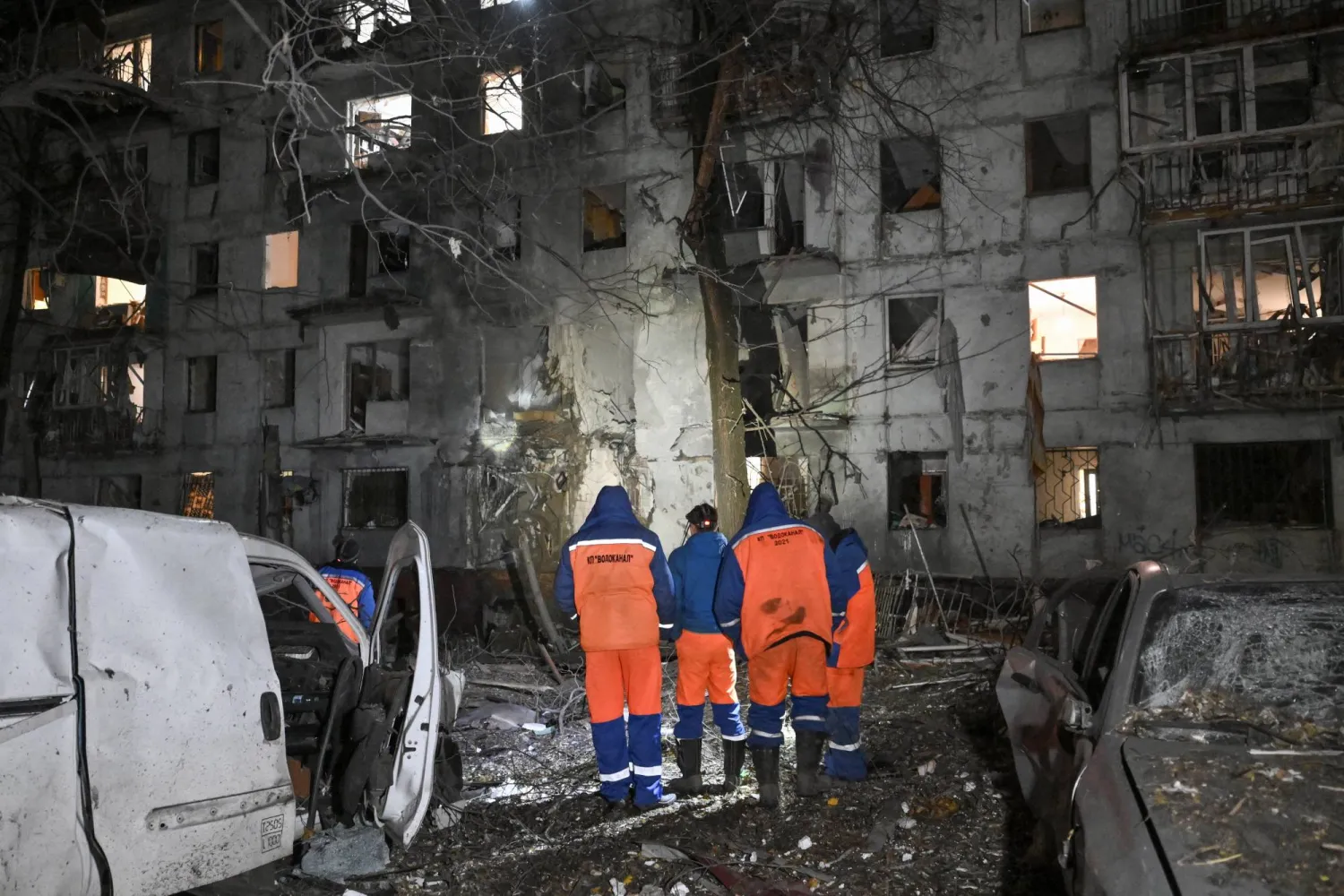

Ukraine to Restrict Reporting on Impact of Russian Strikes

Municipal employees stand in front of an apartment building hit by a Russian air strike, amid Russia's attack on Ukraine, in Zaporizhzhia, Ukraine November 24, 2026. REUTERS/Stringer
TT

Ukraine to Restrict Reporting on Impact of Russian Strikes

Municipal employees stand in front of an apartment building hit by a Russian air strike, amid Russia's attack on Ukraine, in Zaporizhzhia, Ukraine November 24, 2026. REUTERS/Stringer

Ukraine on Saturday said it would restrict media outlets from publishing details about the impact of Russian strikes on critical infrastructure, as Moscow steps up its bombardments ahead of winter.

A decree issued by President Volodymyr Zelensky ordered his government to "take urgent measures to prohibit the media from covering information about the consequences of destruction and the timelines for restoring critical infrastructure facilities".

Since Russia invaded Ukraine in 2022, both countries have implemented degrees of military censorship.

Ukraine has typically urged media outlets not to publish information about the damage or location of Russian strikes, arguing it helps Moscow's army target future attacks.

Russia has imposed similar restrictions and also criminalized swathes of reporting and public commentary on the war -- including through a ban on calling the offensive an "invasion".

Last week Russian lawmakers proposed bills that the Institute for the Study of War said would "prohibit independent and unauthorized reporting on the aftermath of Ukrainian strikes", threatening fines or jail for violations.

Zelensky's decree would also stop the publication of information about the construction and condition of "protective structures" at critical sites, AFP reported.

The measures were proposed at a security council meeting last month, the decree stated.

It did not say how the measures would be enforced.

Dmytro Lytvyn, an adviser to Zelensky conceded Saturday it would be "complicated because a significant portion of such posts come from anonymous Telegram channels".

Russia has already launched multiple missile and drone attacks at Ukraine's energy network and other critical infrastructure sites -- like major bridges in Kyiv -- ahead of winter.

The strikes have triggered widespread cuts to heating, power and water supplies.

Fears are high in Ukraine that this winter could be the toughest yet of the almost five-year-long war.



China Responds to Taiwan Local Elections with Call for 'Reunification'

Taipei Mayor Chiang Wan-an (C) of the Kuomintang (KMT) declares victory during a celebratory rally outside his campaign headquarters following local elections, in Taipei, Taiwan, 28 November 2026. EPA/DANIEL CENG
TT

China Responds to Taiwan Local Elections with Call for 'Reunification'

Taipei Mayor Chiang Wan-an (C) of the Kuomintang (KMT) declares victory during a celebratory rally outside his campaign headquarters following local elections, in Taipei, Taiwan, 28 November 2026. EPA/DANIEL CENG

China warned on Sunday that "reunification" cannot be stopped, responding to Taiwan's local elections where the ruling Democratic Progressive Party (DPP) doubled the number of cities and counties it controls, though it lost the Taipei mayoral vote.

China views democratically governed Taiwan as its own territory and has never renounced the use of force to bring the island under its control.

Taiwan's government rejects Beijing's territorial claims.

China's Taiwan Affairs Office said in a statement that it "noted" the election result, adding that "mainstream public opinion" in Taiwan wanted peace, development, exchanges and cooperation.

"No matter how Taiwan's political landscape changes, it cannot alter the direction and trend of cross-Strait relations moving forward, and it cannot stop the historical trend that the motherland must and will inevitably be reunified," Reuters quoted it as saying.

The government will continue to "firmly crack down ⁠on Taiwan independence separatist ⁠forces and oppose external interference" and "advance the great cause of national reunification," it said.

Taiwan's government said China should respect its democratic system and choices of its people and face the election result pragmatically.

Beijing should talk with Taiwan's democratically elected, legitimate government on the principles of "no preconditions and equal dignity", the China-policy making Mainland Affairs Council said in a statement.

China refuses to speak with Taiwan President Lai Ching-te, saying he is a "separatist". Lai, who is also the DPP chairman, says only Taiwan's people can decide their future.

The China issue did not feature prominently during the election campaign, with a focus ⁠on domestic issues such as water safety and school meals.

But in the run-up to the vote China relentlessly attacked the DPP's Taipei candidate Puma Shen, whom Beijing has sanctioned, also for "separatism".

China also sent dozens of warplanes and warships into the skies and waters around Taiwan on Friday.

Attention now turns to Taiwan's next presidential election in early 2028.

While Lai will almost certainly seek his second and constitutionally limited last four-year term, the candidate for the main opposition party the Kuomintang (KMT), which traditionally favors close ties with Beijing, is unclear.

KMT Chairwoman Cheng Li-wun, who met Chinese President Xi Jinping in Beijing in April, told reporters late Saturday there was a lot of work ahead, including for the 2028 vote, though she offered no clues about the KMT candidate.

"We must immediately begin all of our work and preparations," she said.

The KMT's Chiang Wan-an, who won re-election convincingly ⁠as Taipei mayor, is widely ⁠considered a possible future presidential contender.

But Chiang gave no indication he was interested in standing for president in two year's time.

"For the next four years, I am the mayor of Taipei," Chiang told reporters on Sunday, adding that as a KMT member he would of course offer a supporting role for 2028.

The KMT also suffered a big setback in losing control of the central city of Taichung, the DPP's biggest scalp of the night.

Although the academic-turned-lawmaker Shen, who is an expert in Chinese disinformation, lost in KMT stronghold Taipei, he managed to raise his profile by attracting an unexpectedly high amount of voter attention all over Taiwan, not just in the capital.

That could set him up as one of the next generation of DPP leaders, though Shen said on Sunday the next election is still a long way off, and for the time being he would be returning to teaching and his lawmaker duties.

"For the DPP, they gained promising new stock by fielding Puma Shen to fight an impossible battle, but he lost beautifully," said Charles Lo, a professor at the Kaohsiung University of Science and Technology.


Ukraine to Restrict Reporting on Impact of Russian Strikes

Municipal employees stand in front of an apartment building hit by a Russian air strike, amid Russia's attack on Ukraine, in Zaporizhzhia, Ukraine November 24, 2026. REUTERS/Stringer
TT

Ukraine to Restrict Reporting on Impact of Russian Strikes

Municipal employees stand in front of an apartment building hit by a Russian air strike, amid Russia's attack on Ukraine, in Zaporizhzhia, Ukraine November 24, 2026. REUTERS/Stringer

Ukraine on Saturday said it would restrict media outlets from publishing details about the impact of Russian strikes on critical infrastructure, as Moscow steps up its bombardments ahead of winter.

A decree issued by President Volodymyr Zelensky ordered his government to "take urgent measures to prohibit the media from covering information about the consequences of destruction and the timelines for restoring critical infrastructure facilities".

Since Russia invaded Ukraine in 2022, both countries have implemented degrees of military censorship.

Ukraine has typically urged media outlets not to publish information about the damage or location of Russian strikes, arguing it helps Moscow's army target future attacks.

Russia has imposed similar restrictions and also criminalized swathes of reporting and public commentary on the war -- including through a ban on calling the offensive an "invasion".

Last week Russian lawmakers proposed bills that the Institute for the Study of War said would "prohibit independent and unauthorized reporting on the aftermath of Ukrainian strikes", threatening fines or jail for violations.

Zelensky's decree would also stop the publication of information about the construction and condition of "protective structures" at critical sites, AFP reported.

The measures were proposed at a security council meeting last month, the decree stated.

It did not say how the measures would be enforced.

Dmytro Lytvyn, an adviser to Zelensky conceded Saturday it would be "complicated because a significant portion of such posts come from anonymous Telegram channels".

Russia has already launched multiple missile and drone attacks at Ukraine's energy network and other critical infrastructure sites -- like major bridges in Kyiv -- ahead of winter.

The strikes have triggered widespread cuts to heating, power and water supplies.

Fears are high in Ukraine that this winter could be the toughest yet of the almost five-year-long war.


UN Rapporteur Albanese Arrives in Mexico After Costa Rica Barred Her Entry

United Nations Special Rapporteur on the Palestinian Territories, Francesca Albanese, speaks to the press upon her arrival at Benito Juarez International Airport in Mexico City on November 28, 2026, following her two-days stay at the airport in Costa Rica. (AFP)
TT

UN Rapporteur Albanese Arrives in Mexico After Costa Rica Barred Her Entry

United Nations Special Rapporteur on the Palestinian Territories, Francesca Albanese, speaks to the press upon her arrival at Benito Juarez International Airport in Mexico City on November 28, 2026, following her two-days stay at the airport in Costa Rica. (AFP)

Francesca Albanese, the United Nations' special rapporteur on the Israeli-occupied Palestinian territories, arrived in Mexico City on Saturday after she was barred from Costa Rica, a move which drew UN concern but praise from the United States.

Albanese arrived at Mexico City's international airport around 10:30 a.m. local time (1630 GMT), where supporters with Palestinian flags offered her a bouquet of flowers and met her with a regional musical band.

Albanese, an Italian national who had traveled on Thursday to receive ‌an honorary ‌doctorate at the University of Costa Rica, was denied ‌entry ⁠at the country's ⁠airport on "national security grounds," according to the UN human rights office.

Albanese has become one of the most outspoken international critics of Israel's conduct in Gaza, making her a frequent target of pro-Israel officials and governments.

The UN's human rights chief Volker Turk was "deeply concerned" by Costa Rica's decision to deny Albanese entry, his office said, adding he found this "difficult to reconcile with Costa Rica's longstanding commitment to ⁠human rights."

Costa Rica has joined several Latin American countries ‌in a rightward political shift and deepening ‌ties with Washington, which gives military aid to Israel and sanctioned Albanese in 2025 over ‌her criticisms of US and Israeli policies in Gaza.

Jeff Bartos, the ‌US' ambassador to the UN for management and reform, said he was "grateful to Costa Rica for keeping this liar and lunatic out of their beautiful country."

Albanese had been scheduled to spend about five days in Mexico, where she is expected at a ‌Palestinian solidarity event, a talk at the capital's human rights commission and a university lecture on responsibility in times ⁠of genocide.

Palestinian ⁠authorities say more than 74,000 people have been killed in Israel's assault on Gaza, launched after Hamas-led fighters killed about 1,200 people in southern Israel on October 7, 2023.

The assault has also caused a hunger crisis and internally displaced Gaza's entire population. Scholars and a UN inquiry have assessed that Israel's conduct in Gaza amounts to genocide.

Israel and the US reject those assessments. Israel says its military campaign is an act of self-defense against Hamas.

Held for two nights at Costa Rica's San Jose airport, Albanese delivered Friday's university keynote lecture remotely.

"Goodbye, for now," Albanese said in a social media post early Saturday, posting a photo of herself on a plane holding her passport. "I'll be back, I promise, when Costa Rica is again free."