


Ukraine to Restrict Reporting on Impact of Russian Strikes

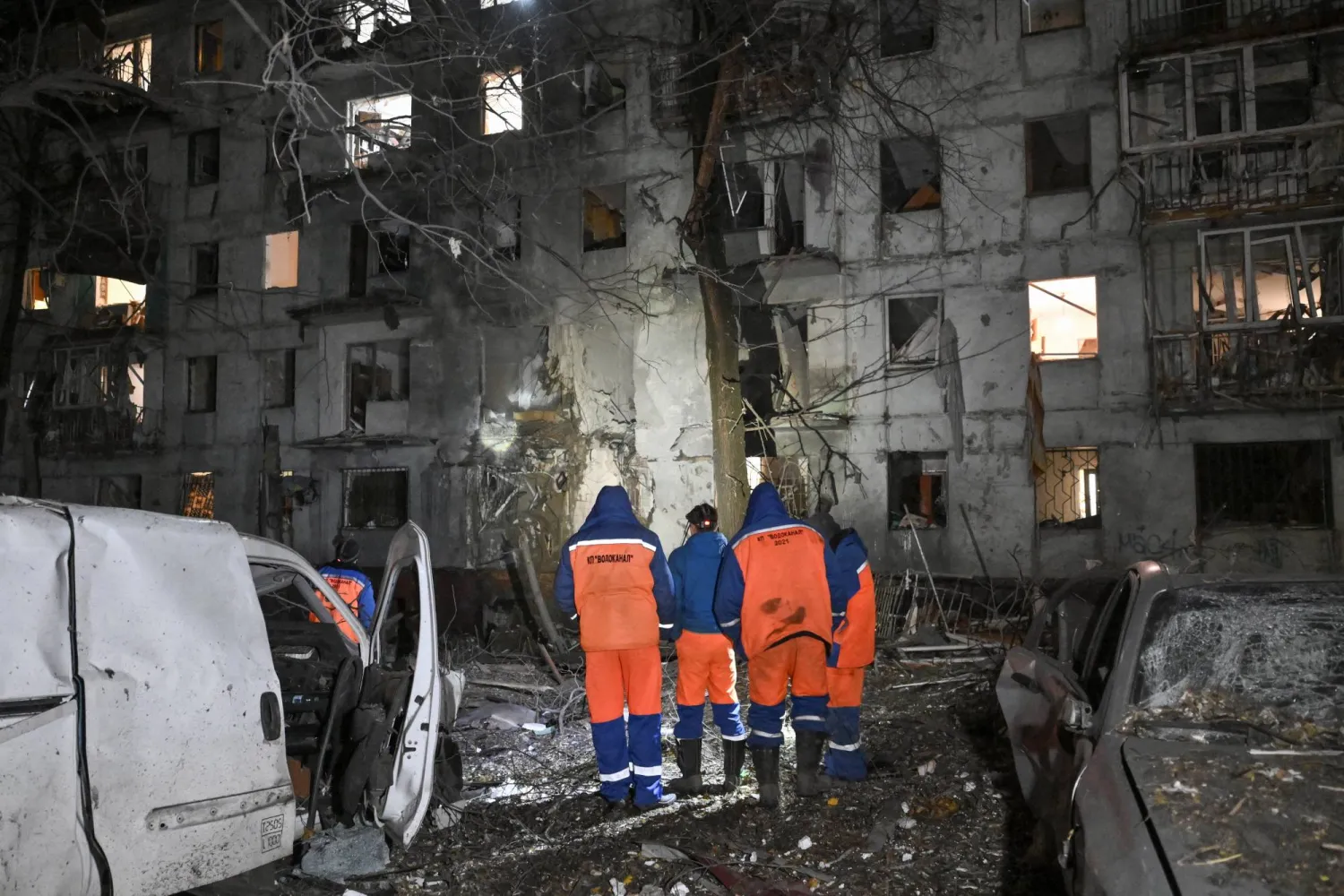
Municipal employees stand in front of an apartment building hit by a Russian air strike, amid Russia's attack on Ukraine, in Zaporizhzhia, Ukraine November 24, 2026. REUTERS/Stringer
TT

Ukraine to Restrict Reporting on Impact of Russian Strikes

Municipal employees stand in front of an apartment building hit by a Russian air strike, amid Russia's attack on Ukraine, in Zaporizhzhia, Ukraine November 24, 2026. REUTERS/Stringer

Ukraine on Saturday said it would restrict media outlets from publishing details about the impact of Russian strikes on critical infrastructure, as Moscow steps up its bombardments ahead of winter.

A decree issued by President Volodymyr Zelensky ordered his government to "take urgent measures to prohibit the media from covering information about the consequences of destruction and the timelines for restoring critical infrastructure facilities".

Since Russia invaded Ukraine in 2022, both countries have implemented degrees of military censorship.

Ukraine has typically urged media outlets not to publish information about the damage or location of Russian strikes, arguing it helps Moscow's army target future attacks.

Russia has imposed similar restrictions and also criminalized swathes of reporting and public commentary on the war -- including through a ban on calling the offensive an "invasion".

Last week Russian lawmakers proposed bills that the Institute for the Study of War said would "prohibit independent and unauthorized reporting on the aftermath of Ukrainian strikes", threatening fines or jail for violations.

Zelensky's decree would also stop the publication of information about the construction and condition of "protective structures" at critical sites, AFP reported.

The measures were proposed at a security council meeting last month, the decree stated.

It did not say how the measures would be enforced.

Dmytro Lytvyn, an adviser to Zelensky conceded Saturday it would be "complicated because a significant portion of such posts come from anonymous Telegram channels".

Russia has already launched multiple missile and drone attacks at Ukraine's energy network and other critical infrastructure sites -- like major bridges in Kyiv -- ahead of winter.

The strikes have triggered widespread cuts to heating, power and water supplies.

Fears are high in Ukraine that this winter could be the toughest yet of the almost five-year-long war.



Ukraine to Restrict Reporting on Impact of Russian Strikes

Municipal employees stand in front of an apartment building hit by a Russian air strike, amid Russia's attack on Ukraine, in Zaporizhzhia, Ukraine November 24, 2026. REUTERS/Stringer
TT

Ukraine to Restrict Reporting on Impact of Russian Strikes

Municipal employees stand in front of an apartment building hit by a Russian air strike, amid Russia's attack on Ukraine, in Zaporizhzhia, Ukraine November 24, 2026. REUTERS/Stringer

Ukraine on Saturday said it would restrict media outlets from publishing details about the impact of Russian strikes on critical infrastructure, as Moscow steps up its bombardments ahead of winter.

A decree issued by President Volodymyr Zelensky ordered his government to "take urgent measures to prohibit the media from covering information about the consequences of destruction and the timelines for restoring critical infrastructure facilities".

Since Russia invaded Ukraine in 2022, both countries have implemented degrees of military censorship.

Ukraine has typically urged media outlets not to publish information about the damage or location of Russian strikes, arguing it helps Moscow's army target future attacks.

Russia has imposed similar restrictions and also criminalized swathes of reporting and public commentary on the war -- including through a ban on calling the offensive an "invasion".

Last week Russian lawmakers proposed bills that the Institute for the Study of War said would "prohibit independent and unauthorized reporting on the aftermath of Ukrainian strikes", threatening fines or jail for violations.

Zelensky's decree would also stop the publication of information about the construction and condition of "protective structures" at critical sites, AFP reported.

The measures were proposed at a security council meeting last month, the decree stated.

It did not say how the measures would be enforced.

Dmytro Lytvyn, an adviser to Zelensky conceded Saturday it would be "complicated because a significant portion of such posts come from anonymous Telegram channels".

Russia has already launched multiple missile and drone attacks at Ukraine's energy network and other critical infrastructure sites -- like major bridges in Kyiv -- ahead of winter.

The strikes have triggered widespread cuts to heating, power and water supplies.

Fears are high in Ukraine that this winter could be the toughest yet of the almost five-year-long war.


UN Rapporteur Albanese Arrives in Mexico After Costa Rica Barred Her Entry

United Nations Special Rapporteur on the Palestinian Territories, Francesca Albanese, speaks to the press upon her arrival at Benito Juarez International Airport in Mexico City on November 28, 2026, following her two-days stay at the airport in Costa Rica. (AFP)
TT

UN Rapporteur Albanese Arrives in Mexico After Costa Rica Barred Her Entry

United Nations Special Rapporteur on the Palestinian Territories, Francesca Albanese, speaks to the press upon her arrival at Benito Juarez International Airport in Mexico City on November 28, 2026, following her two-days stay at the airport in Costa Rica. (AFP)

Francesca Albanese, the United Nations' special rapporteur on the Israeli-occupied Palestinian territories, arrived in Mexico City on Saturday after she was barred from Costa Rica, a move which drew UN concern but praise from the United States.

Albanese arrived at Mexico City's international airport around 10:30 a.m. local time (1630 GMT), where supporters with Palestinian flags offered her a bouquet of flowers and met her with a regional musical band.

Albanese, an Italian national who had traveled on Thursday to receive ‌an honorary ‌doctorate at the University of Costa Rica, was denied ‌entry ⁠at the country's ⁠airport on "national security grounds," according to the UN human rights office.

Albanese has become one of the most outspoken international critics of Israel's conduct in Gaza, making her a frequent target of pro-Israel officials and governments.

The UN's human rights chief Volker Turk was "deeply concerned" by Costa Rica's decision to deny Albanese entry, his office said, adding he found this "difficult to reconcile with Costa Rica's longstanding commitment to ⁠human rights."

Costa Rica has joined several Latin American countries ‌in a rightward political shift and deepening ‌ties with Washington, which gives military aid to Israel and sanctioned Albanese in 2025 over ‌her criticisms of US and Israeli policies in Gaza.

Jeff Bartos, the ‌US' ambassador to the UN for management and reform, said he was "grateful to Costa Rica for keeping this liar and lunatic out of their beautiful country."

Albanese had been scheduled to spend about five days in Mexico, where she is expected at a ‌Palestinian solidarity event, a talk at the capital's human rights commission and a university lecture on responsibility in times ⁠of genocide.

Palestinian ⁠authorities say more than 74,000 people have been killed in Israel's assault on Gaza, launched after Hamas-led fighters killed about 1,200 people in southern Israel on October 7, 2023.

The assault has also caused a hunger crisis and internally displaced Gaza's entire population. Scholars and a UN inquiry have assessed that Israel's conduct in Gaza amounts to genocide.

Israel and the US reject those assessments. Israel says its military campaign is an act of self-defense against Hamas.

Held for two nights at Costa Rica's San Jose airport, Albanese delivered Friday's university keynote lecture remotely.

"Goodbye, for now," Albanese said in a social media post early Saturday, posting a photo of herself on a plane holding her passport. "I'll be back, I promise, when Costa Rica is again free."


Two Migrants Die, Hundreds Rescued off Greek Islands

Migrants who arrived from North Africa walk towards a controlled area at the port of Heraklion, on the island of Crete, Greece, Saturday, Nov. 28, 2026. (Image On Line via AP)
TT

Two Migrants Die, Hundreds Rescued off Greek Islands

Migrants who arrived from North Africa walk towards a controlled area at the port of Heraklion, on the island of Crete, Greece, Saturday, Nov. 28, 2026. (Image On Line via AP)

Two migrants died and more than 400 others were rescued in less than 24 hours off the islands of Gavdos and Crete, the Greek coastguard said Saturday.

South of Gavdos, rescuers found two bodies and rescued 41 people trying to reach the European Union in a joint operation by the Greek authorities and the EU border agency Frontex, according to the ANA news agency and port officials.

The coastguard also reported six rescue operations since Friday evening off Gavdos and Crete, in which 391 migrants were brought to safety.

In one operation on Saturday, 102 migrants, including 16 women and five minors, were transferred to the port of Heraklion, Crete's main city.

Authorities gave no details on the migrants' nationalities or point of departure, though most crossings in the area originate from Libya.

Shipwrecks and accidents have become increasingly common off Crete as migrants attempt the dangerous sea crossing, often in rough weather and high winds.

Earlier this month, at least 22 people died in migrant boats trying to reach the island, according to port authorities.

The UN's International Organization for Migration has said the growing number of attempted crossings from Libya to Crete has exposed gaps in search and rescue capabilities.