


Syrian Regime Bypasses 'Southern Truce'...Reaches Jordanian Border

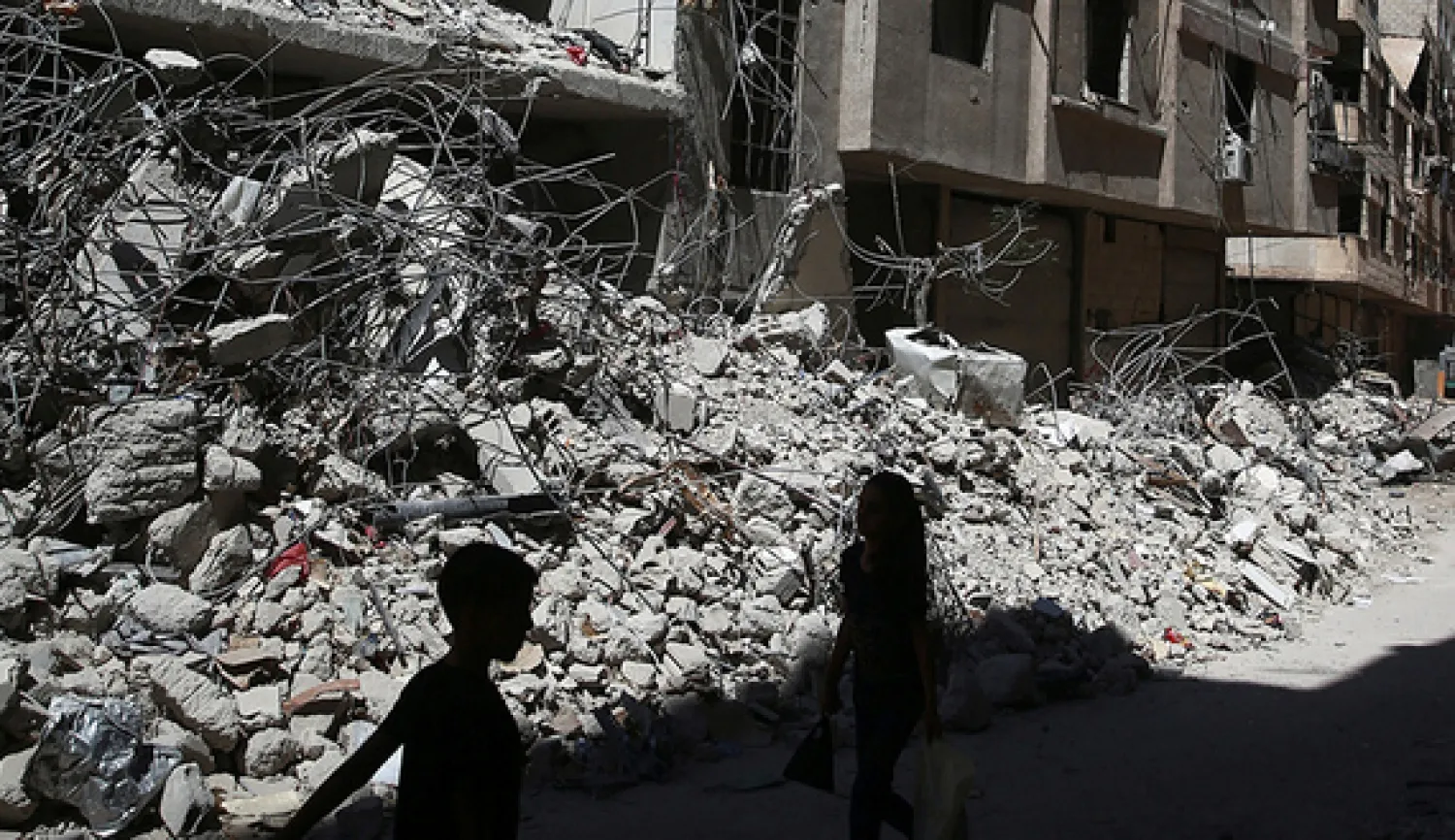
Children walk past the rubble of damaged buildings in Ein Tarma in the Damascus suburb of Eastern Ghouta, Syria, July 19, 2017.  (photo by REUTERS/Bassam Khabieh)
Children walk past the rubble of damaged buildings in Ein Tarma in the Damascus suburb of Eastern Ghouta, Syria, July 19, 2017. (photo by REUTERS/Bassam Khabieh)
TT

Syrian Regime Bypasses 'Southern Truce'...Reaches Jordanian Border

Children walk past the rubble of damaged buildings in Ein Tarma in the Damascus suburb of Eastern Ghouta, Syria, July 19, 2017.  (photo by REUTERS/Bassam Khabieh)
Children walk past the rubble of damaged buildings in Ein Tarma in the Damascus suburb of Eastern Ghouta, Syria, July 19, 2017. (photo by REUTERS/Bassam Khabieh)

Beirut- Syrian regime forces and their allies managed to capture on Thursday areas at the borders of Souweida province with Jordan, a movement considered as bypassing the west southern truce signed under a US-Russian-Jordanian patronage, including the countryside of Deraa.

“The Syrian regime-linked Team 15 in addition to Iran’s Revolutionary Guards and members of Lebanon’s Hezbollah have already reached the Syrian-Jordanian borders and controlled the areas of Bi’r Saboun-Tal Assada, reaching the entire Abu Sharshouh border crossing and border posts,” the German news agency quoted sources in the countryside of Souweida as saying.

Also, the Syrian Observatory for Human Rights said on Thursday that the advancement made by the Syrian regime forces and their allies has ended the presence of opposition factions at the Syrian-Jordanian border, inside the administrative borders of the Souweida province.

According to the Observatory, “With this advancement, the factions are now left with no external access in east and southeast of Syria, except for a border strip on the southeast border of the Damascus countryside with Jordan, in addition to a border strip with Iraq extending over the provinces of Damascus countryside and Homs, which includes al-Tanf border crossing between Syria and Iraq.”

Meanwhile, regime forces intensified their attacks on the Jobar neighborhood in Damascus and other areas in the Ghouta area using surface-to-surface missiles despite an agreement ratified last month in Cairo under an Egyptian-Russian brokerage to involve the city of Deraa.

The Observatory also spoke about regime forces airstrikes in the areas of al-Manasher, Zhahab, Taldo and Kfarlaha in addition to other areas in the Houla region.

“Warplanes targeted at least two villages in the Houla area causing material damage, without information about casualties, in the first such strike on the northern countryside of Homs since the Egyptian-Russian truce was put in effect last Aug. 3.”

Meanwhile, opposition-linked websites reported that several civilians were killed by the intensified regime forces shelling on the region of Houla in the countryside of north Homs, despite an announced truce in the area.



Trump Says Nations Doing Business with Iran Face 25% Tariff on US Trade

US President Donald Trump speaks with members of the media aboard Air Force One en route from Florida to Joint Base Andrews, Maryland, US, January 11, 2026. REUTERS/Nathan Howard
TT

Trump Says Nations Doing Business with Iran Face 25% Tariff on US Trade

US President Donald Trump speaks with members of the media aboard Air Force One en route from Florida to Joint Base Andrews, Maryland, US, January 11, 2026. REUTERS/Nathan Howard

President Donald Trump said on Monday any country that does business with Iran will face a tariff rate of 25% on any trade with the US, as Washington weighs a response to the situation in Iran which is seeing its biggest anti-government protests in years.

"Effective immediately, any Country doing business with the Islamic Republic of Iran will pay a Tariff of 25% on any and all business being done with the United States of America," Trump said in a post on Truth Social. Tariffs are paid by US importers of goods from those countries. Iran, a member of the OPEC oil producing group, has been heavily sanctioned by Washington for years. It exports much of its oil to China, with Türkiye, Iraq, and India among its other top trading partners.

"This Order is final ‌and ⁠conclusive," Trump said ‌without providing any further detail.

There was no official documentation from the White House of the policy on its website, nor information about the legal authority Trump would use to impose the tariffs, or whether they would be aimed at all of Iran's trading partners. The White House did not respond to a request for comment.

The Chinese embassy in Washington criticized Trump's approach, saying China will take "all necessary measures" to safeguard its interests and opposed "any illicit unilateral sanctions and long-arm jurisdiction."

"China's position against the indiscriminate imposition of tariffs is consistent and clear. Tariff wars and trade wars have no winners, and ⁠coercion and pressure cannot solve problems," a spokesperson of the Chinese embassy in Washington said on X.

Japan and South Korea, which agreed on trade ‌deals with the US last year, said on Tuesday they are ‍closely monitoring the development.

"We ... plan to take any necessary ‍measures once the specific actions of the US government become clear," South Korea's trade ministry said in a ‍statement.

Japan’s Deputy Chief Cabinet Secretary Masanao Ozaki told reporters that Tokyo will "carefully examine the specific content of any measures as they become clear, as well as their potential impact on Japan, and will respond appropriately."

Iran, which had a 12-day war with US ally Israel last year and whose nuclear facilities the US military bombed in June, is seeing its biggest anti-government demonstrations in years. Trump has said the US may meet Iranian officials and that he was in contact with Iran's opposition, while piling pressure on its leaders, including threatening military action.

Tehran said ⁠on Monday it was keeping communication channels with Washington open as Trump considered how to respond to the situation in Iran, which has posed one of the gravest tests of clerical rule in the country since the Iranian Revolution in 1979.

Demonstrations evolved from complaints about dire economic hardships to defiant calls for the fall of the deeply entrenched clerical establishment. US-based rights group HRANA said it had verified the deaths of 599 people - 510 protesters and 89 security personnel - since the protests began on December 28.

While air strikes were one of many alternatives open to Trump, "diplomacy is always the first option for the president," White House press secretary Karoline Leavitt said on Monday.

During the course of his second term in office, Trump has often threatened and imposed tariffs on other countries over their ties with US adversaries and over trade policies that he has described as unfair to Washington.

Trump's trade policy is under legal pressure as ‌the US Supreme Court is considering striking down a broad swathe of Trump's existing tariffs.

Iran exported products to 147 trading partners in 2022, according to World Bank's most recent data.


In 'Big Trouble'? The Factors Determining Iran's Future

In this frame grab from video taken by an individual not employed by The Associated Press and obtained by the AP outside Iran shows people blocking an intersection during a protest in Tehran, Iran, Thursday Jan. 8, 2026. (UGC via AP)
TT

In 'Big Trouble'? The Factors Determining Iran's Future

In this frame grab from video taken by an individual not employed by The Associated Press and obtained by the AP outside Iran shows people blocking an intersection during a protest in Tehran, Iran, Thursday Jan. 8, 2026. (UGC via AP)

Over two weeks of protests mark the most serious challenge in years to Iran's theocratic leadership in their scale and nature but it is too early to predict the immediate demise of the Iranian republic, analysts say.

The demonstrations moved from protesting economic grievances to demanding a wholesale change from the clerical system that has ruled Iran since the 1979 revolution that ousted the shah.

The authorities have unleashed a crackdown that, according to rights groups, has left hundreds dead while the rule of supreme leader Ali Khamenei, now 86, remains intact.

"These protests arguably represent the most serious challenge to Iran in years, both in scale and in their increasingly explicit political demands," Nicole Grajewski, professor at the Sciences Po Centre for International Studies in Paris told AFP.

She said it was unclear if the protests would unseat the leadership, pointing to "the sheer depth and resilience of Iran's repressive apparatus".

The Iranian authorities have called their own counter rallies, with thousands attending on Monday.

Thomas Juneau, professor at the University of Ottawa, said: "At this point, I still don't assess that the fall of the regime is imminent. That said, I am less confident in this assessment than in the past."

These are the key factors seen by analysts as determining whether Iran’s leadership will hold on to power.

- Sustained protests -

A key factor is "simply the size of protests; they are growing, but have not reached the critical mass that would represent a point of no return," said Juneau.

The protest movement began with strikes at the Tehran bazaar on December 28 but erupted into a full-scale challenge with mass rallies in the capital and other cities from Thursday.

The last major protests were the 2022-2023 demonstrations sparked by the death in custody of Mahsa Amini who had been arrested for allegedly violating the dress code for women. In 2009, mass rallies took place after disputed elections.

But a multi-day internet shutdown imposed by Iranian authorities has hampered the ability to determine the magnitude of the current demonstrations, with fewer videos emerging.

Arash Azizi, a lecturer at Yale University, said "the protesters still suffer from not having durable organized networks that can withstand oppression".

He said one option would be to "organize strikes in a strategic sector" but this required leadership that was still lacking.

- Cohesion in the elite -

While the situation on the streets is of paramount importance, analysts say there is little chance of a change without cracks and defections in the security forces and leadership.

So far there has been no sign of this, with all the pillars of Iran from parliament to the president to the Revolutionary Guards (IRGC) lining up behind Khamenei's defiant line expressed in a speech on Friday.

"At present, there are no clear signs of military defections or high-level elite splits within the regime. Historically, those are critical indicators of whether a protest movement can translate into regime collapse," said Sciences Po's Grajewski.

Jason Brodsky, policy director at US-based group United Against Nuclear Iran, said the protests were "historic".

But he added: "It's going to take a few different ingredients for the regime to fall," including "defections in the security services and cracks in the Islamic republic's political elite".

Israeli or US military intervention

US President Donald Trump, who has threatened military retaliation over the crackdown, announced 25 percent tariffs on Monday against Iran's trading partners.

The White House said Trump was prioritizing a diplomatic response, and has not ruled out strikes, after having briefly joined Israel's 12-day war against Iran in June.

That war resulted in the killing of several top Iranian security officials, forced Khamenei to go into hiding and revealed Israel's deep intelligence penetration of Iran.

US strikes would upend the situation, analysts say.

The Iranian foreign ministry said on Monday it has channels of communication open with Washington despite the lack of diplomatic relations.

"A direct US military intervention would fundamentally alter the trajectory of the crisis," said Grajewski.

Juneau added: "The regime is more vulnerable than it has been, domestically and geopolitically, since the worst years of the Iran-Iraq war" that lasted from 1980-1988.

- Organized opposition -

The US-based son of the ousted shah, Reza Pahlavi, has taken a major role in calling for protests and pro-monarchy slogans have been common chants.

But with no real political opposition remaining inside Iran, the diaspora remains critically divided between political factions known for fighting each other as much as the Iranian republic.

"There needs to be a leadership coalition that truly represents a broad swathe of Iranians and not just one political faction," said Azizi.

- Khamenei's health -

Khamenei has now been in power since 1989 when he became supreme leader, a post for life, following the death of revolutionary founder Khomeini.

He survived the war with Israel and appeared in public on Friday to denounce the protests in typically defiant style.

But uncertainty has long reigned over who could succeed him, with options including his shadowy but powerful son Mojtaba or power gravitating to a committee rather than an individual.

Such a scenario between the status quo and a complete change could see "a more or less formal takeover by the Revolutionary Guards", said Juneau.


Al-Alimi Orders Closure of Illegal Prisons in Southern Yemen

The Port of Aden during sunset, in Aden, Yemen, October 20, 2024. (Reuters)
TT

Al-Alimi Orders Closure of Illegal Prisons in Southern Yemen

The Port of Aden during sunset, in Aden, Yemen, October 20, 2024. (Reuters)

Chairman of Yemen's Presidential Leadership Council Dr. Rashad al-Alimi ordered on Monday the closure of all illegal prisons and detention centers in southern Yemen.

The prisons are located in the governorates of Aden, Lahj and Dhaleh.

Al-Alimi met in the Saudi capital Riyadh with Tobias Tunkel, Germany’s Commissioner for the Middle East, Near East and North Africa, and German Ambassador to Yemen, Thomas Schneider, the state news agency Saba reported.

Al-Alimi ordered the immediate release of detainees who have been illegally imprisoned. He tasked the security and military agencies to coordinate with the Defense Ministry public prosecution to carry out the order.

He made the order amid accusations by rights groups that forces aligned with the dissolved Southern Transitional Council had run illegal jails.

Al-Alimi warned against supporting these illegal armed groups, saying backing them does not help in the fight against terrorism.

Security chaos and legitimizing weapons outside state control are the greatest threat to the security of Yemen, the region and international waterways, he cautioned.

Al-Alimi and the German delegation discussed the latest developments in Yemen in wake of the handover of military camps to the legitimate forces and the withdrawal of the STC.

He said the move will help consolidate internal stability and pave the way for normal work to resume at state institutions, the flow of aid and restore the international community's trust.