


Disgusted by Racism Targeting Soccer’s Vinicius, His Brazilian Hometown Rallies to Defend Him

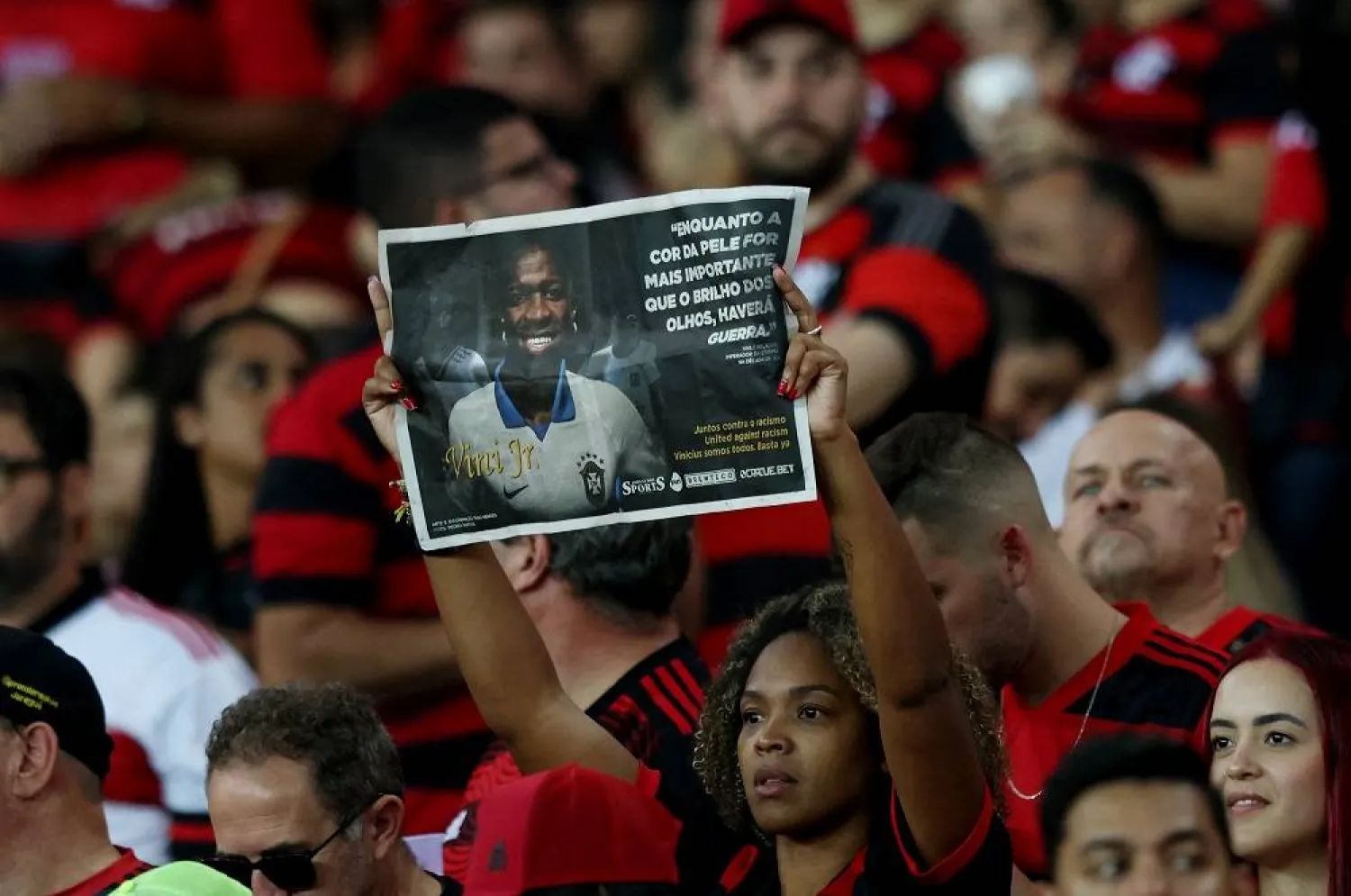
Football - Brasileiro Championship - Flamengo v Cruzeiro - Estadio Maracana, Rio de Janeiro, Brazil - May 27, 2023 A Flamengo fan displays an image of Vinicius Junior in support against racism before the match. (Reuters)
TT

Disgusted by Racism Targeting Soccer’s Vinicius, His Brazilian Hometown Rallies to Defend Him

Football - Brasileiro Championship - Flamengo v Cruzeiro - Estadio Maracana, Rio de Janeiro, Brazil - May 27, 2023 A Flamengo fan displays an image of Vinicius Junior in support against racism before the match. (Reuters)

The chants of “monkey!” at the Spanish soccer stadium echoed across the Atlantic, reaching the ears of people on the outskirts of Rio de Janeiro.

That’s where Vinicius Junior, who is Black, grew up and launched his football career. Now, despite his global fame and millions, he was again the target of crude European racism.

His city in multiracial Brazil was sickened, and has rallied to his defense.

In Sao Goncalo, rapper Deivisson Oliveira was eating breakfast when the TV news showed the abuse aimed at his hometown hero.

“I needed to cry out,” said Oliveira, 30, who raps under the name MC Menor do CPX.

Oliveira typed lyrics on his phone with his 6-month-old son at his feet. Powerful verses surged through his thumbs: “From the favela to the world: Strength, Vinicius Junior!”

Racism in the Spanish league has intensified this season, especially after Vinicius started celebrating goals by dancing. On at least nine occasions, people have made monkey sounds at Vinicius, chanted the slur “monkey!” and hurled other racist slurs. Vinicius has repeatedly demanded action from Spanish soccer authorities.

Vinicius’ 2017 move to Real Madrid was the culmination of years of effort. One of the most popular clubs in global soccer paid 45 million euros (about $50 million) — at the time the most ever for a Brazilian teenager — even before his professional debut with Rio-based Flamengo. Relentless racism wasn’t part of Vinicius’ dream when he was growing up in Sao Goncalo.

Sao Goncalo is the second-most populous city in Rio’s metropolitan region, and one of the poorest in the state of Rio de Janeiro, according to the national statistics institute. At night in some areas, motorists turn on their hazard lights to signal to drug-trafficking gangs that the driver is local. It is also where the 2020 police killing of a 14-year-old sparked Black Lives Matter protests across Rio.

Racism has once again fanned outrage.

Rio’s imposing, illuminated Christ the Redeemer statue was made dark one night in solidarity. The city’s enormous bayside Ferris wheel this week exhibits a clenched Black fist and the scrolling words: “EVERYONE AGAINST RACISM.”

“My total repudiation of the episode of racism suffered by our ace and the pride of all of us in Sao Goncalo,” the city’s mayor, Nelson Ruas dos Santos, wrote on Twitter the morning after the incident.

Rio’s Mayor Eduardo Paes was less diplomatic when responding to a defense issued by the Spanish soccer league’s president.

“Go to hell, son of a...” Paes wrote.

On Thursday, Spanish league president Javier Tebas held a news conference claiming that the league has been acting alone against racism, and that it could end it in six months if granted more power by the government.

At the same time in Rio, representatives of more than 150 activist groups and nonprofits delivered a letter to Spain’s consulate, demanding an investigation into the league and its president. They organized a protest that evening.

“Vinicius has been a warrior, he’s being a warrior, for enduring this since he arrived in Spain and always taking a stand,” activist Valda Neves said. “This time, he’s not alone.”

On Saturday, players from Vinicius’ former club, Flamengo, took the field at the Maracana Stadium before a Brazilian championship match against Cruzeiro wearing jerseys bearing the player’s name and sat on the pitch before kick off in an anti-racism protest.

In the stands, thousands of supporters made a tifo that read “everyone with Vini Jr.”

The first Black Brazilian players to sign for European clubs in the 1960s met some racism in the largely white society, but rarely spoke out. At the time when Brazil still considered itself a “racial democracy,” and did not take on the racism that many faced.

In the late 1980s, the federal government made racial discrimination a crime and created a foundation to promote Afro-Brazilian culture. At the time, many Brazilian players who might identify as Black today did not recognize themselves as such. Incidents of racism in Europe prompted little blowback in Brazil.

In the decades since, Brazil’s Black activists have gained prominence and promoted awareness of structural racism. The federal government instituted policies aimed at addressing it, including affirmative-action admissions for public universities and jobs. There has been heightened consciousness throughout society.

In 2014, a fan hurled a banana at defender Dani Alves during a Spanish league match; he picked it up and ate it in a show of defiance, triggering a coordinated social media campaign with other Brazilian players, including star forward Neymar, who did the same.

Vinicius’ own educational nonprofit this week launched a program to train public school teachers to raise awareness about racism and instruct kids in fighting discrimination. A teacher at a Sao Goncalo school that will host the project, Mariana Alves, hopes it will provide kids much-needed support and preparation. She spoke in a classroom with soccer-ball beanbag chairs strewn about, and enormous photos of Vinicius on the walls.

Most of the school’s students are Black or biracial, and many have experienced racism, Alves said in an interview. This week, her 10-year-old students have been asking if she saw what happened to Vinicius because they don’t fully understand.

“He has money, he has all this status, and not even that stopped him from going through this situation of racism,” said Alves, who is Black and from Sao Goncalo. “So the students wonder ... ‘Will I go through that, too? Is that going to happen to me?’”

As a boy, Vinicius started training at a nearby feeder school for Flamengo, Brazil’s most popular club, before signing with its youth team.

Sao Goncalo kids there were a blur Wednesday afternoon as they ran non-stop drills, leaving them without time or breath to discuss their idol’s troubles on another continent.

Still, they knew.

One of them, Ryan Gonçalves Negri, said he has talked about it with his friends outside the soccer school, and that Vinicius should transfer out of the Spanish league “urgently.”

“I would never want to play there,” Negri, 13, said. “It’s not for Brazilians who know how to score goals and celebrate.”

While the kids practiced, the rapper Oliveira and his producer Éverton Ramos, known as DJ Cabide, stepped onto the turf and made their way to the corner. They set up a speaker beneath a banner of Vinicius as a brash teenager with his tongue extended, then started recording a clip for their protest song’s music video.

“I’m no one, but my voice can reach where I can’t go, where I can’t imagine going,” Oliveira said. “My voice will get there, you understand?”



Morocco Coach Dismisses Aguerd Injury Talk, Backs Ait Boudlal ahead of Mali Test

Soccer Football - Africa Cup of Nations - Round of 16 - Morocco v South Africa - Laurent Pokou Stadium, San Pedro, Ivory Coast - January 30, 2024 Morocco coach Walid Regragui reacts REUTERS/Siphiwe Sibeko
TT

Morocco Coach Dismisses Aguerd Injury Talk, Backs Ait Boudlal ahead of Mali Test

Soccer Football - Africa Cup of Nations - Round of 16 - Morocco v South Africa - Laurent Pokou Stadium, San Pedro, Ivory Coast - January 30, 2024 Morocco coach Walid Regragui reacts REUTERS/Siphiwe Sibeko

Morocco coach Walid Regragui has dismissed reports that defender Nayef Aguerd is injured, saying the center back was fit and ready for ​Friday’s Africa Cup of Nations Group A clash against Mali.

"Who told you Aguerd is injured? He’s training as usual and has no problems," Regragui told reporters, Reuters reported.

Regragui confirmed captain Romain Saiss will miss the game with a muscle injury sustained against Comoros in their tournament ‌opener, while ‌full back Achraf Hakimi, ‌recently ⁠crowned ​African Player ‌of the Year, is recovering from an ankle problem sustained with Paris St Germain last month and could feature briefly. "Hakimi is doing well and we’ll make the best decision for him," Regragui said. The coach also heaped praise on 19-year-old ⁠defender Abdelhamid Ait Boudlal, calling him "a great talent".

"I’ve been following ‌him for years. I called ‍him up a ‍year and a half ago when he was ‍a substitute at Rennes and people criticized me. Today everyone is praising him – that shows our vision is long-term," Regragui said. "We must not burn the ​player. We’ll use him at the right time. We’ll see if he starts tomorrow ⁠or comes in later."

Ait Boudlal echoed his coach's confidence.

"We know the responsibility we carry. Every game is tough and requires full concentration. We listen carefully to the coach’s instructions and aim to deliver a performance that meets fans’ expectations," he said.

Morocco opened the tournament with a 2-0 win over Comoros and will secure qualification with victory over Mali at Rabat’s Prince Moulay Abdellah ‌Stadium.

"It will be a tough match against a strong team," Regragui added.


Mali coach Saintfiet hits out at European clubs, FIFA over AFCON changes

Mali coach Tom Saintfiet pictured at his team's opening AFCON game against Zambia in Casablanca on Monday © Abdel Majid BZIOUAT / AFP/File
TT

Mali coach Saintfiet hits out at European clubs, FIFA over AFCON changes

Mali coach Tom Saintfiet pictured at his team's opening AFCON game against Zambia in Casablanca on Monday © Abdel Majid BZIOUAT / AFP/File

Mali coach Tom Saintfiet on Thursday railed against the decision to play the Africa Cup of Nations every four years instead of two, insisting the move was forced upon the continent by FIFA and European clubs motivated by money.

"I am very shocked with it and very disappointed. It is the pride of African football, with the best players in African football," the Belgian told reporters in Rabat ahead of Friday's AFCON clash between Mali and Morocco, AFP reported.

"To take it away and make it every four years, I could understand if it was a request for any reason from Africa, but it is all instructed by the big people from (European governing body) UEFA, the big clubs in Europe and also FIFA and that makes it so sad."

Saintfiet, 52, has managed numerous African national teams including Gambia, who he led to the quarter-finals of the 2022 Cup of Nations.

He was appointed by Mali in August last year and on Friday will lead them out against current AFCON hosts in a key Group A game at the Prince Moulay Abdellah Stadium.

The Cup of Nations has almost always been held at two-year intervals since the first edition in 1957 but Confederation of African Football president Patrice Motsepe last weekend announced that the tournament would go ahead every four years after a planned 2028 tournament.

"We fought for so long to be respected, to then listen to Europe to change your history -- because this is a history going back 68 years -- only because of financial requests from clubs who use the load on players as the excuse while they create a World Cup with 48 teams, a Champions League with no champions," Saintfiet said.

"If you don't get relegated in England you almost get into Europe, it is so stupid," he joked.

"If you want to protect players then you play the Champions League with only the champions. You don't create more competitions with more load. Then you can still play AFCON every two years.

"Africa is the biggest football continent in the world, all the big stars in Europe are Africans, so I think we disrespect (Africa) by going to every four years.

"I am very sad about that -- I hoped that the love for Africa would win over the pressure of Europe."


My Grandfather Encouraged Me to Play for Algeria, Luca Zidane Says

 Algeria's goalkeeper #23 Luca Zidane reacts during the Africa Cup of Nations (CAN) Group E football match between Algeria and Sudan at Moulay Hassan Stadium in Rabat on December 24, 2025. (AFP)
Algeria's goalkeeper #23 Luca Zidane reacts during the Africa Cup of Nations (CAN) Group E football match between Algeria and Sudan at Moulay Hassan Stadium in Rabat on December 24, 2025. (AFP)
TT

My Grandfather Encouraged Me to Play for Algeria, Luca Zidane Says

 Algeria's goalkeeper #23 Luca Zidane reacts during the Africa Cup of Nations (CAN) Group E football match between Algeria and Sudan at Moulay Hassan Stadium in Rabat on December 24, 2025. (AFP)
Algeria's goalkeeper #23 Luca Zidane reacts during the Africa Cup of Nations (CAN) Group E football match between Algeria and Sudan at Moulay Hassan Stadium in Rabat on December 24, 2025. (AFP)

Luca Zidane, son of French World Cup-winner Zinedine, said his grandfather had supported him in switching international allegiance to Algeria, after playing for France at junior level.

Zinedine Zidane is widely regarded as one of the greatest French footballers, inspiring his country to their first World Cup victory in 1998 and scoring two goals in the 3-0 win over Brazil in the final in Paris. The midfielder also guided them to the Euro 2000 trophy, achieving an unprecedented double for Les Bleus.

The decision to switch nationalities by Luca, who chose to avoid comparisons with ‌his father from ‌an early age by opting to play as ‌a ⁠goalkeeper, came as ‌a surprise, especially since he made it at the age of 27.

He quickly became Algeria's first-choice keeper, and his father watched him play against Sudan in Vladimir Petković's side's opening Africa Cup of Nations Group E match on Wednesday, which they won 3-0.

Zidane was not tested much during the match, but he did make an important save from a dangerous chance that fell to Yaser Awad with the score at ⁠1-0.

"When I think of Algeria, I remember my grandfather. Since childhood, we’ve had this Algerian culture in the ‌family," Zidane told BeIN Sports France.

"I spoke to ‍him before playing for the national ‍team, and he was extremely happy about this step. Every time I receive ‍an international call-up, he calls me and says that I made a great decision and that he is proud of me."

He said his father had also backed his decision. "He supported me," Luca said. "He said to me ‘Be careful, this is your choice. I can give you advice, but in the end, the final decision will be yours'.

"From the moment the coach and the federation ⁠president reached out to me, it was clear that I wanted to go and represent my country. After that, I naturally spoke with my family, and they were all happy for me."

Zinedine Zidane, who was sent off in the 2006 World Cup final in Germany which they lost to Italy on penalties, won the Champions League in 2002 with Real Madrid and claimed the Ballon d'Or award in 1998.

His son, who plays in Spain for Granada after starting his career at Real Madrid, has always worn a shirt bearing the name Luca, but he decided his national team jersey would carry the name Zidane.

"So for me, being able to honor ‌my grandfather by joining the national team is very important," he said. "The next jersey with the name on it will be for him."