Djokovic Finally Adds Olympic Gold to his Resume by Beating Alcaraz

Gold medalist, Serbia's Novak Djokovic kisses his medal on the podium at the presentation ceremony for the men's singles tennis event on Court Philippe-Chatrier at the Roland-Garros Stadium during the Paris 2024 Olympic Games, in Paris on August 4, 2024. (Photo by CARL DE SOUZA / AFP)
TT

Djokovic Finally Adds Olympic Gold to his Resume by Beating Alcaraz

Gold medalist, Serbia's Novak Djokovic kisses his medal on the podium at the presentation ceremony for the men's singles tennis event on Court Philippe-Chatrier at the Roland-Garros Stadium during the Paris 2024 Olympic Games, in Paris on August 4, 2024. (Photo by CARL DE SOUZA / AFP)

For all of his Grand Slam championships and other titles, for all of his time at No. 1, Novak Djokovic really, really wanted an Olympic gold medal for Serbia, the last significant accomplishment missing from his glittering resume.
He finally got one at age 37 on Sunday, beating Carlos Alcaraz 7-6 (3), 7-6 (2) in an enthralling and evenly matched men’s tennis singles final at the 2024 Games, The Associated Press reported.
In a sense, it doesn't matter one bit how long it took, of course. Djokovic is now an Olympic champion and forever will be. And in another sense, the years of waiting, the stumbles along the journey, made him appreciate this triumph as much as — no, make that more than — every other, which is why his hands trembled when he knelt on Court Philippe Chatrier's red clay at the end and why his tears flowed.
“When I take everything into consideration, this probably is the biggest sporting success I ever had in my career,” said Djokovic, who didn't drop a set in Paris and is the oldest man to win the Summer Games tennis title since 1908. “This kind of supersedes everything that I imagined, that I hoped that I could experience, that I could feel.”
With margins so thin that any mistake felt as if it could tilt things, Djokovic was at his best when the stakes were highest, dominating each of the two tiebreakers against Alcaraz, who beat him in the Wimbledon final three weeks ago.
“In the close moments, in the difficult situations, in the tiebreaks, he played an impressive game,” said silver medalist Alcaraz, the 21-year-old from Spain who sobbed, too, after falling short of becoming the youngest male singles gold medalist. “That’s why I saw that he’s hungry for the gold medal. He was going to go for it.”
Djokovic already owns a men's-record 24 Grand Slam trophies and the most weeks spent atop in the rankings by any man or woman. He also already owned an Olympics medal, from 2008, but it was a bronze — and he made it clear that simply wasn't sufficient. He kept talking over the past week, but also the past months, about what a priority the gold was for him — and Alcaraz said Sunday he kept hearing about it.
Until getting Paris bronze medalist Lorenzo Musetti of Italy on Friday, Djokovic was 0-3 in Olympic semifinals, losing to the gold winner each time: Rafael Nadal at Beijing in 2008, Andy Murray at London in 2012, and Alexander Zverev in Tokyo three years ago.
This time, Djokovic said, “I was ready.”
In Paris, wearing a gray sleeve over the right knee that required surgery for a torn meniscus two months ago, Djokovic faced Nadal in the second round and eliminated his longtime rival in straight sets.
The 2-hour, 50-minute final featured one of the best to ever do it, in Djokovic — and the “highest mountain to climb at the moment,” in Alcaraz, as Djokovic put it.
There was superb ball-striking, deft drop shots and tremendous sprinting, sliding, stretching defense. The No. 1 seed Djokovic saved eight break points, No. 2 Alcaraz saved six. Pressure? Ha. What pressure?
“We both played at a very high level," Djokovic said. "We really went toe-to-toe.”
The only shame, perhaps, for the fans — and, naturally, Alcaraz — was that the Olympics uses a best-of-three-set format, instead of the best-of-five at Grand Slam tournaments. Those in the stands became part of the show, breaking out into choruses of “No-le! No-le!” or “Car-los! Car-los!” that often overlapped, creating an operatic fugue. As Alcaraz attempted to mount a comeback, his supporters chanted “Si, se puede!” (essentially, “Yes, you can!”).
Yet the place was as quiet as a theater between points; play was delayed briefly when a young child’s crying pierced the air that was thick with anticipation.
The first set alone lasted more than 1 1/2 hours, full of epic shots and epic games. One lasted 18 points spread over more than a dozen mesmerizing minutes on the way to that tiebreaker, when Djokovic grabbed the last four points, then turned to face his guest box — which included his tennis team and his wife and their two children — with a fist held high.
In the second tiebreaker, after Djokovic laced a cross-court forehand winner on the run to cap a 10-shot point for a 3-2 lead, he waved his arms to encourage the folks standing and screaming. Soon, thanks to one last forehand winner, he had earned that prize he wanted, at long last.
When the Serbian national anthem finished ringing out, Djokovic reached for his gold and brought it to his lips for a kiss.
Was he worried that moment would never arrive?
“There are always doubts. Absolutely, I had doubts," Djokovic said. “But the belief and the conviction that I can make it is stronger than my doubts. It always has been. I knew that it’s going to happen. It was just a matter of when it’s going to happen.”



Kostyuk Stuns 4-time Champion Swiatek on Big Day for Ukraine at French Open

31 May 2026, France, Paris: Ukrainian tennis player Marta Kostyuk celebrates a point against Poland's Iga Swiatek during their Women's Singles Match on Day 8 of the French Open tennis tournament on Court Philippe-Chatrier at the Roland-Garros Complex. Photo: Matthieu Mirville/ZUMA Press Wire/dpa
TT

Kostyuk Stuns 4-time Champion Swiatek on Big Day for Ukraine at French Open

31 May 2026, France, Paris: Ukrainian tennis player Marta Kostyuk celebrates a point against Poland's Iga Swiatek during their Women's Singles Match on Day 8 of the French Open tennis tournament on Court Philippe-Chatrier at the Roland-Garros Complex. Photo: Matthieu Mirville/ZUMA Press Wire/dpa

There will be a first-time women’s champion at the French Open this year, and two Ukrainian players are among the strongest contenders.

Undefeated this season on clay, 15th-seeded Marta Kostyuk showed her strong credentials as she reached the quarterfinals in Paris for the first time on Sunday by taking out four-time champion Iga Swiatek 7-5, 6-1 and ruining her birthday.

She will be up against her compatriot Elina Svitolina next, ensuring there will be an Ukrainian woman semifinalist at Roland Garros for the first time in the professional era (1968). The seventh-seeded Svitolina rallied past Belinda Bencic 4-6, 6-4, 6-0.

“There’s going to be Ukraine in the semifinals, so it’s already amazing,” said Svitolina, whose country is in a 4-year-old war with Russia.

“I think it couldn’t be a better, amazing achievement for Ukrainian tennis. I think in such a difficult situation right now in the war, with the invasion, it’s really, really difficult, and I think it’s really inspiring for the next generation to really believe that it is possible one day to play on this court and win.”

None of the players still in the draw have yet lifted the trophy in Paris, following Coco Gauff’s elimination on Saturday and Swiatek's exit. It's the same in the men’s draw, after the defeats of Jannik Sinner and Novak Djokovic and with Carlos Alcaraz absent because of an injury.

Kostyuk had lost her three previous matches against Swiatek and never taken a set against the former top-ranked player, who turned 25 on Sunday.

“I’m still in shock. To beat such an unbelievable player, who won four times here," The Associated Press quoted her as saying.

Kostyuk has been the best player of the clay-court season. She defended extremely well, chasing Swiatek’s shots all over the court, and also produced some stunning groundstroke winners while her rival was also undone by her own mistakes.

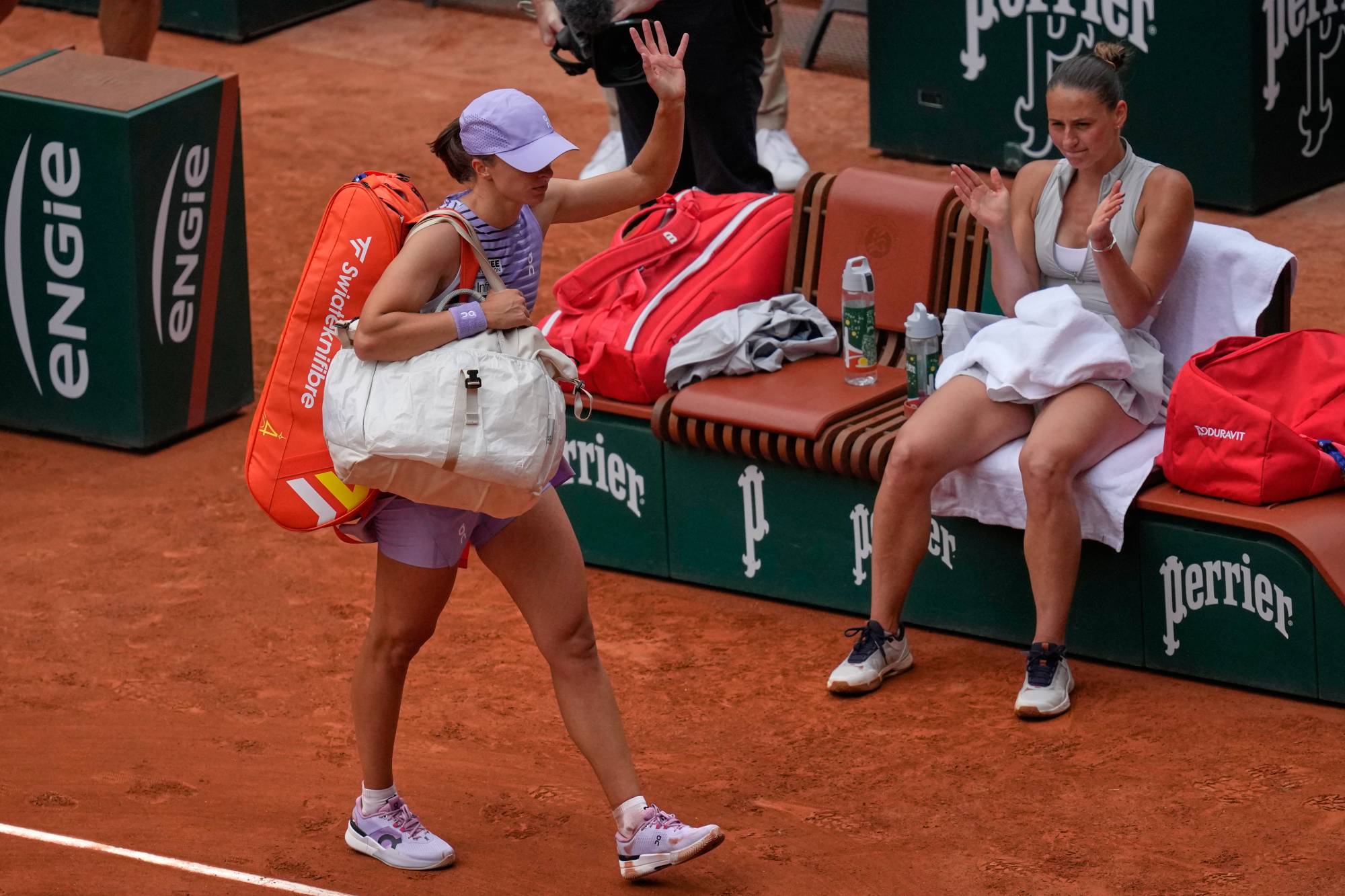
Poland's Iga Swiatek leaves the court after losing to Ukraine's Marta Kostyuk in the fourth-round tennis match at the French Open in Paris, Sunday, May 31, 2026. (AP Photo/Christophe Ena)

An intense baseline battle unfolded from the outset. Swiatek showed signs of nerves as she double-faulted, shanked a forehand wide and then missed a volley at the net, allowing Kostyuk to level at 5-5 in the opener. Swiatek hit two more double faults in the 12th game and the 15th-seeded Ukrainian player sealed the set with a backhand passing shot.

Swiatek then briefly left the court. Meanwhile, Kostyuk kept herself warm by stretching and hopping beside her chair, then received some applause as she did a few dance moves to the music playing in the stadium.

Following a first week marked by a suffocating heatwave, relief finally arrived in Paris on Sunday, with temperatures dropping to 21 degrees C (70 F) around midday. When play resumed, Swiatek broke but another double fault coupled with more unforced errors brought her opponent back at 1-1. Kostyuk then won the last five games.

Kostyuk, who had reached the fourth round at Roland Garros in 2021 when she lost to Swiatek, extended her winning streak on clay to 16 matches. Ahead of the French Open, she won in Madrid, the biggest title of her career, after she claimed another clay-court title in Rouen, France.

“The most important thing that I’ve been doing this whole time is really just trying to enjoy,” she said. “It’s helping. I want to keep enjoying. I try not to focus at all on winning or losing because I’m not playing tennis to win, I’m playing tennis because I love it."

17 years later Romanian veteran Sorana Cirstea, who is planning to retire at the end of the season, beat Chinese qualifier Wang Xiyu 6-3, 7-6 (4) to reach her second Roland Garros quarterfinal, 17 years after first making it to the last eight.

The gap between Cirstea’s first and second Grand Slam quarterfinal appearances in Paris is the longest at a single major by any woman in the Open Era.

“There is no expiration date for ambition and for dreams,” Cirstea said. “I think back then I was a kid, just started on tour. Now I have so many years behind me. I have so much experience, maturity. I feel I’m a completely different player.”


Jordan to Let Fans Start Work Late for World Cup Debut

Jordan's defender #2 Mohammad Abu Hashish (L) fights for the ball with Switzerland's midfielder #16 Christian Fassnacht next to Jordan's forward Mohammad Abu Zraiq (R) during a friendly match between Switzerland and Jordan ahead of the 2026 FIFA World Cup football tournament at the Kybunpark stadium, in St. Gallen on May 31, 2026. (Photo by Ennio LEANZA / AFP)
TT

Jordan to Let Fans Start Work Late for World Cup Debut

Jordan's defender #2 Mohammad Abu Hashish (L) fights for the ball with Switzerland's midfielder #16 Christian Fassnacht next to Jordan's forward Mohammad Abu Zraiq (R) during a friendly match between Switzerland and Jordan ahead of the 2026 FIFA World Cup football tournament at the Kybunpark stadium, in St. Gallen on May 31, 2026. (Photo by Ennio LEANZA / AFP)

Jordan said on Sunday it will allow a late start to work for public sector employees on World Cup matchdays to let fans enjoy the national team's debut appearance at the tournament.

A decree from Prime Minister Jafar ⁠Hassan said official ⁠working hours would begin at 10 a.m. instead of 8:30 a.m. for its Group J games against Austria, Algeria and ⁠Argentina which are being played in the US on June 17, 23 and 28.

"The decision aims to enable citizens to follow and rally behind our national football team during its historic participation in this tournament," Reuters quoted a ⁠government ⁠statement as saying.

Jordan, popularly known as Al-Nashama (The Chivalrous Ones), qualified for the World Cup after finishing second behind South Korea in their Asian qualifying group, an unprecedented achievement that sparked nationwide celebration.


Japan Defeat Iceland in World Cup Send-off through Late Ogawa Header

Japan Defeat Iceland in World Cup Send-off through Late Ogawa Header
TT

Japan Defeat Iceland in World Cup Send-off through Late Ogawa Header

Japan Defeat Iceland in World Cup Send-off through Late Ogawa Header

Japan eked out a late 1-0 win over Iceland in Tokyo on Sunday through Koki Ogawa's 87th-minute header as Hajime Moriyasu's side closed out their home-based preparations for the World Cup with a barely deserved victory.

Ogawa was one of 11 substitutions made by Moriyasu in a match that had the mood of a testimonial with Maya Yoshida granted a final appearance for the Samurai Blue almost four years after his previous game for Japan.

The 37-year-old left the pitch to a guard of honor in the 13th minute and passed the captain's armband to Wataru Endo, the Liverpool man returning to the line-up after several months on the sidelines in an injury-affected season, Reuters reported.

Yoshida had started in a backline that featured Takehiro Tomiyasu for the first time in almost two years, the former Arsenal defender continuing to build his fitness towards Japan's World Cup opener against the Netherlands on June 14.

The Japanese threatened in the early exchanges, with Keito Nakamura sliding his attempt from the left across the face of the Iceland goal.

But Logi Tomasson almost caught the hosts out in the 30th minute when he swept a first-time left-foot shot towards goal from 25 yards out only for the ball to bend away from Zion Suzuki's left post.

Takefusa Kubo's long-range attempt was gathered by Hakon Valdimarsson, who soon after tipped Keito Nakamura's header over the bar as Japan pressed for the opener.

Suzuki threw himself to his right to keep out Dagur Dan Thorhallsson's attempt late in the half while Valdimarsson gathered Tomiyasu's strike at the second attempt in stoppage time.

Ko Itakura was denied by Valdimarsson six minutes after the restart and Ogawa bent his 62nd-minute effort wide of the post with Japan laboring to find a way through the Icelandic defence.

With three minutes remaining Ogawa pounced, nodding Yukinari Sugawara's cross from the right beyond Valdimarsson, beating the goalkeeper via the inside of the post.

Japan will be appearing at their eighth consecutive World Cup and will face the Netherlands, Tunisia and Sweden in the group phase.