

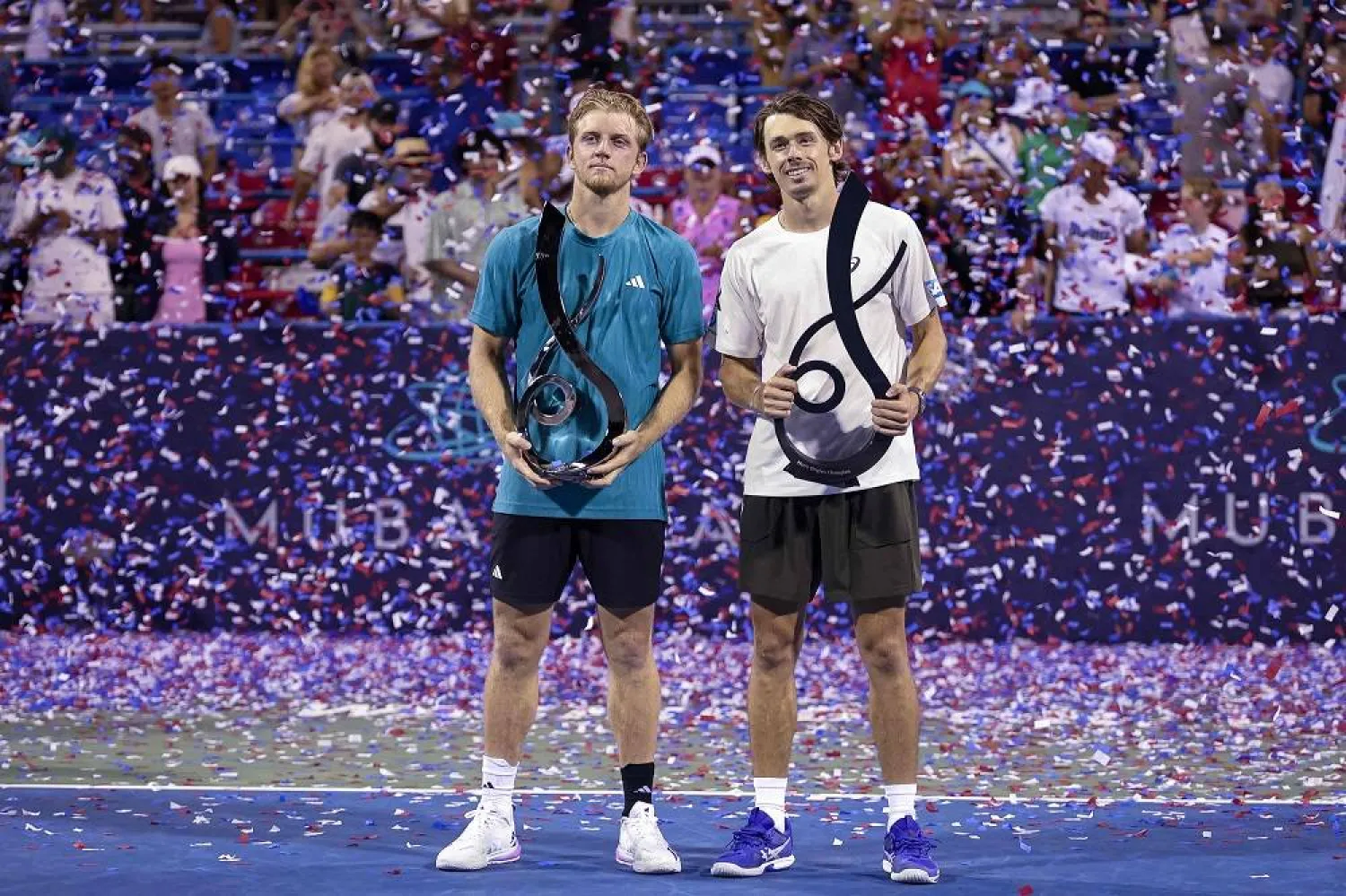

‘Lucky’ De Minaur Saves Three Match Points to Lift Washington Open Title 

(L-R) Alejandro Davidovich Fokina of Spain and Alex De Minaur of Australia pose with the men's singles trophies after the men's singles finals match on the final day of the Mubadala Citi DC Open 2025 at William H.G. FitzGerald Tennis Center on July 27, 2025 in Washington, DC. (Getty Images/AFP)
TT

‘Lucky’ De Minaur Saves Three Match Points to Lift Washington Open Title 

(L-R) Alejandro Davidovich Fokina of Spain and Alex De Minaur of Australia pose with the men's singles trophies after the men's singles finals match on the final day of the Mubadala Citi DC Open 2025 at William H.G. FitzGerald Tennis Center on July 27, 2025 in Washington, DC. (Getty Images/AFP)

Alex De Minaur rallied from a set down and saved three match points to claim the Washington Open title with a 5-7 6-1 7-6(3) win over Alejandro Davidovich Fokina in the final of the ATP 500 event on Sunday.

The Australian number one, who lost the 2018 final to Alexander Zverev, felt he rode his luck to secure his 10th career title and ensure he will enter the top 10 in the world rankings ahead of next month's US Open.

The two 26-year-olds exchanged breaks early in the opening set before Spain's Davidovich Fokina seized control by breaking again and closed out the set with the help of some crisp forehand winners.

De Minaur responded emphatically in the second set, converting two of four break-point opportunities while holding serve throughout, wrapping up the set in just over 30 minutes with an ace to level the contest.

The Spaniard looked on course for his first career title when he broke to grab the lead in the decider, but he failed to serve out the match at 5-3, sending a forehand long to hand the break back to seventh seed De Minaur.

Davidovich Fokina's frustration mounted as the 12th seed squandered three match points on De Minaur's serve, and the Australian then capitalized on a series of unforced errors in the tiebreak to edge the contest.

"I came here in 2018 and it gave me so much confidence, so I'm so happy that I was able to come back and end up winning the title," De Minaur said at the trophy presentation.

"Alejandro, you're way too good not to have one of these, it's coming for sure," he added, gesturing to the trophy.

"You deserved it today, I just got lucky. You are a hell of a competitor, hell of a player. No one on the tour wants to play you. And this is not the end, this is only going on for you."

Davidovich Fokina recalled that he had required a wild card to play in the US capital last year and was pleased to have at least guaranteed a rise to a career high world number 19 when the rankings are updated on Monday.

"He deserved the win, he was fighting every ... ball, he was always pushing through my limits," Davidovich Fokina said.

"We had a job to do before we started the year, to be at the middle of the year in the top 20. This week we did it, just not with the trophy. But for sure, we will keep going, pushing our limits, pushing harder."



Ballon d'Or Winner Dembele Still Searching for a Home in France Team

Football - FIFA World Cup 2026 - Group I - France v Senegal - New York/New Jersey Stadium, East Rutherford, New Jersey, US - June 16, 2026 France's Ousmane Dembele in action. (Reuters)
TT

Ballon d'Or Winner Dembele Still Searching for a Home in France Team

Football - FIFA World Cup 2026 - Group I - France v Senegal - New York/New Jersey Stadium, East Rutherford, New Jersey, US - June 16, 2026 France's Ousmane Dembele in action. (Reuters)

If Ousmane Dembele arrived at the World Cup hoping his last two club seasons would finally establish him as one of the cornerstones of Didier Deschamps' France side, the tournament's opening match has instead reinforced a familiar question - where exactly does he fit in this team?

For all his success with Paris St Germain, where he reinvented himself as a central creative force and one of Europe's most influential forwards, Dembele remains a player searching for his place in the national team. France's 3-1 victory over Senegal ‌offered another illustration ‌of the dilemma.

While Les Bleus produced enough attacking quality ‌to ⁠ease past the ⁠African side, Dembele again struggled to make himself indispensable in an attack that increasingly appears to revolve around Kylian Mbappe and Michael Olise.

The emergence of Olise has complicated Dembele's quest to become France's attacking leader. The Bayern Munich playmaker has quickly developed an understanding with Mbappe, combining between the lines and helping drive many of France's most dangerous moves.

That connection has left Dembele operating largely on the right ⁠flank, a role that contrasts sharply with the freedom he ‌enjoyed at PSG this season. In Paris, he ‌drifted inside, dictated attacks and became the focal point of the European champions' offensive ‌play. With France, he found himself wider on Tuesday, leaving room for the ‌explosive Mbappe-Olise duo.

At a time when Mbappe and Olise appear to be forming the attacking partnership around which France are building their title challenge, Dembele is still trying to define his own role.

"The key question is what to do with Ousmane Dembele," Bixente Lizarazu, ‌a 1998 World Cup winner, told French sports daily L'Equipe.

"How do you position him to get the best out ⁠of him and ⁠bring out the Dembele we've seen at PSG? So far, whether in the warm-up games or in this opening match, we haven't seen him play with his usual freedom. After a game like this, he'll be sitting there wondering what more he can do."

Dembele has never entered a major tournament in better form, yet rarely has his place in the team seemed less obvious.

Deschamps continues to trust his ability to unbalance opponents and create danger, but the challenge facing the France coach is becoming increasingly clear. It is no longer about finding room for Dembele in the starting lineup, but about finding a role that allows the Ballon d'Or winner to become as influential for France as he has been for PSG.

If he can't, the 29-year-old could end up sitting on the bench.


FIFA Hydration Breaks Spark Backlash, Blamed for Killing Momentum at the World Cup

Football - FIFA World Cup 2026 - Group J - Austria v Jordan - San Francisco Bay Area Stadium, Santa Clara, California, US - June 16, 2026 Austria coach Ralf Rangnick speaks to players during a hydration break. (Reuters)
TT

FIFA Hydration Breaks Spark Backlash, Blamed for Killing Momentum at the World Cup

Football - FIFA World Cup 2026 - Group J - Austria v Jordan - San Francisco Bay Area Stadium, Santa Clara, California, US - June 16, 2026 Austria coach Ralf Rangnick speaks to players during a hydration break. (Reuters)

Curaçao fans went wild. The Germans were in shock.

Livano Comenencia had scored a goal for the smallest nation by population to ever qualify for the World Cup against four-time champion Germany.

At 1-1 in Houston a famous upset looked possible.

Then came the hydration break.

Curaçao lost the initiative, conceding two goals before halftime in what eventually became a 7-1 defeat to the Germans.

“I actually felt sorry for them,” former England striker Alan Shearer told The Rest is Football podcast. “They scored and then it was maybe 30 seconds after that it stopped. So it’s killed their momentum.”

FIFA’s new hydration breaks midway through each half — a novelty for this World Cup — were introduced to help players deal with the summer heat in the United States, Canada and Mexico. But critics say they’re having unintended consequences, ruining the flow of the game and giving coaches a chance to tactically shift momentum in their team’s favor.

While player welfare is a real concern with temperatures expected to exceed 90 F (32 C) in the hottest World Cup venues, some say the hydration breaks are just an excuse for broadcasters to go to commercials in the middle of the game.

“We’re in America, right? So, it’s like it is it’s like it’s a timeout,” former Ireland international Roy Keane said on The Overlap, a podcast that he co-hosts with long-time Manchester United teammate Gary Neville. “We love football because of the pace of the game ... what it’s doing is stopping the flow of the game, the momentum.”

A chance for coaches to huddle with the players

Rather than players merely taking on fluids, coaches have been seizing the opportunity to pass on in-game tactical instructions that would normally not be possible. And early indications are that it is having an effect.

“You can use the break to tell the players what they need to improve or what is good or what they should do better,” Netherlands coach Ronald Koeman said. “So you can use it in different ways to your advantage, and this is what we will be doing.”

In eight of the first 16 games, there were goals scored within 10 minutes of the rehydration break.

Curaçao never recovered after the restart against Germany.

Morocco paid the price against Brazil in New Jersey, having dominated the game from the start and scored just before the first break. Less that 10 minutes after play resumed the game was level with Vinicius Junior equalizing.

Canada, the US, Australia, Scotland, Sweden and Iran have all benefited with goals soon after the break.

Momentum maps have shown how games have shifted after the new stoppages in play.

The hydration breaks also affect the experience of fans watching the games at stadiums. There were boos from the crowd on the first hydration break in the game Tuesday between Iraq and Norway in Foxborough, Massachusetts.

Breaks will be implemented regardless of the weather

Referees pause the games 22 minutes into each half, with players given three minutes to rehydrate.

FIFA stipulated that the breaks would occur regardless of the weather, venue or location, meaning the Spain vs. Cape Verde match in Atlanta on Monday was interrupted despite being under a roof and in an air-conditioned stadium.

The governing body said it was to “ensure equal conditions for all teams, in all matches.”

Spain coach Luis de la Fuente said the breaks make sense in “extreme” heat conditions but questioned whether they were necessary at every match.

“Pause, freshen up and continue. Tomorrow, when the temperature that we’ll have in this stadium is chill, maybe these breaks are not so needed, but we need to abide by the rules," he said.

Norway coach Staale Solbakken agreed.

“I can understand it when it’s like it’s been in Greensboro (North Carolina), when it’s been 35 degrees (95 Fahrenheit) and a really hot climate and there’s a bit of vibration in the air – then I think it’s fine. But I don’t like it otherwise. I think it’s unnecessary," he said.

Broadcasters cutting to commercials

Aside from the sporting impact on games, the stoppages have been criticized for damaging the spectacle for fans, with broadcasters using the opportunity to take commercial breaks.

In the United States, Fox immediately goes to commercials during the hydration breaks. Telemundo, a Spanish-language US broadcaster, does not.

Unlike in US professional sports like baseball, basketball and football, commercial breaks have not been a common feature in football except during the half-time break.

“Every time going to a commercial is a bit ... not really (something) that I like,” said Netherlands captain Virgil van Dijk, who watched World Cup games on TV before the Dutch began their campaign with a 2-2 draw against Japan. “I think for the neutral watchers on TV it’s also not great.”

France coach Didier Deschamps, however, said this is the changing face of football.

“It’s not two half times, it is four quarter times basically that we’ve got. This is what’s been decided and so the players and the coaches adapt to this new reality,” he said.

It is not known if FIFA will implement hydration breaks at all future World Cups, but the English Football Association said it was unlikely to be in place for the European Championship, hosted by the UK and Ireland in 2028.


Bernardo Silva Joins Real Madrid on 2-year Deal Following Manchester City Exit

Manchester City's Bernardo Silva speaks during a farewell ceremony after his last match for the club after a Premier League soccer match between Manchester City and Aston Villa in Manchester, England, Sunday, May 24, 2026. (AP Photo/Alastair Grant)
TT

Bernardo Silva Joins Real Madrid on 2-year Deal Following Manchester City Exit

Manchester City's Bernardo Silva speaks during a farewell ceremony after his last match for the club after a Premier League soccer match between Manchester City and Aston Villa in Manchester, England, Sunday, May 24, 2026. (AP Photo/Alastair Grant)

Manchester City great Bernardo Silva has joined Real Madrid on a two-year contract, the Spanish club said on Wednesday.

The Portugal international is one of the most decorated players in City’s history, winning many major trophies including six Premier Leagues and one Champions League. He made 460 appearances and scored 76 goals during a nine-year stint with the club.

In his final season in the north of England, Silva won both the English League Cup and the FA Cup. He is currently playing at the World Cup with Portugal.

His trophy haul includes three FA Cups, five League Cup successes, three Community Shields, a FIFA Club World Cup and a UEFA Super Cup winner’s medal.

“Real Madrid C. F. and Bernardo Silva have reached an agreement for him to become a Real Madrid player for the next two seasons, until June 30, 2028,” The Associated Press quoted Madrid as saying in a statement.

The 31-year-old midfielder joined from Monaco in 2017.