


Sabalenka Will Face Anisimova in US Open Women's Final

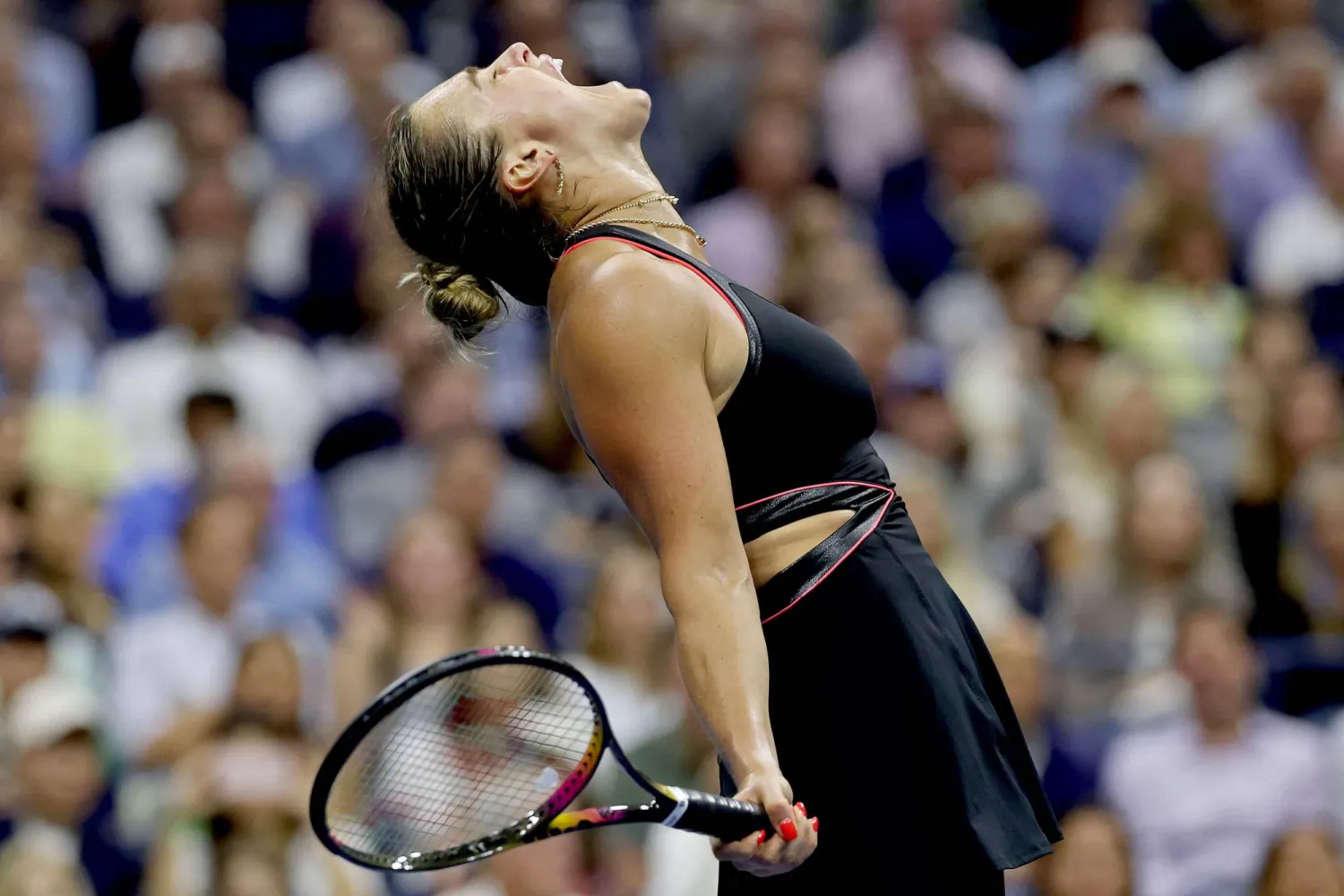
NEW YORK, NEW YORK - SEPTEMBER 04: Aryna Sabalenka celebrates match point against Jessica Pegula of the United States during their Women's Singles Semifinal match on Day Twelve of the 2025 US Open at USTA Billie Jean King National Tennis Center on September 4, 2025 in the Flushing neighborhood of the Queens borough of New York City. Matthew Stockman/Getty Images/AFP
TT

Sabalenka Will Face Anisimova in US Open Women's Final

NEW YORK, NEW YORK - SEPTEMBER 04: Aryna Sabalenka celebrates match point against Jessica Pegula of the United States during their Women's Singles Semifinal match on Day Twelve of the 2025 US Open at USTA Billie Jean King National Tennis Center on September 4, 2025 in the Flushing neighborhood of the Queens borough of New York City. Matthew Stockman/Getty Images/AFP

On Aryna Sabalenka's first chance to end her US Open semifinal against Jessica Pegula and earn the chance to play for a second consecutive trophy at Flushing Meadows, the defending champion dumped what should have been an easy overhead into the net, then stared at the ground.

On Sabalenka's second chance, she missed a clumsy volley — and later acknowledged she shouldn't have ventured forward, because she went just 15 for 27 when up at the net. Uh, oh.

So good at important moments in the high-stakes, high-tension final set, Sabalenka held it together there and held on, converting her third match point Thursday night for a 4-6, 6-3, 6-4 victory over Pegula in a rematch of last year’s final.

“I was super emotional. I was just like, ‘Oh, my gosh, no way it’s happening. Please, just close this match,’” Sabalenka explained afterward, according to The Associated Press. “The whole match, I just keep telling myself: (Onto) the next one, just one step at a time, don’t worry about the past. Just try better in the next point.”

When it was over, Sabalenka rocked back on her heels, spread her arms and screamed.

On Saturday, when she faces No. 8 Amanda Anisimova in the final, the No. 1-seeded Sabalenka will be trying to become the first woman to claim consecutive championships at Flushing Meadows since Serena Williams got three in a row from 2012 to 2014.

Anisimova eliminated No. 23 Naomi Osaka 6-7 (4), 7-6 (3), 6-3 in a match that ended at nearly 1 a.m. to reach her second straight major final. At Wimbledon in July, Anisimova was the runner-up to Iga Swiatek, who beat her 6-0, 6-0 in the title match.

But Anisimova recovered from that well enough, and quickly enough, to get past Swiatek in two sets in the U.S. Open quarterfinals.

Now Anisimova, a 24-year-old who was born in New Jersey and grew up in Florida, gets another shot at winning her first Grand Slam trophy.

She is the first opponent to beat Osaka this late in a Grand Slam tournament. Before this loss, Osaka had been a combined 13-0 over her career in major quarterfinals, semifinals and finals.
Like Osaka vs. Anisimova, Thursday's first semifinal was quite close — closer than the straight-set triumph for Sabalenka over Pegula 12 months ago that gave the 27-year-old from Belarus her third Grand Slam title, all on hard courts.

Since then, Sabalenka was the runner-up to Madison Keys at the Australian Open in January and to Gauff at the French Open in June, then was eliminated in the Wimbledon semifinals by Anisimova in July.

Arthur Ashe Stadium’s retractable roof was shut before the semifinals began, which prevented disruption from the wind outside gusting at up to 30 mph and the rain that arrived during play.

In the good, indoor conditions, No. 4 Pegula played about as cleanly as possible in the first set and the third, making just three unforced errors in each. But in the second, that count was nine.

By the end, Sabalenka had accumulated more than twice as many winners as Pegula, 43-21.
“We were pushing each other,” Pegula said, “every single game.”

All evening, Pegula went after her returns, taking big cuts and not playing it safe, by any means. This, then, was the key: Sabalenka was able to save all four break points she faced in the last set.
“It was really high-level. I don’t really know what else to say,” said Pegula, who was wearing a white New York Yankees jacket and enjoying a root beer lollipop at her news conference. “I don’t know how I didn’t break back in the third.”

Asked how she managed to handle those moments, Sabalenka replied with a laugh: “Just praying inside and hoping for the best.”

Neither she nor Pegula had lost a set in the tournament before Thursday, although Sabalenka only needed to go through four matches, instead of five, to reach the semifinals, because her quarterfinal opponent, Marketa Vondrousova, withdrew with an injured knee.

That meant Sabalenka hadn’t competed since Sunday.

Might she be rusty? Sure didn’t look that way at the outset, and Sabalenka used a nifty drop-shot-volley-winner combination to help go up a break and grab a 4-2 lead.

But Pegula didn’t fold. In the next game, with the thousands in the stands roaring for every point gained by the American, Sabalenka netted off-balance groundstrokes on two points in a row and double-faulted to get broken right back.

Sabalenka shook her head and slammed her arms by her side. That ended her run of 32 consecutive holds, and she draped a white towel over her head at the changeover. Pegula then broke again to cap a four-game run that wrapped up the set and, this time, Sabalenka quickly retrieved her bag and headed off to the locker room.

When she came back, Sabalenka elevated her play — and steadied her mind when necessary.
“I will go out there on Saturday,” she said, "and I'll fight for every point like the last point of my life.”



Shakhtar Boss Pays Ukrainian Racer $200,000 After Games Disqualification

Ukrainian President Volodymyr Zelenskiy holds helmet as he meets with a Ukrainian skeleton racer Vladyslav Heraskevych , who was disqualified from the Olympic skeleton competition over his "helmet of remembrance" depicting athletes killed since Russia's invasion and his father and coach, Mykhailo Heraskevych, amid Russia's attack on Ukraine, in Munich, Germany February 13, 2026. (Ukrainian Presidential Press Service/Handout via Reuters)
TT

Shakhtar Boss Pays Ukrainian Racer $200,000 After Games Disqualification

Ukrainian President Volodymyr Zelenskiy holds helmet as he meets with a Ukrainian skeleton racer Vladyslav Heraskevych , who was disqualified from the Olympic skeleton competition over his "helmet of remembrance" depicting athletes killed since Russia's invasion and his father and coach, Mykhailo Heraskevych, amid Russia's attack on Ukraine, in Munich, Germany February 13, 2026. (Ukrainian Presidential Press Service/Handout via Reuters)

The owner of ‌Ukrainian football club Shakhtar Donetsk has donated more than $200,000 to skeleton racer Vladyslav Heraskevych after the athlete was disqualified from the Milano Cortina Winter Games before competing over the use of a helmet depicting Ukrainian athletes killed in the war with Russia, the club said on Tuesday.

The 27-year-old Heraskevych was disqualified last week when the International Bobsleigh and Skeleton Federation jury ruled that imagery on the helmet — depicting athletes killed since Russia invaded Ukraine in 2022 — breached rules on athletes' expression at ‌the Games.

He ‌then lost an appeal at the Court ‌of ⁠Arbitration for Sport hours ⁠before the final two runs of his competition, having missed the first two runs due to his disqualification.

Heraskevych had been allowed to train with the helmet that displayed the faces of 24 dead Ukrainian athletes for several days in Cortina d'Ampezzo where the sliding center is, but the International Olympic Committee then ⁠warned him a day before his competition ‌started that he could not wear ‌it there.

“Vlad Heraskevych was denied the opportunity to compete for victory ‌at the Olympic Games, yet he returns to Ukraine a ‌true winner," Shakhtar President Rinat Akhmetov said in a club statement.

"The respect and pride he has earned among Ukrainians through his actions are the highest reward. At the same time, I want him to ‌have enough energy and resources to continue his sporting career, as well as to fight ⁠for truth, freedom ⁠and the remembrance of those who gave their lives for Ukraine," he said.

The amount is equal to the prize money Ukraine pays athletes who win a gold medal at the Games.

The case dominated headlines early on at the Olympics, with IOC President Kirsty Coventry meeting Heraskevych on Thursday morning at the sliding venue in a failed last-minute attempt to broker a compromise.

The IOC suggested he wear a black armband and display the helmet before and after the race, but said using it in competition breached rules on keeping politics off fields of play. Heraskevych also earned praise from Ukraine President Volodymyr Zelenskiy.


Speed Skating-Italy Clinch Shock Men’s Team Pursuit Gold, Canada Successfully Defend Women’s Title

 Team Italy with Davide Ghiotto, Andrea Giovannini, Michele Malfatti, celebrate winning the gold medal on the podium of the men's team pursuit speed skating race at the 2026 Winter Olympics, in Milan, Italy, Tuesday, Feb. 17, 2026. (AP)
Team Italy with Davide Ghiotto, Andrea Giovannini, Michele Malfatti, celebrate winning the gold medal on the podium of the men's team pursuit speed skating race at the 2026 Winter Olympics, in Milan, Italy, Tuesday, Feb. 17, 2026. (AP)
TT

Speed Skating-Italy Clinch Shock Men’s Team Pursuit Gold, Canada Successfully Defend Women’s Title

 Team Italy with Davide Ghiotto, Andrea Giovannini, Michele Malfatti, celebrate winning the gold medal on the podium of the men's team pursuit speed skating race at the 2026 Winter Olympics, in Milan, Italy, Tuesday, Feb. 17, 2026. (AP)
Team Italy with Davide Ghiotto, Andrea Giovannini, Michele Malfatti, celebrate winning the gold medal on the podium of the men's team pursuit speed skating race at the 2026 Winter Olympics, in Milan, Italy, Tuesday, Feb. 17, 2026. (AP)

An inspired Italy delighted the home crowd with a stunning victory in the Olympic men's team pursuit final as

Canada's Ivanie Blondin, Valerie Maltais and Isabelle Weidemann delivered another seamless performance to beat the Netherlands in the women's event and retain their title ‌on Tuesday.

Italy's ‌men upset the US who ‌arrived ⁠at the Games ⁠as world champions and gold medal favorites.

Spurred on by double Olympic champion Francesca Lollobrigida, the Italian team of Davide Ghiotto, Andrea Giovannini and Michele Malfatti electrified a frenzied arena as they stormed ⁠to a time of three ‌minutes 39.20 seconds - ‌a commanding 4.51 seconds clear of the ‌Americans with China taking bronze.

The roar inside ‌the venue as Italy powered home was thunderous as the crowd rose to their feet, cheering the host nation to one ‌of their most special golds of a highly successful Games.

Canada's women ⁠crossed ⁠the line 0.96 seconds ahead of the Netherlands, stopping the clock at two minutes 55.81 seconds, and

Japan rounded out the women's podium by beating the US in the Final B.

It was only Canada's third gold medal of the Games, following Mikael Kingsbury's win in men's dual moguls and Megan Oldham's victory in women's freeski big air.


Lindsey Vonn Back in US Following Crash in Olympic Downhill 

Milano Cortina 2026 Olympics - Alpine Skiing - Women's Downhill 3rd Official Training - Tofane Alpine Skiing Centre, Belluno, Italy - February 07, 2026. Lindsey Vonn of United States in action during training. (Reuters)
TT

Lindsey Vonn Back in US Following Crash in Olympic Downhill 

Milano Cortina 2026 Olympics - Alpine Skiing - Women's Downhill 3rd Official Training - Tofane Alpine Skiing Centre, Belluno, Italy - February 07, 2026. Lindsey Vonn of United States in action during training. (Reuters)

Lindsey Vonn is back home in the US following a week of treatment at a hospital in Italy after breaking her left leg in the Olympic downhill at the Milan Cortina Games.

“Haven’t stood on my feet in over a week... been in a hospital bed immobile since my race. And although I’m not yet able to stand, being back on home soil feels amazing,” Vonn posted on X with an American flag emoji. “Huge thank you to everyone in Italy for taking good care of me.”

The 41-year-old Vonn suffered a complex tibia fracture that has already been operated on multiple times following her Feb. 8 crash. She has said she'll need more surgery in the US.

Nine days before her fall in Cortina d'Ampezzo, Italy, Vonn ruptured the ACL in her left knee in another crash in Switzerland.

Even before then, all eyes had been on her as the feel-good story heading into the Olympics for her comeback after nearly six years of retirement.