


British Football Union Wants Fewer Headers for Pros, and None for Kids, to Protect Players’ Brains

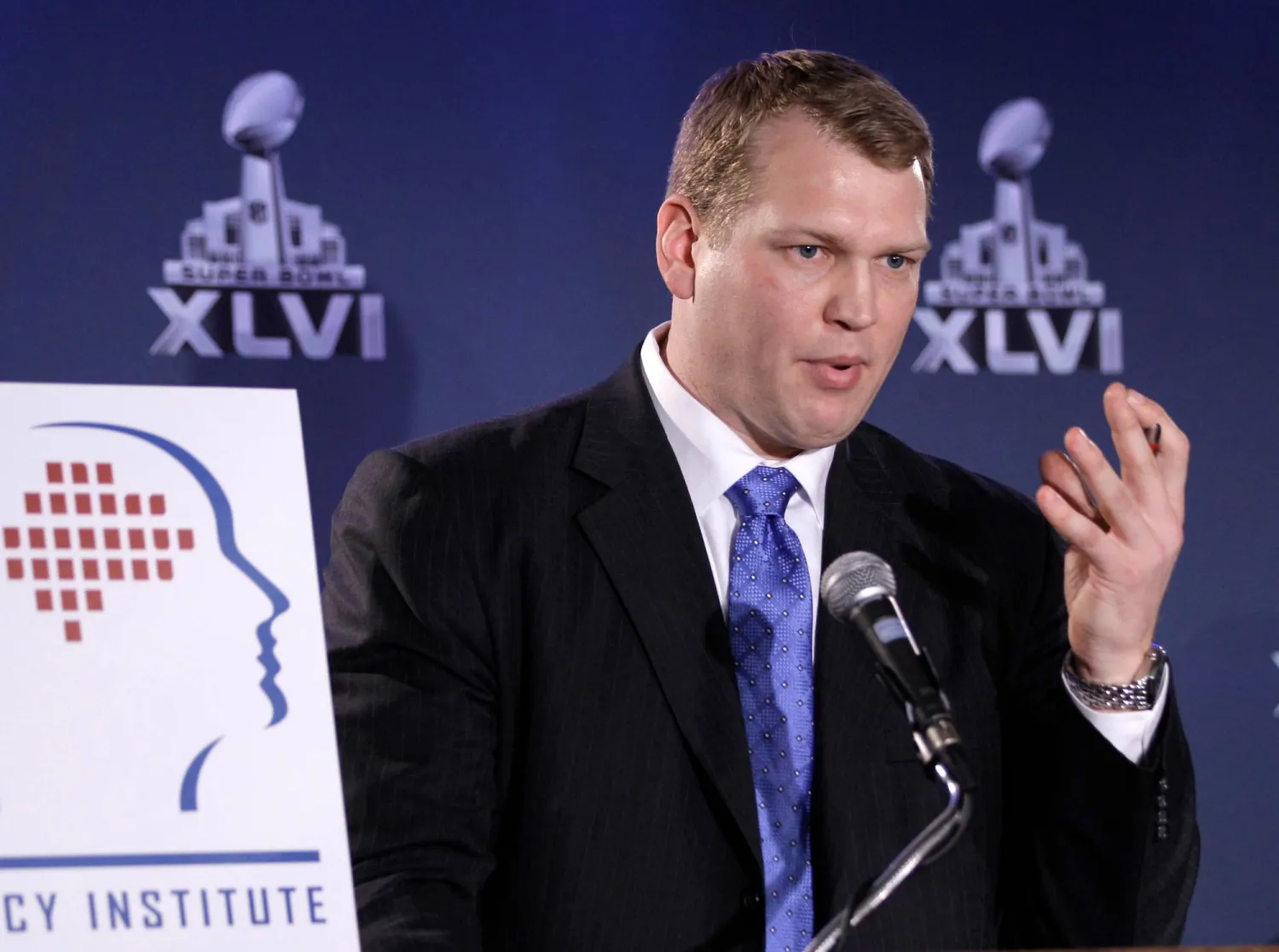
In this Feb. 3, 2012, file photo, Chris Nowinski, head of the Sports Legacy Institute in Boston, talks about a hit count proposal to dramatically reduce youth athletes' exposure to repetitive brain trauma in multiple sports during a news conference at the Super Bowl XLVI media center in Indianapolis. (AP)
TT

British Football Union Wants Fewer Headers for Pros, and None for Kids, to Protect Players’ Brains

In this Feb. 3, 2012, file photo, Chris Nowinski, head of the Sports Legacy Institute in Boston, talks about a hit count proposal to dramatically reduce youth athletes' exposure to repetitive brain trauma in multiple sports during a news conference at the Super Bowl XLVI media center in Indianapolis. (AP)

The union representing British football players will announce on Tuesday the first comprehensive protocol for preventing the brain disease CTE, expanding the heightened concern over concussions to include the damage that can be caused by the less forceful blows from heading the ball.

The guidelines from the Professional Footballers’ Association, which represents current and former players in the Premier League, the FA Women’s Super League and the English Football Leagues, recommend no more than 10 headers per week – including practice – for professionals.

Children under 12 shouldn’t head the ball at all, the PFA said, part of a chronic traumatic encephalopathy prevention protocol designed to reduce head impacts across a player’s lifetime.

“CTE is preventable. Period,” Dr. Adam White, Director of Brain Health at the PFA, said on Monday at the first-ever Global CTE Summit, which was held in San Francisco while the NFL descended on the Bay Area for Sunday’s Super Bowl.

“It is the principles of less heading, less force, less often and later in life that matter,” White told The Associated Press. “These could apply to any sport and are the best hope we have of stopping current and future players from the same fate as former generations.”

Speakers at the summit included researchers, former athletes and lawmakers; those in the virtual and in-person audience also included family members who witnessed the dangers of CTE, which can cause memory loss, depression, violent mood swings and other cognitive and behavioral issues.

“This might be the most underreported public health challenge in the world right now," former US Surgeon General Richard Carmona said. “CTE prevention requires courage – the courage to change tradition, the courage to confront denial, and the courage to put long-term health ahead of short-term gains."

The degenerative brain disease now known as CTE was studied in boxers more than a century ago as punch drunk syndrome and first diagnosed in American football players in 2005. It has since become a concern in ice hockey, soccer and other contact sports and among combat veterans and others who sustain repeated blows to the head.

A 2017 study found CTE in 110 of 111 brains donated by former NFL players. The disease can only be identified posthumously through an examination of the brain.

NFL Hall of Famer Warren Sapp, speaking about an hour away from Levi’s Stadium on the day of the Super Bowl’s much-ballyhooed Opening Night, said attention shouldn’t just be on professionals, who are at least compensated and able to make informed decisions about the risks of playing a dangerous sport.

“It’s our obligation to the game to make it better,” he said. “It’s how we apply it to our children and the age that we give it to them.”

The NFL, college football and many other sports have instituted protocols that guide teams and athletes on returning to play after sustaining a possible concussion.

But the British soccer protocol, a copy of whish was obtained by the AP, is the first comprehensive plan to combat CTE by addressing the less dramatic, subconcussive blows that can be common in practice, according to Chris Nowinski, the founder of the Concussion and CTE Foundation.

“For contact sports, CTE prevention protocols are equally important and possibly more important than concussion protocols,” he said.

Among the more recent concerns are the routine head hits sustained by football lineman, and those from soccer players heading the ball. Research funded by the union and the Football Association found that Scottish pros have a risk of dementia that is 3.5 times greater than the general population; studies of brains from British soccer players found the majority had CTE, including Jeff Astle, Gordon McQueen and Chris Nicholl.

“With what we know today about the disease, it would be a failure to our players to do nothing,” White said in a statement. “The science and solutions are clear, it just takes willingness from the sporting bodies to put athletes’ long-term health first and I am pleased that we have been able to do that in England. I encourage all sports to put as much, if not more, effort into CTE prevention protocols as they have concussion protocols.”

The protocol also includes annual education, support for research and care for ex-players who suspect they are living with CTE. It follows the publication of a CTE prevention framework published in 2023 by researchers assembled by the Concussion and CTE Foundation and Boston University’s CTE Center.

Nowinski called on sports leagues and their medical advisors to adopt CTE prevention protocols.

“There is now overwhelming evidence that more head impacts in sports will result in more athletes with CTE,” Nowinski said. “Sports administrators aren’t risking CTE themselves, but the policies they set are sentencing some athletes to a life with CTE, a burden that will primarily be carried by their spouses and children. Enough is enough.”



Zverev Reaches US Open 4th Round with Win over Tabilo

Zverev Reaches US Open 4th Round with Win over Tabilo
TT

Zverev Reaches US Open 4th Round with Win over Tabilo

Zverev Reaches US Open 4th Round with Win over Tabilo

Top seed Alexander Zverev lost his way in the second set but got his game back under control to secure a 6-2 7-6(2) 6-2 victory over Alejandro Tabilo and reach the fourth round of the US Open on Saturday.

After spending a grueling nine hours and 26 minutes on court across back-to-back five-setters against Lorenzo Sonego and Quentin Halys, the last thing the German would have wanted was another long night on Arthur Ashe Stadium.

"My coach was quite smart, he said that best-of-five sets doesn't mean that you have to play ⁠five sets. I ⁠didn't know it until now, that was quite helpful," Zverev joked later, according to Reuters.

"I'm happy with my level right now, it's going in the right direction and I'm happy to be in the second week.

"I didn't practice much yesterday, only an hour, which is very little for me. I'd spent almost 10 ⁠hours on court, so I had to find my rhythm somehow. I still think I can play better, but for now I'm happy with how things are going."

The 29-year-old, who won his first Grand Slam title at the French Open and finished runner-up at Wimbledon, stormed out of the blocks by breaking 25th seed Tabilo twice before taking the first set with an unreturnable serve to love.

Zverev raced to a 4-2 lead in the second set but his level suddenly dropped, ⁠allowing world ⁠number 28 Tabilo to claim three games in a row and go within touching distance of drawing level in the match.

However, the Chilean was unable to press home the advantage and Zverev, after chiding a courtside fan who appeared to be offering coaching advice during the ensuing tiebreak, rediscovered his composure and his best tennis, pulling away to tighten his grip on the match.

The writing was on the wall for Tabilo when Zverev raced ahead 5-2 in the third, and the German booked his place in the round of 16 where 21st-seeded Italian Luciano Darderi awaits.


Jovic 'Loses Sanity Five Times Over' to Oust Eala and Book Gauff Clash

Iva Jovic of the US in action against Alexandra Eala of the Philippines during the Women's Singles third round of the US Open Tennis Championships in Flushing Meadows, New York, USA, 05 September 2026. EPA/BRIAN HIRSCHFELD
TT

Jovic 'Loses Sanity Five Times Over' to Oust Eala and Book Gauff Clash

Iva Jovic of the US in action against Alexandra Eala of the Philippines during the Women's Singles third round of the US Open Tennis Championships in Flushing Meadows, New York, USA, 05 September 2026. EPA/BRIAN HIRSCHFELD

American teen Iva Jovic outlasted Philippines star Alexandra Eala in an epic three-hour showdown on Saturday to reach the fourth round of the US Open, where fourth seed Coco Gauff awaits.

Jovic, the 14th seed, won five of the last six games for a 7-5, 3-6, 7-5 triumph over 17th-seed Eala after three hours and three minutes.

"That felt like a marathon and I felt like I lost my sanity five times over to win that match," Jovic said. "But it's really worth it for this feeling."

Two of the top rising stars of women's tennis made their Arthur Ashe Stadium debut a memorable battle that featured 17 service breaks in 33 games.

Jovic, 18 and Eala, 21, are friends and sometime doubles partners, knowing well each other's skills and style. That helped produce seven service breaks in the first 11 games.

"I'm usually not one that shows that many emotions but this one really meant a lot to me. It's everything to have another match here at the US Open," said Jovic.

That match will be against compatriot Gauff, the 2023 US Open and 2025 French Open champion.

"I'm going to be more than happy to just bring this fight and this energy and whatever happens I can leave with my head high," Jovic said.

Jovic broke four times to win the first set but was broken three times by left-hander Eala to drop the second.

Eala broke Jovic in the first game of the third set when the American netted a backhand.
"I just tried to take my time in those moments and feel the energy and feel the crowd -- even though they weren't always rooting for me," Jovic said.

Jovic smacked a forehand winner to break Eala in the fourth game and level the set, but the American double-faulted away a break in the fifth.

Jovic broke back to 4-4 with a backhand service return winner and broke again in the last game, smacking a forehand winner to reach match point and taking the victory when Eala netted a forehand.

Jovic, a quarter-finalist at this year's Australian Open, won her first WTA title last year in Guadalajara at age 17.


Rybakina Books US Open Fourth-round Berth, Inches Closer to No. 1

Second-seeded Elena Rybakina is through to the fourth round of the US Open after a victory over Yuliia Starodubtseva. Caleb Bowlin / GETTY IMAGES NORTH AMERICA/AFP
TT

Rybakina Books US Open Fourth-round Berth, Inches Closer to No. 1

Second-seeded Elena Rybakina is through to the fourth round of the US Open after a victory over Yuliia Starodubtseva. Caleb Bowlin / GETTY IMAGES NORTH AMERICA/AFP

World number two Elena Rybakina avenged her French Open defeat to Yuliia Starodubtseva on Saturday, beating the unseeded Ukrainian 7-6 (8/6), 6-3 to reach the US Open last 16.

The hard-hitting Kazakh, who claimed her second Grand Slam title at the Australian Open in January, fell to Starodubtseva in the second round at Roland Garros, a defeat that may have been on her mind as she struggled to find her rhythm in the opening set.

Starodubtseva took full advantage of Rybakina's struggles with her forehand and broke for a 5-4 lead, said AFP.

But Rybakina steadied, breaking back with an angled drop shot to level the set.

She saved a set point in the tiebreaker with one of her 12 aces, and with the first set in hand attacked in the second with confidence.

A double fault from Starodubtseva handed Rybakina a break to open the second and Rybakina maintained the edge to finish the job in just under two hours.

"It was a tough match," Rybakina said. "I feel like it wasn't my best performance, but Yuliia she's a great player. Last time we had a battle, too, and I'm glad I could win in straight sets."

Rybakina now just needs two wins -- to reach the semi-finals -- to be assured of supplanting Aryna Sabalenka atop the world rankings -- even if Sabalenka wins a third straight US Open title.

"Not there yet," she said. "It's still very far. I need to focus on my next match and not think about it."

That next match will be against four-time Grand Slam champion Naomi Osaka, who beat Elise Mertens of Belgium 6-3, 3-6, 7-5.