


Damascus, SDF Move to Close Political Detainee File

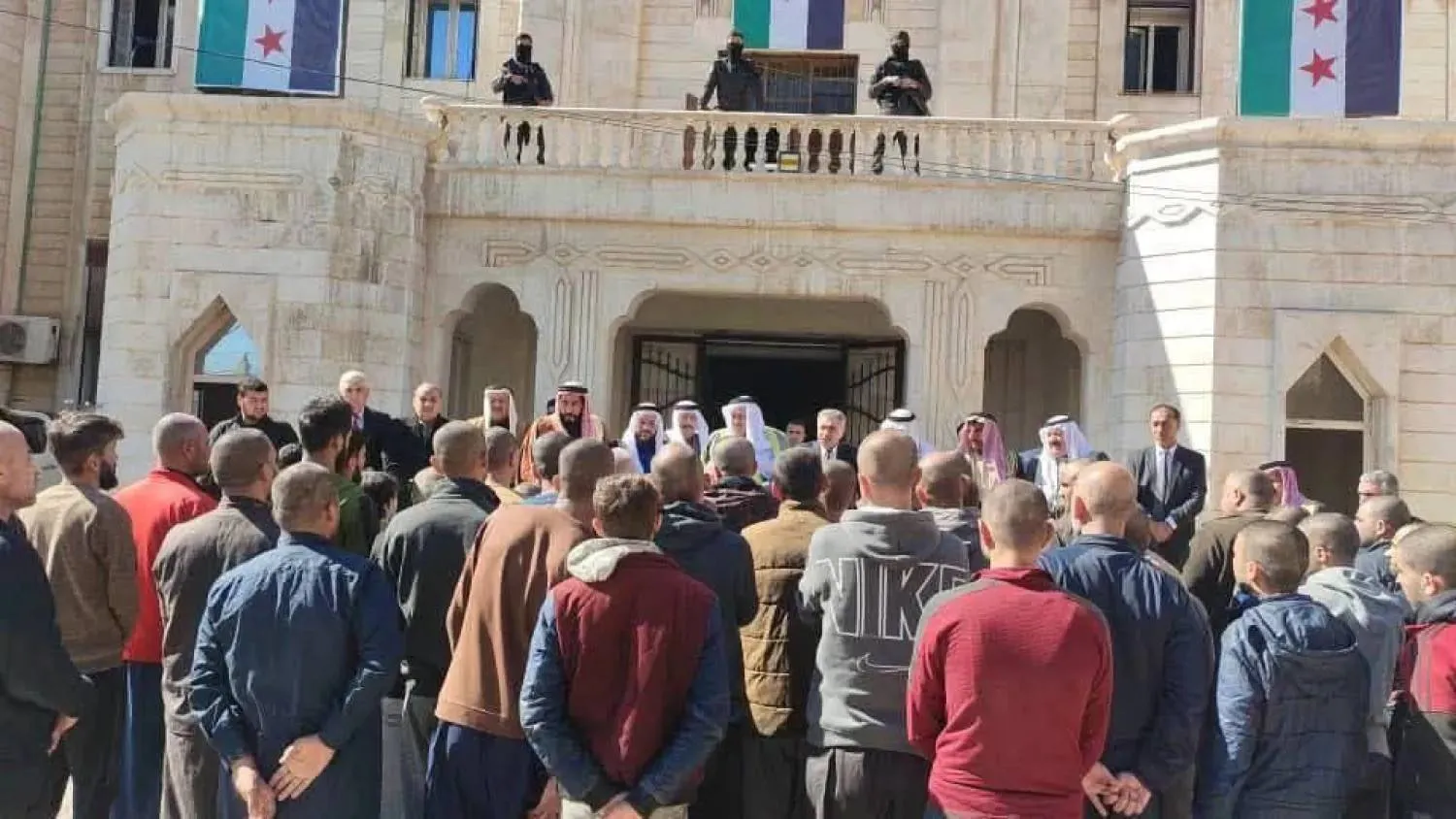
Former detainees released from Alaya Prison, controlled by the Syrian Democratic Forces (SDF) in Qamishli, in February (Al-Furat). 
TT

Damascus, SDF Move to Close Political Detainee File

Former detainees released from Alaya Prison, controlled by the Syrian Democratic Forces (SDF) in Qamishli, in February (Al-Furat). 

Syrian authorities are working with the Syrian Democratic Forces (SDF) to close the file of political detainees held by both sides, as part of ongoing coordination between Damascus and the Kurdish-led force.

Families in al-Hasakah province recently demanded the release of relatives from Alaya Prison in Qamishli, which remains under SDF control. Local sources said prison officials told families that no detainees remained at the facility and that some prisoners had been transferred to Iraq last month along with other Syrian inmates under a bilateral arrangement reportedly mediated by Washington.

At the same time, the Syrian government is preparing to resolve the broader detainee issue linked to the SDF. A presidential team operating in al-Hasakah is compiling lists of prisoners held by the SDF in preparation for their release. In return, Damascus is expected to free a new group of detainees held by the government in the coming days.

Video circulating online showed families gathering outside Alaya Prison seeking information about their relatives. The Hasakah Media Center said SDF personnel told them the prison held no detainees and that those previously held had been transferred to Iraq on terrorism-related charges.

Families told the outlet that some detainees had been arrested by the SDF for raising the Syrian flag, displaying images of Syrian President Ahmed al-Sharaa, or posting comments on social media.

Local reports, however, suggest some prisoners may still be held in Alaya. The SDF had previously transferred detainees there from al-Hasakah Central Prison, widely known as Ghuwayran Prison, before it was handed over to government authorities. Other detention sites include prisons in al-Aqtaan and al-Shaddadi.

Alaya Prison has been one of the SDF’s main detention facilities for individuals accused of criminal, security, or political offenses. According to available figures, it previously held about 1,000 detainees, most of whom have since been released.

A second round of prisoner releases involving SDF detainees is expected soon. Brigadier General Ziad al-Ayesh, the Syrian presidential envoy overseeing implementation of the January 29, 2026 agreement between Damascus and the SDF, said the process would include individuals previously detained during clashes with government forces in earlier “law-enforcement operations.”

In an interview with Syrian Al-Ikhbariah TV, al-Ayesh said the Syrian state intends to take over prisons formerly controlled by the SDF. Their administration would be transferred to the Interior Ministry and placed under judicial supervision by the Justice Ministry to ensure full state oversight.

He added that Damascus is also working with the SDF to release all political detainees, prisoners of conscience, and those detained in connection with events during the years of the Syrian uprising.

On March 10, the Syrian government and the SDF exchanged the release of 200 detainees. Al-Ayesh stated that Damascus aims to close the detainee file as part of a broader “national integration” process intended to promote reconciliation and strengthen the country’s unity.

Meanwhile, in remarks during a funeral for SDF fighters in Ayn al-Arab (Kobani), SDF commander Mazloum Abdi said that the group is working to return about 300 prisoners to the Syrian government in the coming days, as well as recover the bodies of fighters killed in recent clashes.

Further releases are expected before Nowruz on March 21, which Syria will celebrate this year for the first time as an official national holiday under Decree No. 17.



Israeli Airstrike Kills at Least 10 Near Gaza School as Ceasefire Strains

 Palestinians react following an Israeli strike outside a school sheltering displaced people, according to medics, at Al-Aqsa Martyrs Hospital in Deir al-Balah in the central Gaza Strip, April 6, 2026. (Reuters)
Palestinians react following an Israeli strike outside a school sheltering displaced people, according to medics, at Al-Aqsa Martyrs Hospital in Deir al-Balah in the central Gaza Strip, April 6, 2026. (Reuters)
TT

Israeli Airstrike Kills at Least 10 Near Gaza School as Ceasefire Strains

 Palestinians react following an Israeli strike outside a school sheltering displaced people, according to medics, at Al-Aqsa Martyrs Hospital in Deir al-Balah in the central Gaza Strip, April 6, 2026. (Reuters)
Palestinians react following an Israeli strike outside a school sheltering displaced people, according to medics, at Al-Aqsa Martyrs Hospital in Deir al-Balah in the central Gaza Strip, April 6, 2026. (Reuters)

An Israeli airstrike killed at least 10 people and wounded several others outside a school housing displaced Palestinians on Monday, health officials said, in the latest violence overshadowing the fragile US-backed Gaza ceasefire deal.

Before the strikes, some Palestinians had clashed with members of an Israeli-backed militia, who they said attacked the school in an attempt to abduct some people, medics and residents said.

In the midst of the clashes, east of the Maghazi refugee camp in the central Gaza Strip, Israeli drones fired two missiles into the area, killing at least 10 people and wounding several others, they added.

It was not immediately ‌clear how many ‌civilians had been killed in the strikes, which hit ‌in ⁠a closely packed neighborhood ⁠of mostly displaced Palestinians.

Ahmed al-Maghazi, an eyewitness, said their area was attacked by members of the Israeli-backed militia who operate in the territory adjacent to where the Israeli forces are in control, before they opened fire.

"The residents tried to defend their homes, but the occupation forces targeted them directly," he told Reuters.

Earlier on Monday, an Israeli airstrike killed one Palestinian and wounded ⁠a child as they traveled on a motorbike in ‌Gaza City, medics said.

Medics said that ‌Israeli forces killed another Palestinian when they opened fire on a vehicle in central ‌Gaza, taking Monday's death toll to at least 12.

The Israeli military ‌had no immediate comment on any of the three incidents on Monday.

The Palestinian group Hamas, which has run Gaza since 2007, and Israel have traded blame over violations of the ceasefire that kicked off in October.

The Gaza health ministry says ‌Israeli fire has killed at least 700 people since the ceasefire began. Israel says four soldiers have been killed ⁠by militants ⁠in Gaza over the same period.

The violence comes as Hamas has continued to resist relinquishing its weapons, a major obstacle in talks to implement the next steps in US President Donald Trump’s proposed peace plan for Gaza.

On Sunday, Hamas' armed wing said that discussing the group's disarmament before Israel fully implements the first phase of Trump's Gaza plan was an attempt to continue what it called a genocide against the Palestinian people.

Hamas' October 7, 2023, attacks on Israel killed 1,200 people, according to Israeli tallies.

Israel's ensuing two-year campaign killed more than 72,000 Palestinians, most of them civilians, according to Gazan health authorities.

The offensive spread famine, reduced most of the strip to rubble, and displaced the majority of its population.


SDRPY Advances Construction of Model Secondary School in Yemen's Seiyun

These initiatives aim to strengthen technical and higher education and better align graduates’ skills with labor market needs - sPA
TT

SDRPY Advances Construction of Model Secondary School in Yemen's Seiyun

These initiatives aim to strengthen technical and higher education and better align graduates’ skills with labor market needs - sPA

Work is progressing on the construction and outfitting of Al-Sabban model secondary school in Yemen’s Seiyun, a project implemented by the Saudi Development and Reconstruction Program for Yemen (SDRPY) as part of its ongoing efforts to support the education sector and enhance learning environments across Yemen’s governorates.

The school features modern classrooms, laboratories, and supporting facilities designed to meet the demands of contemporary education and provide a comprehensive and stimulating environment for students.

It is one of four model schools in Hadramout and part of more than 30 similar projects across various Yemeni governorates, according to SPA.

The SDRPY has also implemented a range of initiatives to support education in Hadhramout, including renewable energy projects that expand access to learning in Mukalla, Seiyun, and Doan and Wadi Al-Ain districts.

In January, the program announced several key projects, including the establishment of computer science and information technology colleges at Hadhramout and Seiyun universities, as well as the rehabilitation and development of the Agricultural Veterinary Technical Institute.

These initiatives aim to strengthen technical and higher education and better align graduates’ skills with labor market needs.

Collectively, these projects are expected to expand access to education, improve the quality of learning environments, and enhance the efficiency of educational infrastructure in Hadramout Governorate. They will also help empower students and develop a skilled workforce, supporting long-term sustainable development.


Israeli Strike Kills Lebanese Forces Official, Widening Divisions Over Hezbollah

 The exterior of an apartment building hit by an Israeli strike amid escalating hostilities between Israel and Hezbollah, as the US-Israel conflict with Iran continues, in Ain Saadeh, Lebanon, April 6, 2026. (Reuters)
The exterior of an apartment building hit by an Israeli strike amid escalating hostilities between Israel and Hezbollah, as the US-Israel conflict with Iran continues, in Ain Saadeh, Lebanon, April 6, 2026. (Reuters)
TT

Israeli Strike Kills Lebanese Forces Official, Widening Divisions Over Hezbollah

 The exterior of an apartment building hit by an Israeli strike amid escalating hostilities between Israel and Hezbollah, as the US-Israel conflict with Iran continues, in Ain Saadeh, Lebanon, April 6, 2026. (Reuters)
The exterior of an apartment building hit by an Israeli strike amid escalating hostilities between Israel and Hezbollah, as the US-Israel conflict with Iran continues, in Ain Saadeh, Lebanon, April 6, 2026. (Reuters)

An Israeli strike on an apartment east of Beirut late on Sunday killed a local official from the Lebanese Forces, sharpening internal divides over Hezbollah as Israel's strikes expand to new parts of the country.

The war raging in Lebanon over the past month has deepened fractures between supporters of Hezbollah and those who blame the Iran-backed group for igniting a new conflict with Israel just 15 months after the last one.

On Sunday, an Israeli strike hit an apartment in Ain Saadeh, a predominantly Christian town in the hills east of Beirut, killing a man and two women, Lebanon's health ministry said. Ain Saadeh's mayor said the victims were one floor below the targeted apartment.

The ‌Lebanese Forces, ‌a fiercely anti-Hezbollah party, identified two of the dead as Pierre ‌Moawad, ⁠a local party official, ⁠and his wife Flavia.

"We are paying a heavy price for a war into which we have been dragged by the lawless organization Hezbollah," Lebanese Forces parliamentarian Razi El Hage told Lebanese broadcaster MTV.

Israel's full-scale air and ground campaign, launched in retaliation for Hezbollah firing into Israel on March 2 in solidarity with Iran, has killed more than 1,460 people, according to Lebanese authorities.

ISRAEL REVIEWING STRIKE

The air campaign and Israel's orders for people to leave swathes of Lebanon's south, east, and Beirut's southern suburbs have displaced more ⁠than a million people, most of them from the Shiite ‌community from which Hezbollah draws its support.

Some residents and local ‌officials in predominantly Christian areas have expressed concern that displaced communities are harboring fighters that could be targeted by Israel, ‌with local authorities vetting those seeking rented accommodation.

Nadim Gemayel, of the Kataeb party, told ‌Reuters last month he was worried Israel was deliberately pushing Shiites into other parts of Lebanon to create conflict with other communities.

There was no Israeli military order for people to flee before Sunday's strike. Residents said no displaced people were living in the targeted apartment or surrounding buildings.

"I've been in my house for 20 ‌years, I've never even seen this apartment lit. There's no one in it," Antoine Aalam, a 70-year-old man who lives across from the ⁠targeted apartment, told Reuters on ⁠Monday.

The Israeli military told Reuters it had struck a "terror target east of Beirut" without providing further details.

"Reports that several uninvolved individuals were harmed as a result of the strike are being reviewed," it said.

CIVIL PEACE IS 'RED LINE'

Although the last war with Hezbollah ended with a ceasefire in 2024, Israel continued its strikes on Lebanon and kept troops stationed in the country's south. Lebanon's calls for Israel to negotiate a new truce have fallen on deaf ears.

Sunday's strike came just hours after Lebanese President Joseph Aoun, in his first televised address since the war erupted, said the country's "primary concern is preserving civil peace, which is a red line."

A separate Israeli strike on Beirut's southern suburbs killed five people, including a teenage girl and two Sudanese migrant workers, and another on a car in southern Lebanon killed a man and his wife, and injured their two children.
